





















Mobile apps are dominating the shopping world, with global downloads reaching 218 billion in 2024, showing how much people rely on their phones for buying and browsing. For Shopify merchants, this is a clear chance to connect with customers directly.
While mobile websites are helpful, they often lose buyers to slow checkout or distractions. A Shopify mobile app solves this by making browsing simple, purchases quick, and engagement continuous. But just having an app isn’t enough. Without the right marketing, installs and repeat use can stall. That’s why a focused approach is key.
In this blog, we will explore how to market a Shopify mobile app effectively using strategies that increase downloads, engagement, and customer loyalty.
Overview
- Marketing a Shopify mobile app turns it from a simple channel into a central tool for engagement, loyalty, and seamless customer experience.
- Pre-launch campaigns, smart banners, email, and social strategies create awareness, drive installs, and set the foundation for long-term app usage.
- App-exclusive offers, push notifications, AI-driven personalization, and flexible checkout flows encourage repeat visits and higher conversion rates.
- Retention programs, loyalty perks, and targeted campaigns turn first-time buyers into habitual app users while reinforcing brand preference.
- Continuous tracking, A/B testing, and data-driven optimization ensure every marketing effort adapts to user behavior and sustains long-term growth.
Why Marketing Your Shopify Mobile App Is Essential?
A mobile app is the command center for your mobile customers. Without it, you’re leaving sales on the table, relying on email open rates, and hoping buyers find your site in crowded search feeds. Done strategically, it drives installs, repeat purchases, and long-term retention.
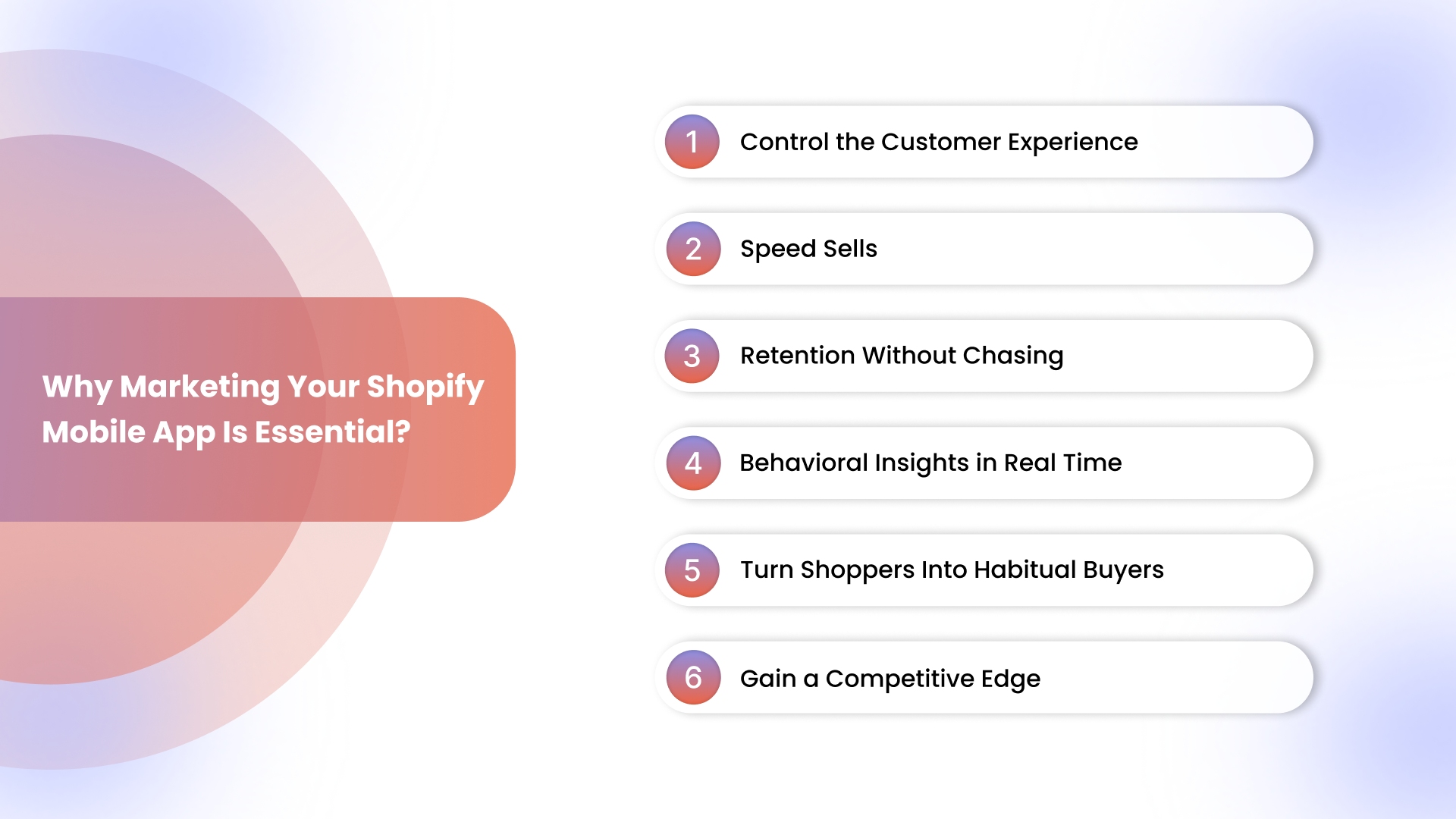
Here’s why merchants must invest in shopify app marketing:
- Control the Customer Experience: Ensure your flow, layout, and messaging reach buyers exactly how you intend with no algorithms, no third-party interference.
- Speed Sells: Every extra tap or second in browsing or checkout costs conversions. A marketed app guides users to products, carts, and checkout seamlessly.
- Retention Without Chasing: Push notifications, in-app promotions, and timely reminders reach buyers when they’re most likely to act, instead of relying on buried emails or social posts.
- Behavioral Insights in Real Time: Marketing your app allows tracking of top-performing products, collections, and campaigns, giving actionable insights to optimize sales and engagement.
- Turn Shoppers Into Habitual Buyers: App-exclusive rewards, early-access drops, and personalized recommendations make opening your app part of the shopping routine.
- Gain a Competitive Edge: Most Shopify stores ignore app marketing. Doing it well positions your brand as modern, premium, and customer-focused, standing out from template-based competitors.
Now that we understand why app marketing is essential, let’s explore 11 actionable strategies to boost installs and engagement.
11 Strategies to Market Your Shopify Mobile App
Launching an app is just the start. Without a precise marketing approach, installs stagnate and engagement fizzles. These 11 strategies focus on real-world tactics Shopify merchants can implement today to drive downloads, keep users returning, and turn casual shoppers into habitual buyers.
1. Pre-Launch Campaigns to Build Anticipation
Before your app goes live, the goal isn’t just awareness; it’s creating intent and urgency among your most valuable customers. A strong pre-launch campaign primes users to install the app the moment it’s available, turning early interest into high-quality installs and engaged users from day one.
How to optimize your pre-launch campaigns:
- Segment Early Access Invitations: Identify your top buyers or repeat customers and give them exclusive beta access to test features, providing feedback and building ownership.
- Create Teaser Content That Shows Value: Release short videos or carousel posts highlighting app-exclusive features, rewards, or faster checkout flow. Don’t just announce “we have an app.”
- Build a Dedicated Landing Page: Clearly communicate benefits, app-exclusive perks, and a pre-signup form to capture emails and push notifications ahead of launch. Push notifications deliver 5–10X higher CTRs than paid marketing.
- Gamify Early Engagement: Use contests, referral invites, or milestone unlocks to turn sign-ups into an interactive, shareable experience, ensuring momentum before the official launch.
2. Smart App Banners and Website CTAs
Your website is already driving traffic, so don’t let it leak potential app installs. Smart banners and strategically placed CTAs turn casual visitors into app users by making the download option visible, contextual, and irresistible without interrupting the browsing experience.
How to optimize banners and CTAs for maximum impact:
- Dynamic Placement Based on Behavior: Show banners only to mobile users who have visited multiple product pages or added items to cart, targeting high-intent shoppers.
- Highlight App-Exclusive Benefits: Communicate clear reasons to download, like faster checkout, push alerts for sales, or loyalty rewards. Don’t leave it generic.
- Test CTA Copy and Design: Use strong action verbs (“Unlock faster checkout” vs “Download our app”) and contrasting visuals that grab attention without feeling intrusive.
- Link to Specific Pages or Offers: Instead of just sending users to the app home, deep-link to a product, collection, or promotion relevant to their browsing behavior to increase adoption. Deep-linking drive 29% more app downloads per click, as per the CS Strategy Draft by Plobal Apps.
3. Email Marketing for App Adoption
Email remains one of the most direct ways to get your app into the hands of customers who already know your brand. The goal is to create a sense of value, exclusivity, and urgency so recipients move from inbox to install seamlessly.
How to make your emails drive app installs:
- Segment for High-Intent Users: Target repeat buyers, cart abandoners, and high-value customers separately, tailoring messages to their behavior and purchase patterns.
- Lead with App-Exclusive Benefits: Show what’s only available in the app: faster checkout, early access to new products, rewards points, or personalized recommendations.
- Use Clear, Action-Oriented CTAs: Instead of generic “Download Now,” use context-driven language like “Unlock Your Faster Checkout” or “Claim Your Early Access.”
- Automate Follow-Ups for Non-Installers: Send reminder emails 24–48 hours after the first, using different angles or incentives to convert those who didn’t act the first time.
4. Social Media Promotion & Influencer Partnerships
Social media is a direct acquisition channel for your app. Done right, it drives installs by showing real-world app value to engaged audiences, using both your followers and niche influencers to reach buyers who are already primed to shop.
How to maximize social media for app adoption:
- Feature App-Exclusive Experiences: Highlight benefits only accessible in the app, like limited-time products, faster checkout, or in-app rewards, directly in posts and stories.
- Micro-Influencer Partnerships: Collaborate with influencers in your niche whose audience matches your top buyers; have them demo the app’s UX, features, and perks in authentic content.
- Video-Led Storytelling: Use short clips or reels to show how fast checkout, product discovery, and personalized recommendations work inside the app. According to the TapCart BFCM 2025 Report, Shoppable video stands out as a proven conversion lever. Video-rich product detail pages (PDPs) can deliver up to +152% lifts in conversion rate.
- Platform-Specific CTA Integration: Add deep-linked CTAs in Instagram Stories, TikTok videos, or Facebook posts so viewers can install the app with one tap, minimizing friction.
5. App-Exclusive Offers & Incentives
Your app is a private storefront for your most engaged shoppers. Offering app-only perks not only drives downloads but also trains users to interact with your app regularly, turning casual buyers into loyal, repeat customers. The key is to make the value tangible, immediate, and irresistible.
How to implement app-exclusive offers effectively:
- Early Access to Products or Collections: Release new arrivals or limited-edition products first in the app to create urgency and FOMO.
- In-App Discounts & Flash Sales: Offer special discounts only visible inside the app, ensuring users open it regularly to check for deals.
- Reward Points & Loyalty Integration: Tie in-app purchases or engagement (like referrals) to loyalty points redeemable for discounts or freebies.
- Gamify Incentives: Use milestones, streaks, or unlockable rewards to make app engagement habitual and encourage repeated use.
6. Push Notifications That Drive Engagement
Push notifications are one of the most direct ways to pull users back into your app, but only if they’re targeted, timely, and relevant. You must create micro-moments that encourage purchases, repeat visits, and loyalty.
How to make push notifications work for your Shopify app:
- Segment Based on Behavior: Send notifications to users who abandoned carts, browsed specific categories, or purchased related products, making messages hyper-relevant.
- Use Timely Triggers: Send alerts when products are back in stock, a sale starts, or a limited-time offer is about to expire to drive immediate action.
- Personalize Content: Include the user’s name, previous purchase, or browsing history to make the notification feel tailored, not generic.
- Test Frequency and Messaging: Avoid notification fatigue by A/B testing send times, copy, and visuals to find the balance that maximizes opens and clicks.
7. App Store Optimization (ASO) & Reviews
Your app store listing is your silent salesperson. It helps convert window-shoppers into install-ready users. Without careful optimization, even high-value customers scroll past. ASO isn’t just keywords; it’s clear messaging, trust-building, and showing real value before the first tap.
How to make your listing convert:
- Lead With Core Value: In the title and description, show exactly why your app beats a mobile website: faster checkout, rewards, or personalized recommendations.
- Visual Proof of Experience: Screenshots or short videos should depict users navigating, checking out, or accessing app-exclusive rewards. Don’t just show static product pages.
- Strategic Review Prompts: Ask for reviews at the peak of satisfaction, after a first purchase, a loyalty reward, or an app-exclusive offer to ensure authentic, high-quality feedback.
- Update Continuously With Each Release: Every time you add a feature or promotion, refresh screenshots, descriptions, and copy to highlight the new value, keeping the listing current and persuasive.
8. Personalized Experiences Using AI
Your Shopify app shouldn’t feel generic; personalization is how it becomes sticky. Tailored recommendations, layouts, and messaging make every user feel the app was built just for them, increasing engagement, repeat purchases, and long-term loyalty.
How to use AI for maximum impact:
- Dynamic Product Recommendations: AppMaker’s Rubik AI automatically shows products based on browsing history, past purchases, or trending items, making every session feel relevant without manual intervention.
- Behavior-Driven Push Notifications: Trigger alerts for abandoned carts, back-in-stock items, or price drops tailored to each user’s interests, driving timely conversions.
- Tailored Home Screens & Layouts: AppMaker’s Eidolon AI can adjust banners, collections, and featured products per user segment, ensuring the app always highlights the most relevant items.
- Automated Cross-Sell and Upsell Messaging: Present complementary or higher-value products during checkout or browsing, increasing average order value and user engagement.
9. Flexible Checkout & One-Click Purchases
Friction at checkout kills conversions. Optimizing your app’s checkout flow ensures users move from cart to purchase in minimal taps. This improves install ROI, boosting conversions and encouraging repeat buying behavior.
How to optimize checkout for app conversions:
- One-Click Checkout: Enable users to purchase with a single tap, reducing abandoned carts and simplifying the buying process.
- Support Multiple Payment Options: Include credit cards, digital wallets, and alternative payment methods to cater to diverse user preferences.
- Saved User Profiles & Auto-Fill: Remember shipping addresses, payment methods, and order history to make repeat purchases effortless.
- Upsells & In-App Discounts: Offer bundles, limited-time discounts, or complementary product suggestions during checkout to increase average order value and incentivize app engagement.
10. Retention & Loyalty Programs
Acquiring users is only half the battle. Keeping them engaged drives long-term revenue. A well-structured retention strategy turns one-time buyers into habitual app users, increasing lifetime value and strengthening your Shopify app.
How to build retention and loyalty effectively:
- Tiered Loyalty Programs: Reward users based on purchase frequency or app engagement, encouraging repeat orders and incentivizing higher spend.
- Exclusive App-Only Perks: Offer discounts, early-access products, or members-only content to make the app the primary destination for loyal customers.
- Gamification & Milestones: Use streaks, badges, or unlockable rewards to motivate repeated app usage and create habit-forming engagement loops.
- Behavior-Based Re-Engagement Campaigns: Send targeted push notifications or in-app messages to lapsed users, highlighting personalized offers or items left in cart.
11. Paid Ads & Cross-Channel Campaigns
Organic growth only takes you so far. Paid ads and coordinated campaigns across multiple channels amplify app visibility, drive installs, and ensure your app reaches high-intent shoppers consistently, instead of relying solely on discovery via organic traffic.
How to execute effective campaigns:
- Targeted Social & Search Ads: Run app-install campaigns on Facebook, Instagram, TikTok, and Google Ads, focusing on high-intent audiences like repeat buyers or lookalike audiences.
- Deep-Link Your Campaigns: Direct ads to specific product pages or app features rather than the home screen to increase conversion rates.
- Retargeting & Cross-Channel Consistency: Use email, social, and in-app retargeting in tandem to reach users who didn’t install or complete a purchase, reinforcing messaging and offers.
- Optimize Campaigns with App Analytics: Tools like AppMaker’s John AI can help analyze which campaigns drive installs and engagement, enabling smarter budget allocation and A/B testing.
Once you learn these strategies, you must focus on measuring key metrics and continuously optimizing to ensure your marketing efforts bring sustainable growth.
Measuring Success & Optimizing for Long-Term Growth
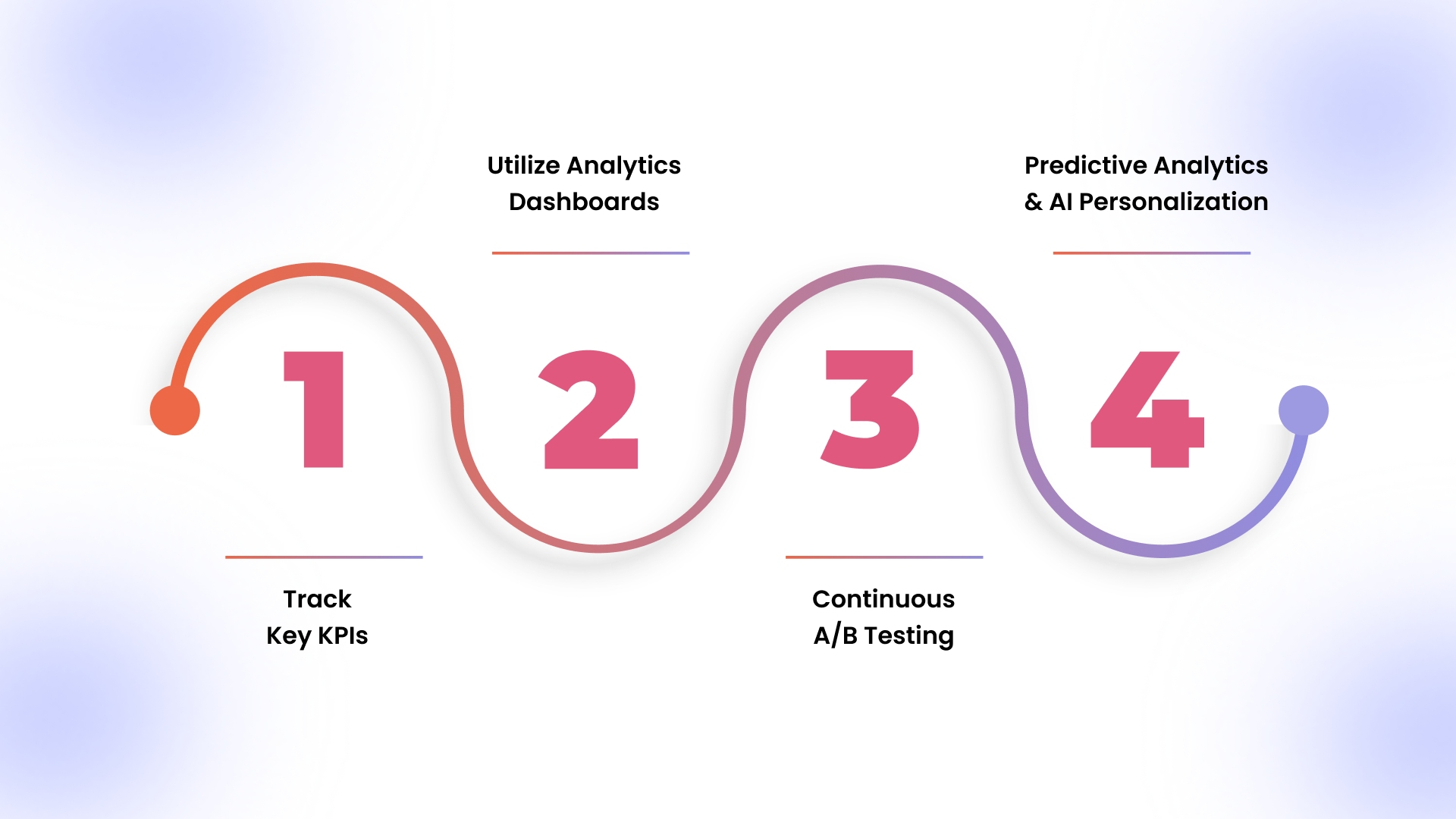
Marketing your Shopify mobile app requires tracking performance, analyzing user behavior, and continuously optimizing campaigns. It ensures long-term growth, higher retention, and repeat purchases. Using data-driven insights helps you refine messaging, targeting, and app features over time. Let's learn what you must do:
1. Track Key KPIs
Focus on installs, active users, retention rates, and repeat purchases to understand your app’s performance. Monitoring these metrics regularly allows you to identify drop-off points, prioritize improvements, and make informed decisions for future campaigns and user engagement strategies.
2. Utilize Analytics Dashboards
Use Shopify and app analytics dashboards to examine traffic sources, in-app behavior, and conversion patterns. Combining these insights with segmentation data ensures campaigns are refined in real time, helping you focus marketing efforts where they deliver the highest ROI.
3. Continuous A/B Testing
Test banners, push notifications, onboarding flows, and CTAs to see what resonates with your audience. Iterative experimentation allows you to optimize messaging, placement, and timing, creating a data-driven approach that improves engagement, reduces friction, and maximizes lifetime value.
4. Predictive Analytics & AI Personalization
Use AI-driven insights to forecast user behavior, personalize recommendations, and anticipate churn. Predictive analytics ensures you can proactively target high-value users, optimize campaigns dynamically, and deliver personalized app experiences that consistently outperform competitors.
Having tracked performance and user behavior, the right platform can simplify execution, boost efficiency, and help implement every strategy effectively.
How AppMaker Helps You Market Your Shopify Mobile App
Marketing your app effectively starts with having the right platform. AppMaker doesn’t just build apps; it equips Shopify merchants with tools to drive installs, engagement, and repeat purchases seamlessly. Every feature is designed to make marketing actions faster, smarter, and measurable.
Here’s how AppMaker supports your growth:
- Eidolon AI: Turn your designs into fully branded app layouts ready to showcase promotions and campaigns instantly.
- Deep Customization: Appmaker Studio gives brands full creative control, from UI/UX to integrations with code-level access and limitless flexibility.
- John AI: Analyze sales, app engagement, and campaign performance in real time to optimize marketing efforts.
- Rubik AI: Personalize content, product recommendations, and layouts to increase conversions and retention.
- Push Notifications & Campaign Tools: Run targeted notifications and in-app campaigns to get repeat visits and customer loyalty.
In 2025 alone, we have generated over 1,000Cr+ GMV Through Mobile Apps for our Customers in 2025. With AppMaker, every marketing strategy from pre-launch to retention is easier, measurable, and effective.
Conclusion
Marketing a Shopify mobile app is essential for turning users into repeat buyers. From pre-launch campaigns and smart banners to personalized experiences, push notifications, and optimized checkout, each strategy drives engagement, conversions, and long-term loyalty. Besides, tracking results ensures every effort contributes to measurable growth.
AppMaker helps merchants execute these strategies efficiently. Tools like Eidolon AI, John AI, and Rubik AI simplify complex marketing tasks. Push notifications and in-app campaigns can be managed directly, making it easier to drive installs, engagement, and repeat purchases without technical hurdles.
Contact us to learn how AppMaker can help your Shopify app reach more users, increase conversions, and build lasting customer loyalty.
FAQs
1. How much does it cost to market a mobile app?
Marketing costs vary by strategy and scale. Organic tactics like email, social media, and push notifications are low-cost, while paid ads, influencer partnerships, and cross-channel campaigns may range from hundreds to thousands monthly.
2. How can I market my app for free?
Focus on organic methods: share your app on social media, use email campaigns, apply push notifications, encourage reviews, and add smart banners to your Shopify store. These tactics increase installs without paid spending.
3. How can I make my Shopify app stand out from competitors?
Differentiate with personalized experiences, app-exclusive products, smooth checkout, and smart onboarding flows. Highlight unique features, run targeted campaigns, and engage users consistently to make your app a preferred choice.
4. When is the best time to launch marketing campaigns for my Shopify app?
Start pre-launch campaigns to build anticipation, followed by post-launch promotions aligned with product drops, seasonal sales, or app updates. Timed campaigns maximize visibility, installs, and user retention effectively.