























Building a mobile app for your Shopify or D2C brand is an exciting step, but it’s not without its challenges. Many brand owners invest in apps only to see low engagement, high churn, or minimal repeat purchases.
According to recent benchmarks, mobile apps generate 3.5–7x more revenue per user than mobile web visitors for e-commerce brands, yet over 70% of apps fail to retain users beyond day 30.
In this article, you’ll gain a practical framework to measure mobile app engagement, avoid common pitfalls, and implement strategies that turn your app into a revenue driver.
Overview
- Focus on the Daily Active Users (DAU) /Monthly Active Users (MAU) ratio, session length, retention rate, churn, and lifetime value to measure app performance effectively.
- Monitor Average Revenue Per User (ARPU), Customer Acquisition Cost (CAC), and conversion rates to optimize revenue from your app.
- Use push notifications, in-app messaging, and AI-driven content to increase relevance and user retention.
- Ensure fast load times, intuitive navigation, and minimal friction in key user flows.
- Improve discoverability, encourage positive feedback, and analyze analytics to continuously refine engagement strategies.
What Is Mobile App Engagement?
Mobile app engagement refers to how actively and consistently users interact with your mobile app over time. Instead of focusing only on installs, mobile app engagement measures the quality and frequency of user actions that indicate ongoing value and interest.
For eCommerce and Shopify brands, mobile app engagement typically includes actions such as:
- Opening the app regularly.
- Browsing products or collections.
- Adding items to the cart or wishlist.
- Completing purchases.
- Responding to push notifications or in-app messages.
High engagement shows that users find your app useful, relevant, and easy to use, making them more likely to return and buy again.
It’s also important to understand how engagement differs from other app metrics:
- Installs measure how many users download your app.
- Retention tracks whether users return after a certain period.
- Engagement measures what users do once they return.
A strong mobile app engagement strategy focuses on increasing these meaningful interactions, ensuring users stay active, involved, and motivated every time they open your app.
Why Mobile App Engagement Matters?
Mobile app engagement directly impacts how much value your app delivers to your business. For Shopify brands, it’s not enough to have users install the app; what matters is how often they return and take action.
Engaged users are more likely to browse products, respond to promotions, and complete purchases. This makes mobile app engagement a core driver of revenue, not just a performance metric.
When your mobile app engagement is strong, you see clear business benefits:
.jpg)
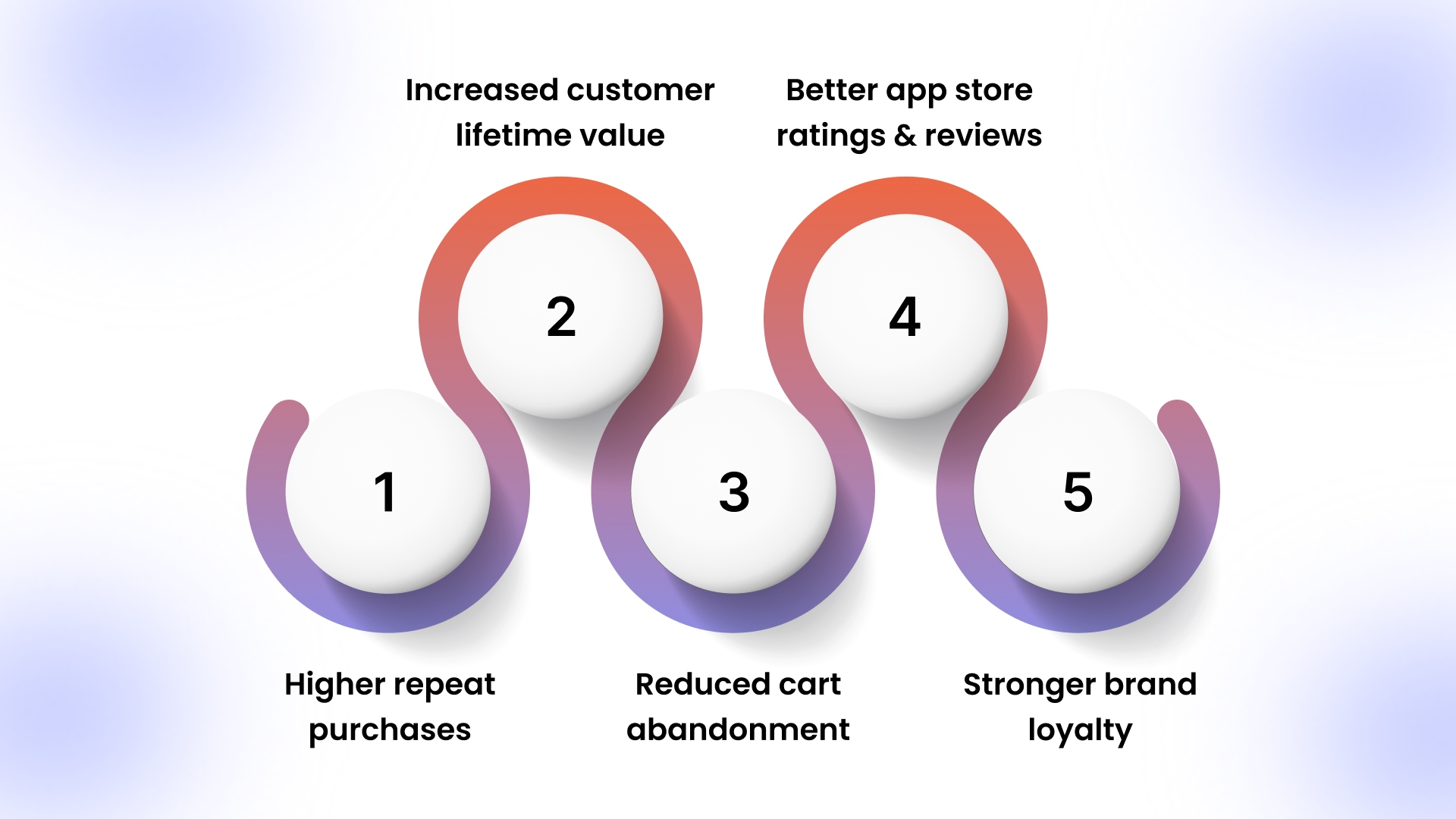
- Higher repeat purchases, as customers return to the app instead of competitors.
- Increased customer lifetime value (LTV) through consistent re-engagement.
- Reduced cart abandonment, supported by timely reminders and offers.
- Better app store ratings and reviews, improving visibility and trust.
- Stronger brand loyalty, built through direct, owned communication.
Mobile apps already offer faster experiences and push notifications compared to mobile websites. However, without consistent engagement, these advantages go unused. That’s why improving mobile app engagement is critical for Shopify brands looking to scale sustainably.
Engagement vs Retention vs Conversion: How They Work Together
Engagement, retention, and conversion measure different stages of user value, but they only drive growth when they reinforce each other.
- Engagement reflects what users do inside the app: browsing products, searching, adding items to the cart, or opening push notifications. High engagement shows that users find the app useful and easy to interact with.
- Retention measures whether they come back. A user might engage once, but without a reason to return, that activity has limited value. Retention improves when engagement feels relevant, fast, and personalized, such as saved carts, recently viewed items, or timely reorder reminders.
- Conversion is the outcome: turning engagement into purchases. Conversion improves when retained users face less friction, for example, through persistent login, stored payment details, or personalized offers.
How they work together in practice:
- An engaged user browses products and adds items to a wishlist (engagement).
- A personalized push notification or price-drop alert brings them back a few days later (retention).
- Faster checkout and saved preferences help complete the purchase (conversion).
If engagement exists without retention, the app feels interesting but disposable. If retention exists without conversion, users return but don’t buy. Sustainable app growth happens when engagement creates habits, retention reinforces trust, and conversion captures that value consistently.
10 Key Mobile App Engagement Metrics (And How to Improve Them)
To build a strong mobile app engagement strategy, you first need to understand what each engagement metric actually measures. Once the meaning is clear, it becomes much easier to apply the right strategies to improve performance.
Below are the most important mobile app engagement metrics for Shopify brands, along with practical ways to optimize each one.
Daily Active Users (DAU) and Monthly Active Users (MAU)
DAU and MAU measure how many unique users open your app daily or monthly. These metrics show how frequently users return to your app and whether it’s becoming part of their regular shopping behavior.
Strong DAU and MAU are clear indicators of healthy mobile app engagement.
How to improve DAU & MAU:
- Send personalized push notifications based on browsing or purchase history.
- Promote app-exclusive deals to give users a reason to return.
- Use dynamic home screens that refresh content on every visit.
Session Frequency
Session frequency tracks how often users open your app within a given time period. Higher frequency usually indicates stronger interest and habit formation, which directly supports long-term mobile app engagement.
How to improve session frequency:
- Trigger reminders for wishlisted or recently viewed products.
- Use back-in-stock and price-drop alerts.
- Run limited-time sales and flash campaigns.
Session Length
Session length measures how much time users spend in your app during each visit. Longer sessions often signal better content relevance, smoother navigation, and deeper engagement.
How to improve session length:
- Improve product discovery with clear categories and filters.
- Add personalized product recommendations.
- Highlight featured collections, banners, or trending products.
Retention Rate (Day 1, Day 7, Day 30)
Retention rate shows how many users return to your app after their first visit. It’s one of the strongest indicators of sustainable mobile app engagement and long-term customer value.
How to improve retention rate:
- Simplify onboarding to reduce friction for first-time users.
- Offer welcome incentives for new app users.
- Re-engage inactive users with targeted campaigns.
Conversion Rate, Repeat Purchase Rate, and Monetization Metrics
These metrics show how effectively mobile app engagement translates into revenue. Conversion rate reflects action, repeat purchase rate shows loyalty, and metrics like ARPU and LTV indicate long-term monetisation efficiency.
Engaged app users typically convert at significantly higher rates than mobile web users
How to improve conversions and repeat purchases:
- Reduce checkout steps for faster purchases.
- Send abandoned cart push notifications.
- Reward repeat engagement with loyalty perks or app-only discounts.
Onboarding Completion and Early Activation
Onboarding is where engagement is either established or lost. Early activation tracks whether users complete key actions such as signing in, viewing products, or adding items to the cart.
If users drop off before activation, later engagement strategies won’t be effective.
How to improve onboarding and activation:
- Remove unnecessary steps during signup.
- Use progressive onboarding instead of long tutorials.
- Highlight one primary action, not multiple choices.
Feature Adoption and In-App Engagement
Not all app features contribute equally to mobile app engagement. Feature adoption shows which capabilities users actually use, such as wishlists, search, filters, loyalty points, or subscriptions.
Low adoption often signals poor discovery, not poor functionality.
How to improve feature adoption:
- Introduce features contextually, not all at once.
- Use in-app prompts to guide discovery.
- Remove or simplify features that add friction without value.
Push Notifications and In-App Messaging Performance
Messaging is one of the strongest engagement levers when used responsibly. Poorly timed or irrelevant messages can quickly reduce trust and opt-in rates.
Key metrics to track include open rate, action rate, and opt-out rate.
How to improve messaging performance:
- Segment users based on behavior, not just demographics.
- Trigger messages using intent signals like cart activity.
- Limit frequency and give users control over preferences.
User Satisfaction Signals: Ratings, Reviews, and Feedback
Mobile app engagement isn’t only behavioral, it’s emotional. Ratings and reviews often surface friction that users won’t report elsewhere. A drop in ratings frequently precedes a decline in retention.
How to improve satisfaction signals:
- Prompt reviews after positive in-app actions.
- Respond visibly to feedback and issues.
- Treat complaints as engagement insights, not noise.
Personalization and Segmentation Impact
Personalization directly influences engagement depth. Effective segmentation uses purchase history, browsing behavior, and lifecycle stage to deliver relevant experiences.
Generic experiences flatten mobile app engagement, especially for returning users.
How to improve personalization:
- Tailor home screens dynamically.
- Adjust promotions based on user intent.
- Align content with each stage of the customer lifecycle.
Understanding these mobile app engagement metrics makes it easier to identify why many mobile apps struggle to keep users active in the first place.
6 Strategies to Improve Mobile App Engagement
Improving app engagement is less about adding features and more about removing friction, delivering relevance, and iterating fast. The strategies below focus on levers that consistently move retention, session depth, and repeat usage.
1. Design Onboarding Around the “First Value Moment.”
Onboarding should guide users to their first meaningful action as quickly as possible. Reduce sign-up friction, explain benefits visually, and highlight one clear next step.Apps that help users experience value within the first session see significantly higher Day-1 and Day-7 retention.
2. Personalize the Experience Using Behavioral Data.
Personalization should extend beyond names or static segments. Use browsing behavior, purchase history, and in-app actions to tailor home screens, recommendations, and messaging.
Relevant content increases session duration and makes repeat visits feel purposeful rather than habitual.
3. Refresh Content and UI Regularly Without App Updates
Static apps lose relevance quickly. Update banners, collections, and layouts frequently to reflect campaigns, seasons, or trends.
The ability to iterate without waiting on app store releases allows teams to respond faster to user behavior and market shifts.
4. Reduce Friction Across Core User Flows
Engagement drops when users encounter delays, cluttered navigation, or unnecessary steps. Optimize loading speed, simplify navigation, and streamline high-intent paths like search, checkout, or repeat purchases.Small UX improvements often deliver outsized gains in session frequency and conversion.
5. Track Engagement Metrics and Iterate Continuously
Monitor retention, DAU/MAU, session frequency, and feature adoption to understand how users actually interact with your app. Use these insights to test improvements, double down on high-engagement features, and fix drop-off points before churn sets in.
6. Enable Faster Experimentation With No-Code or Modular Tools
Teams that can experiment quickly outperform those waiting on development cycles. Being able to adjust layouts, content, and flows without engineering support makes engagement optimization continuous rather than reactive. Iteration speed often matters more than technical complexity when it comes to sustaining engagement.
5 Common Reasons Mobile Apps Struggle With Engagement
Even well-designed mobile apps can struggle with engagement if user expectations aren’t met. For Shopify brands, low mobile app engagement usually isn’t due to a lack of features; it’s caused by friction, irrelevant experiences, or slow iteration.
Here are the most common reasons apps fail to keep users engaged:
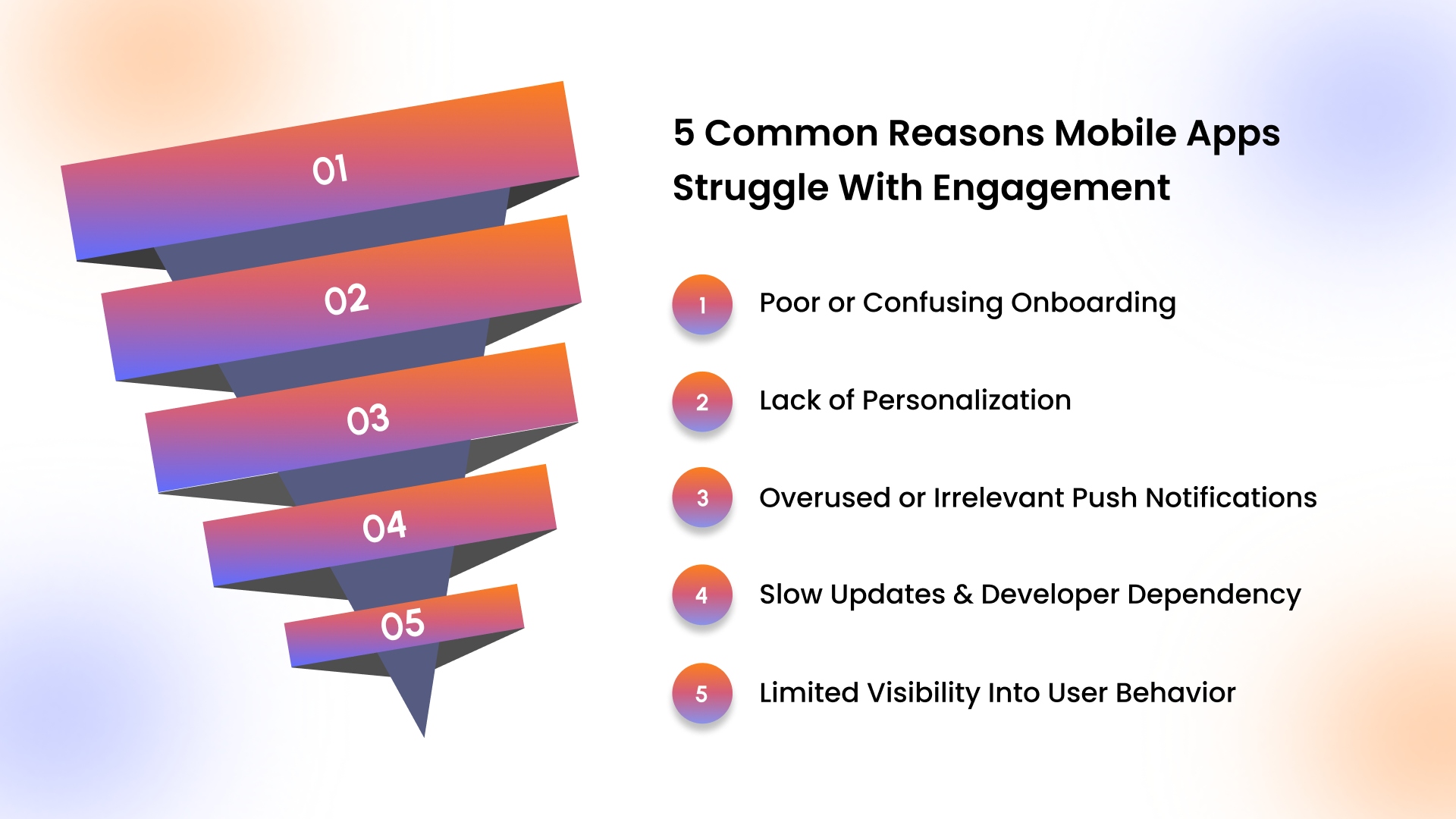
1. Poor or Confusing Onboarding
First impressions matter. If users don’t understand the value of your app within the first few minutes, they’re unlikely to return.
- Too many steps during sign-up.
- No clear reason to explore the app.
- The value proposition was not communicated early.
2. Lack of Personalization
Generic experiences quickly lead to disengagement. Users expect apps to reflect their preferences and behavior.
- Same home screen for every user.
- No personalized product recommendations.
- Irrelevant offers or messaging.
3. Overused or Irrelevant Push Notifications
Push notifications can boost engagement, but only when used correctly.
- Too many notifications in a short time.
- Messages not tied to user behavior.
- Promotions without clear value.
4. Slow Updates and Developer Dependency
Apps that feel outdated lose engagement fast.
- Delayed campaign launches.
- Inability to update content in real time.
- Heavy reliance on developers for small changes.
5. Limited Visibility Into User Behavior
Without clear data, it’s hard to improve engagement.
- No insight into drop-off points.
- Engagement metrics are not tracked consistently.
- Decisions based on assumptions, not data.
Each of these issues alone may seem manageable. Together, they explain why many mobile apps struggle with engagement despite strong installs and brand recognition.
Avoiding these pitfalls enables mobile app engagement to shift from reactive troubleshooting to proactive growth.
For e-commerce and D2C brands, this shift often marks the difference between an app that exists and an app that drives measurable revenue.
Turning Engagement Problems Into Clear Signals
If you examine the issues above closely, a common thread emerges: most engagement problems aren’t apparent until they’ve already impacted revenue.
Teams know something isn’t working, but they don’t always know where users are dropping off, which campaigns are actually driving repeat purchases, or what to fix first.
This is where having built-in insight matters. With tools like John AI Appmaker’s built-in AI assistant, Shopify teams can ask straightforward questions, like
- Which screens lose users?
- Which push notifications lead to purchases?
- Or how app engagement changes after a campaign?
And get answers pulled directly from live app data.
That kind of visibility helps brands move from reacting to engagement dips to proactively improving onboarding, personalization, and messaging, without waiting on reports or developer updates.
In the next section, we’ll look at how addressing these gaps systematically can turn a mobile app from a static channel into a reliable driver of repeat revenue.
Also Read: Enhancing Your Mobile App Experience with Shoppable Videos: An In-Depth Look with Quinn
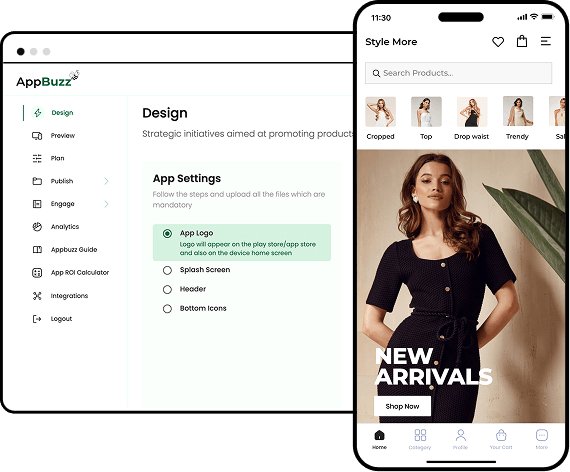
How Appmaker Helps Boost Mobile App Engagement?
After tracking key engagement metrics, brands often struggle to implement strategies efficiently. Appmaker helps turn insights into action through:
- No-Code App Builder: Quickly launch iOS and Android apps with essential engagement features without coding.
- AI-Powered Personalization: Tools like Eidolon AI and John AI dynamically adjust layouts, product recommendations, and content based on user behavior.Newer solutions, such as Rubik’s AI, take this further by focusing on real-time layout optimization, product recommendations, and content personalization driven by in-app user behavior.
- Conditional & Code Blocks: Apply reusable logic to personalize experiences, manage loyalty programs, or execute targeted promotions across the app.
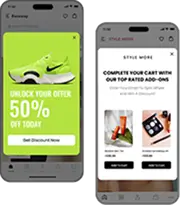
- Push Notifications & Campaign Tools: Send behavior-triggered messages to increase retention and repeat purchases.
- Seamless Integration: Syncs with Shopify, payment gateways, CRM, and inventory systems to streamline user experience.
By simplifying execution, Appmaker allows eCommerce brands to implement engagement strategies efficiently, turning insights into measurable growth.
Conclusion
Mobile app engagement is not a single metric or tactic. It is a system built around understanding user behavior, prioritizing the right metrics, and continuously improving experiences. When engagement strategies align with business goals, mobile apps become long-term growth engines rather than experimental channels.
For Shopify brands scaling mobile engagement, Appmaker enables rapid experimentation without development bottlenecks. Its no-code platform helps you personalize experiences, send targeted push notifications, and iterate quickly, all while syncing in real time with your store. Book a demo today!
FAQs
1. What is a good mobile app engagement rate?
A good mobile app engagement rate varies by industry and use case, but steady growth in DAU/MAU and improving retention over time are strong indicators of healthy engagement. What matters more than a single benchmark is whether users are returning regularly and spending meaningful time inside the app.
2. Which metric matters most for mobile app engagement?
Retention is the most critical engagement metric, as it shows whether users find ongoing value in the app. When combined with session frequency, it provides a clearer picture of how often users return and how deeply they interact, beyond surface-level installs.
3. How often should I track engagement metrics?
Engagement metrics should be reviewed weekly to identify trends and guide iteration decisions. Daily monitoring is useful for catching sudden drops caused by bugs, performance issues, or campaign-related spikes that need quick action.
4. Do push notifications always improve engagement?
Push notifications improve engagement only when they are relevant, timely, and personalized. Overusing generic notifications often leads to fatigue, muted notifications, or uninstalls, ultimately reducing long-term engagement instead of increasing it.
5. Can no-code apps achieve strong engagement?
Yes. Engagement depends more on user experience, personalization, and how quickly teams can iterate based on data. No-code platforms often enable faster updates, testing, and optimization, which can directly support stronger engagement over time.