
















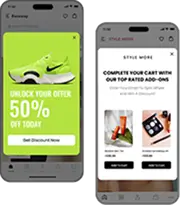




Mobile apps don’t struggle because users stop installing them. They struggle because users stop coming back. Without timely, relevant reminders, even the best apps fade from a customer’s daily routine.
This is where push notifications become critical. When used well, they reconnect users at high-intent moments, bringing them back to browse, complete purchases, or take action they were already considering. But when push notifications are generic, poorly timed, or disconnected from real user behavior, they’re quickly ignored or disabled.
The effectiveness of push messaging depends heavily on the service behind it. A good push notification service helps trigger notifications based on user behavior, personalize content, link users to the right screen, and track how messages improve engagement and conversions.
In this article, we’ll break down the top mobile push notification services for 2026, explain what differentiates them, and help you choose the right platform based on your app’s growth, retention, and conversion goals.
Before we dive into
- Mobile push notifications are most effective when they’re behavior-driven, timely, and closely connected to what users are doing inside the app, not sent as generic broadcasts.
- The best push notification services for mobile apps go beyond delivery to support real-time triggers, personalization, deep linking, and revenue-linked analytics.
- Leading platforms like AppMaker, OneSignal, Braze, Airship, MoEngage, and CleverTap serve different needs, from ecommerce-focused engagement to enterprise-scale orchestration.
- Push notifications outperform email for real-time actions and re-engagement, while email works better for long-form communication and nurture flows.
- Effective use cases include cart abandonment recovery, back-in-stock alerts, price drops, re-engagement, and post-purchase follow-ups, all supported by deep links and accurate data.
What Makes a Push Notification Service “Best” in 2026?
Push notification tools have evolved significantly. By 2026, effective services will no longer be judged on message delivery alone but on how well they operationalize engagement.
The best platforms share these core capabilities:
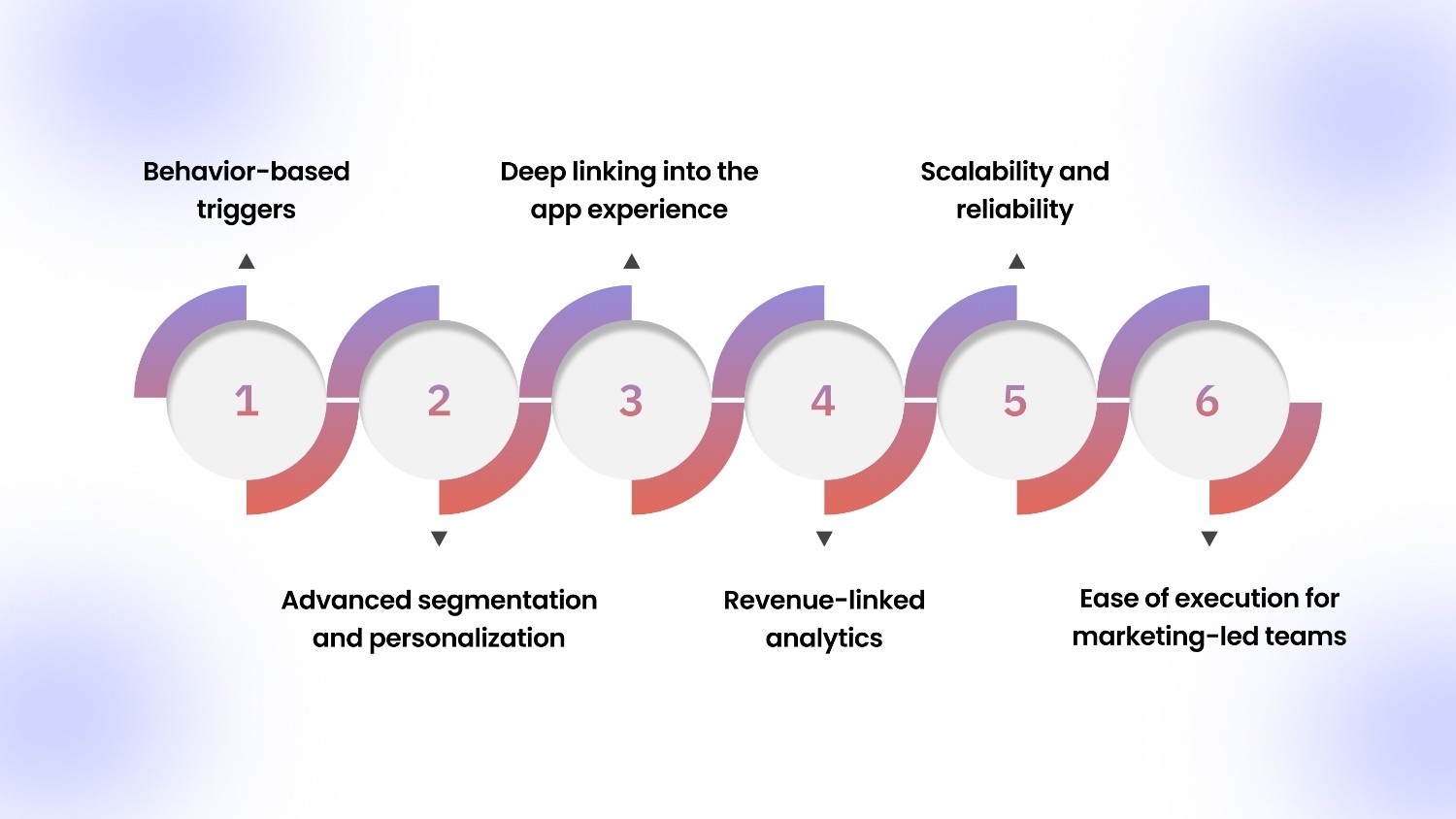
- Behavior-based triggers that respond to live user actions such as cart abandonment, product views, restocks, or inactivity, allowing messages to reach users when intent is highest rather than on fixed schedules.
- Advanced segmentation and personalization are built on browsing history, purchase behavior, and lifecycle stage, so messages feel relevant to each user instead of generic broadcasts.
- Deep linking into the app experience that opens users directly to the exact product, category, or cart referenced in the notification, reducing friction after the tap.
- Revenue-linked analytics that go beyond open rates to show how notifications impact conversion, retention, repeat purchases, and overall app performance.
- Scalability and reliability that ensure notifications are delivered accurately during peak traffic periods, major sales events, and high-volume campaigns.
- Ease of execution for marketing-led teams, with intuitive workflows that reduce reliance on developers and make it easier to launch, test, and optimize campaigns quickly.
These features separate mature engagement platforms from basic notification tools.
Things You Can’t Ignore When Evaluating Push Notification Services
Even if a push notification service looks good on paper, these practical considerations often determine whether it actually works long-term. Ignoring them leads to low engagement, user opt-outs, or operational friction later.
- Message relevance over volume: A service that makes it easy to send more notifications, but not better ones, often leads to declining engagement over time. Relevance matters more than reach.
- Broken or generic post-click experience: Even with deep linking support, poor execution can land users on the wrong screen or a generic page, breaking trust and reducing conversions.
- Delayed reaction to intent: If notifications can’t trigger immediately after an action, high-intent moments are missed. Timing delays often matter more than copy or design.
- Overdependence on manual workflows: Platforms that rely heavily on manual setup, exports, or repeated configuration slow teams down and make optimization harder as campaigns scale.
- Lack of feedback loops: Without clear signals showing why notifications underperform (not just that they do), teams struggle to improve results and often resort to guesswork.
- Misalignment with the app experience: Notifications should feel like a natural extension of the app, not a separate marketing channel. When messaging and in-app experience are disconnected, engagement suffers.
These factors don’t always appear in feature lists, but they strongly influence whether push notifications become a sustainable engagement channel or a short-lived experiment.
8 Best Mobile Push Notification Services for 2026
Here are the best push notification services for mobile apps in 2026, each organized with a consistent format to help you compare features, strengths, and use cases.
1. AppMaker Push Notifications
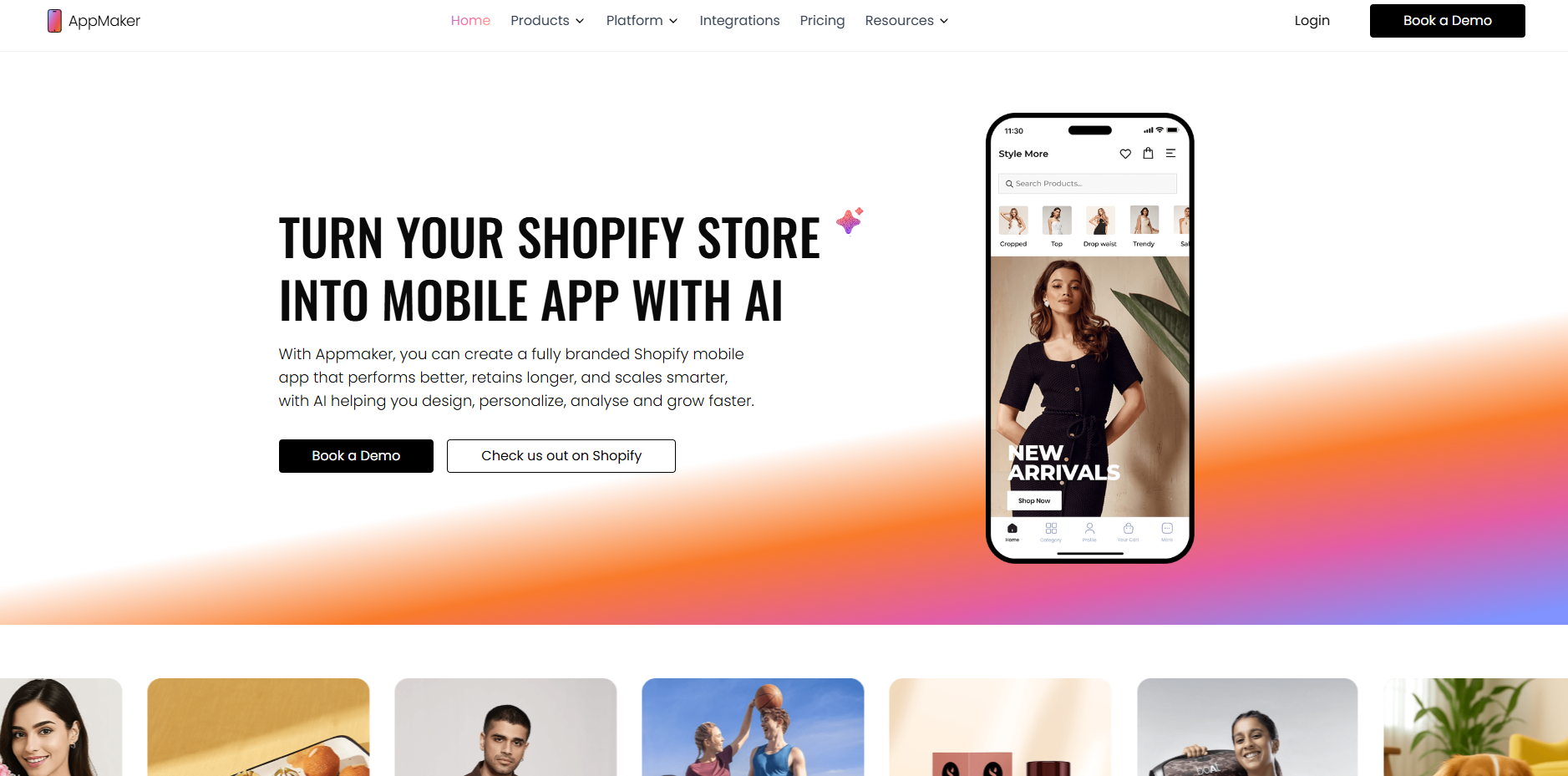
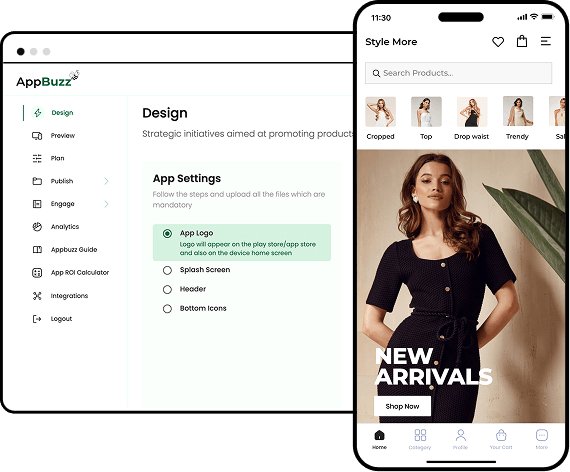
AppMaker’s push notifications are part of a broader no-code mobile app platform built specifically for ecommerce and Shopify brands. Notifications are tightly connected to in-app behavior and real-time store data, making them highly actionable in 2026’s intent-driven environment.
Key strengths:
- AppMaker Studio: A drag-and-drop CMS that lets teams manage home layouts, banners, PDPs, and content without code.
- Eidolon AI: Converts Figma files or screenshots into reusable app layouts, reducing design-to-launch time.
- John AI: A plain-English analytics assistant that answers questions like “Which products drive the most repeat purchases?”
- Push notifications and conditional blocks: Enable behavior-based messaging and personalized experiences.
- Code blocks and extensibility: Allow teams to add custom logic and advanced workflows when needed, without rebuilding the app.
- Integration support (160+): Works with a wide range of ecommerce, marketing, analytics, and loyalty tools to fit existing tech stacks.
- Multi-lingual support: Enables localized app experiences for brands selling across regions or international markets.
- Native iOS and Android apps: Built on React Native for performance and scalability.
Best for: US-based Shopify brands focused on increasing AOV, repeat purchases, and long-term customer value without adding engineering overhead.
Pricing: Starts at $599 per month + 2% of in-app sales and a 14-day free trial option.
2. OneSignal
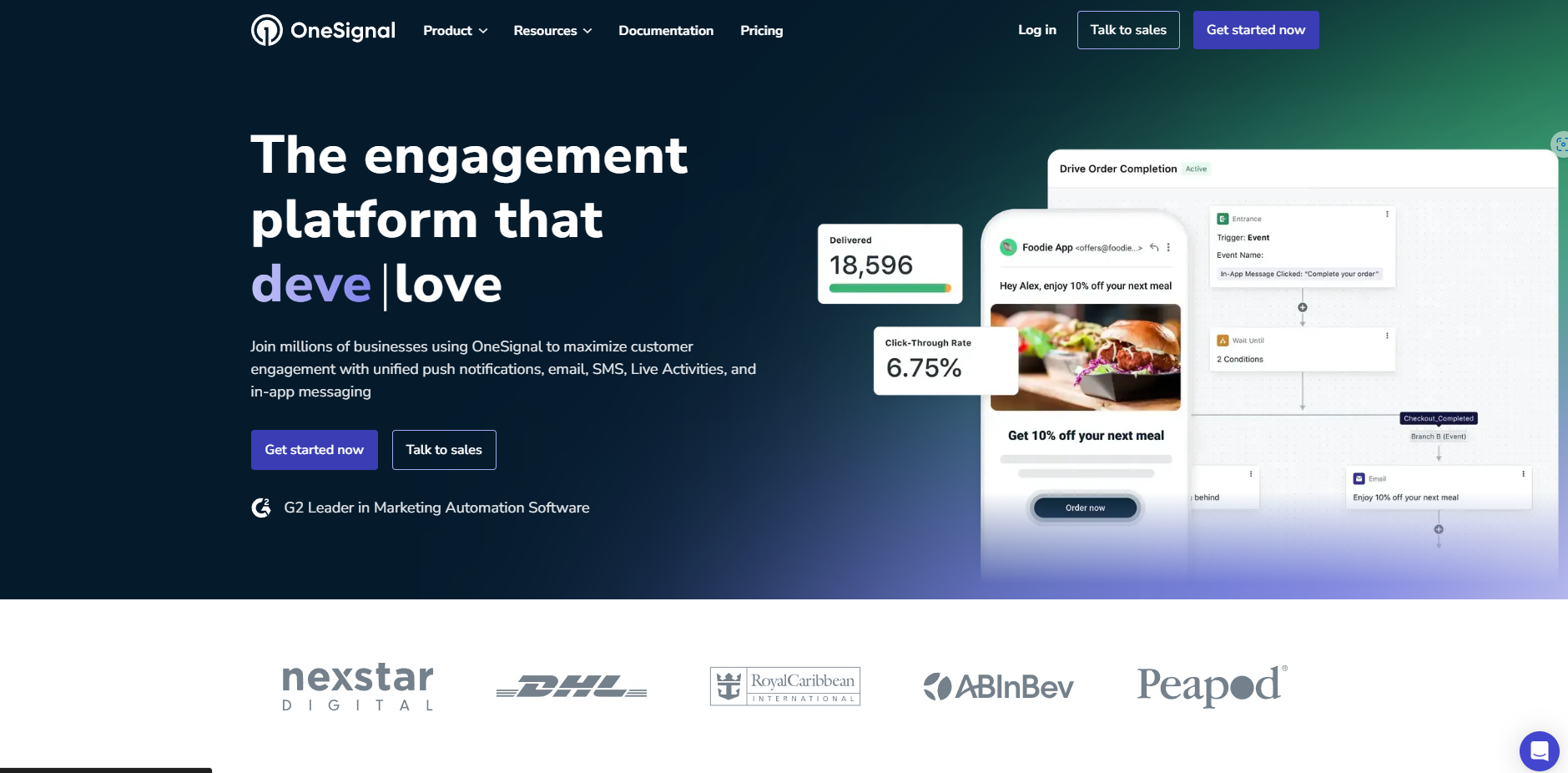
sourcelinkOneSignal is one of the most widely adopted push notification platforms, supporting mobile apps, web push, and cross-platform campaigns from a centralized console. Its balance of ease of use, segmentation, and automation makes it appealing for a range of app categories, from ecommerce to gaming.
Key strengths:
- Cross-platform support (iOS, Android, web)
- Powerful segmentation and audience targeting
- A/B testing and delivery optimization tools
- Free tier suitable for early-stage teams
Best for: Brands that need a flexible, multi-platform push solution without heavy infrastructure setup.
3. Firebase Cloud Messaging (FCM)
.png)
sourcelinkFirebase Cloud Messaging is Google’s free push messaging service, often used as the backbone for custom notification systems. While it requires development support to build advanced workflows, FCM offers reliable delivery and deep integration possibilities for teams that want full control over notification logic.
Key strengths:
- 100% free and fully scalable delivery infrastructure
- Deep integration with Firebase Analytics and Crashlytics
- Flexibility to build custom triggers and workflows
- Reliable delivery backed by Google’s infrastructure
Best for: Developer-centric teams building custom, backend-driven push systems.
4. Airship
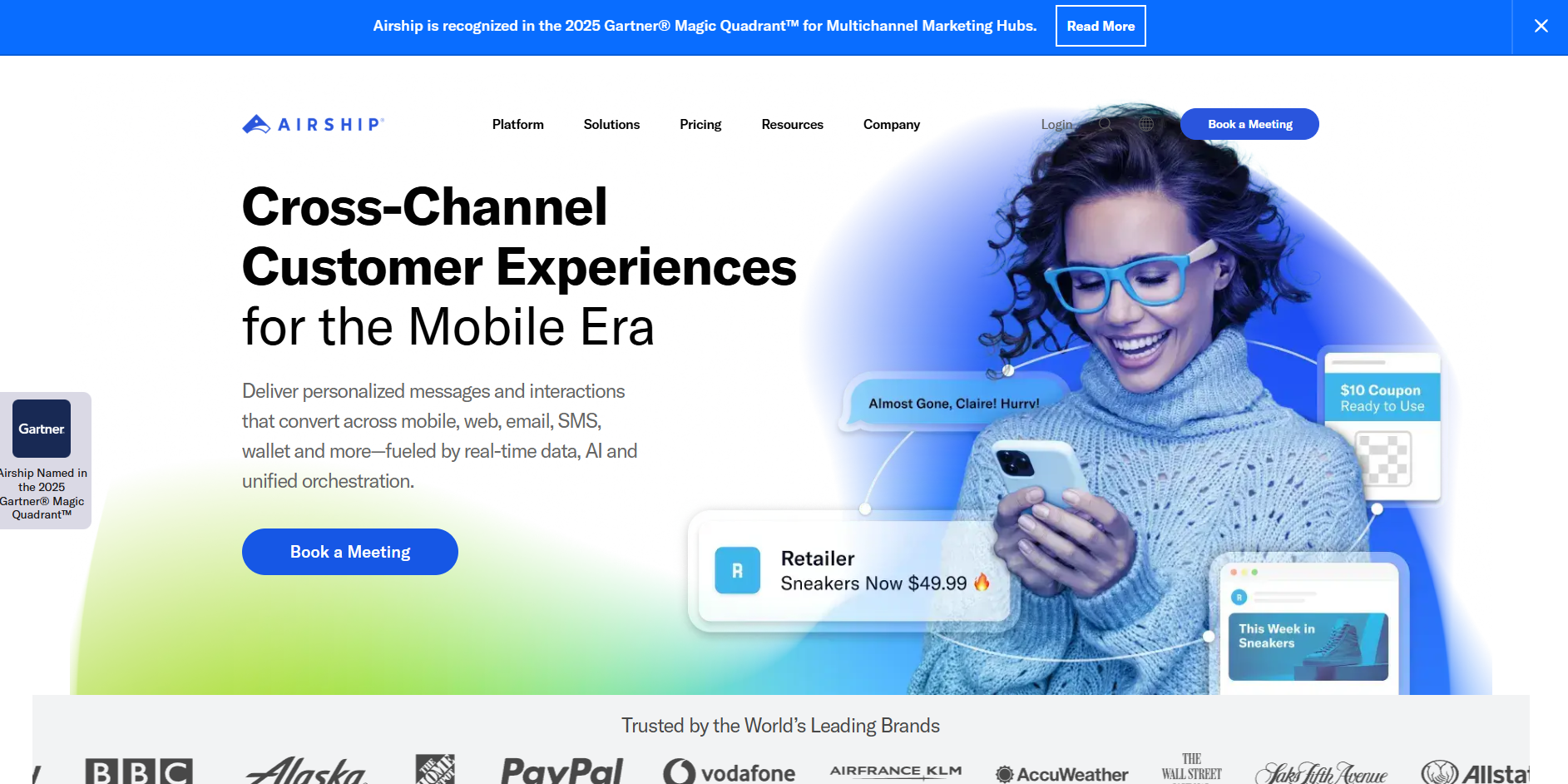
sourcelinkAirship is an enterprise-grade push notification and engagement platform focused on cross-channel messaging and advanced audience orchestration. It provides robust segmentation and predictive features, making it suitable for large brands with complex customer journeys and CRM requirements.
Key strengths:
- Advanced segmentation and audience building tools
- Cross-channel orchestration (push, email, SMS)
- Predictive analytics and personalization models
- Enterprise-grade scalability and security
Best for: Large enterprises with mature data teams and omni-channel engagement strategies.
5. Braze
sourcelinkBraze is a comprehensive customer engagement platform that powers push notifications alongside email, in-app messaging, and lifecycle automation. Its strength lies in real-time behavioural targeting and journey orchestration, helping brands craft consistent messaging across channels.
Key strengths:
- Unified push, email, and in-app messaging workflows
- Real-time behavioural segmentation
- Predictive and AI-based personalization
- Flexible campaign orchestration
Best for: Brands with complex, omnichannel engagement requirements seeking unified messaging.
6. MoEngage
sourcelinkMoEngage combines push notification capabilities with analytics and AI-driven insights to support retention and lifecycle campaigns. Its focus on behavioural intelligence helps teams identify churn risks and re-engagement opportunities, while automations make these workflows easier to scale.
Key strengths:
- AI-driven behavioural insights and churn predictions
- Support for push, email, in-app, and SMS campaigns
- Dynamic segmentation and lifecycle automation
- Campaign performance optimization suggestions
Best for: Growth teams focused on retention and personalised lifecycle engagement.
7. CleverTap
sourcelinkCleverTap blends push notifications with deep behavioural analytics and funnel tracking, enabling teams to optimise messaging based on user journeys and long-term engagement patterns. It’s particularly useful when push campaigns need to tie back to broader retention and revenue metrics.
Key strengths:
- Cohort and funnel analytics for lifecycle insights
- Behaviour-based segmentation and automation
- Real-time campaign monitoring
- Retention and conversion trend reporting
Best for: Analytics-driven teams who want to track push performance across the user lifecycle.
8. Air360
sourcelinkAir360 is a push notification and user engagement platform built for brands looking for advanced automation without sacrificing simplicity. It focuses on behaviour-based triggers, engagement workflows, and easy integration with backend systems, supporting both mobile and web push.
Key strengths:
- Behaviour triggers and automated workflows
- Easy backend and SDK integration
- Cross-platform support
- Performance tracking and insight dashboards
Best for: Brands that want balanced push capabilities with straightforward implementation.
Once you’ve shortlisted the best push notification service for mobile apps, the next decision is how push fits into your overall retention mix.
Push Notifications vs Email in 2026: Which Channel Works Better for Mobile Apps?
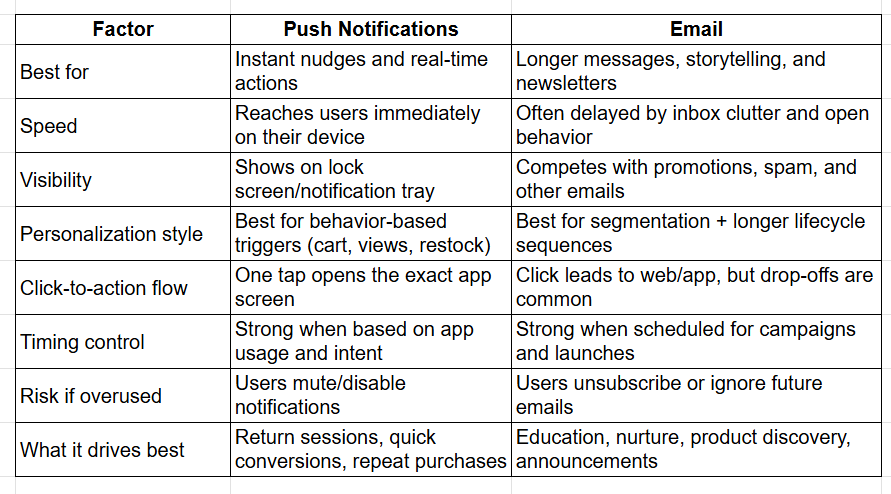
Many brands still rely heavily on email because it feels familiar and scalable. But in 2026, mobile behavior has shifted: customers expect faster, more contextual nudges that match what they’re doing inside the app.
That’s where push notifications stand out. Push is designed for real-time intent, while email is better for long-form messaging and slower nurture flows. Most high-performing teams don’t choose one over the other; they use both, but for different jobs.
Here’s a clear comparison to help you decide what to prioritize.
How to Choose the Best Push Notification Service for Mobile Apps
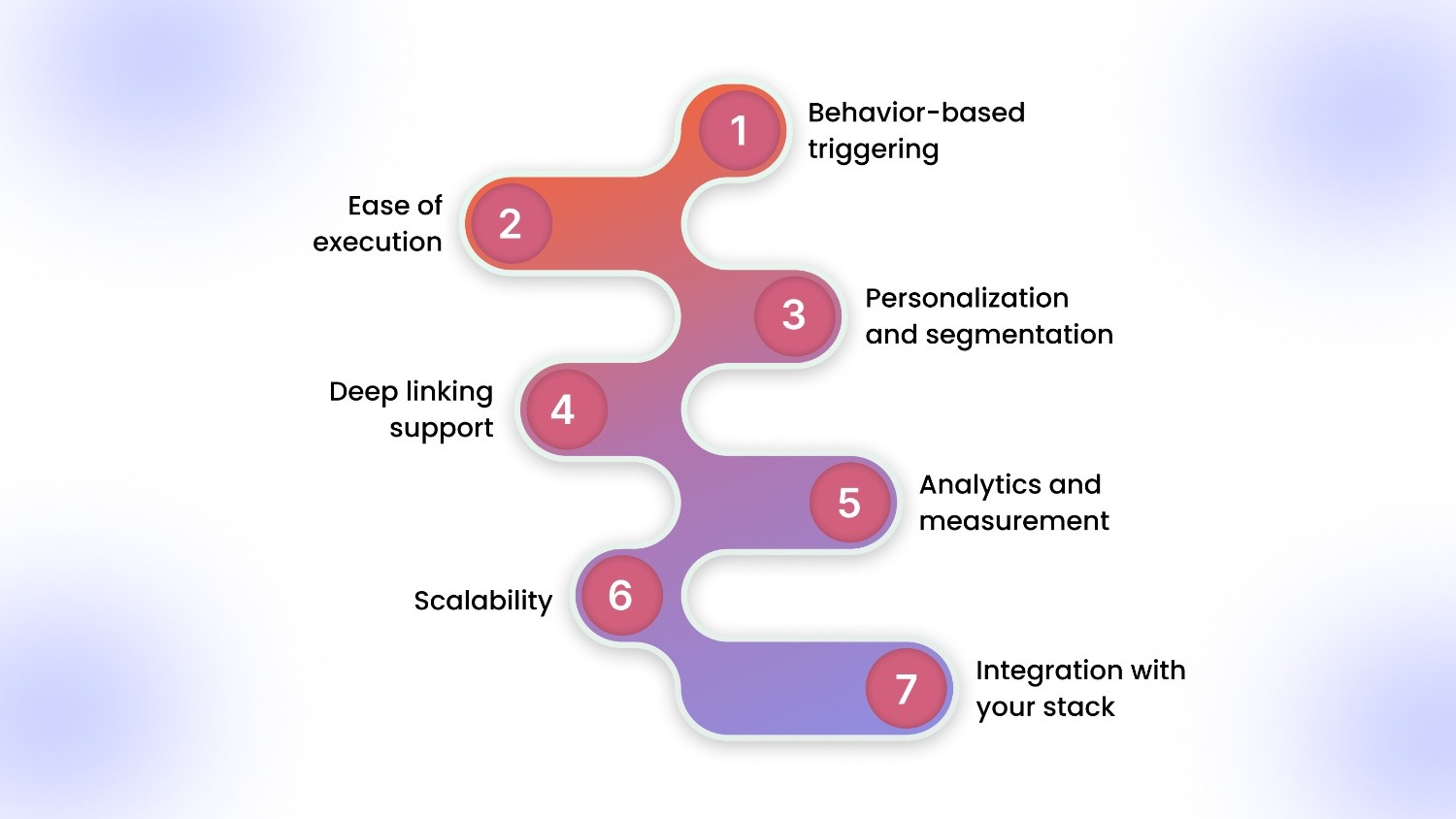
Choosing the best push notification service for mobile apps in 2026 comes down to how well the platform fits your team, your tech stack, and your engagement goals. Rather than focusing on feature lists, the right choice depends on how easily you can act on user intent and measure results.
When evaluating a push notification service, consider the following:
- Behavior-based triggering: Look for a platform that sends notifications based on real user actions like cart abandonment, product views, or inactivity, not just scheduled campaigns.
- Ease of execution: Marketing teams should be able to create, update, and optimize campaigns without constant developer support.
- Personalization and segmentation: The service should adapt messaging based on user behavior, preferences, and lifecycle stage.
- Deep linking support: Notifications should open directly into the relevant app screen to reduce friction after the tap.
- Analytics and measurement: Clear reporting on opens, conversions, and engagement helps you understand what’s working and improve over time.
- Scalability: As your app grows, the platform should handle higher volumes without delays or delivery issues.
- Integration with your stack: Ecommerce apps benefit from push services that integrate with platforms like Shopify and reflect real-time product and inventory data.
Choosing a service that aligns with these factors makes it easier to turn push notifications into a reliable engagement and revenue channel rather than a manual task.
Use Cases and Best Practices: When Push Notifications Work Best
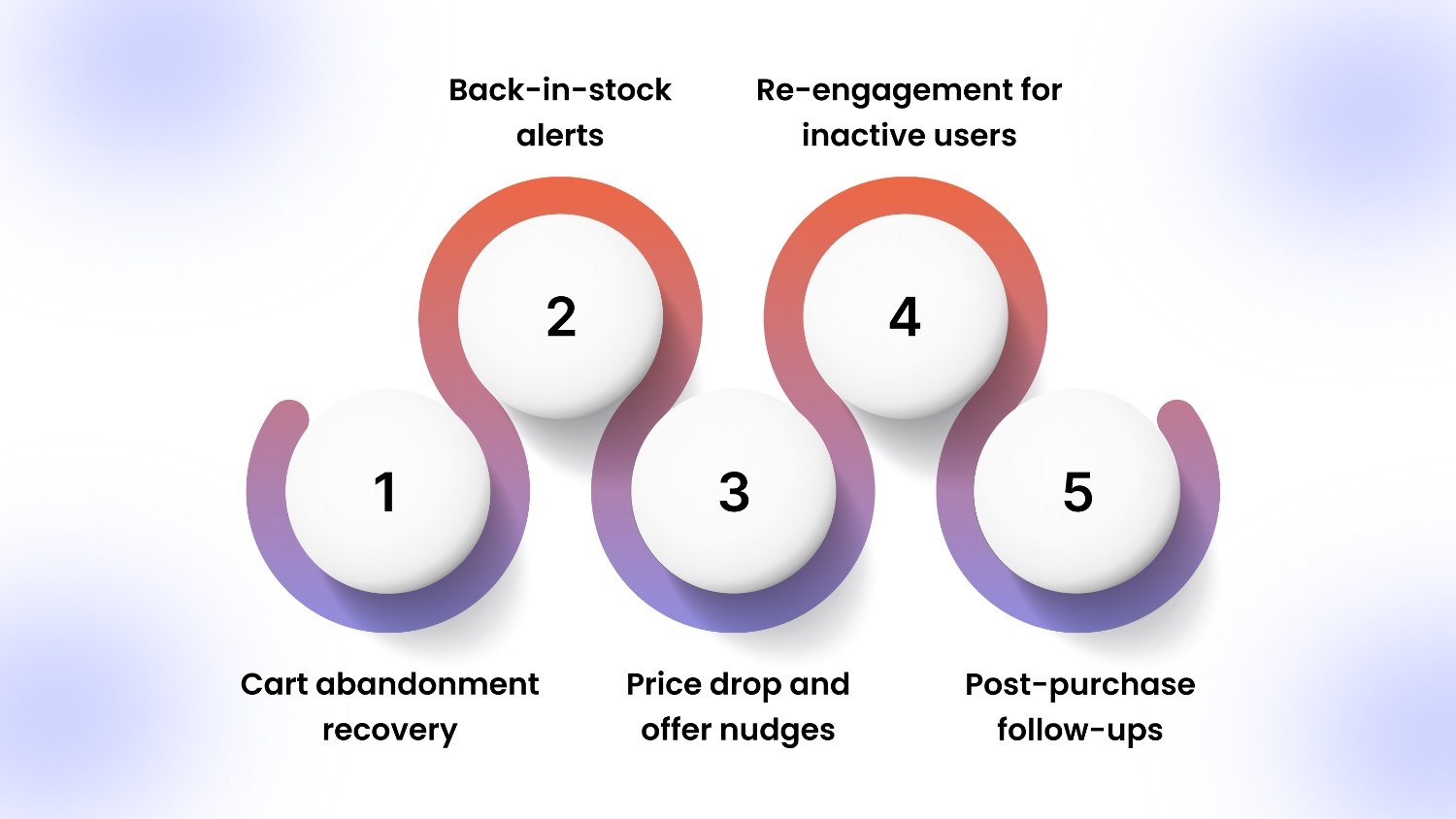
Push notifications are most effective when they align with clear user intent and help users pick up exactly where they left off. Instead of acting as reminders to “come back,” the best notifications act as helpful nudges that reduce friction and guide users toward a natural next step.
Below are the most effective push notification use cases, paired with a simple example for clarity.
- Cart abandonment recovery: Send a timely reminder when a user leaves items in their cart, referencing what they added and linking directly back to checkout.Example: A user leaves sneakers in their cart, and a push opens the app directly to their saved cart later that day.
- Back-in-stock alerts: Notify users as soon as an item they viewed becomes available again to capture renewed interest quickly.Example: A shopper views a sold-out jacket and receives a push the moment it’s restocked, linking straight to the product page.
- Price drop and offer nudges: Trigger notifications when products a user has shown interest in receive meaningful price changes.Example: A user revisits a product multiple times and gets a push when the price drops, opening directly to that item.
- Re-engagement for inactive usersBring users back by highlighting relevant content or products based on past browsing behavior instead of generic promotions.Example: A user who hasn’t opened the app in two weeks receives a push featuring new arrivals from a category they previously explored.
- Post-purchase follow-ups: Use push notifications to support the post-purchase experience with updates, reminders, or timely reorders.Example: After an order is delivered, a push confirms delivery and later reminds the customer when it’s time to restock.
Across all use cases: keep messages timely, relevant, and limited in frequency; always use deep links; and adjust based on engagement and opt-out signals.
If you want to build smarter push notifications that trigger from real user behavior, AppMaker helps mobile teams turn use cases like cart recovery, restocks, and re-engagement into timely, high-impact messages.
How AppMaker Fits Into Modern Mobile Push Notification Services
As push notification services evolve, the most effective platforms are no longer just delivery tools. They connect user behavior, app context, and messaging execution so notifications feel timely, relevant, and easy to act on.
This is where AppMaker stands out among mobile push notification services by combining notification delivery with the in-app experience itself.
- Push notifications trigger from live user signals, not preset rules, so messages respond to cart abandonment, restocks, or repeat buying patterns at the moment intent is highest, instead of firing generic reminders on a schedule.
- Real-time Shopify sync preserves message accuracy, ensuring every notification reflects current pricing, availability, and product context, which prevents mismatches that reduce trust and conversion.
- John AI shortens the gap between insight and action, identifying engagement drops, underperforming notification flows, or emerging behavior trends so teams can refine messaging before relevance decays.
- Conditional logic and reusable code blocks scale personalization, enabling different notification paths for new users, loyal customers, or inactive segments without duplicating campaigns or templates.
- Analytics and insights help refine notification strategies in real time, tracking revenue per session, conversion rate, AOV, retention, and purchase frequency across user segments.
Conclusion
Mobile push notifications have evolved from simple alerts into a core engagement channel for modern apps. The best push notification services are no longer defined by delivery alone, but by how well they connect user behavior, timing, personalization, and in-app context.
Choosing the right push notification service depends on your app’s goals, team structure, and how closely notifications need to align with real user actions. When notifications feel timely and useful, they drive stronger engagement, higher conversion, and long-term retention.
If you want to build smarter push notifications that respond to real user behavior instead of static schedules, AppMaker helps teams connect messaging directly to the in-app experience.
Book a demo to see how AppMaker supports behavior-driven push notifications that are easy to execute and scale.
FAQs
1. What is the best push notification service for mobile apps?
The best push notification service depends on your use case. Some platforms focus on enterprise-scale orchestration, while others prioritize ease of use, personalization, or ecommerce integration. The right choice balances behavior-based triggering, deep linking, analytics, and ease of execution.
2. Are push notifications more effective than email for mobile apps?
Push notifications are typically more effective for real-time engagement and quick actions because they reach users instantly on their devices. Email works better for longer-form communication, while push excels at reminders, alerts, and time-sensitive nudges.
3. How often should mobile apps send push notifications?
There’s no fixed rule, but relevance matters more than frequency. Notifications tied to real user actions tend to perform better and feel less intrusive than scheduled broadcasts. Monitoring opt-outs and engagement helps determine the right balance.
4. Do push notifications require user permission?
Yes, users must explicitly opt in to receive push notifications. Clear value at the opt-in stage, such as order updates or restock alerts, improves acceptance rates and long-term engagement.
5. How do push notification services support personalization?
Most modern services use behavioral signals like app activity, browsing history, or purchase data to personalize messages. More advanced platforms also adapt timing, content, and deep links based on how users interact with the app.