

























For Shopify brands managing steeper ad costs and slowing retention from web traffic alone, growing mobile engagement is no longer optional; it’s a strategic necessity. Many scaling e-commerce teams find that mobile web alone doesn’t deliver the stickiness or repeat purchases. But needed to improve lifetime value and reduce customer acquisition costs.
At the same time, choosing the right mobile app builder can feel overwhelming because tools vary widely in capabilities, real-time store sync, and retention impact. According to the U.S. Census Bureau, retail e-commerce sales in the third quarter of 2025 rose to $310.3 billion, reflecting strong continued demand for online shopping experiences. Of which mobile traffic is a dominant driver, even as merchants struggle with conversion and loyalty from mobile browsers alone.
Understanding how the best mobile app builder for Shopify can solve these challenges helps you make smarter decisions that directly influence retention, average order value, and long-term growth. In this article, you’ll learn which platforms deliver real business outcomes in 2026 and how to evaluate them for your growth stage.
Quick Overview
- Shopify mobile apps drive higher conversion, retention, and owned customer engagement than the mobile web alone.
- Pricing models vary widely, but long-term value depends on personalization depth, scalability, and control, not entry cost.
- Choosing a builder hinges on growth readiness: data usage, automation, analytics maturity, and future customization needs.
- Platforms like Appmaker align well when brands outgrow templates and need flexible, data-led mobile experiences.
What Defines the Best Shopify Mobile App Builder?
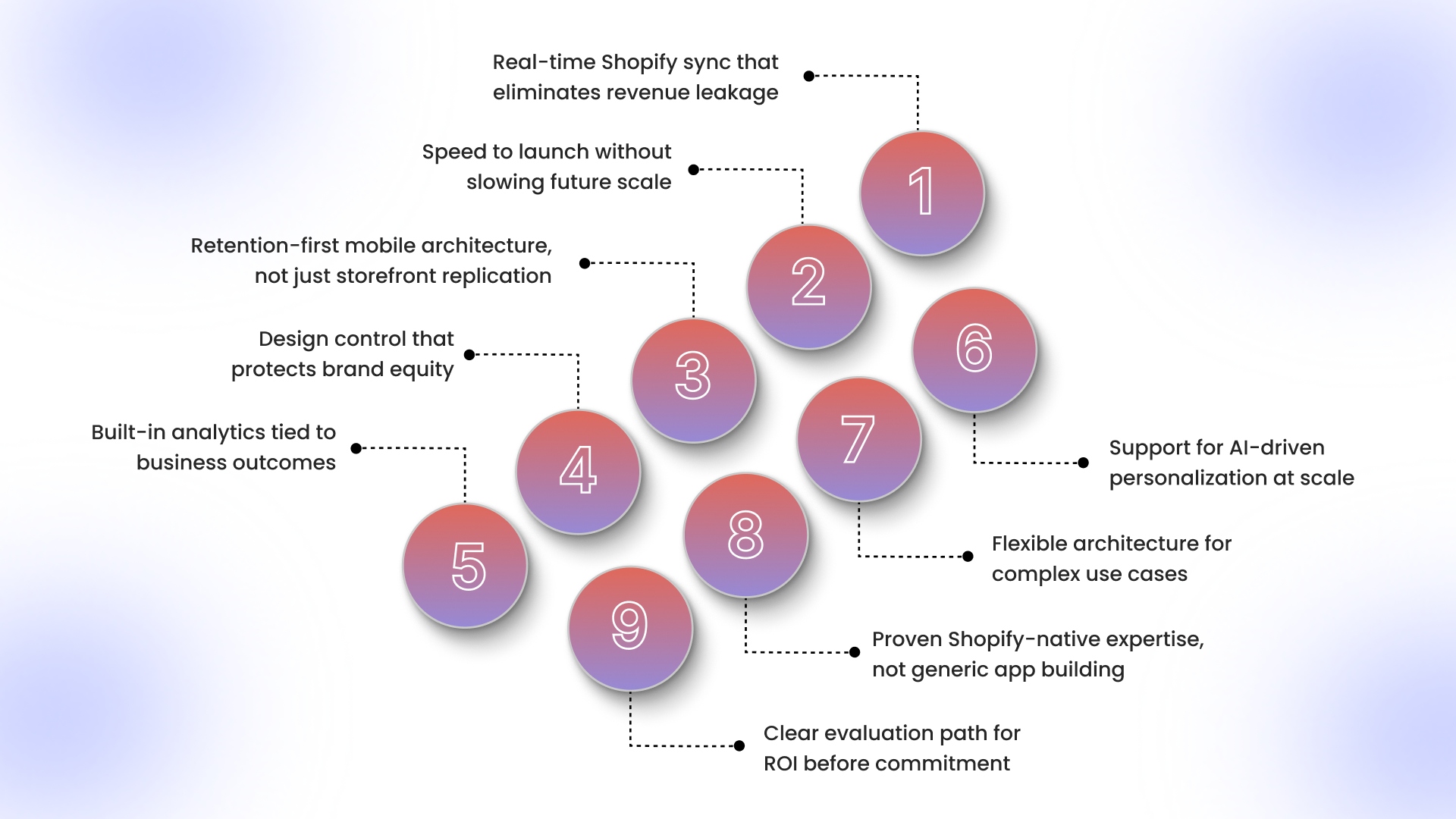
The best Shopify mobile app builder is defined by how well it supports retention, speed, scalability, and operational control for growing e-commerce brands, not by surface-level features.
Here are the criteria that actually matter when you evaluate the best mobile app builder for Shopify in 2026.
- Real-time Shopify sync that eliminates revenue leakage: For $1M–$10M Shopify brands, delayed sync between inventory, pricing, and orders creates operational risk and customer frustration. The best Shopify mobile app builders offer real-time, two-way sync to ensure app data always mirrors your store without manual intervention.
- Speed to launch without slowing future scale: The fastest Shopify mobile app builder is one that lets you launch quickly and adapt later. Leading platforms balance no-code setup for immediate go-live with developer-friendly layers for advanced customization as your store scales.
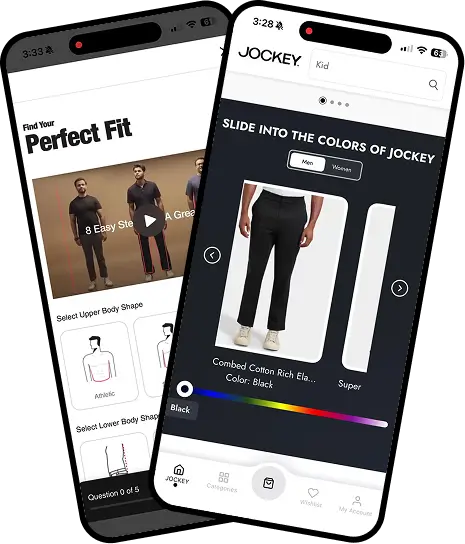
- Retention-first mobile architecture, not just storefront replication: The best mobile app for Shopify focuses on repeat purchases through push notifications, personalized home screens, and behavior-based campaigns, rather than simply replicating your mobile website.
- Design control that protects brand equity: Top mobile app builders for Shopify allow precise control over layouts, management, and visual hierarchy. This is critical for DTC brands that rely on a consistent brand experience to drive trust and conversions across channels.
- Built-in analytics tied to business outcomes: The best Shopify app builder goes beyond installs and sessions, giving you visibility into retention rate, repeat purchase behavior, and AOV so mobile decisions align with revenue goals, not vanity metrics.
- Support for AI-driven personalization at scale: In 2026, the best mobile app builders for Shopify stores use AI to accelerate design, tailor in-app experiences, and surface insights faster, helping lean teams move without relying on external designers or analysts.
- Flexible architecture for complex use cases: Shopify app builder reviews consistently highlight the importance of hybrid flexibility. Platforms that support conditional logic, reusable components, and custom code are better suited for brands with subscriptions, loyalty programs, or region-specific flows.
- Proven Shopify-native expertise, not generic app building: The best mobile app development companies for Shopify integration are Shopify-first by design. This means they understand checkout behavior, product variants, promotions, and store logic without requiring workarounds or third-party patches.
- Clear evaluation path for ROI before commitment: Knowing how to choose a Shopify mobile app builder comes down to whether the platform helps you forecast impact on retention, time-to-value, and internal workload, not just feature availability.
10 Best Mobile App Builders for Shopify in 2026
The best mobile app builders for Shopify in 2026 are the platforms that help scaling brands launch faster, retain mobile users longer, and maintain operational control as complexity grows.
Below are the top mobile app builders for Shopify that stand out based on performance, flexibility, and suitability for high-revenue Shopify stores.
Appmaker
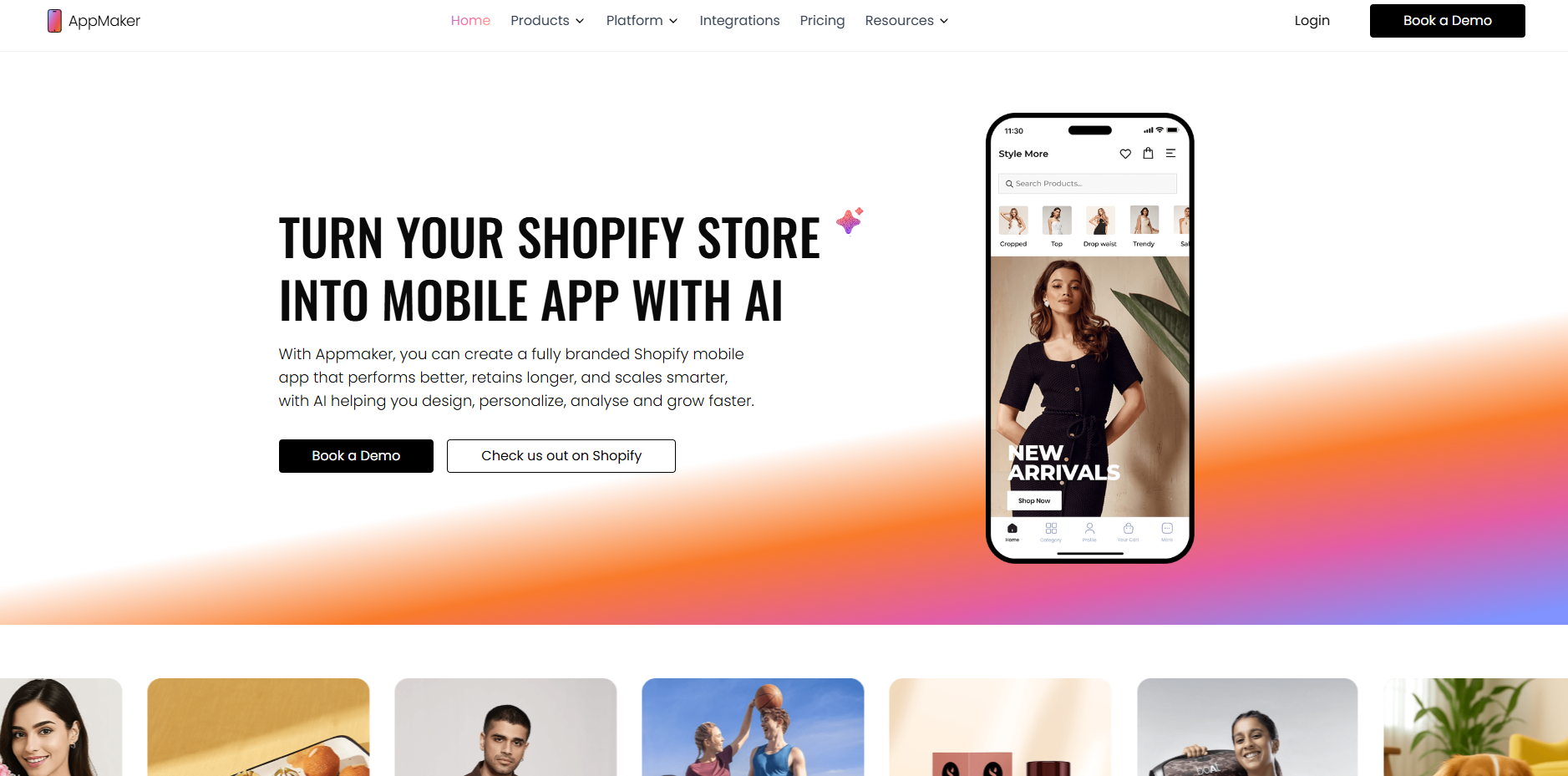
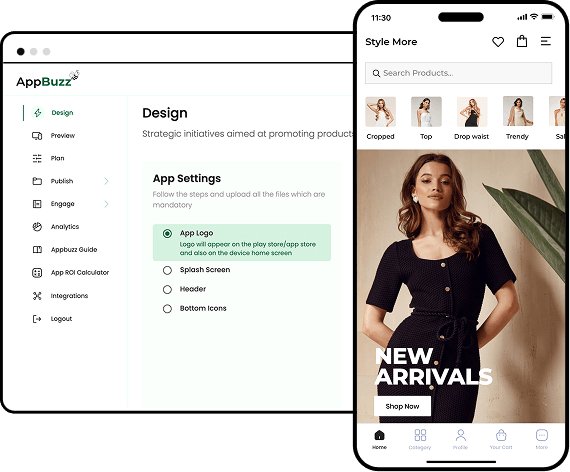
AppMaker is built for Shopify brands that have outgrown templated app builders and need deeper customization, faster iteration, and real control over their mobile experience. It helps you turn your Shopify store into a fully branded, high-converting native mobile app while using AI to design, personalize, analyze, and scale without slowing your team down.
Key features:
- Eidolon AI for design-to-app workflows: Instead of starting from rigid templates, Eidolon AI lets you upload screenshots or Figma files and converts them into reusable, production-ready app layouts, helping teams launch and iterate faster without design bottlenecks.
- AppMaker Studio with true no-code control: The block-based drag-and-drop studio allows you to manage banners, scrollers, videos, timed campaigns, and home layouts in real time, giving non-technical teams speed without sacrificing precision.
- Deep customization with Code Blocks and Conditional Blocks: Unlike most Shopify mobile app builders, AppMaker supports reusable code blocks and condition-based logic, making it suitable for complex use cases like loyalty flows, subscriptions, region-specific content, and personalized journeys.
- AI-powered insights with John AI: John AI acts as an in-app executive assistant, allowing you to ask plain-language questions about revenue, campaigns, LTV, and customer behavior, so decisions are tied directly to outcomes, not dashboards alone.
- Retention-first push notification engine: Push notifications are built around behavior, not blasts, helping you re-engage users with cart reminders, restocks, promotions, and personalized alerts that drive repeat purchases.
- Built for scale with open architecture: AppMaker’s React Native foundation and open model architecture allow in-house teams or agencies to extend functionality, integrate custom services, and innovate without platform lock-in.
Integrations:
- Shopify-native, real-time store sync: Products, inventory, orders, pricing, and customer data sync instantly between Shopify and the mobile app, reducing operational errors and ensuring consistency across channels.
- 160+ integrations across commerce and growth tools: AppMaker connects seamlessly with payment gateways, CRM systems, analytics tools, inventory platforms, and marketing services, allowing your mobile app to fit cleanly into your existing stack.
- Built to support complex commerce ecosystems: The platform is designed to work alongside loyalty platforms, custom checkout logic, third-party services, and internal systems without forcing workarounds.
AppMaker Reviews (Shopify App Store)
- Strong merchant approval: AppMaker has a 4.9/5 rating from 30 Shopify reviews. Brands cite ease of use and smooth Shopify sync.
- Support is a key differentiator: Merchants praise fast onboarding and responsive support. Many report improved retention after launch.
Pros
- Easy adoption for non-technical Shopify teams
- Consistent, reliable Shopify store sync
- Strong onboarding during the app launch phase
- Highly responsive post-launch support
- Proven impact on retention for growing brands
Cons
- Advanced configurations need team coordination
MobiLoud
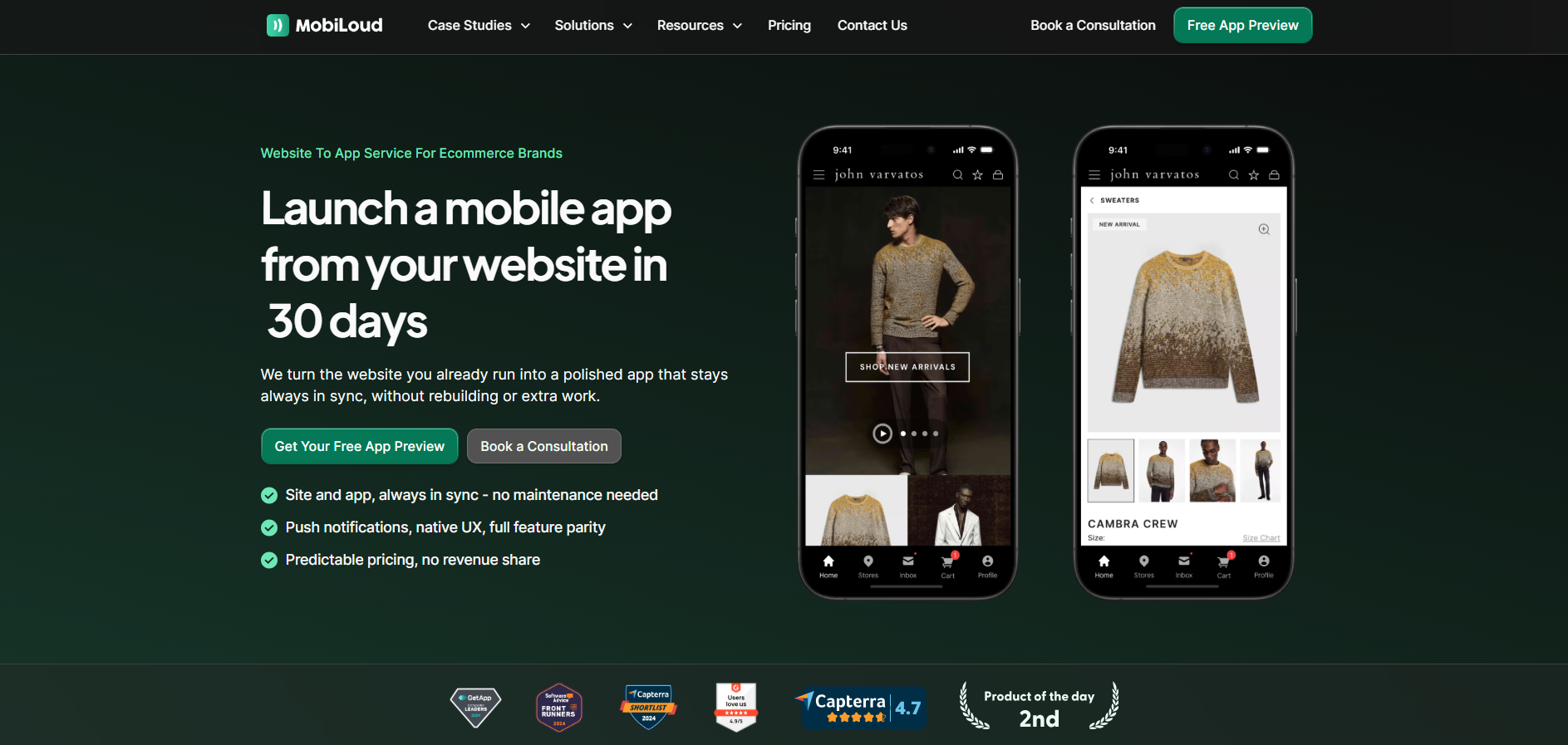
MobiLoud is a website-to-app service that helps eCommerce brands launch native mobile apps by converting their existing website into an app within 30 days. It focuses on keeping the site and app fully in sync while removing the need for in-house development or ongoing maintenance.
Key features
- Website-to-app conversion: Turns your existing eCommerce website into a native iOS and Android app without rebuilding core functionality.
- Fully managed app delivery: Handles configuration, design assets, app store submissions, updates, and technical maintenance on your behalf.
- Push notifications for retention: Enables abandoned cart recovery, product drop alerts, and repeat-purchase campaigns through native push.
- Single codebase, always in sync: Website updates automatically reflect in the app, reducing operational overhead for internal teams.
Integrations
- Shopify and major commerce platforms: Works with Shopify, BigCommerce, WordPress, Magento, and Adobe Commerce while preserving existing site features.
- Broad eCommerce tech stack support: Compatible with common tools for search, reviews, loyalty, analytics, payments, and customer support without custom APIs.
Shopify ratings
- Overall rating: 5/5
- Total reviews: 2
- Merchants highlight smooth onboarding and hands-on support during launch and early growth phases.
Pros
- No need to rebuild the existing website
- Fully managed setup and maintenance
- Fast launch timeline for native apps
Cons
- Limited control over deep app customization
- App experience mirrors website closely
- Less flexibility for custom UI logic
- Changes depend on managed workflows
Shopney
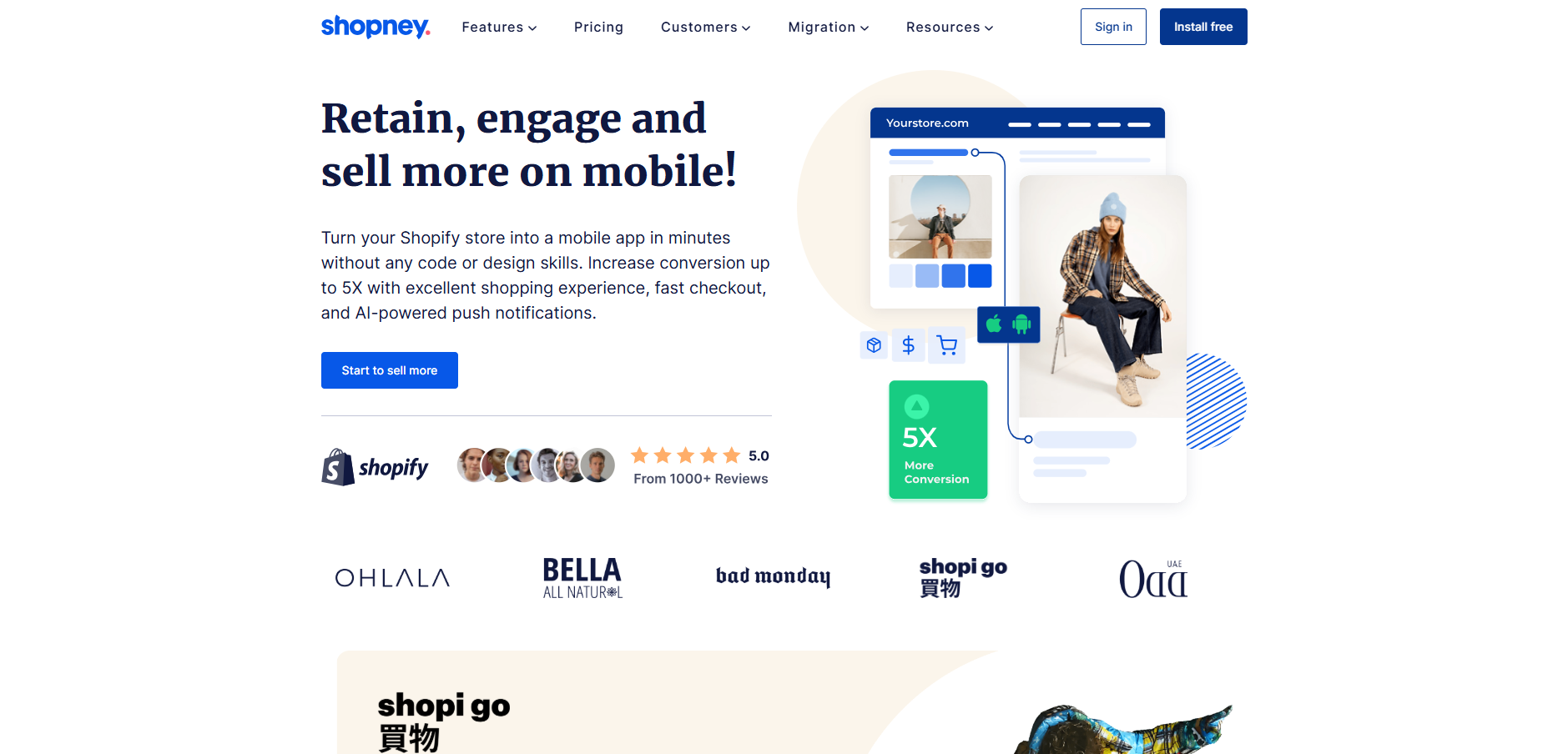
Shopney is a no-code mobile app builder that helps Shopify and Shopify Plus brands launch native iOS and Android apps quickly. It focuses on fast setup, in-app marketing automation, and push notifications to drive engagement and conversions on mobile.
Key features
- No-code drag-and-drop design editor: Build and customize your mobile app layout without design or development skills, using pre-built elements and modular components.
- AI-powered push notifications: Run unlimited push campaigns for abandoned carts, promotions, and product drops, helping reduce CAC and increase repeat purchases.
- In-app marketing automation: Trigger offers and campaigns during browsing sessions to shorten the path to purchase and improve conversion rates.
- Theme-based layouts for Shopify stores: Choose from industry-specific themes designed to speed up launch and standardize mobile UX.
Integrations
- Shopify-native real-time sync: Products, collections, inventory, checkout, and customer data sync automatically with your Shopify store.
- Wide Shopify app ecosystem support: Integrates with popular tools for reviews, loyalty, analytics, email, subscriptions, and customer support with minimal setup.
Shopify App Store reviews
- Overall rating: 5/5
- Total reviews: 737
- Merchants frequently highlight quick setup, ease of use, and highly responsive support, with many noting improved engagement and repeat orders after launch.
Pros
- Very fast launch timelines
- Easy for non-technical teams
- Strong push notification capabilities
- Large Shopify integration ecosystem
Cons
- Custom UI flexibility is limited
- Advanced features depend on plan tier
- App experience follows preset structures more closely
Tapcart
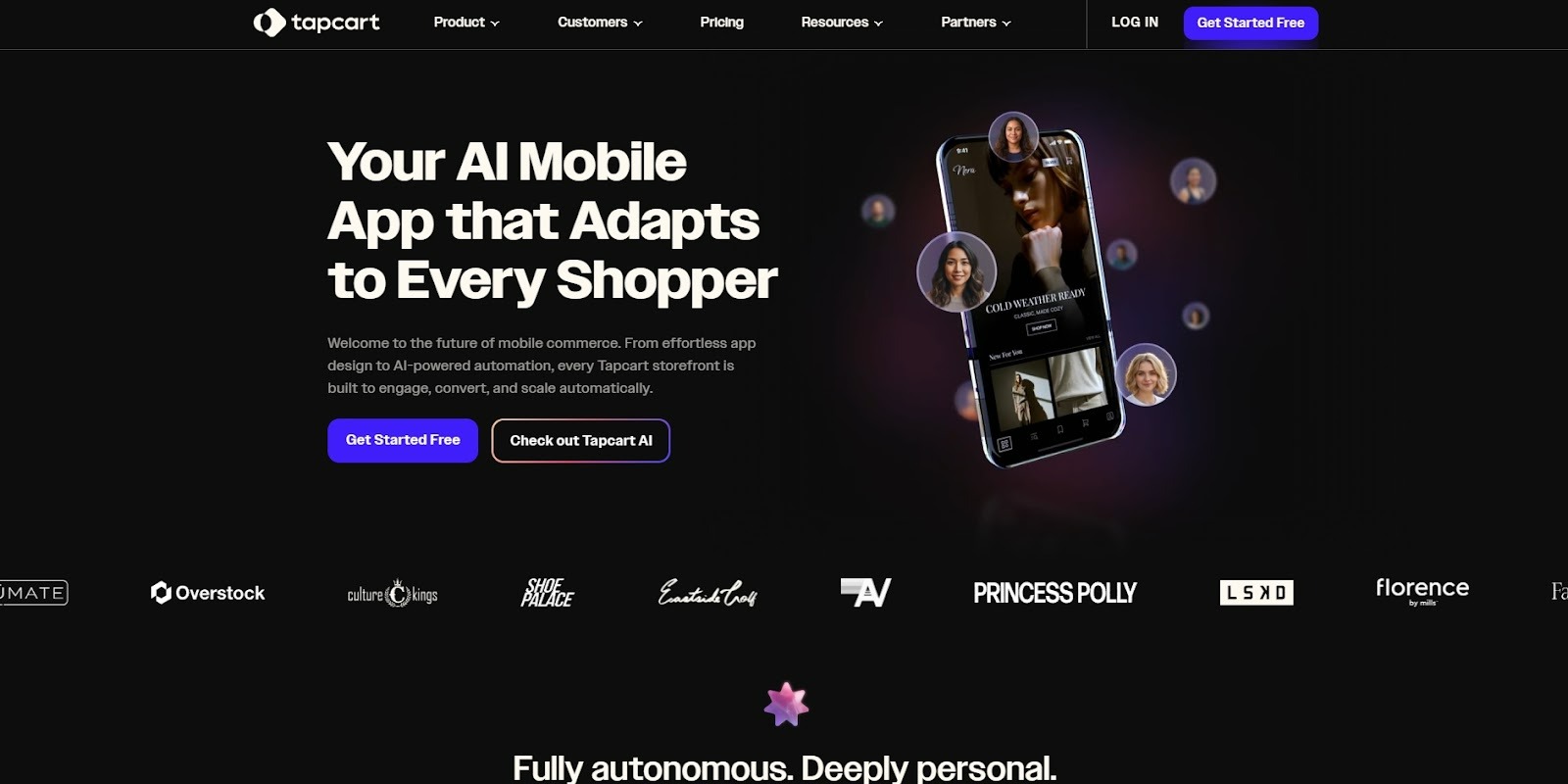
Tapcart is a Shopify-focused mobile app builder designed for fast-growing DTC brands that want a polished, mobile-first storefront with strong retention and marketing capabilities. It emphasizes AI-powered personalization, push automation, and a tightly integrated Shopify ecosystem to drive revenue without adding headcount.
Key features
- AI-powered mobile personalization (Tapcart AI): Uses shopper behavior and large-scale merchant data to personalize content, offers, push notifications, and in-app blocks at a 1:1 level.
- Drag-and-drop App Studio with automation: Build and update app layouts quickly using blocks, with AI-assisted workflows that reduce manual campaign and content work.
- Advanced push notification engine: Supports segmented, automated, and rich push notifications to drive repeat purchases and bring customers back at the right moments.
- Marketing and loyalty-focused mobile UX: Includes loyalty hubs, custom onboarding flows, conditional content, and in-app campaigns designed to increase AOV and retention.
Integrations
- Deep Shopify-native infrastructure: Syncs products, inventory, checkout, themes, and customer data in real time, built as an extension of Shopify rather than a wrapper.
- Strong marketing and retention stack compatibility: Works well with tools like Klaviyo, Yotpo, analytics platforms, loyalty tools, and customer support systems without duplicate workflows.
Shopify App Store reviews
- Overall rating: 4.9/5
- Scale: Used by many high-growth Shopify brands
- Merchants often cite higher conversion rates, strong retention impact, and the ability to manage mobile as a serious revenue channel rather than a side project.
Pros
- Strong AI-driven personalization
- Powerful push and marketing automation
- Designed for high-growth Shopify brands
Cons
- Customization relies on platform blocks
- Advanced capabilities suit mature teams
- Requires an ongoing strategy to maximize ROI
Mage Native
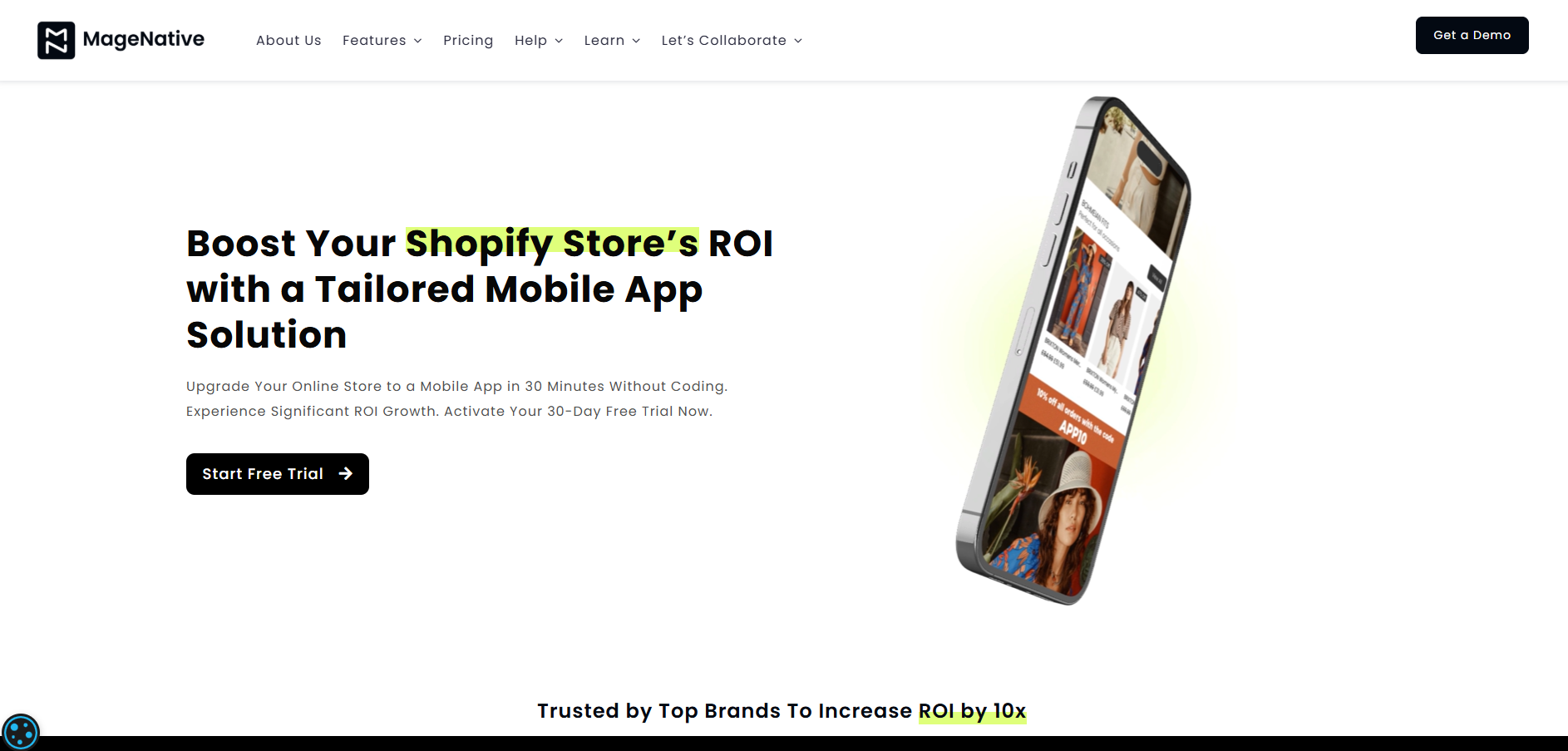
MageNative is a no-code mobile app builder that helps Shopify and Shopify Plus merchants convert their stores into native iOS and Android apps. It focuses on quick setup, theme-based customization, and engagement features aimed at improving mobile conversions and ROI.
Key features
- No-code app builder with theme selection: Build a mobile app using predefined themes and layouts, with basic customization for branding and content.
- Push notifications for engagement: Supports personalized and automated push notifications for promotions, cart reminders, and re-engagement.
- Multi-language and multi-currency support: Enables global selling with localization options across languages and currencies.
- Add-on features like AR and in-app chat: Includes optional features such as augmented reality previews and in-app customer chat for select use cases.
Integrations
- Shopify-native integration: Syncs products, orders, checkout, and inventory with Shopify in real time.
- Third-party app compatibility: Works with common Shopify tools for reviews, loyalty, email marketing, and customer support, depending on plan level.
Shopify App Store reviews
- Overall rating: 4.8/5
- Total reviews: 330
- Merchants often highlight ease of use, beginner-friendly setup, and responsive support, while a smaller set of reviews points to delivery delays and limitations during long-term scaling.
Pros
- Easy for beginners to launch quickly
- No-code setup with theme options
- Strong focus on mobile engagement
Cons
- Customization limited by templates
- Complex changes require support and involvement
- Inconsistent timelines in edge cases
- Long-term scalability can be challenging
Plobal
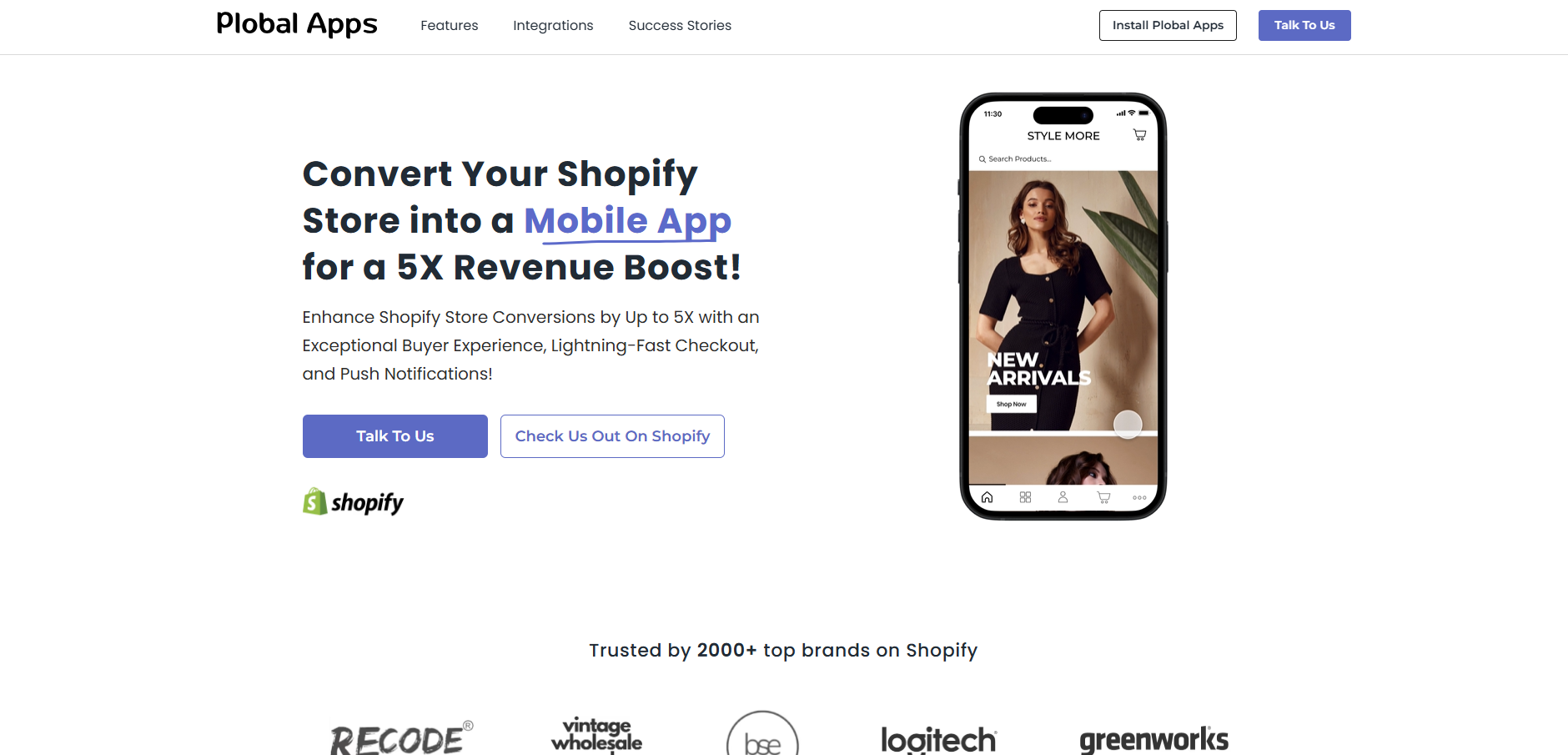
Plobal Apps is a mobile commerce platform designed for Shopify brands that want to turn their store into a dedicated mobile sales channel. It focuses on push-led retention, analytics-driven decisions, and app performance to increase mobile conversions and revenue.
Key features
- No-code mobile app builder: Create iOS and Android apps using a drag-and-drop editor without development effort.
- Code Blocks for app customization: Add custom features and logic using HTML, CSS, and JavaScript to extend beyond default layouts.
- Push notifications as an owned channel: Run targeted campaigns for cart recovery, product launches, and promotions to drive repeat purchases.
- Advanced app analytics: Track over 60 in-app actions, user behavior, and revenue signals to identify growth opportunities.
- AI-based product recommendations: Suggest products based on browsing and purchase behavior to increase AOV.
Integrations
- Shopify-native real-time sync: Keeps products, inventory, checkout, and customer data aligned between the app and the Shopify store.
- Broad Shopify app ecosystem support: Integrates with loyalty, reviews, subscriptions, shipping, search, analytics, and marketing tools without siloed data.
Shopify App Store reviews
- Overall rating: 4.8/5
- Total reviews: 152
- Merchants often highlight strong support, smooth onboarding, and measurable revenue impact, while noting that customization depth depends on technical involvement.
Pros
- Strong push-notification-driven retention
- Detailed analytics for mobile performance
- Supports custom logic via Code Blocks
Cons
- Customization requires technical input
- Setup can feel complex for small teams
- Best suited for mature Shopify stores
- Interface has a learning curve
StoreLab
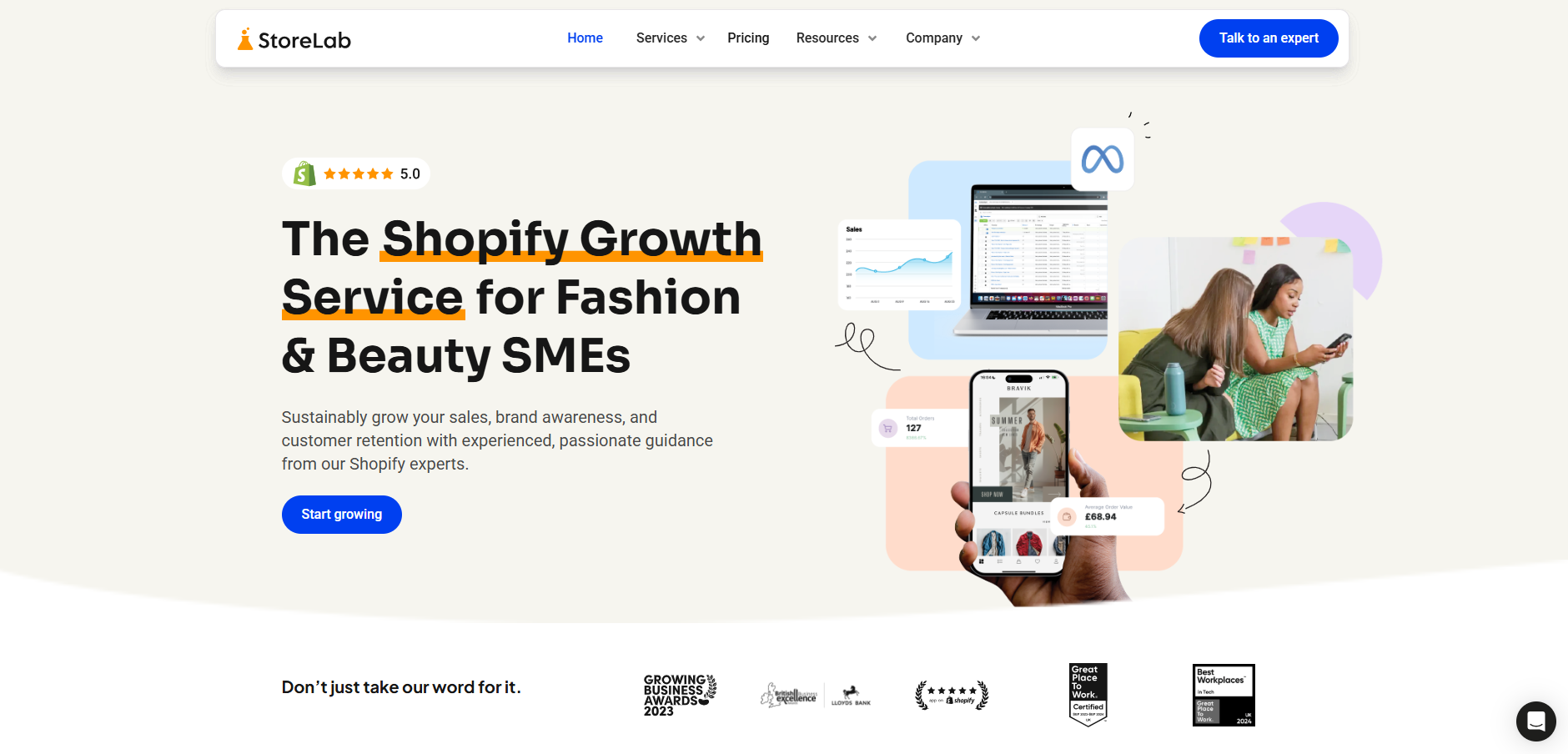
StoreLab is a Shopify-focused mobile app builder combined with managed growth services, aimed at helping small to mid-sized brands improve retention and repeat purchases on mobile. It positions the mobile app as a retention and marketing channel, supported by hands-on account management rather than self-serve customization.
Key features
- Code-free iOS and Android app setup: Launch a mobile app without development effort, supported by StoreLab’s in-house mobile experts.
- Push notifications as a primary retention tool: Uses push notifications to re-engage customers, recover carts, and drive repeat purchases without added sending costs.
- Managed app and growth support: Higher-tier plans include full app management, strategy guidance, and ongoing optimization by a dedicated account manager.
- Built-in focus on mobile UX performance: Emphasizes faster browsing, smoother checkout, and app-first shopping experiences to improve mobile conversions.
Integrations
- Shopify-native integration: Syncs products, checkout, and customer data directly with Shopify for consistent app and store experiences.
- Selective Shopify app integrations: Supports loyalty, reviews, and UGC tools, with more integrations rolling out over time rather than broad plug-and-play coverage.
Shopify App Store reviews
- Overall rating: 5/5
- Total reviews: 36
- Merchants frequently praise hands-on support, transparency, and revenue impact, especially when using managed or guided plans.
Pros
- Strong hands-on account management
- Simple setup for non-technical merchants
Cons
- Less control over deep app customization
- Heavily service-led rather than product-led
- Best value tied to higher-tier plans
- Limited appeal for in-house dev teams
Onemobile
OneMobile is a no-code Shopify mobile app builder designed to help merchants quickly convert their store into a native iOS and Android app with built-in AI features, push notifications, and flexible design components. It focuses on fast setup, affordability, and engagement-driven features for brands looking to establish a mobile app channel without heavy technical effort.
Key features
- Native iOS and Android apps: Enables brands to launch fully functional mobile apps with smooth navigation and optimized checkout flows.
- Drag-and-drop app builder: Offers pre-built themes and 25–35+ design blocks that allow teams to customize layouts without coding.
- AI-powered features: Includes AI content generation, AI campaigns, and AI sales assistance to improve merchandising and engagement.
- Push notifications & automation: Supports segmented, automated, and personalized push notifications to drive repeat purchases.
- Global commerce support: Multi-language and multi-currency capabilities help brands scale across regions.
- Easy publishing & support: Handles app submission via shared developer accounts, reducing setup complexity and cost.
Integrations
OneMobile supports a wide range of integrations across marketing, analytics, and ecommerce workflows, allowing brands to extend app functionality without custom development.
Notable integrations include:
- Shopify Checkout & Customer Accounts
- Shopify Flow
- Email & SMS tools (Klaviyo, etc.)
- Push notification tools
- Loyalty & wishlist apps (e.g., Bon Loyalty)
- Analytics platforms (Google Analytics, Amplitude)
- Advertising tools (Facebook Ads)
- Review & localization tools (Ali Reviews, Transcy)
This makes it flexible for brands already running a multi-tool Shopify stack, though integration depth may vary compared to Shopify-native builders.
Shopify App Store reviews
- Overall rating: 4.9/5
- Total reviews: 350+
Pros
- Easy drag-and-drop builder with no coding required
- Fast launch and quick deployment
- Strong customer support responsiveness
- Push notifications and loyalty features driving engagement & repeat purchases
Cons
- Primarily suited for DTC brands
- Heavier focus on performance than DIY simplicity
- Requires strategic input to maximize value
- Less emphasis on small-store use cases
9. Vajro
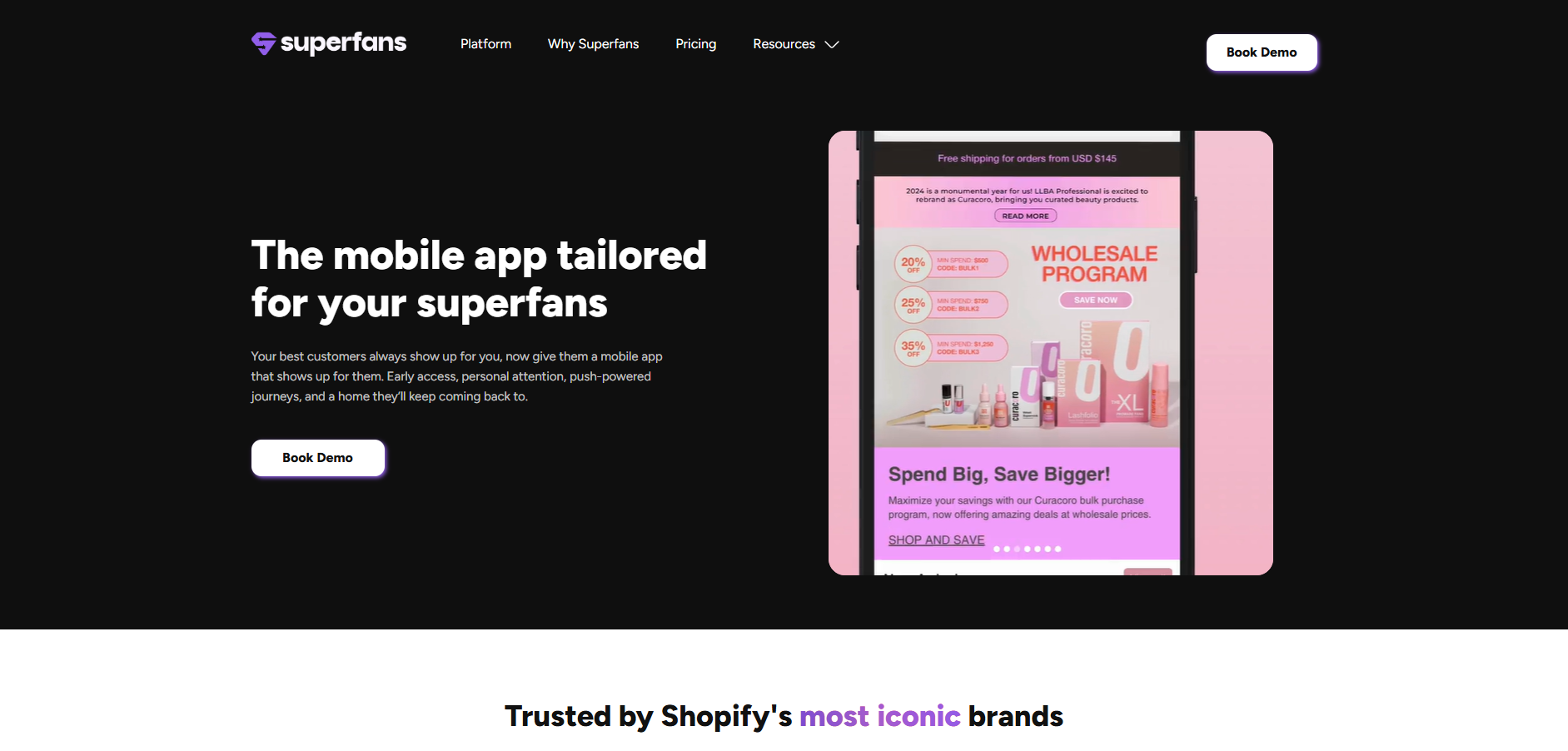
Vajro, now branded as Superfans, is a Shopify mobile app builder focused on engagement-led commerce through push notifications, live selling, and social-style shopping experiences. It primarily targets small to mid-sized brands looking to boost interaction and repeat purchases via mobile-first features.
Key features
- No-code drag-and-drop app builder: Create iOS and Android apps using pre-built, industry-specific themes without coding.
- Push notifications with behavioral triggers: Supports rich media pushes, cart reminders, product launches, and segmented campaigns using first-party data.
- Live selling and video commerce: Run live streams directly inside the app, with replays contributing to post-event revenue.
- Conversion-focused app capabilities: Includes one-click checkout, BNPL options, social login, live chat, and social selling tools.
- Basic analytics dashboard: Provides visibility into app usage, campaign performance, and live-selling metrics.
Integrations
- Shopify-native integration: Syncs products, inventory, and checkout with Shopify for consistent storefront updates.
- Selective third-party integrations: Supports reviews, loyalty, subscriptions, and shipping tools, though compatibility can vary by setup.
Shopify App Store reviews
- Overall rating: 4.9/5
- Total reviews: 887
- Merchants often praise onboarding support, ease of launch, and engagement tools, while long-term reviews highlight concerns around responsiveness, pricing transparency, and control over app updates.
Pros
- Strong push notification capabilities
- Live selling is built into the app
- Easy initial setup for non-technical users
Cons
- Pricing thresholds can escalate unexpectedly
- Limited self-serve control over app updates
- Support responsiveness declines over time
- Customization depends heavily on the vendor
- Integration changes may impact store operations
Apptile
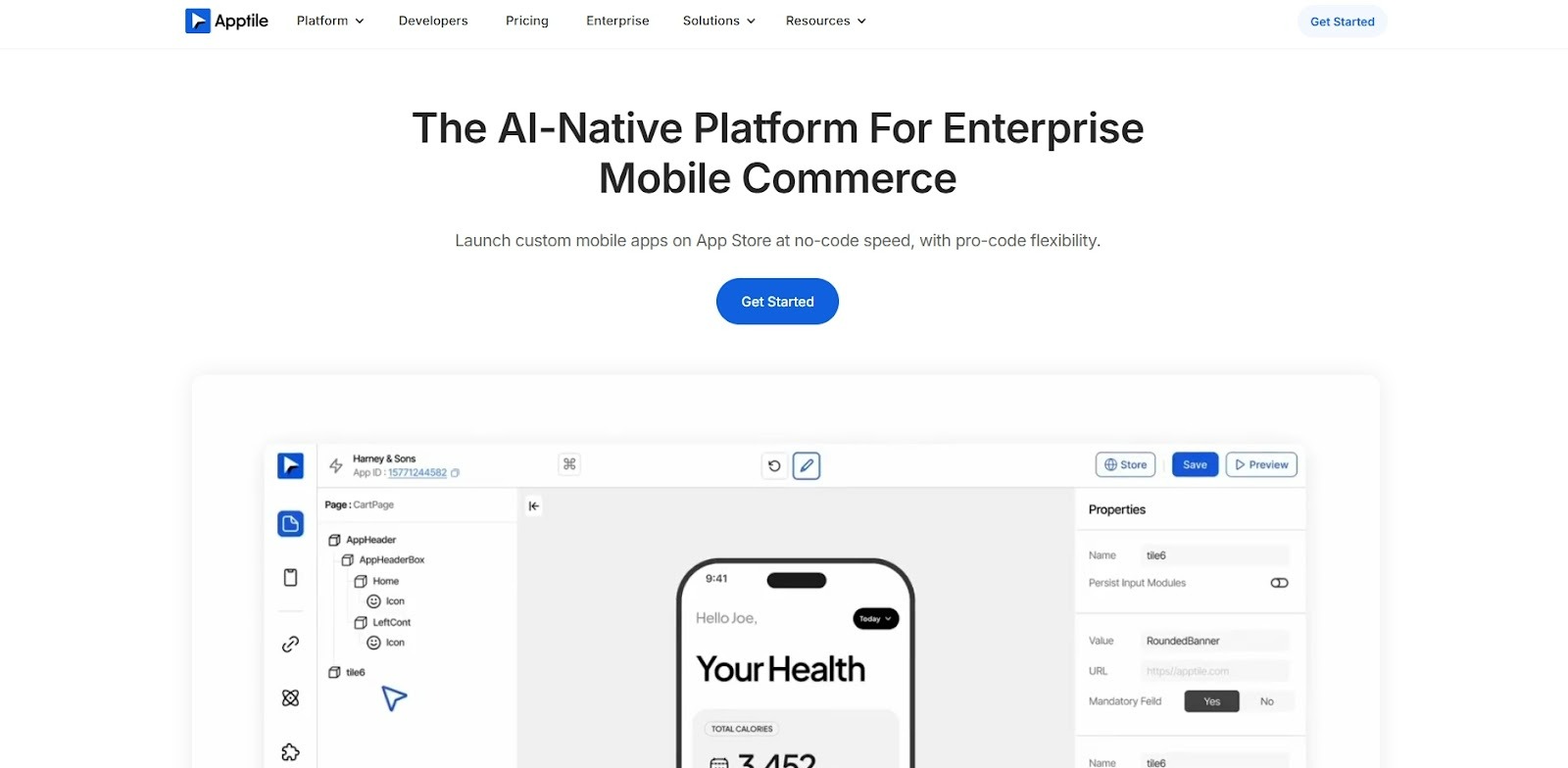
Apptile is an AI-native Shopify mobile app platform designed for brands that need faster launches without sacrificing technical depth. It blends no-code speed with pro-code flexibility, making it suitable for scaling teams and enterprise-leaning commerce setups.
Key features
- AI-native app studio: Launch production-ready iOS and Android apps in days using AI-assisted workflows and visual builders.
- No-code + pro-code architecture: Supports drag-and-drop building alongside SDKs, APIs, and full code-level control.
- Over-the-air (OTA) updates: Push real-time app updates without waiting for App Store or Play Store approvals.
- Advanced analytics and release management: Track performance, manage multiple app versions, and monitor engagement from one dashboard.
- Growth-focused commerce tools: Includes app-only discounts, AI push notifications, install banners, and live selling.
Integrations
- Shopify-native foundation: Syncs products, inventory, checkout, and customer data directly with Shopify.
- Ecosystem integrations: Works with tools like Klaviyo, Recharge, and other marketing, subscription, and analytics platforms.
- Extensible SDK framework: Allows teams to plug Apptile into complex enterprise tech stacks.
Shopify App Store reviews
- Overall rating: 5.0/5
- Total reviews: 122
- Merchants frequently highlight fast go-live timelines, strong customization, and highly responsive onboarding and support teams.
Pros
- Combines no-code speed with developer control
- Fast launches, often within days
- Strong live selling and OTA updates
- Enterprise-grade scalability and security
Cons
- Requires technical input to unlock full value
- May be excessive for very small stores
- Advanced features add operational complexity
Shopify Mobile App Builder Pricing & Value Comparison
Where a platform sits on pricing often reflects how much control, flexibility, and long-term ownership it gives growing Shopify brands.The table below maps how leading builders structure cost alongside control and growth readiness.
| Platform | Pricing | Pricing Model | Level of Control | Best fit by Stage |
|---|---|---|---|---|
| AppMaker | $599/month | Subscription + Revenue Share | High (CMS, AI, Dev flexibility) | Brands building a serious long term mobile channel |
| Mobiloud | $399/month | Fixed monthly, user cap | Low-Medium | Early brands that need predictable costs |
| Shopney | $149/month | Flat pricing, no commission | Medium | SMBs prioritising design and speed |
| Tapcart | $250/month | Tiered pricing + Revenue Share | Medium | Growth brands focused on marketing automation |
| MageNative | $49/month | Low-cost flat pricing | Low-Medium | Budget-conscious small stores |
| Plobal Apps | $199/month | Tiered + commission at scale | Medium | Brands needing managed onboarding |
| StoreLab | $499/month | Managed service pricing | Low (agency-led) | Merchants wanting hands-off execution |
| OneMobile | $99/month | Tiered pricing, no/low commission | Medium (template-led with limited deep customization) | Early-stage Shopify brands optimizing for speed, cost, and quick go-live |
| Vajro | $249/month | Tiered, revenue-based at scale | Medium | Brands priortizing live selling |
| Apptile | $99/month | Scales with features | Very High (SDKs , OTA, dev tools) | Tech-forward and enterprise teams |
How to Choose a Shopify Mobile App Builder That Scales?
The right mobile app builder quietly removes friction as your Shopify store grows, instead of introducing new constraints.
Use the following criteria to separate platforms that simply launch apps from those built to support long-term mobile growth.
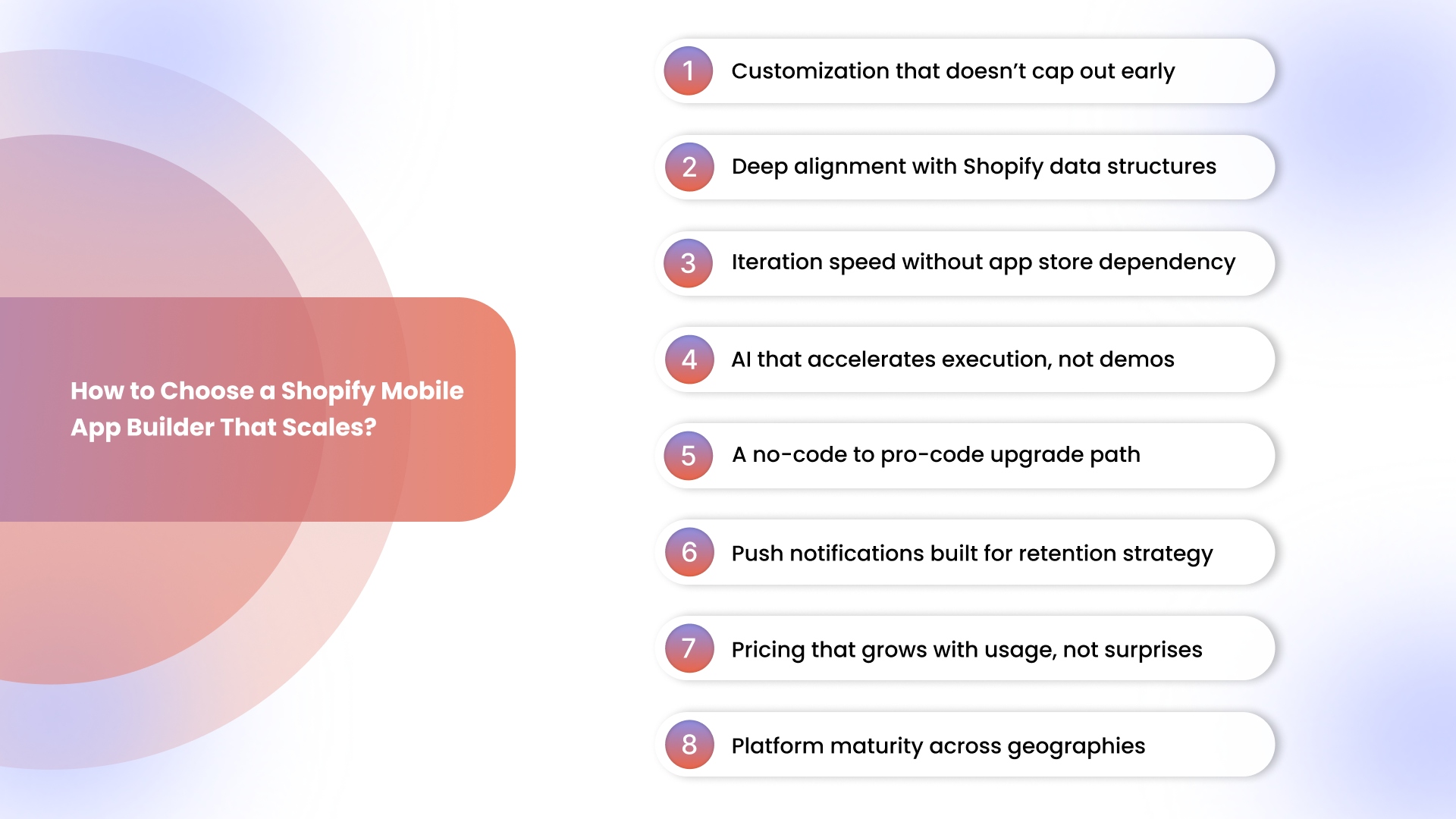
- Customization that doesn’t cap out early: Early-stage templates are fine, but growth demands layout logic, reusable components, and design control that doesn’t reset every time requirements change.
- Deep alignment with Shopify data structures: Builders that natively use tags, metafields, and customer attributes unlock more precise personalization than surface-level syncing.
- Iteration speed without app store dependency: The ability to update layouts, campaigns, or content in real time matters once weekly experiments become daily operations.
- AI that accelerates execution, not demos: Practical AI shows up in faster layout creation, content reuse, or campaign setup—not just dashboards or insights.
- A no-code to pro-code upgrade path: Even if development isn’t needed today, access to APIs, SDKs, or custom logic prevents platform migration later.
- Push notifications built for retention strategy: Segmentation, triggers, and conditional logic matter far more than unlimited sends.
- Pricing that grows with usage, not surprises: Transparent scaling avoids forced plan jumps when app adoption increases.
- Platform maturity across geographies: Multi-language, regional content handling, and localization support become critical once international traffic picks up.
These requirements are why some brands start evaluating platforms that combine visual builders with deeper control layers, something tools like Appmaker quietly account for as mobile complexity increases.
Wrapping Up
Choosing the right Shopify mobile app builder isn’t about launching faster—it’s about avoiding limits when your mobile channel starts driving real revenue. The strongest platforms are the ones that stay invisible in day-to-day execution while quietly supporting deeper personalization, faster iteration, and long-term scale.
This is where Appmaker fits naturally, by giving brands room to evolve from simple app launches to fully controlled, performance-driven mobile experiences without switching platforms later.
Book a demo to see how a scalable mobile app setup can support your Shopify growth beyond launch.
FAQs
1. How much does it cost to build a Shopify mobile app?
Shopify mobile apps typically cost between $200 and $1,000+ per month, depending on customization, integrations, analytics depth, and personalization features. Enterprise-grade setups scale pricing based on app revenue and advanced requirements.
2. Do I need coding skills to create a Shopify mobile app?
No. Most Shopify mobile apps can be built using no-code visual builders for layouts, content, and campaigns. Coding is only required if you need custom logic, APIs, or deeper backend integrations.
3. Can a mobile app really increase Shopify conversion rates?
Yes. Shopify mobile apps convert 2–3x higher than mobile websites due to faster load times, native checkout, push notifications, and personalized in-app experiences that reduce friction and cart abandonment.
4. How long does it take to launch a Shopify mobile app?
Most Shopify mobile apps can launch in 7–21 days, depending on design complexity and app store approvals. Platforms with real-time updates allow changes after launch without resubmitting to app stores.
5. What features matter most in a Shopify mobile app builder?
Key features include real-time Shopify sync, app personalization, segmented push notifications, flexible layout control, and revenue-focused analytics. Builders that support growth without forcing platform migration offer the best long-term value.