





















Key Takeaways
- John AI is an AI assistant inside AppMaker that automates a Shopify brand's entire push notification lifecycle using real-time store data.
- It writes personalised push copy on its own, inserting each customer's name, offer, and product through dynamic Shopify variables.
- Triggers notifications from real customer behaviour like cart abandonment and restocks, rather than sending generic blasts on a fixed schedule.
- It schedules every notification for the time window each customer segment is most likely to open and act on.
- Builds and runs lifecycle campaigns abandoned-cart recovery, welcome, and win-back flows automatically from your Shopify tags.
- Answers push, revenue, and campaign questions in plain English, replacing slow manual dashboard reporting with instant insights.
- Personalised, behaviour-triggered push outperforms generic blasts, letting a lean team run enterprise-grade lifecycle marketing without extra headcount.
Somewhere in your Shopify store right now, a shopper added a hoodie to their cart, got pulled into a meeting, and closed the app. In the manual world, that moment quietly becomes a lost sale because recovering it depends on a human noticing the abandoned cart, writing a message, guessing a send time, and hoping it lands before the shopper forgets your brand exists.
That entire chain is what John AI replaces. It reads the cart-abandonment signal the instant it happens, writes a personalised push notification, schedules it for the window that shopper is most likely to open, sends it, and then reports back on what it earned all inside the AppMaker dashboard, without your marketing team drafting a single line.
This guide breaks down exactly how John AI automates the full push notification lifecycle, shows what its notifications actually look like, and explains why, backed by the latest data from Omnisend, Airship, and Salesforce, behaviour-triggered push has quietly become one of the highest-return channels in ecommerce.
What is John AI?
John AI is an AI executive assistant built into the AppMaker platform that writes, schedules, and optimises push notifications, builds behaviour-triggered lifecycle flows (like abandoned-cart recovery, welcome series, and win-back campaigns), and answers analytics questions in plain English, all grounded in a brand's live Shopify data.
It's not a chatbot bolted onto a dashboard. John AI has direct access to your products, inventory, orders, customer tags, and campaign history, so every notification it drafts reflects current pricing and live stock, and every answer it gives is tied to your actual numbers.
What John AI Does, in One Line Each
- Writes push copy with dynamic variables (name, offer, product), optimised for open rate.
- Schedules sends for the window each segment is most likely to engage.
- Builds lifecycle flows: abandoned cart, welcome, win-back, restock off your Shopify tags.
- Creates quick assets like countdown banners and "buy more, save more" progress bars inside the app.
- Answers analytics questions: "What was my push revenue last month?" in seconds.
You can explore John AI here.
How John AI Differs From a Standard Push Tool
Most push tools are senders: you write the copy, pick the audience, choose the time, and hit go. John AI is an operator. Because it's wired into live Shopify data, it decides what to send, to whom, and when on its own and because it also handles analytics, it can spot an underperforming flow and tell you in plain language, rather than leaving you to find it in a report. The difference is between a tool you operate and an assistant that operates the channel for you.
How John AI Automates the Push Notification Lifecycle
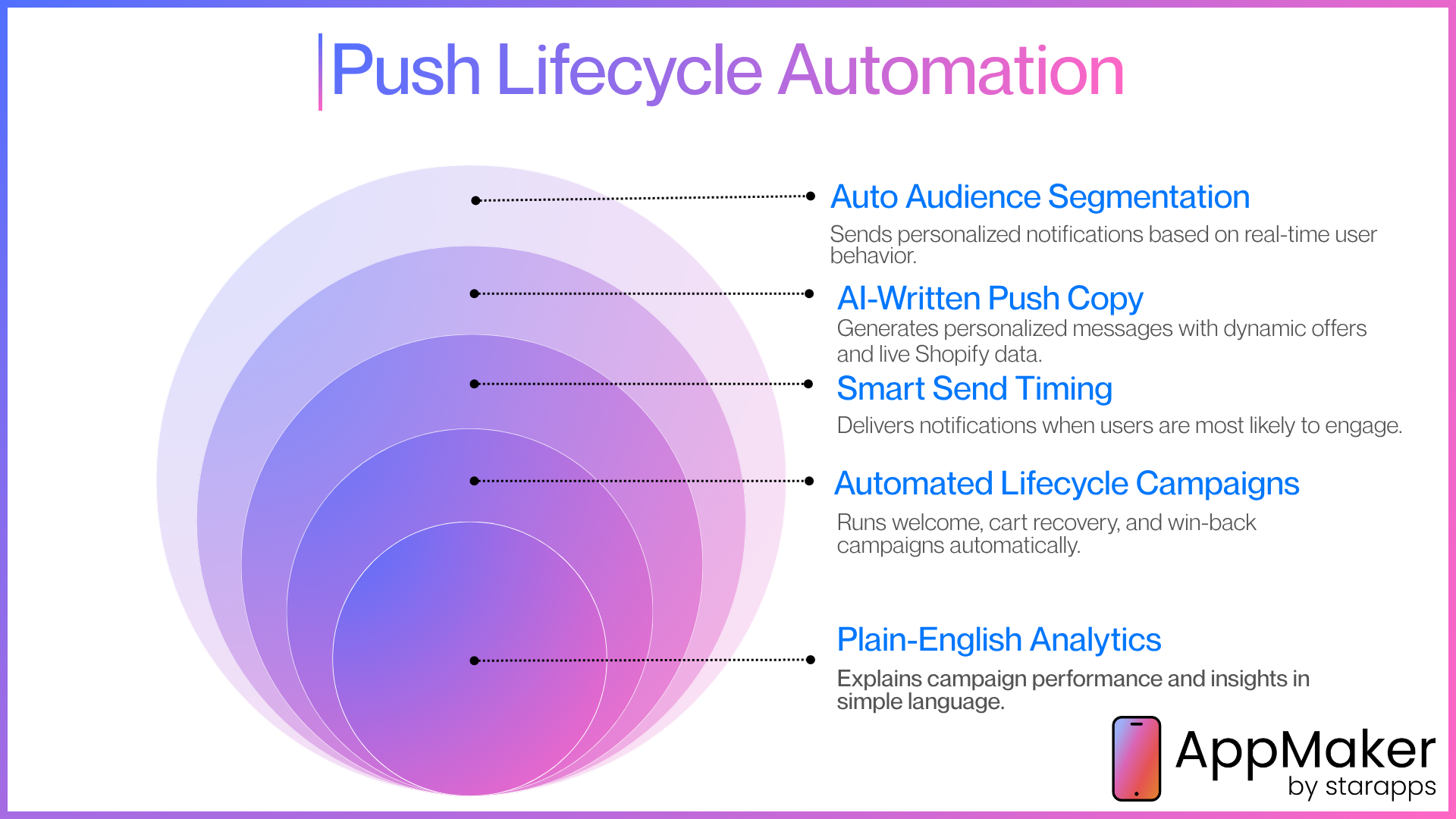
Push management has traditionally been five separate manual jobs stitched together across disconnected tools. John AI collapses them into one automated loop:
| Stage | The manual way | How John AI automates it |
|---|---|---|
| Trigger | A person notices a cart abandonment, restock, or lapse hours or days later | Reads live Shopify signals the instant they happen |
| Segment | Someone duplicates campaigns for each audience by hand | Routes each signal to the right segment using tags and behaviour |
| Write | A marketer drafts and approves copy for every send | Generates optimised copy with dynamic variables |
| Time | A send time is chosen on gut feel | Schedules for each segment's highest-engagement window |
| Measure | Reports take days to compile across tools | Surfaces performance and insights in plain language, on demand |
Here's what each stage looks like in practice.
1. It Segments and Targets Audiences Automatically
Generic, one-size-fits-all blasts are precisely the behaviour that drives users to the unsubscribe button. John AI uses AppMaker's conditional blocks and reusable logic to route new users, loyal repeat customers, and lapsed shoppers down entirely different notification paths without a marketer duplicating campaigns for each group.
The segmentation runs on live behavioural signals, not static rules. A shopper who just abandoned a cart gets a different message, at a different moment, than a loyal customer who hasn't opened the app in three weeks. Because personalised, targeted push produces nearly 7× the open rates of broadcasts, this segmentation isn't a nicety; it's the difference between converting and getting muted.
2. It Writes Push Copy with Dynamic Variables
Copywriting is usually the biggest bottleneck in a manual push strategy: someone has to find an angle, write the line, and get it approved for every campaign. John AI removes that bottleneck, generating optimised copy on request around dynamic variables that insert a customer's name, an active offer, or a specific product directly into the message with open-rate optimisation as an explicit goal, not an afterthought.
It also grounds every line in real-time Shopify sync, so copy reflects current pricing and live stock. That prevents the mismatched-offer problem of advertising a price or product that no longer exists that quietly erodes trust with every send.
3. It Optimises Send Times
Even great copy fails if it lands at 3 a.m. John AI folds send-time decisions into the same automated workflow, scheduling each notification for the window its segment is most likely to open rather than defaulting to one blanket time. This matters because engagement isn't evenly distributed: Airship found that simply A/B testing and optimising send time can lift reaction rates by around 40%. Capturing that lift by hand across thousands of users and multiple segments, updated continuously, isn't a task a team can do manually.
4. It Runs Lifecycle Campaigns on Autopilot
John AI's most durable value is lifecycle automation: the recurring flows that run in the background regardless of who's on the team that week. It builds abandoned-cart recovery, welcome series, and win-back campaigns directly off your Shopify tags and customer data, so they never have to be rebuilt or babysat.
A cart abandoned at 9 p.m. no longer waits for a human to notice it the next morning; John triggers the recovery sequence off the live signal itself. The priority is data-backed: in Omnisend's report, abandoned-cart and welcome messages drove 76% of all automation-generated orders, and back-in-stock automations posted the highest conversion rate (6.46%) of any automation type.
5. It Answers Analytics Questions in Plain English
Reporting has traditionally been as manual as copywriting: open a dashboard, filter by date, interpret the numbers. John AI collapses that into a question. Ask "Why did conversions dip last week?" or "Which campaign drove the highest LTV?" and you get an answer in seconds. Rather than presenting numbers and leaving interpretation to you, John AI surfaces engagement drops, underperforming flows, and emerging trends in plain language, turning analytics from a report that sits unread into a decision you can act on immediately.
What John AI-written Push Notifications Look Like
Good push copy is short, specific, and personal. A Localytics study found that notifications of 10 words or fewer earned nearly twice the click rate of longer ones, so John AI writes tight, dynamic messages built around live store data rather than generic filler. Here's the difference in practice (variables like {first_name} and {product} populate automatically from Shopify):
| Scenario | Generic blast | John AI (behavior-triggered + dynamic) |
|---|---|---|
| Abandoned cart | "You left something in your cart. Complete your order." | "{first_name}, your {product} is almost gone free shipping ends at midnight 🛒" |
| Back-in-stock | "Some items are back in stock!" | "{first_name}, the {product} you wanted is back limited stock 👟" |
| Win-back (lapsed) | "We miss you! Here's 10% off." | "{first_name}, your favourites restocked. Here's 15% to pick up where you left off" |
| Price drop | "Sale now on!" | "Good news the {product} on your wishlist just dropped to {price} 💸" |
The generic versions are guesses broadcast to everyone. The John AI versions are triggered by a specific action (an abandoned cart, a restock, a price change), addressed to a specific person, and reference a specific product, which is exactly what turns a lock-screen glance into a tap.
Why Push Notifications Decide Retention and Revenue
Before automation matters, it's worth being precise about why this channel carries so much weight. A push notification lands on the single most visible surface in mobile: the lock screen, with no inbox to compete with and no algorithmic feed to fight.
Push is now an Intent Channel, not a Broadcast Channel.
The most important shift, documented in Omnisend's 2026 ecommerce marketing report (27 billion emails, 321 million SMS, and 458 million push notifications across 150,000 brands in 2025), is that push has become a channel for shoppers who are ready to act. When Omnisend split automated push from scheduled campaigns, the gap was stark:
| Metric (2025) | What Omnisend found |
|---|---|
| Automated push click-to-conversion | 22.9% (up from 13.9% in 2024) |
| Automated vs. campaign push conversion | ~10× higher |
| Automated vs. campaign push ROI | ~7× higher |
| Automated vs. campaign push open rate | ~37% higher |
| Push message volume | +11% year over year |
Push is One of Your Strongest Retention Levers
Airship's benchmark research, drawn from billions of notifications, found that users who receive any push in their first 90 days retain at roughly 3× the rate of those who receive none and that 78% of users churn within the first week of installing an app when there's no clear engagement strategy. Airship's retail data showed opted-in users retained 40% longer on iOS and 90% longer on Android than opt-out audiences.
The Catch: the Channel is Easy to Burn
This is also the easiest channel to destroy. Sending 2–5 pushes per week is enough to push 40%+ of users to disable notifications entirely, and the average US smartphone user already receives around 46 push notifications a day. That tension huge upside, low tolerance for irrelevance is the exact problem automation exists to solve. Relevance and timing decide who taps and who mutes, and neither scales by hand.
Why Manual Push Notifications Break Down
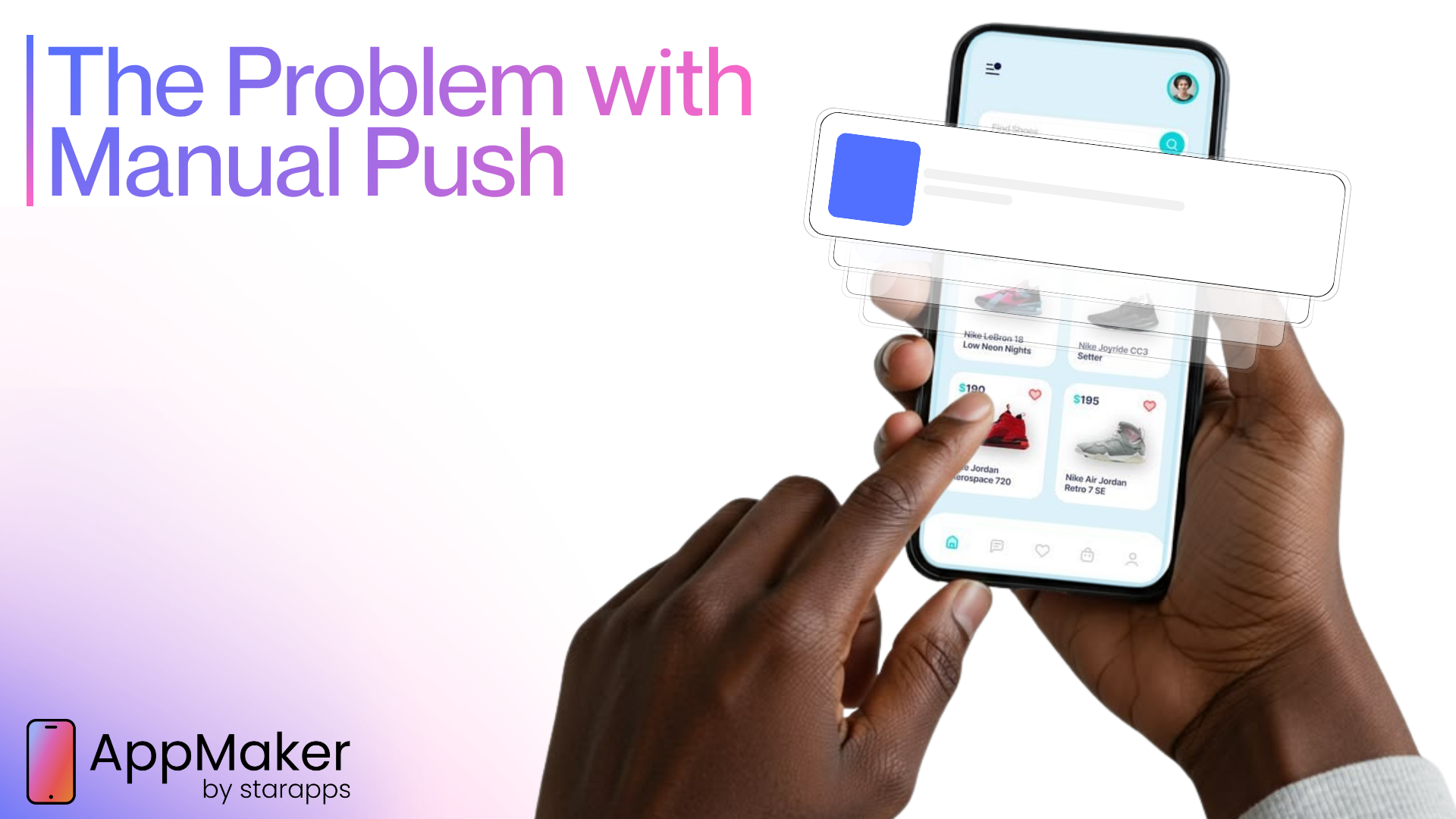
Ask most Shopify brand owners how push actually gets sent, and the honest answer is rarely flattering. Someone drafts copy in a doc. Someone else picks a send time by feel. Last month's performance takes days to pull because the data lives across three tools. Abandoned carts pile up, and by the time anyone retargets them, the moment of highest intent has passed.
This isn't a knowledge problem; teams understand push perfectly well. It's a coordination and speed problem. Customer behaviour moves in real time, and manual execution can't keep pace. The result is predictable: campaigns stuck in draft, reports that arrive too late to act on, and recovery flows that never fire. That's the exact gap an in-dashboard assistant is designed to close, which is why John AI lives inside AppMaker analytics, campaign drafting, and optimisation tied to the same store data rather than scattered across a stack of disconnected apps.
A Practical Walkthrough: John AI From Trigger to Send
Each capability sounds incremental on its own. Together, they replace an entire manual workflow:
- It reads the signal: John monitors live Shopify events: a cart abandonment, a restock on a wishlisted item, a customer crossing a purchase-frequency threshold that marks them "loyal."
- It routes to the right segment: A first-time visitor, a repeat buyer, and a lapsed customer each get a different notification path; no one manually builds three campaigns.
- It writes the copy: John drafts the message, inserting the customer's name, the relevant offer, or the specific product via dynamic variables, optimised for open rate.
- It sets the send time: The notification is scheduled for the window that the segment is most likely to engage, not one universal time.
- It measures and reports. After the send, John tracks performance, and if a flow starts underperforming, that surfaces as a plain-language insight instead of sitting buried in a report.
Trigger, segment, write, send, measure, refine running continuously, without a marketing team operating any single step.
Push Notification Mistakes John AI Helps You Avoid
Even well-intentioned push strategies fail in predictable ways, and automation targets each one directly:
- Sending on assumptions instead of behaviour. Notifications that feel random despite looking "personalised" come from guesswork. John grounds every message in live customer signals.
- Acting on stale product or inventory data. Advertising prices or availability that no longer match the store erodes trust. Real-time Shopify sync keeps every notification accurate to the moment it's sent.
- Over-sending. Notification fatigue drives a meaningful share of opt-outs; recall that just 2–5 messages a week can push 40%+ of users to disable push. Intelligent timing and segmentation avoid the blanket-blast approach that burns the channel.
The throughline: all three are symptoms of push running on static rules and manual guesswork instead of live data. For a deeper strategic breakdown, see AppMaker's guide to effective push notification strategies for 2026 and its comparison of the best mobile push notification services.
How to Get Started with John AI
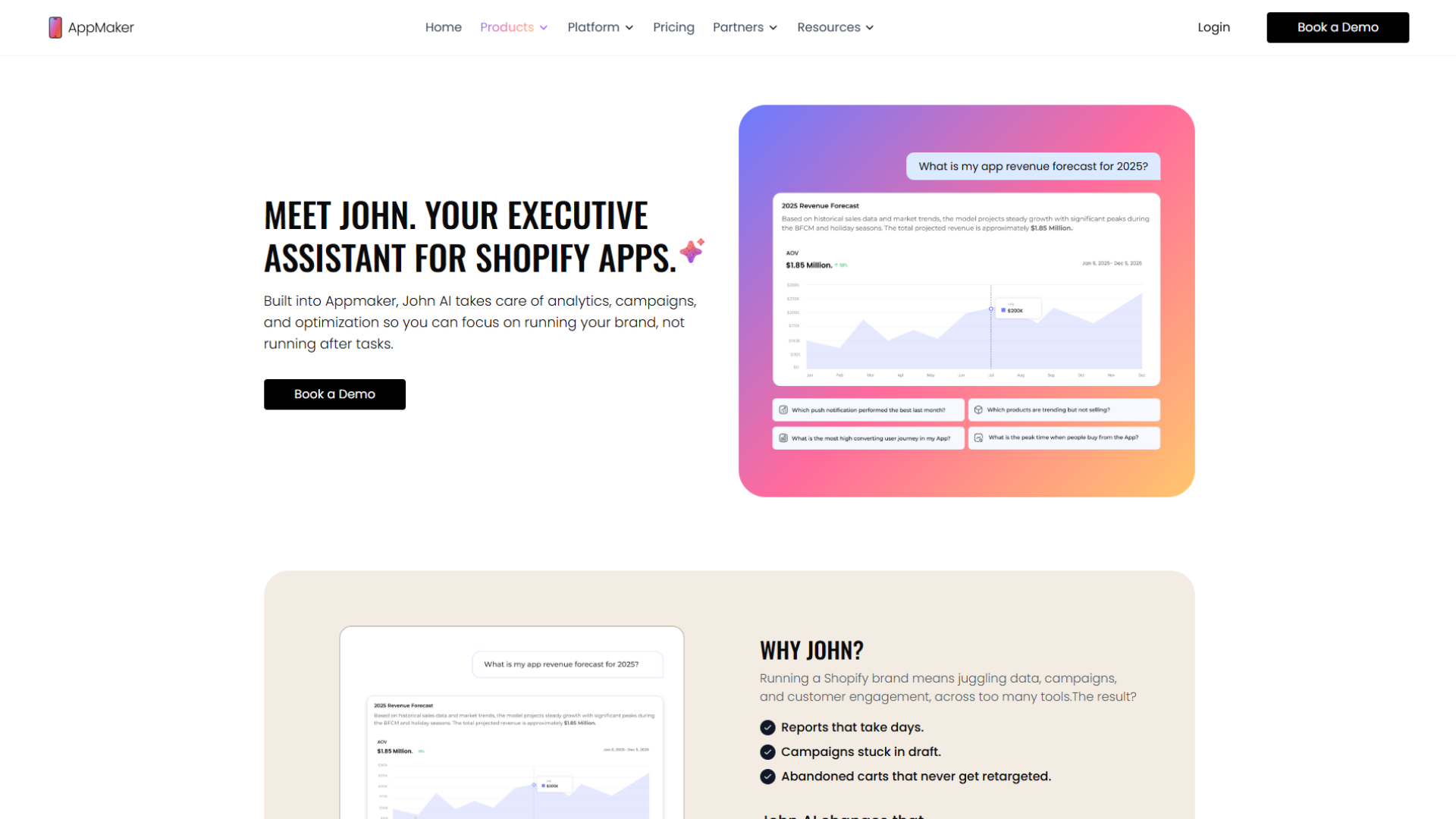
Because John AI is built into AppMaker rather than requiring separate integration work, getting to a working, automated push strategy is fast:
- Connect your Shopify store to AppMaker: Products, inventory, orders, and customer data sync in real time the foundation John draws on for every message.
- Let John build your core lifecycle flows: Point it at your existing tags, and it drafts abandoned-cart recovery, welcome, win-back, and restock campaigns for you.
- Review, tweak, and approve: Copy and timing come pre-drafted; you adjust tone and brand voice, then set them live.
- Ask John how it's performing: Instead of pulling reports, ask questions in plain language and let it flag what to refine.
Most brands get functioning automated flows running in days rather than the weeks a custom-built system would take. Book a John AI demo to see it against your own store data.
Where John AI Fits in AppMaker's Mobile Stack
Push automation only delivers its full value when it's connected to the rest of your mobile presence, which is exactly the position AppMaker occupies as a no-code mobile app platform built specifically for ecommerce and Shopify brands. Because notifications inside AppMaker are tightly connected to in-app behaviour and live store data, every message is highly actionable rather than a generic blast disconnected from what's happening in the store.
John AI sits inside that stack as the analytics-and-campaign layer, working alongside AppMaker's design and personalisation tools, including Eidolon AI, which turns Figma files or store screenshots into working app layouts in hours instead of weeks, so every part of the mobile experience stays responsive to real customer behaviour. For brands scaling from roughly $1 million to $10 million in revenue, this combination of no-code speed and AI-driven operations is what lets a small team run enterprise-grade lifecycle marketing without enterprise-sized headcount. (For the full picture, see AppMaker's ultimate guide to Shopify mobile app builders.)
The Bigger Picture: AI Adoption vs. The Personalisation Gap
The case for automating push isn't just an AppMaker story; it reflects where marketing as a whole is heading, and where it's stuck. Salesforce's tenth-edition State of Marketing report, based on a survey of 4,450 marketers, found that 75% of marketing organisations now use AI, yet 84% still admit to running generic campaigns, and 69% say they struggle to respond to customers promptly. The culprit isn't effort; it's usable, connected data. Siloed systems and poor data quality remain the top barriers to real personalisation.
That's the entire point of an assistant wired directly into your Shopify data. Push sits at the centre of this shift because it rewards exactly what automation does best: real-time reaction to behaviour, personalisation at a scale no human team can match by hand, and continuous optimisation rather than set-and-forget campaigns. Brands still writing and scheduling push manually aren't just working harder than they need to; they're competing against brands whose push strategy adjusts itself every hour of every day.
Frequently Asked Questions
What is John AI?
John AI is an AI executive assistant built into the AppMaker dashboard. It writes, schedules, and optimises push notifications; builds automated lifecycle flows like abandoned-cart recovery, welcome series, and win-back campaigns; and answers analytics questions in plain English, functioning as a full-time campaign and insights assistant for Shopify brands, grounded in live store data.
How does John AI personalise push notifications?
It inserts dynamic variables customer names, active offers, and specific products directly into notification copy, and routes different segments (new visitors, loyal customers, inactive users) down separate automated paths based on live behaviour rather than static rules. Personalisation matters because targeted push produces nearly 7× the open rates of generic broadcasts.
What kinds of push campaigns can John AI automate?
Behaviour-triggered lifecycle flows including abandoned-cart recovery, welcome series, win-back campaigns, and back-in-stock alerts, as well as promotional campaigns and product drops, all built off your Shopify tags and customer data.
Can John AI replace a full marketing team?
No, it's designed to extend a lean team's output, not replace strategic decision-making. John AI automates the repetitive, time-sensitive work (copywriting, scheduling, segmentation, reporting) so a small team can run always-on lifecycle marketing that would otherwise require dedicated headcount.
Do push notifications really get better engagement than email?
They land directly on the lock screen instead of competing inside an inbox, and behaviour-triggered push is now a top-converting channel: automated push reached a 22.9% click-to-conversion rate in 2025, roughly 10× the conversion rate of scheduled push blasts. The channels are complementary: email drives broad reach, while push and automation drive high-intent conversions per message.
Does automating push notifications increase the risk of users opting out?
It's the opposite when done correctly. Over-sending generic, poorly timed messages is what drives opt-outs; 2–5 messages a week can push 40%+ of users to disable push. AI-driven segmentation and send-time optimisation reduce irrelevant sends compared to manual, one-size-fits-all blasts.
How quickly can a Shopify brand set up John AI-driven push automation?
Because John AI is built directly into AppMaker rather than requiring separate integration work, brands can typically get functioning automated flows abandoned-cart recovery, welcome series, win-back campaigns running in days rather than the weeks a custom-built system would take.