



















Key Takeaways
- Personalized push notifications reach roughly 4x the reaction rate of untargeted broadcasts, and personalization can lift reaction rates by up to 400% compared to generic sends, but most of that gain comes from timing and triggers, not name insertion.
- Rich media beats plain text. Industry benchmarks put rich-media click-through improvement at around 2–3x over text-only, and Airship's analysis of 600 billion notifications found images can raise direct open rates by up to 56%.
- There is no universal "best time." The winning approach is behavior-triggered sends tied to what a user just did, not a fixed schedule.
- Most users tolerate one notification a day or fewer. Push past that and opt-outs climb quickly.
- Conversion, retention, and opt-out rate matter more than open rate. Open rate alone tells you almost nothing about whether a notification did its job.
Most push notifications get ignored, and the data shows why: they're generic, badly timed, or asking for attention they haven't earned. This guide breaks down exactly what separates a push notification that gets swiped away from one that gets tapped, read, and acted on, using benchmarks grounded in primary research from Airship, CleverTap, Omnisend, and Business of Apps rather than recycled marketing claims.
Why Most Push Notifications Fail to Convert
A push notification has roughly two seconds to justify its existence on someone's lock screen before it's swiped away. That's the entire pitch, and most brands waste it. The pattern behind almost every underperforming campaign is the same: the message ignores what the user was just doing, it lands at a moment they don't want to be interrupted, or it asks for a click without giving a clear reason to make it.
It helps to separate three metrics that get treated as interchangeable but aren't:
- Open rate measures whether the notification got noticed. A weak open rate usually points to a headline that didn't grab attention or a send buried among dozens of others.
- Click-through rate (CTR) measures whether the notification's promise was compelling enough to tap.
- Conversion rate measures whether the person who clicked completed the goal: a purchase, a signup, a return visit. A weak conversion rate usually signals a landing page that doesn't match the notification's promise, an offer that isn't compelling, or friction such as too many steps or slow load times.
Chasing open rate alone is a trap. A notification can be opened at a high rate and still convert nobody if the copy overpromises or the destination underdelivers. The metrics worth optimizing for in 2026 are conversion rate per notification, retention and repeat usage, and opt-out or mute rates, not raw opens.
The State of Push in 2026: What the Data Actually Says
Before you write a single word of copy, it's worth knowing the baseline you're working against.
Push remains one of the highest-reach owned channels available. The average U.S. smartphone user receives around 46 app push notifications per day, according to Business of Apps' benchmark research, which tells you exactly how much competition your message faces on the lock screen.
Adoption is accelerating on the web-push side specifically. Omnisend's analysis found brands sent over 413 million web push messages in 2024, up from 266 million the year before, roughly 55% growth year over year.
Opt-in behavior differs sharply by platform: Because Android historically enabled notifications by default while iOS requires explicit consent, Android opt-in rates run far higher than iOS. Airship's benchmark data has placed Android opt-in rates as high as the 80–95% range, with iOS typically hovering around 51%. That single design difference should shape how much effort you put into your opt-in prompt on each platform. (Note that Android 13+'s permission changes have pushed Android opt-in rates down in more recent reporting, so the gap is narrowing another reason to treat opt-in as something to actively earn rather than assume.)
Opted-in users are measurably more valuable: Airship research found customers who are opted-in to push make about 13% more purchases than non-opted-in customers, with top-performing apps seeing a purchase lift as high as 39%.
Over-sending is genuinely costly: Business of Apps reports that a single push notification per week leads roughly 10% of users to disable notifications and about 6% to uninstall the app a pattern that has stayed remarkably consistent for years.
For a deeper look at how these numbers translate into an actual send strategy, this AppMaker breakdown of push notification strategy walks through channel selection and behavioral triggers in more depth.
Anatomy of a High-Converting Push Notification

Every element in a push notification is doing a specific job, and none of them are decorative.
The Headline is the Whole Pitch
The headline is the only guaranteed real estate you get. If it doesn't communicate value in the first few words, nothing else matters, because the user has already decided to swipe. Shorter copy consistently wins: a Localytics study found that notifications with 10 or fewer words had nearly twice the click rate of those with 11–20 words and nearly 3x the click rate of those with more than 20 words.
The Body Copy Earns the Click, not the Open.
If the headline is the hook, the body line is the reason to act right now. It should carry exactly one idea. Trying to cram a discount, a deadline, and a product name into one line usually means none of them land. Notice the difference between a vague line like "check out today's deals" and a specific one like "your cart is waiting; 2 items are selling out fast." Treating the call to action as an invitation rather than a demand, and swapping generic phrasing for something specific, consistently changes how the message performs.
Rich Media is no Longer Optional.
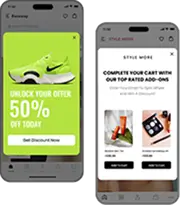
Text-only notifications increasingly compete with everything else in a crowded tray. Industry benchmarks put the CTR improvement from rich media (images, GIFs, video, action buttons) at around 2–3x versus plain text, and Airship's research across 600 billion notifications found that adding an image can raise direct open rates by up to 56%. Short-form video adds further lift in categories where it renders reliably. MoEngage has reported that clips under six seconds can raise CTR by around 41% over static images, though delivery consistency for video is still uneven across iOS and Android, so a high-quality static image remains the more reliable default for most campaigns.
The CTA and Deep Link Close the Loop
A generic "open app" button sends someone back to a homepage they have to re-navigate, which is exactly where conversions leak away. Deep links route the user straight to the specific page or screen the notification referenced, whether that's a cart, a product page, or an order tracker, reducing friction and improving the experience. Airship has found that push campaigns with CTA buttons can deliver meaningfully better results than those without, in part because each button can carry its own deep link.
Personalization: The Single Biggest Lever for Conversion
If one variable separates push notifications people act on from push notifications people mute, it's personalization and not just inserting a first name.
Personalization can increase push reaction rates by up to 400% compared to untargeted sends, a figure that traces back to Airship and Localytics research widely cited by Business of Apps. But the strongest gains rarely come from the copy itself. The strongest personalization is in the timing and the trigger. A notification sent shortly after someone abandons a cart consistently outperforms the identical message sent on a fixed daily schedule to everyone.
Real personalization draws on a few concrete signals:
- Browsing and purchase history: surfacing products related to what someone already viewed or bought, rather than a generic bestseller list.
- Lifecycle stage: new users, lapsed users, and power users respond to fundamentally different messages, so treating them identically wastes the channel's biggest advantage.
- Location: offers triggered by proximity to a store or pickup point.
- Live behavior: cart activity, repeated browsing of one category, or a lapsed session.
Airship's analysis of 50 billion notifications found that personalized notifications earn roughly 4x higher reaction rates, and that advanced targeting based on behavior, preferences, and location can lift retention by up to 3x.
This is also where generic blasts actively backfire, not just underperform. A notification promoting winter jackets right after someone browsed summer footwear doesn't just get ignored; it teaches the user that your notifications aren't worth reading, which quietly raises your opt-out rate over time. AppMaker's guide on personalized push notifications and use cases covers which behavioral signals to build triggers around for ecommerce specifically.
Timing and Frequency: When to Send, and How Often
Timing is the variable most brands guess at instead of test. There's no single "best hour" that applies universally; the right time depends on what your app does and how your users behave.
That said, the aggregate data shows some patterns worth testing against. Airship's reaction-rate benchmarks find engagement is generally lower in the morning and mid-afternoon and climbs toward the end of the day, with reaction rates running slightly higher on Tuesdays and Wednesdays. Context still matters more than the clock, though a meditation app might peak first thing in the morning while a food-delivery app spikes around mealtimes. Aligning send timing with those behavioral rhythms is what actually moves the needle.
Frequency is where the real risk lives. Around two-thirds of users prefer one push notification per day or fewer, and pushing past that threshold is where opt-outs start climbing fast, regardless of category. Airship data shows that 46% of users will opt out if they receive two to five messages in a single week, rising further with higher volume. On the other end, sending just one notification per week still prompts roughly 6% of users to uninstall if that single message misses the mark.
The safest approach for most new programs is to start conservatively; one to three notifications per week is a reasonable baseline, then use A/B testing to find the right frequency per segment, since high-engagement users can often tolerate more while dormant users need fewer, higher-value touches.
For app-specific guidance on balancing frequency with the delivery differences between Android and iOS, AppMaker's piece on using push notifications across web and mobile is worth reading alongside this section.
Copywriting Techniques That Actually Move the Needle

Write in the First Person and Active Voice
Push notifications that read like a message from a person, not a company, consistently perform better. Swapping "Brand X has free coins for you" for "I have free coins for you" makes the message feel like it's coming from someone rather than something. Active, direct phrasing is easier to process in the two seconds you have.
Lead with Curiosity or Urgency, not Both Diluted.
Curiosity-driven copy ("something new arrived based on your last order") and urgency-driven copy ("your coupon expires in 3 hours") both work, but they trigger different instincts, and stacking too many triggers into one line dilutes both. Pick one lane per notification rather than trying to combine them.
Use emojis, but sparingly.
Emojis are a legitimate visual cue in a crowded tray, not a gimmick, but there's a clear ceiling on how many help. CleverTap's analysis of 301 billion notifications found emojis raise CTR by around 9.6% (roughly 3.48% with emojis versus 2.74% without, about a 38% relative lift), while reaction rates rise about 20%. The gains flatten fast when messages are overloaded, so one or two relevant emojis outperform a string of them.
Match copy to Notification Type.
The same creative approach doesn't work for every message. A cart-abandonment reminder, a flash-sale alert, and a shipping update solve three completely different problems for the reader:
- Reminders and re-engagement recover sessions that would otherwise quietly disappear: an abandoned cart, an unfinished action, a feature never tried.
- Transactional updates build trust by keeping users informed on orders and deliveries, and reduce support queries as a side effect.
- Promotional sends should be the minority of your volume, not the majority, precisely because they're the ones most likely to get you muted.
AppMaker's roundup of 20 push notification examples that get clicked is a good reference if you want real copy mapped to each category before drafting your own.
A/B Testing: How to Know What's Actually Working
Guessing at what resonates is the slow way to improve a push program. Testing is the fast way, but only if it's structured correctly.
The core discipline is testing one variable at a time. If variant B differs from variant A in copy, emoji, and timing all at once, you can't attribute the result to anything specific. Beyond that single rule, a few practices separate a useful test from a wasted one:
- Run tests to completion: Set a minimum duration before starting, and only stop early if a variant is actively causing harm, like a spike in opt-outs.
- Avoid testing during unusual periods: A test run during a major sale reflects abnormal behavior and won't generalize to a standard weekday send.
- Match the metric to the goal: Re-engagement campaigns should be judged on CTR and time-to-interact; conversion campaigns should track conversion rate directly rather than using CTR as a proxy; frequency experiments should be judged on opt-out rate.
- Prioritize by business impact, not lift percentage alone: A 2% CTR lift on a low-volume segment is worth less than a 15% lift on your highest-value cohort, so weigh results against segment size and value.
What's worth testing: headline phrasing, CTA wording and placement, send time, frequency, and whether rich media helps or is unnecessary for a given segment.
Common Mistakes That Quietly Kill Conversion

Most of these are fixable without touching the copy at all:
- Sending checkout reminders after the order is already complete: A purely technical failure, but it signals the brand isn't paying attention, which erodes trust faster than an irrelevant promotion.
- Repeating the same discount message across multiple days: Repetition conditions users to stop reading; by the third identical send, even engaged users skim past it.
- Treating the opt-in prompt as an afterthought: On iOS, you get one shot at the system permission dialog, so using a "push primer" a custom in-app screen that explains the value before triggering the native prompt consistently lifts opt-in rates over triggering the system prompt cold.
- Ignoring opt-in friction on web push: PushPushGo's 2025 analysis found that moving to a single-click (one-step) opt-in drove over 600% growth in sign-ups versus a two-step flow. The tradeoff is real, though: two-step opt-ins produce a more intentional, lower-churn subscriber base, and browser changes in Chrome and Firefox can penalize prompts that aren't triggered by a user action, so test both against list size and list quality rather than assuming one is universally better.
- Sending on a fixed schedule instead of a behavioral trigger: A notification tied to a live action cart change, browsing pattern, inactivity will consistently beat the same message sent on a calendar basis to the same audience.
Push Notifications vs Email: Choosing the Right Channel for the Moment
Push and email aren't really competing channels; they're tools built for different moments. Web push subscribers are a high-intent audience, and it shows in the numbers: Omnisend's analysis found roughly 35% of people who click a promotional web push notification go on to make a purchase (a click-to-conversion rate), compared with only about 5–7% of people who click a promotional marketing email. Web push also lands the moment it's sent, whereas most email opens trickle in over hours.
The practical takeaway: use push for anything urgent, behavior-triggered, or tied to a specific moment cart abandonment, restock alerts, flash sales, shipping updates. Use email for anything that benefits from more space or a slower decision cycle: newsletters, detailed product education, win-back sequences with multiple touchpoints. The two channels compound when a customer's lifecycle stage determines which one leads, rather than firing the same message down both pipes at once.
Building This Into Your Stack With AppMaker
Everything above is a set of principles: behavioral triggers, segmentation, deep linking, disciplined testing. Executing it at scale across thousands of users is a different problem, and it's the one AppMaker's push notification tooling is built to solve for ecommerce and Shopify brands.
AppMaker's push notifications are tightly connected to real-time store data and in-app behavior rather than operating as a bolt-on marketing tool, which keeps them actionable, responding to live cart activity, product views, restocks, and inactivity rather than firing on a fixed calendar. As covered above, live-triggered messages consistently outperform scheduled blasts.
A few areas where AppMaker supports the practices in this guide:
- Behavior-based segmentation and triggers, so cart abandonment, price drops, and restock alerts fire automatically instead of requiring manual campaign builds for every scenario.
- Deep linking by default, so a CTA lands users on the exact cart or product page the notification referenced.
- AI-assisted workflows through AppMaker's built-in AI tooling, including Eidolon AI, which turns Figma files or screenshots into reusable app layouts, and John AI, a dashboard assistant for surfacing insights and refining campaigns.
- Real-time Shopify sync, so products, inventory, orders, and customer data flow directly into the app that notifications are built on.
If you're evaluating push tooling more broadly, AppMaker's comparison of the top mobile push notification services for 2026 is a useful reference point.
Frequently Asked Questions
How long should a push notification be?
Shorter is stronger. A Localytics study found notifications of 10 or fewer words had nearly twice the click rate of those with 11–20 words, and nearly triple the click rate of those over 20 words. As a general rule, if you can't communicate the value in one short sentence, the notification needs editing, not more room.
How many push notifications should I send per day?
Around two-thirds of users prefer one push notification per day or fewer, and sending more than one or two per day tends to push opt-out rates up quickly. News, social, and sports apps can often tolerate higher frequency because of the nature of the content, but for most brands one well-targeted send beats three generic ones.
What's the difference between open rate, CTR, and conversion rate?
Open rate measures whether the notification got noticed. Click-through rate measures whether the message was compelling enough to act on. Conversion rate measures whether that click turned into the outcome you wanted: a purchase, a signup, a completed action. A high open rate with a low conversion rate almost always points to a mismatch between what the notification promised and what the destination delivered.
Does personalization really make that big a difference?
Yes, and the effect is measurable rather than anecdotal. Personalization can increase push reaction rates by up to 400% compared to untargeted sends, and personalized notifications earn roughly 4x the reaction rate of generic ones. The biggest gains tend to come from behavioral triggers and timing rather than name insertion alone.
Should I use emojis in push notifications?
In moderation, yes. CleverTap's analysis of 301 billion notifications found emojis raise CTR by around 9.6% and reaction rates by about 20%, but the benefit flattens when messages are overloaded. Treat emojis as a visual accent, not a decoration to repeat in every send.
What's the single biggest mistake brands make with push notifications?
Sending the same message to everyone on a fixed schedule instead of triggering it off real user behavior. It undercuts personalization, timing, and relevance all at once, and it's usually the first thing worth fixing before touching copy or design.