
























Key Takeaways
- AI personalization in mobile shopping uses behavioural signals and machine learning to tailor discovery, search, offers, and messaging to each shopper in real time.
- McKinsey found fast-growing companies earn 40% more of their revenue from personalization than slower-growing peers, with typical revenue lifts of 5% to 15%.
- Mobile drives roughly 60% of global ecommerce sales but converts below desktop, so relevance is the lever that closes the gap.
- Personalized push notifications lift open rates by an average of 37%, and behaviour-triggered messages consistently beat scheduled broadcasts.
- Recommendations, semantic search, and behaviour-triggered messaging are proven today; fully autonomous, end-to-end personalization is still emerging.
- Gartner predicted 80% of marketers would abandon personalization by 2025 over weak ROI, so measurement and restraint matter as much as tooling.
- AI answer engines like ChatGPT and Google AI Overviews now shape discovery, making structured product data essential to being recommended at all.
Shoppers Expect The App To Remember Them
Shoppers do not open a retail app to browse a catalogue. They open it to pick up where they left off, and they expect the app to remember their size, their taste, and their last order. When it forgets, the session feels slow and generic, and they leave.
That expectation is not a soft preference. McKinsey's Next in Personalization research found that 71% of consumers expect companies to deliver personalized interactions, and 76% get frustrated when that does not happen. On mobile, meeting that expectation is harder than on desktop, for three reasons:
- The screen is smaller, so the first few items decide everything.
- Attention is shorter, and a mistimed prompt loses the shopper.
- Checkout asks more of a shopper on a phone than it ever did on a desktop.
Artificial intelligence (AI) is what makes personalization work at that scale. It reads behaviour as it happens, predicts what a shopper is likely to want next, and adjusts the experience without a merchandiser touching a template. This article explains how that works across the mobile journey, separates what the evidence proves from what vendors merely promise, and closes with a factual look at where a Shopify mobile app builder like AppMaker fits. Every figure links to its primary source, and where the data is contested, we say so.
What Is AI Personalization In Mobile Shopping?
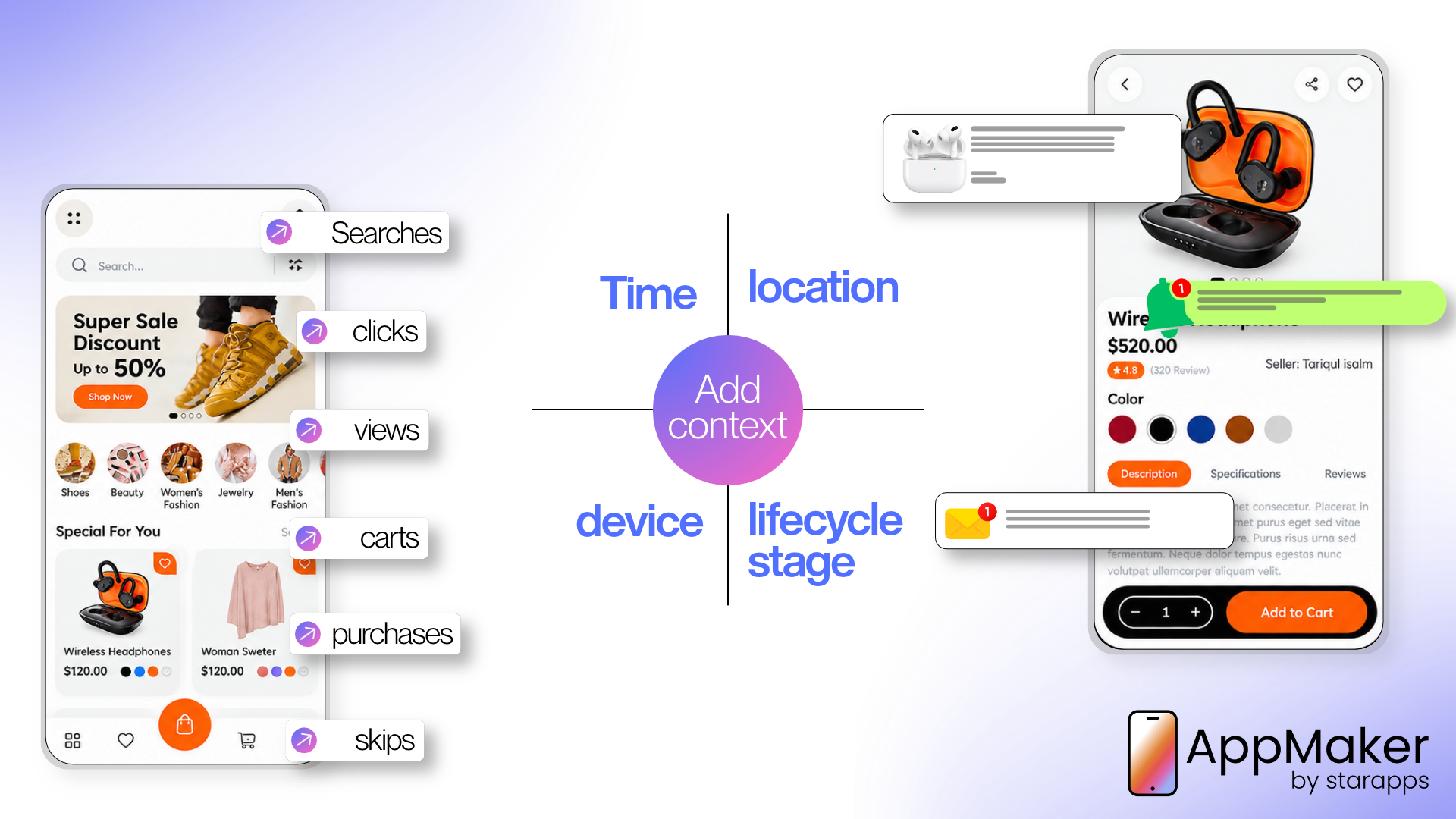
AI personalization in mobile shopping is the use of machine learning and behavioural data to tailor what each shopper sees inside a mobile app or site, in real time, at the level of the individual rather than a broad segment.
The mechanism is consistent, whatever the brand:
- Collect signals: What a shopper searches, taps, dwells on, adds to cart, buys, and ignores.
- Add context: Time of day, location, device, and lifecycle stage.
- Predict and serve: Models pick the next best product, offer, or message and deliver it automatically.
This is a step beyond the rules-based personalization most brands started with. A rule says "show raincoats to shoppers in wet regions." AI personalization learns that one specific shopper keeps returning to a particular coat, has not bought it, and responds to free-shipping nudges rather than discounts, then acts on that pattern.
Three ideas run under everything that follows: relevance (the shopper sees what fits them), timing (they see it when it matters), and consistency (the experience holds together across sessions and channels). Weak data undermines all three, which is why personalization is a data discipline before it is an AI feature.
Why Personalization Matters More On Mobile Than Desktop
Mobile now carries most shopping traffic but has historically struggled to convert it, and that gap is the core reason personalization matters more here than anywhere else.
- Mobile commerce accounts for roughly 60% of global ecommerce sales in 2026, up from 43% in 2018 (Statista).
- Mobile still converts below desktop in most benchmarks, around 1.8% to 2.8% versus desktop's 3.2% to 3.9%.
- The gap has narrowed as checkout and payment improved, and a few 2026 datasets show mobile pulling level, but the structural friction remains.
Personalization attacks that friction at its source. When the first screen a shopper sees is relevant, they reach checkout faster and with clearer intent. The financial case is documented in McKinsey's explainer on personalization:
- It can cut customer acquisition costs by as much as 50%.
- It typically lifts revenue by 5% to 15%.
- It raises marketing return on investment by 10% to 30%.
- Faster-growing companies draw 40% more of their revenue from it than slower-growing peers.
There is also a conversion advantage specific to apps, because an app gives personalization more to work with: persistent login, richer first-party signals, stored payment details, and a home-screen icon that keeps the brand present. AppMaker's own client data reflects this:
- Menswear brand XYXX reports a 5.3x higher conversion rate in its app than on mobile web.
- Pet care brand Supertails now takes 67% of its total orders through the app.
- Two Brothers Organic Farms attributes 50% of orders to the app.
These are single-brand outcomes, not industry averages, but they show what the app environment makes possible when personalization and retention tooling are used well.
How AI Personalizes Each Stage Of The Mobile Journey
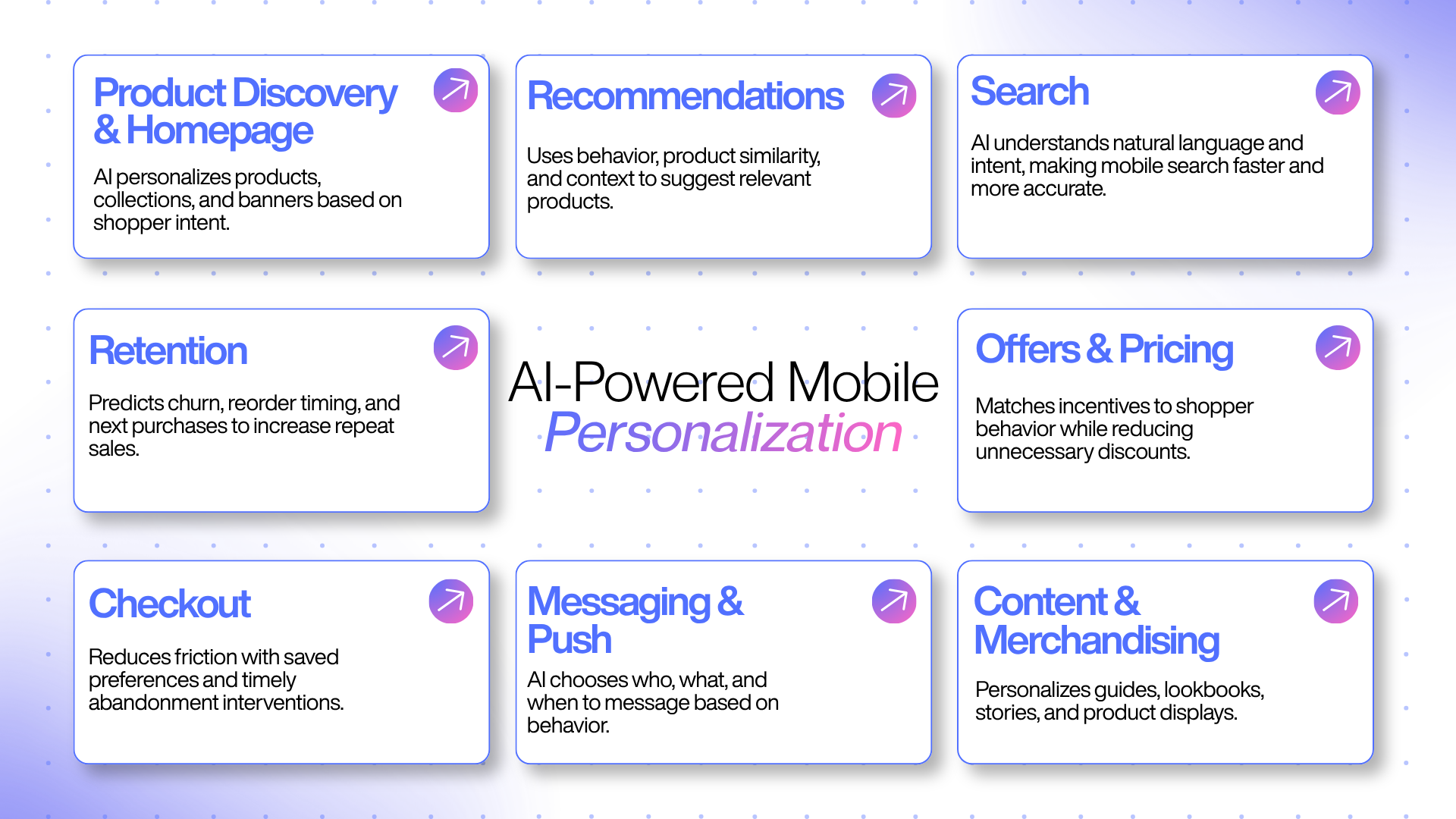
Personalization is not one feature. It is a set of techniques applied across the journey. Here is how AI works at each stage, what is proven, and where the honest limits sit.
Product discovery and the homepage
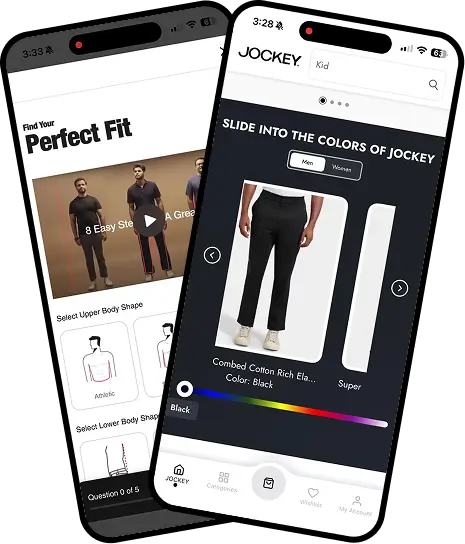
The homepage is the highest-leverage surface, because it is the first thing most shoppers see, and on a phone only a few products sit above the fold. AI reorders collections, banners, and featured products by predicted intent, so a returning skincare buyer and a first-time menswear browser see different homepages. The mobile stakes are higher than on desktop precisely because there is less room to get the first impression wrong.
Recommendations
Recommendation engines are the most mature and measurable form of AI personalization. They combine three signals:
- Collaborative filtering: shoppers like you also bought.
- Content-based signals: products similar to what you viewed.
- Context: time, location, and lifecycle stage.
Across multiple 2025 and 2026 analyses, personalized recommendations are credited with 26% to 31% of e-commerce revenue in sessions where shoppers engage with them. The often-quoted claim that recommendations drive 35% of Amazon's sales traces to McKinsey commentary on 2013 data and has never been confirmed by Amazon, so treat it as long-standing industry lore rather than a current fact. On mobile, good recommendations do real navigational work, because browsing to a product on a small screen is genuinely harder than clicking.
Search
Mobile search is where intent is clearest and where AI has changed the most. Modern AI-powered search reads natural language, forgives typos, and ranks by predicted relevance to the individual rather than keyword match. A shopper who types "warm jacket for rain" gets results based on meaning, not literal words.
- Algolia reports that customers adopting personalized search and discovery have seen conversion increase by up to 50%.
- The same source notes shoppers who use search convert at roughly 1.8 times the rate of those who do not.
For mobile, forgiving personalized search is often the line between a sale and a bounce, because a shopper who cannot find a product in two taps rarely attempts a third.
Offers and pricing
AI helps decide which offer to show which shopper, and when:
- A price-sensitive shopper who responds to free shipping gets a shipping incentive.
- A loyal repeat buyer gets early access to a drop rather than a discount that erodes margin.
This is offer personalization, not variable pricing of the same item shown at different prices to different people, which raises fairness and trust concerns that reputable brands avoid. Matching the type of incentive to the shopper is the more durable win, because it protects margin while still moving the sale.
Content and merchandising
Beyond products, AI personalizes the editorial layer: which lookbook, tutorial, or story a shopper sees. A beauty brand can surface routine guides to a shopper who engages with education and straight product grids to one who just wants to buy. Content-led categories such as beauty and fashion get the most from this, because the education itself becomes part of the merchandising.
Messaging and push notifications
This is where apps hold a structural advantage, because a push notification reaches the lock screen without paying for an ad or an email send. AI decides who to message, what to say, and when. The uplift is well measured:
- Tailoring messages to the individual is the single biggest driver of open rates, producing a 37% average increase (Airship, 2025 benchmarks).
- Rich notifications, with images or interactivity, open roughly 56% more often than plain text (Airship).
- In CleverTap's fintech data, highly segmented campaigns averaged a 16.3% open rate against 4.7% for untargeted ones, a useful illustration of how far contextual targeting moves the number.
Behaviour-triggered messages beat scheduled broadcasts consistently: a back-in-stock alert to someone who viewed a sold-out item, or a cart reminder timed to when that shopper usually browses. The catch is restraint. Over-messaging is the fastest way to lose the opt-in, and once a shopper mutes notifications, the channel is gone. AppMaker's own breakdown of push, email, and SMS is a useful starting point for weighing where each channel earns its place.
Checkout
Checkout is where the most revenue leaks, so reducing friction here compounds everything upstream. AI's role is split:
- Personalization: remembering preferred payment methods and defaulting to the right address.
- Prediction: flagging shoppers likely to abandon so a timely nudge can intervene.
The Baymard Institute aggregate of 50 studies puts the average documented cart abandonment rate at 70.22%, a figure that has barely moved in over a decade, which points to abandonment being structural rather than a defect in any one store. Its survey data also shows the leading fixable reason for abandonment is unexpected extra costs revealed late, cited by around 39% of US shoppers who abandoned for a non-browsing reason. No recommendation engine fixes a checkout that surprises people with fees. Personalization helps most at checkout by removing steps, not adding cleverness.
Retention and post-purchase
Personalization does not end at the sale. AI predicts which customers are likely to churn, when a consumable is due for reorder, and what a shopper is likely to buy next, then triggers the right lifecycle message. Post-purchase personalization, such as order tracking, replenishment reminders, and complementary suggestions, is where repeat-purchase economics are decided, and it is the stage where an app's persistent identity and push access pay off most.
Why Personalization Fails When It Fails
In late 2019, Gartner predicted that by 2025, 80% of marketers who had invested in personalization would abandon those efforts, citing weak return on investment and the difficulty of managing customer data. That was not an anti-personalization stance; it was a warning that tooling without discipline does not pay back. The failure modes it named are still the common ones today:
- Fragmented data: Signals are split across app, web, email, and point of sale, so no single view of the shopper exists.
- Tactics, not capability: Personalization is bolted on as a set of features rather than built around clear use cases.
- No control group: Programs run without a holdout, so lift is assumed rather than measured.
- Over-personalization: Relevance tips into feeling watched, and shoppers mute the channel or leave.
The fixes are equally practical:
- Consolidate your first-party data before you buy an engine.
- Start with the use cases that carry the clearest return, usually recommendations and cart recovery.
- Hold out a control group so you can prove the lift is real.
- Respect the opt-in, because message frequency is the fastest way to destroy the most valuable channel you own.
Established Capabilities Versus Emerging Possibilities
Separating what AI reliably does today from what vendors imply is coming protects you from over-investing in promises.
Established and proven today:
- Product recommendations blending collaborative, content-based, and contextual signals.
- Semantic and personalized search that handles natural language and typos.
- Segmented and behaviour-triggered push notifications and in-app messages.
- Dynamic homepage and content ordering based on behaviour.
- Predictive churn and reorder modelling for lifecycle marketing.
- AI-assisted analytics that answer plain-language questions about store performance.
Emerging and improving, but not yet mature:
- Fully autonomous personalization that optimises every touchpoint end to end with no human oversight.
- Agentic commerce, where AI assistants complete purchases inside chat interfaces. Google and OpenAI have both introduced in-chat checkout features, and this is moving fast.
- Generative, individualised creative produced live for each shopper at scale.
- Real-time cross-channel identity resolution that stitches every session into one accurate profile.
Build on the established layer first, because it returns measurable value now. Treat the emerging layer as a roadmap to watch, not a foundation to bet the year on.
How AI Search Is Changing Mobile Product Discovery
A shift in how shoppers find products at all now matters for personalization, because part of the discovery layer is moving outside your app or site.
Consumers increasingly begin with AI assistants. Adobe Digital Insights reported that in the first quarter of 2026, AI-driven referral traffic to US retail sites grew 393% year over year, and that AI-referred shoppers in March 2026 converted 42% better than non-AI traffic, a full reversal from a year earlier when the same channel converted 38% worse. The reason is pre-qualification: by the time an AI assistant hands a shopper to your store, they have already compared options and arrived with intent.
The evidence is not unanimous. An October 2025 working paper by Maximilian Kaiser and Christian Schulze (University of Hamburg and Frankfurt School of Finance & Management), which analysed 973 ecommerce sites over 12 months, found ChatGPT referrals converting below Google organic search and making up under 0.2% of ecommerce traffic. So the conversion advantage is real but strongest for considered purchases, and the channel is still small in absolute terms.
Either way, the implication for mobile brands is concrete: your product data now needs to be legible to machines, not just shoppers. Adobe found AI traffic converted better in categories with strong trust infrastructure such as clear return policies and deep reviews. Structured product markup, complete attributes, clean identifiers, and answer-friendly content increasingly decide whether AI answer engines surface your products at all. Personalization inside the app is only half the job; being discoverable by the assistant that recommends you is the other half.
Where AppMaker Fits: AI for Mobile Personalization
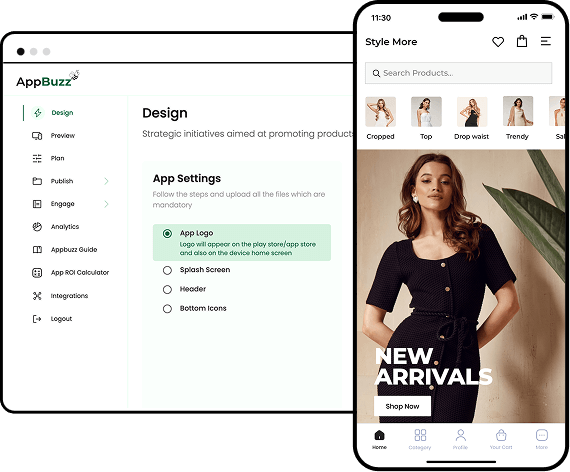
AppMaker (by StarApps) is a no-code Shopify mobile app builder that turns a Shopify store into a branded native iOS and Android app while keeping products, pricing, inventory, and customer data in real-time sync. Its relevance to personalization comes from a layered set of AI and rules-based tools rather than a single feature. Here is a factual account, keeping proven capabilities separate from what is still rolling out.
- Rubik's AI handles real-time, behaviour-based personalization, adjusting product feeds, banners, and recommendations for each shopper based on browsing patterns, clicks, and purchase behaviour. This is the engine tied most directly to the discovery and recommendation stages above.
- Conditional Blocks show different content or offers to different segments inside the same app using Shopify tags, metafields, and customer data, so VIP shoppers and first-time visitors see distinct layouts without building separate apps. This is rules-based personalization done cleanly, and it pairs naturally with the AI layer.
- Eidolon AI is a design engine that converts a Figma file or screenshot into an editable native layout, which shortens design-to-launch timelines. AppMaker currently labels it "Coming Soon," so it belongs in the emerging column and is design acceleration rather than shopper-facing personalization.
Alongside these, AppMaker's segmented and behaviour-triggered push notifications connect messaging to live in-app behaviour and real-time store data, which is where the personalization-versus-generic gaps documented by Airship and CleverTap become achievable in practice.
The results these tools support are visible in AppMaker's published client data:
- XYXX at 5.3x app-versus-mobile-web conversion.
- Supertails at 67% of orders through the app.
- The House of Rare at 45% of orders through the app.
These are individual brand outcomes shaped by each brand's catalogue, audience, and execution, not guarantees, and they should be read that way. The honest framing is that AppMaker provides the surface and the tooling to make the techniques in this article deployable for a Shopify brand without a custom build. It does not remove the need for clean product data, sound merchandising judgment, or a checkout that respects the shopper's time. AppMaker's guides on mobile app personalization and mobile commerce app development go deeper into the tactics.
Where To Start: A Practical Sequence
If you are a Shopify or ecommerce brand deciding where to begin, sequence matters more than ambition. This order front-loads the changes with the clearest returns.
- Consolidate your first-party data: One view of the shopper across app, web, and email is the precondition for everything else, and its absence is the top reason personalization stalls.
- Fix checkout friction: Show total costs early, offer express wallets, and collapse the flow. This protects revenue you already earn before you spend to win more.
- Turn on recommendations. They are the most mature, measurable lever and carry a documented revenue share.
- Personalize the homepage and search: These shape discovery for every session and compound with recommendations.
- Layer in behaviour-triggered messaging: Cart reminders, back-in-stock, and reorder nudges, kept restrained to protect the opt-in.
- Add predictive retention and post-purchase flows, where repeat-purchase economics are decided.
- Make your product data machine-legible with structured markup and complete attributes, so AI answer engines can find and recommend you.
Measure every step against a control group. Vendors quote generous averages, but your baseline, category, and audience decide your actual lift, so a holdout group is worth more than any benchmark.
The Bottom Line
AI personalization in mobile shopping is no longer speculative. The techniques that reliably move revenue, namely recommendations, personalized search, dynamic content, and behaviour-triggered messaging, are proven and measurable, and apps give them a stronger environment to work in than mobile web. The honest ceiling is lower than the loudest statistics suggest, the biggest wins often come from removing checkout friction rather than adding cleverness, and a large share of programs fail on data and discipline rather than technology.
For Shopify brands, the path is practical: unify your data, fix the leaks, turn on the proven levers in sequence, make your product data legible to both shoppers and AI answer engines, and measure everything against a control. A platform like AppMaker packages the surface and the tooling to make that deployable without a custom build, as its client results suggest, but the judgement, the data hygiene, and the respect for the shopper's time remain yours to bring.
Frequently Asked Questions
What is AI personalization in mobile shopping?
It is the use of machine learning and behavioural data to tailor what each shopper sees inside a mobile app or site (products, search results, offers, and messages) in real time and at the level of the individual, rather than showing everyone the same experience or relying only on broad segments.
Does personalization actually increase sales?
Within ranges, yes. McKinsey attributes typical revenue lifts of 5% to 15% to personalization and finds fast-growing companies earn 40% more of their revenue from it. But Gartner warned that many programs fail on weak ROI, so results depend on data quality, clear use cases, and measurement against a control, not on buying a tool.
Why do mobile apps personalize better than mobile websites?
Apps offer persistent login, richer first-party signals, stored payment details, and lock-screen push access, which give personalization more data and more moments to act. AppMaker client XYXX reports a 5.3x higher conversion rate in its app than on mobile web, though such figures are single-brand outcomes, not averages.
How do push notifications fit into personalization?
Push is the most direct personalized channel on mobile, because it reaches the shopper without an ad or email send. Airship's 2025 benchmarks found personalizing messages to individuals lifts open rates by 37% on average, and behaviour-triggered messages outperform scheduled broadcasts. The trade-off is restraint, since over-messaging destroys the opt-in.
Will AI eventually run personalization with no human input?
Not yet. Recommendations, personalized search, dynamic content, and triggered messaging are proven today. Fully autonomous, end-to-end personalization and agentic commerce (AI completing purchases inside chat) are emerging and improving quickly, but are not mature enough to build a strategy on.
How does AI search affect whether my products get found?
Shoppers increasingly discover products through AI assistants such as ChatGPT and Google AI Overviews. Adobe found AI-referred retail traffic converts well because those shoppers arrive pre-qualified. To be surfaced, your product data needs structured markup, complete attributes, clear pricing and availability, and trust signals like return policies and reviews.
Is personalized pricing the same as personalization?
No. Reputable personalization tailors which offers or content a shopper sees, not the price of an identical item shown to different people. Variable pricing of the same product raises fairness and trust concerns that most brands deliberately avoid; offer personalization matches the type of incentive to the shopper while keeping pricing consistent.
What is the biggest mistake brands make with AI personalization?
Treating it as a tool to switch on rather than a capability to build. The common failures are fragmented data, no control group to prove lift, and over-messaging that burns the opt-in. Fixing data and measurement first is what separates programs that pay back from the 80% Gartner expected to give up.