





















Key Takeaways
- Email is the ROI leader. ~$36 per $1 spent on average, ~$45 for retail and ecommerce (Litmus); Omnisend reports its own merchants on paid plans averaged $79 per $1 in 2025.
- Push is the efficiency leader. Automated push drove 21% of push orders from 3% of sends, and behaviour-triggered push automations hit a 22.9% conversion rate in 2025 (Omnisend). Shoppers who opt into push make ~13% more purchases than those who don't (Airship).
- SMS is the attention leader. SMS flows generate 45.2% of SMS revenue from 7.6% of sends, with flow click rates near 10% and top performers above 16% (Klaviyo), but it's the only channel with a hard carrier cost per message.
- The "98% SMS open rate" is real but misleading. It reflects how reliably a text is seen, not a tracked open the way email measures it. Compete on the click and the conversion.
- Automation beats blasts, everywhere. Roughly one in three people who click an automated message buy (Omnisend), and automated messages earn ~16x more revenue per send than scheduled campaigns.
- Layering wins. Three-plus channels = 494% higher order rate vs. single-channel; campaigns including push saw a 614% higher order rate (Omnisend).
- The channel mix works best inside an app, the one place push and behaviour-triggered email and SMS all fire off the same real-time signals the Gap AppMaker is built to close for Shopify brands.
Quick Answer
Push notifications, email, and SMS each win on a different axis. Email delivers the highest documented ROI, roughly $36 back for every $1 spent (Litmus), rising to about $45 in retail and ecommerce. Push notifications are the most efficient per send in Omnisend's ecommerce data; automated pushes generated 21% of all push orders from just 3% of push sends. SMS commands the most attention and urgency. Klaviyo shows SMS flows drive 45.2% of all SMS revenue from only 7.6% of sends, though it carries a real per-message cost.
Every e-commerce brand hits the same fork in the road. You have three ways to reach a customer directly on their phone: push notifications, email, and SMS, and a finite budget and attention span to spend across them. Pick the wrong mix, and you don't just waste money; you quietly cap how much revenue your owned channels can ever produce.
The internet is full of "SMS has a 98% open rate, so switch everything to SMS" takes. That's the kind of shortcut that costs brands money. The honest answer is more useful, and it's what this guide is built around: each channel wins a different moment in the customer journey, and the brands that grow fastest assign each one to its strongest job instead of crowning a single winner.
Below, every number is pulled from primary research Klaviyo, Omnisend, Litmus, and Airship benchmark reports built on billions of messages, not recycled vendor claims. Where a popular stat gets oversold, we say so.
What's the Difference Between Push, Email, and SMS Marketing?
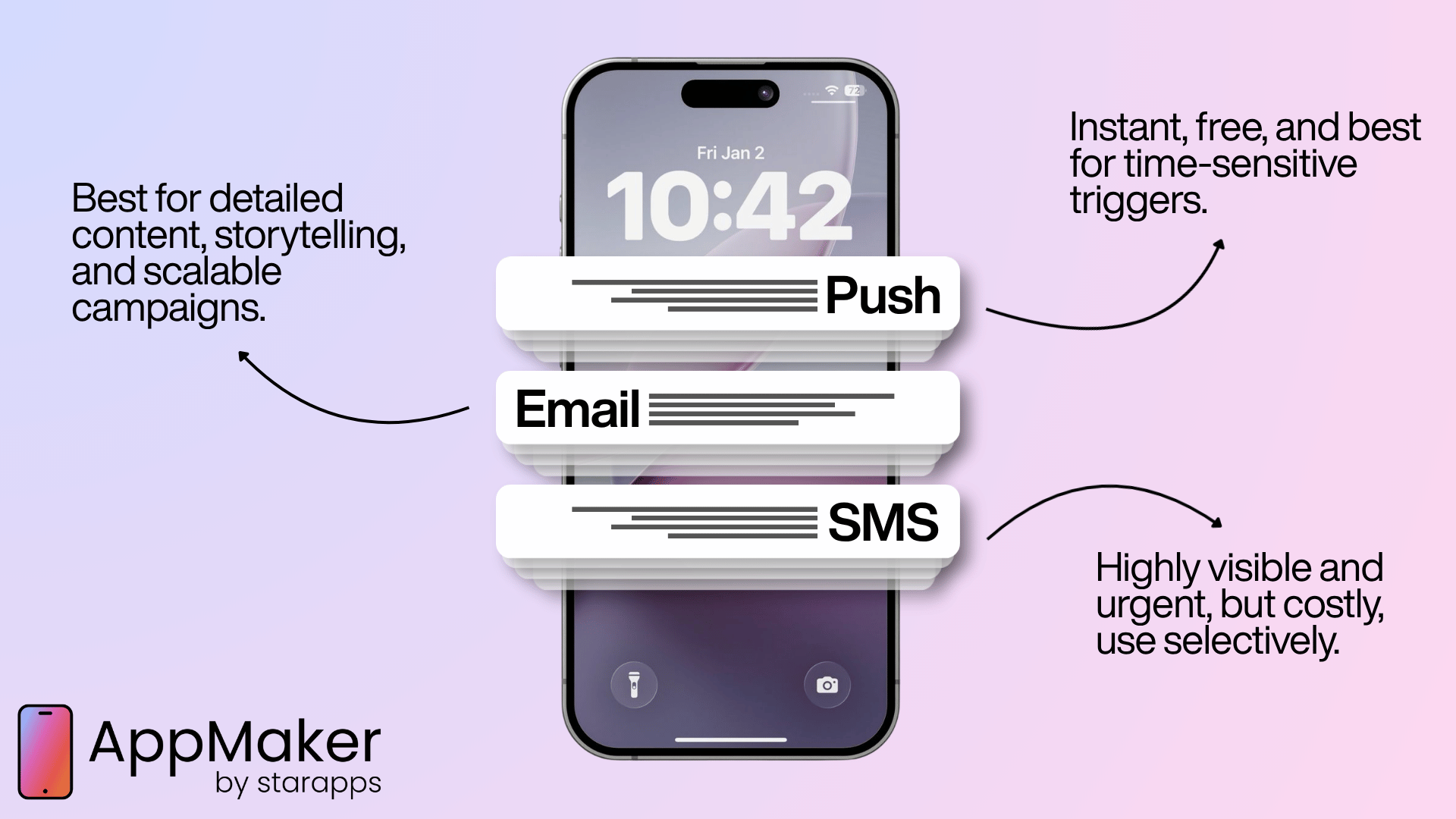
Before comparing revenue, it helps to be precise about mechanics, because the numbers only make sense once you understand what each channel is for. Treating them as interchangeable "message sends" is the root of most wasted spend.
Push notifications are the instant, free nudge: A push notification lands directly on a customer's lock screen or in-app without needing an inbox. Delivery is near-instant, and the marginal cost is effectively zero, which makes push the natural home for time-sensitive triggers: restock alerts, price drops, flash sales, and cart reminders. Push exists to reach a self-selected, high-intent audience the moment something changes. It is a poor fit for anything that needs storytelling; nobody reads a five-part product-education series on a lock screen.
Email is the full-context channel: Email is the only one of the three with room for a real narrative: onboarding sequences, seasonal campaigns, loyalty storytelling, and detailed offers. It is slower to act on than push or SMS, but it's the channel customers expect detailed, revisitable information to arrive through and, crucially, it's cheap enough to send at scale.
SMS is the channel people actually read: Because text messages historically came from people you know, brand SMS still carries an outsized sense of urgency and trust. That's exactly why its engagement runs so far ahead of the other two and exactly why overusing it burns customer goodwill faster than any other channel. Every text also costs you money to send.
Hold those three jobs in mind. They explain every benchmark that follows.
Email Marketing ROI: The Highest Return of Any Channel
Email produces the highest documented return on investment of any direct channel, around $36 for every $1 spent, and roughly $45 in retail and ecommerce because it costs almost nothing to send and scales to your entire list. Its weakness is speed and, increasingly, measurement.
Email's ROI is the most-cited number in marketing for a reason. Litmus's State of Email research puts the average return at about $36 per $1 spent, with retail, ecommerce, and consumer goods near the top of the range at roughly $45 per $1. Returns vary widely by how mature your program is; the figure is a ceiling for well-run programs, not a floor, but even conservative estimates leave email ahead of paid search and social on pure efficiency. For an ecommerce-specific read, Omnisend reports its own merchants on paid plans averaged $79 per $1 in 2025.
The other half of email's story is automation. In Omnisend's 2025 data, automated emails drove 37% of all email-generated sales while making up just 2% of email volume an efficiency gap that tells you exactly where to spend your time. Behaviour-triggered flows (welcome, abandoned cart, browse abandonment, back-in-stock) do the heavy lifting; the promotional blast calendar does far less than most teams assume.
How Apple's Mail Privacy Protection Broke Email Open Rates
Here's where email measurement broke. Apple Mail now accounts for roughly half of all tracked email opens, about 49% as of January 2025 (per Litmus data), and Apple's Mail Privacy Protection auto-fires the tracking pixel on Apple's servers before a human ever sees the message. The result is that reported open rates are inflated and, for strategic decisions, close to meaningless.
The fix isn't to panic; it's to move your yardstick downstream. Serious teams now judge email on clicks, conversions, and revenue per send actions Apple can't fake on a subscriber's behalf. If you're still A/B testing subject lines on open rate, you're testing noise.
Where email wins: onboarding and welcome journeys, product education, seasonal and loyalty storytelling, and any offer that needs room to explain itself. Where it falls short: speed. Email click-through sits around 1–2% in ecommerce (Omnisend), nowhere near push's or SMS's engagement in a time-sensitive moment.
Push Notification ROI: The Most Efficient Channel Per Send
Push notifications generate more revenue per send than any other channel because they reach a self-selected, high-intent audience instantly and for free. They're unbeatable for time-sensitive nudges and near-useless for anything that needs context.
Push punches far above its weight. In Omnisend's ecommerce benchmarks, automated push notifications generated 21% of all push orders from just 3% of push sends, the highest revenue-to-volume ratio of the three channels, and automated push converted 500% better than one-off push campaigns. In its most recent 2026 report (built on 458 million push notifications), behaviour-triggered push automations hit a 22.9% conversion rate, and push volume grew 11% year over year as more brands caught on.
The retention math is where push quietly changes a brand's unit economics. Airship's benchmark research shows shoppers who opt into push make about 13% more purchases than those who don't, and top-performing apps see a purchase lift as high as 39%. In a separate Airship study of 63 million users across 1,500 apps, retention was nearly 3x higher for people who received at least one push in their first 90 days versus those who received none.
For ecommerce and retail specifically, Pushwoosh's 2025 benchmarks put push click-through around 3–3.8%, comfortably above the cross-industry average, with opt-in rates near 68%. Opt-in is the lever that matters most: Airship data compiled by Business of Apps puts median push opt-in at roughly 81% on Android and 51% on iOS, the gap reflecting that iOS requires explicit consent.
Where push wins: flash sales, limited drops, back-in-stock and price-drop alerts, cart recovery, and win-back nudges anything that's time-sensitive and low-effort to act on. Where it doesn't: storytelling, education, or any message that needs more than a sentence. And push only works if customers keep the app installed, which is a retention problem in its own right (more on that below).
SMS Marketing: The Highest Engagement and Conversion Rates
SMS wins on raw attention and urgency: almost every text is seen, and its flows convert at high rates, but it carries a per-message carrier cost and fatigues faster than any other channel, so it should be reserved for high-value, time-bound moments.
If email wins on ROI and push wins on efficiency, SMS wins on attention. You'll see "90–98% open rates" quoted everywhere, and it's directionally true, but be precise about what it means. That figure reflects how reliably a text is delivered and seen, not a tracked "open" the way email fires a pixel. The honest takeaway: assume almost everyone sees your text, then compete on the click and the conversion.
And on clicks and conversions, SMS is genuinely strong. Klaviyo's 2026 SMS benchmarks, built on billions of texts, show SMS flows account for just 7.6% of sends but drive 45.2% of all SMS revenue, with flow click rates near 10% on average and top performers above 16%. Nearly two-thirds (64.4%) of SMS flow revenue comes from brand-new buyers, which makes SMS unusually good at first-purchase acceleration. Klaviyo also found average revenue per recipient for SMS campaigns edged slightly ahead of email across ecommerce in 2024; one text is often worth more than one email, before you account for cost.
That cost is the catch. SMS is the only channel with a hard per-message carrier fee, and it's the fastest to trigger opt-outs. In Klaviyo and Recharge's 2024 consumer research, 61% of people who unsubscribe from brand texts do so because they're getting too many SMS. The discipline that protects both budget and list health is simple: reserve SMS for cart recovery, VIP and early-access offers, and genuinely time-bound incentives, never routine updates.
Where SMS wins: abandoned-cart recovery, VIP and loyalty offers, early access, and urgent, high-value moments. Where it falls short: high-frequency, low-value messaging, where the cost and unsubscribe risk outweigh the return.
Push vs Email vs SMS: Benchmark Comparison Table
No single row crowns a winner; that's the point. Read this as "different tool, different job."
| Push notifications | SMS | ||
|---|---|---|---|
| Reach mechanic | Lock screen / in-app, opted-in users | Inbox | Text message |
| How reliably it's seen | Reaction/CTR ~3–3.8% in ecommerce (Pushwoosh) | ~27% reported open, inflated by Apple MPP (Litmus) | ~90%+ delivered/seen (not a tracked "open") |
| Click-through | ~3–3.8% ecommerce (Pushwoosh) | ~1–2% (Omnisend) | Flows ~10%, top >16% (Klaviyo) |
| Cost per send | Effectively free | Very low | Per-message carrier cost |
| Efficiency signal | 21% of push orders from 3% of sends (Omnisend) | Automations: 2% of sends → 37% of email sales (Omnisend) | Flows: 7.6% of sends → 45.2% of SMS revenue (Klaviyo) |
| ROI headline | High per-send; automation conv. 22.9% (Omnisend) | ~$36/$1 avg; ~$45 ecommerce (Litmus); $79 Omnisend paid (Omnisend) | High conversion, higher unit cost |
| Best for | Time-sensitive, low-effort nudges | Storytelling, nurture, full context | High-intent, high-value, urgent moments |
Benchmarks reflect ecommerce/retail where specified. "Open rate" is measured differently across channels and isn't directly comparable; treat it as a signal of reach, not engagement.
When to Use Push vs Email vs SMS (by Journey Stage)
Match the channel to the customer's intent and the message's complexity. Push wins moments that are time-sensitive and simple to act on; SMS wins moments that need urgency and personal weight; email wins moments that need room to explain something. Most high-value moments deserve a sequence across channels, not a single send.
| Moment in the journey | Lead channel | Why |
|---|---|---|
| Flash sale / limited drop | Push | Instant, free, reaches opted-in high-intent shoppers the second it goes live |
| Back-in-stock / price drop | Push (+ SMS for VIPs) | Real-time trigger; the alert is the value |
| Abandoned cart | SMS → push → email in sequence | SMS carries the urgency; push and email backstop it over hours |
| Welcome / onboarding | Email (+ a welcome push) | Room to tell the brand story and set expectations |
| Product education/nurture | Needs length, images, and a revisitable format | |
| Seasonal / loyalty storytelling | Narrative and design do the selling | |
| Early access / VIP offer | SMS | Personal weight and immediacy signal exclusivity |
| Win-back / re-engagement | Push + email (SMS for high-value lapsed) | Low-cost reach first; reserve paid SMS for your best lapsed customers |
| Order/shipping updates | Transactional (customer's preferred channel) | Utility, not marketing; match their expectation |
The pattern is consistent. When the moment is urgent, and the action is one tap, push and SMS win. When the moment needs context, email wins. And your highest-value triggers cart recovery above all shouldn't pick one channel at all.
Common Push, Email, and SMS Mistakes That Cost Revenue
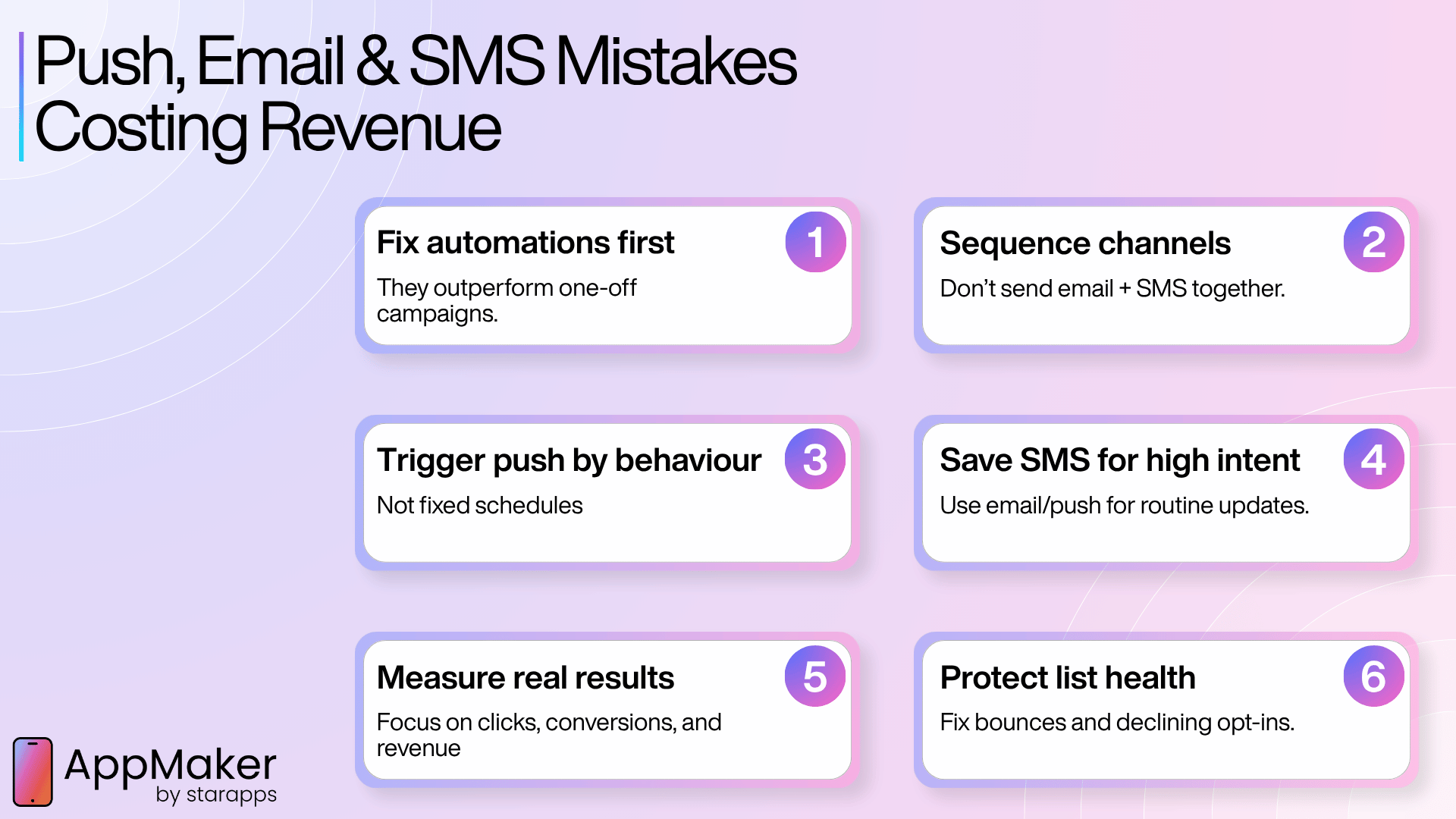
- Comparing campaigns to automations as if they're equal: They aren't. Behaviour-triggered flows out-earn one-off blasts on every channel, by wide margins. If you only have budget to fix one thing, fix your automations first.
- Duplicating the same message across email and SMS at the same time: It doubles your cost, adds nothing, and accelerates opt-outs from both channels. Sequence instead: let each channel play its role in a timed flow.
- Sending push on a blast schedule instead of on behaviour: The complaint about push is almost always timing, not frequency. Trigger it off what the customer just did, not a generic Tuesday 10 am cadence.
- Using SMS for low-value, high-frequency updates: SMS is your most expensive and most trusted channel. Spend it on high-intent, high-value moments; anything routine belongs on push or email.
- Still measuring email on open rate: Post-MPP, opens are inflated. Judge email on clicks, conversions, and revenue per send.
- Ignoring deliverability and list health: A rising bounce rate or falling opt-in rate is a list problem, not a subject-line problem. No creative fix repairs an unhealthy list.
Do You Need a Mobile App to Run Push, Email, and SMS?
A native mobile app is the one environment where push and behaviour-triggered email and SMS can all fire off the same real-time in-app signals, which is what makes coordinated, well-timed messaging actually possible instead of theoretical.
Most brands run push, email, and SMS through three disconnected tools. That's exactly why messages overlap, timing drifts, and customers feel spammed. The channel data above assumes you can trigger the right message, on the right channel, at the moment a customer acts, and on the mobile web, you mostly can't, especially for push, which iOS still restricts heavily in the browser.
The mobile web is also where the conversion math works against you. Contentsquare's 2026 Digital Experience Benchmark, built on 99 billion sessions, measured mobile web conversion at 2.03% versus 3.81% on desktop. The mobile web pulls in most of your traffic and converts it at roughly half the rate. A native app closes that gap: real brand data compiled by MobiLoud shows app shoppers converting several times higher than mobile web (one fashion brand saw 2.6% in-app vs. 0.2% on mobile web), with average order values running higher too.
And apps grow total spend, not just app spend. A peer-reviewed study by Narang and Shankar in Marketing Science (2019), using a difference-in-differences design on real customer data, found that app adoption raised customer spending by 37% and purchase frequency by 33%, the lift showing up across both online and offline channels.
To be fair about it, an app isn't automatically right for every store. If you're pre-revenue with little mobile traffic, optimise the mobile web first and validate demand before investing. But for brands with meaningful mobile traffic and repeat purchases (typically $1M+ in sales), an app is what turns a coordinated push-email-SMS strategy from a slide deck into a running system.
How AppMaker Brings These Three Channels Together
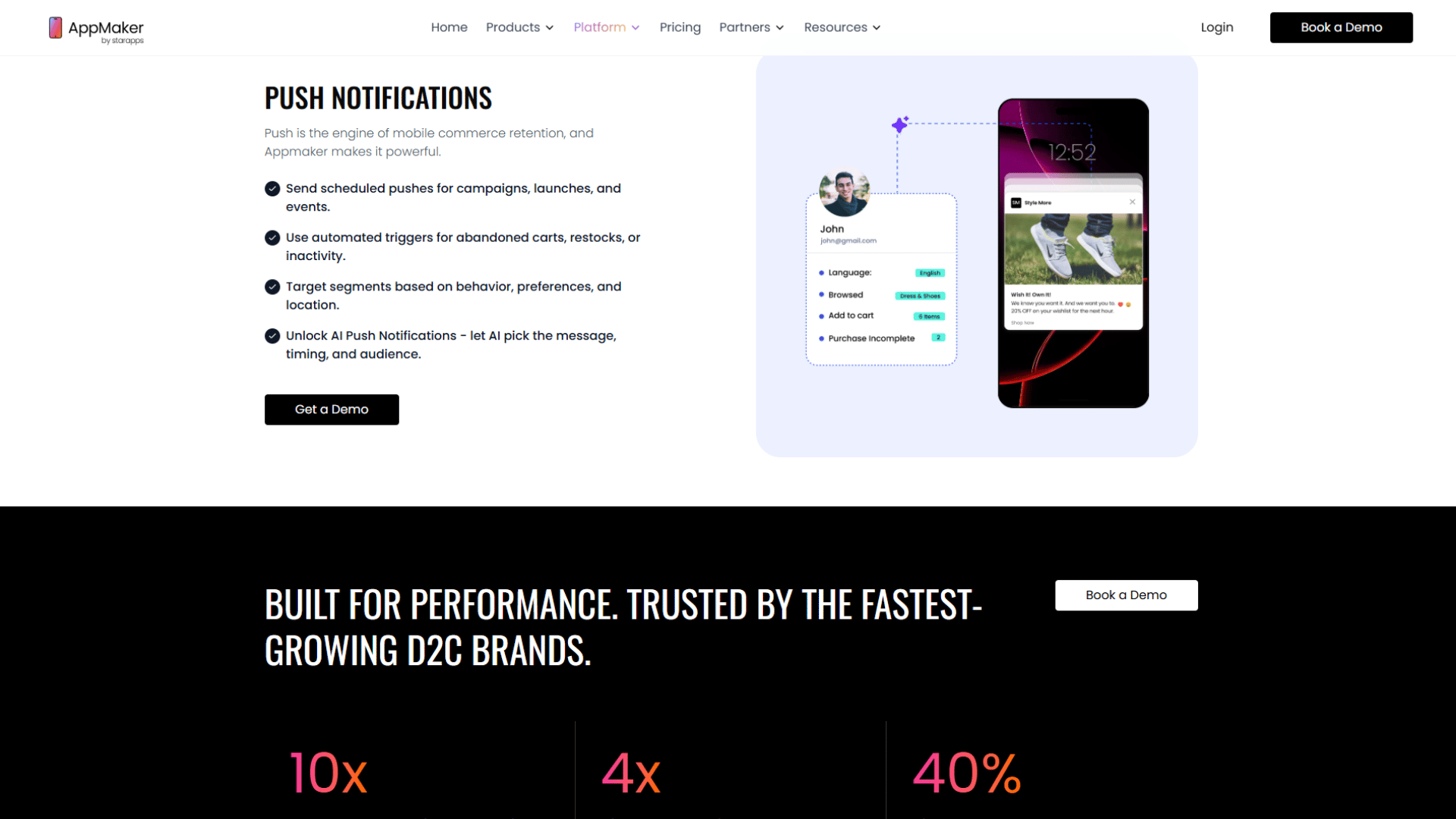
Most brands run push, email, and SMS through three disconnected tools, which is exactly why messages overlap, and customers feel spammed. AppMaker was built to close that gap for ecommerce brands moving from web to mobile app: unlimited push notifications sent from a single dashboard, triggered by real user behaviour inside the app, and timed to the exact moment a customer is most likely to act, not a generic blast schedule.
AppMaker's push notifications are wired to real in-app behaviour and live store data, so a restock, a price drop, or an abandoned cart can fire the right message at the exact moment a customer is most likely to act, not on a generic schedule. Its Conditional Blocks personalise the app itself using Shopify tags and metafields (a VIP, a first-timer, and a wholesale buyer each see a tailored experience), and John AI drafts and schedules those campaigns and answers analytics questions in plain language. Because AppMaker keeps the app in real-time sync with Shopify and connects to the tools you already run, including Klaviyo for email and SMS, you get behaviour-triggered messaging across all three channels from one place, instead of stitching it together across three that don't talk to each other.
For a deeper look at when an app is worth building and how the leading platforms compare, see our ultimate guide to Shopify mobile app builders, and for choosing a push tool specifically, our rundown of the top mobile push notification services for 2026.
The Bottom Line: Which Channel Drives More Revenue?
There's no single winner between push, email, and SMS, and any article that tells you otherwise is selling you something. Email drives the biggest absolute return. Push drives the most efficient return per send. SMS drives the fastest, most personal response. The brands that pull ahead assign each channel to its strongest moment, sequence them off real customer behaviour, and stop duplicating the same message across all three.
The data backs it from every angle: automated messages out-earn blasts by ~16x per send, and three-plus coordinated channels lift order rates by nearly 500%. The move isn't to find the one channel that wins; it's to build the system where all three do.
Ready to run that system for your store? Explore AppMaker or book a demo to see how behaviour-triggered push, email, and SMS work together inside a fully branded Shopify app.
Frequently Asked Questions
Which channel has the highest ROI: push, email, or SMS?
Email has the highest documented ROI, about $36 per $1 spent on average and roughly $45 in retail and ecommerce, per Litmus. Push is the most efficient per send, generating a disproportionate share of revenue from a tiny fraction of volume (21% of push orders from 3% of sends, per Omnisend). SMS drives the highest engagement and conversion per message but carries a per-send carrier cost, so its net return depends on reserving it for high-value moments.
Is SMS marketing worth the extra cost compared to push and email?
Yes, when it's reserved for high-value, time-sensitive moments. Klaviyo found average revenue per recipient for SMS campaigns edged slightly ahead of email, and SMS flows drive 45.2% of SMS revenue from just 7.6% of sends. But because SMS costs money per message and fatigues fastest (61% of unsubscribers cite too many texts), using it for routine, low-value updates erases its advantage.
Should ecommerce brands use all three channels together?
Yes. Coordinated multi-channel programs consistently out-earn single-channel ones: marketers using three or more channels earned a 494% higher order rate than single-channel senders, and campaigns that included push saw a 614% higher order rate (Omnisend). The key is sequencing messages based on customer behaviour rather than blasting the same content everywhere at once.
Why do push notifications convert so well despite low click-through rates?
Push reaches a self-selected, high-intent audience people who already downloaded and kept an app installed at the exact moment something changes. That's why automated, behaviour-triggered push campaigns hit a 22.9% conversion rate in Omnisend's 2026 data and converted 500% better than one-off push campaigns. The audience is smaller and warmer, so a modest click-through still produces outsized revenue per send.
Is the "98% SMS open rate" true?
Directionally, yes, but it's measured differently than email. That figure reflects how reliably a text is delivered and seen, not a tracked open the way email fires a pixel. The practical takeaway is to assume almost everyone sees your text and then judge SMS on clicks and conversions, where Klaviyo shows flow click rates near 10% and top performers above 16%.
Are email open rates still reliable?
No. Apple Mail accounts for roughly half of tracked email opens, and its Mail Privacy Protection auto-fires the tracking pixel before a human sees the message, inflating reported opens (Litmus data). Measure email on clicks, conversions, and revenue per send instead.
Do I need a mobile app to use push notifications effectively?
Not strictly; browser (web) push exists. But native app push integrates far more tightly with real-time customer behaviour, which is where push's timing advantage comes from, and iOS heavily restricts web push in the browser. For ecommerce and retail, Pushwoosh's 2025 benchmarks put app push click-through around 3–3.8%, above the cross-industry average. If push is central to your retention strategy, a native app makes it materially more effective.
Is push, email, or SMS best for abandoned cart recovery?
No single channel works best for abandoned-cart recovery works best as a timed sequence across all three. SMS carries the urgency and converts fastest (Klaviyo shows SMS flows drive 45.2% of SMS revenue from just 7.6% of sends), a push notification a few hours later re-reaches opted-in app users for free, and an email the next morning gives room to restate the offer and handle objections. Firing all three at once wastes spend and risks opt-outs; spacing them over hours recovers more of the cart. Cart-recovery flows are consistently among the highest-converting automations on every channel.
How often should you send push notifications, email, and SMS?
Cadence should follow customer behaviour, not a fixed calendar, and each channel tolerates a different frequency. SMS should be the most sparing, since the top reason people unsubscribe from brand texts is getting too many (61%, per Klaviyo and Recharge's 2024 research); reserve it for high-value, time-bound moments. Email tolerates the highest frequency because it's low-cost and expected, though relevance still governs unsubscribes. For push, the complaint is almost always bad timing rather than volume, so trigger it off what a customer just did: a restock, a price drop, an abandoned cart, instead of a generic schedule. Let each channel's cost and fatigue profile set its pace.
What are good conversion rates for push, email, and SMS in ecommerce?
Benchmarks depend on the channel and, more importantly, on whether the message is a one-off campaign or a behaviour-triggered flow; flows win every time. In Omnisend's 2026 data, automated push notifications converted at 22.9%. Klaviyo's SMS benchmarks show flow click rates near 10% (top performers above 16%), with SMS flows driving 45.2% of SMS revenue from 7.6% of sends. Email click-through in ecommerce runs about 1–2%, but automated emails punch far above their weight, driving 37% of email sales from 2% of volume. Across all three channels, roughly one in three people who click an automated message go on to buy (Omnisend). The consistent takeaway: automations convert several times better than blasts, so benchmark your flows and campaigns separately.