





















Key Takeaways
- Mobile app retention strategies for DTC brands turn first orders into repeat purchases by owning the post-purchase journey, from onboarding to win-back.
- Retention pays. Fred Reichheld's research for Bain found that a 5% lift in retention can raise profits by 25% to 95%.
- Most app users leave fast. CleverTap reports 42% of new shopping app users uninstall within 30 days of install.
- The second purchase is the hardest milestone. Win it with onboarding, personalization, and well-timed reorder and push reminders.
- Push only works with permission. Both iOS and Android now require an explicit opt-in, so earn it during onboarding.
- Personalization drives repurchase. McKinsey found 78% of consumers say personalized communication makes them more likely to buy again.
- Track repeat purchase rate, retention by cohort, and lifetime value. Then test one change at a time to improve them.
The first order is the expensive one. You paid for the click, the creative, and the discount that closed the sale. The profit shows up on the orders after it. For a direct-to-consumer (DTC) brand, a mobile app is the best place to earn those later orders, because it puts you one tap away from your best customers without paying for reach every time.
This guide is a practical playbook for mobile app retention strategies for DTC brands. It follows the full post-purchase journey, and for each strategy, it covers why it works, when to use it, how to put it in place, where it falls short, and how to measure it. Every number here is tied to a named source, and nothing is estimated or invented. The aim is simple: help you turn first-time app buyers into repeat customers who come back on their own.
What Are Mobile App Retention Strategies For DTC Brands?
Mobile app retention strategies are the methods a brand uses to keep app users active and buying after their first install or first order. For DTC brands, they span onboarding, personalization, push notifications, loyalty and rewards, replenishment reminders, app-exclusive offers, customer segmentation, re-engagement, repeat purchase optimization, and churn prevention.Retention is not the same as acquisition. Acquisition counts the new users you bring in. Retention counts how many of them stay and buy again. A healthy DTC app grows mostly by keeping the customers it already paid to acquire and raising how often each one orders.
Why App Retention Beats Acquisition For DTC Brands
Acquisition keeps getting more expensive, and brand loyalty is harder to hold. Retention is the part of growth you own.
The economics settle the argument. Research by Frederick Reichheld of Bain & Company, cited by Harvard Business Review, found that increasing customer retention rates by 5% increases profits by 25% to 95%. A retained customer costs less to serve over time and tends to spend more, so small retention gains compound into large profit gains.
The hard part is that most app users leave quickly. CleverTap's e-commerce app benchmarks found that 42% of new users uninstall a shopping app within 30 days, and only around 11.6% stay active in the first week. That early drop is the leak every DTC brand should close first.
The upside is that app shoppers are usually a brand's most valuable segment. AppMaker reports that Supertails sees 67% of total orders come through its app, with a 2.5x higher conversion rate and a 2x higher repeat rate than website users. Apparel brand XYXX reports a 5.3x higher conversion rate on the app than on mobile web, with a 31% higher app average order value. These are vendor-reported figures, so treat them as directional, but the pattern is consistent: a small share of installed users drives an outsized share of revenue.
Mobile web makes the case sharper. The Baymard Institute puts the average documented cart abandonment rate at 70.22%, and abandonment runs higher on mobile devices than on desktop. A well-built app strips out much of that friction with saved details, faster checkout, and instant re-entry, which is a big reason app buyers return more often.
A Practical Framework For Turning First Orders Into Repeat Customers
Here is a repeatable loop that pulls the strategies together. Work through it in order.
- Get your best customers on the app. Prompt the install after a first purchase, add app links to your emails and SMS, and offer an app-only reason to join.
- Win the opt-in and the first 30 days. Earn the push permission during onboarding, guide new users to a first value moment, and confirm the first order in the app.
- Personalize from the first order. Use onboarding preferences and purchase data to tailor the home screen, recommendations, and offers by segment.
- Close the second-purchase gap. Combine a first-repeat perk, a well-timed cross-sell, and a replenishment reminder for consumables.
- Build the habit. Layer loyalty rewards and app-exclusive access so there is always a reason to come back.
- Catch churn early. Monitor leading indicators, run staged win-back flows, and fix the root causes churn reveals.
- Measure and experiment. Track repeat purchase rate, cohort retention, and CLV, then test one change at a time to improve each.
Run this loop, and the first order stops being the finish line. It becomes the start of a relationship that keeps paying off.
Start Here: Get Existing Customers To Install Your App
Most retention advice skips the first problem. Your retention strategies only reach customers who actually install the app, and for most DTC brands, the majority of traffic and first orders still happen on the web. Moving your best web customers onto the app is step zero.
Why it works: The app is where your highest-intent, repeat-prone customers live. If your loyal web buyers never install it, your push, loyalty, and reorder tools have no audience. A deliberate install push concentrates your most valuable shoppers in the channel built to retain them.
How to implement it:
- Prompt the app install right after a web purchase, when intent is highest, and give a clear reason such as order tracking and app-only perks.
- Add app links to order confirmation emails, shipping updates, and your SMS flows.
- Put a QR code on packaging and inserts so the unboxing moment drives the install.
- Offer a first app-only incentive, such as a reward or early access, rather than a blanket discount that trains discount-seeking.
Watch out for: Do not force the app on casual, one-time buyers who will never return. Focus the install push on customers who have bought once and show repeat potential.
How to measure it: Track install rate from each prompt, the share of repeat customers active on the app, and the repeat purchase rate of app installers against web-only customers.
The Post-Purchase Retention Journey: 5 Stages
Retention is a sequence of moments after the first order, each with its own job. Map a strategy to each stage, and nothing slips through.
- Activation: the user installs the app and places a first order. The job is a smooth first experience that shows the value of staying.
- Early engagement: the first 30 days, where most churn happens. Onboarding and early personalization carry the most weight.
- Repeat purchase: the user returns for a second and third order. Push, loyalty, and replenishment do the heavy lifting.
- Loyalty: the user buys on a regular rhythm. Rewards and exclusive access deepen the habit.
- Win-back: the user goes quiet. Re-engagement and churn prevention bring them back before they are gone.
The strategies below power each stage.
Onboard First-Time Buyers In The First 30 Days
Onboarding is the bridge from a first order to a second one. It sets expectations and shows the user why the app deserves a place on the home screen.
Early experience decides retention. CleverTap's data shows new users drop off fastest in the first week, so a clear first run protects the cohort you just paid to acquire. The goal is to get the user to a first value moment quickly, meaning the first point where the app proves it is useful.
When to use it: Immediately after install and after the first purchase. This is the highest-leverage window in the whole journey.
How to implement it:
- Capture preferences with a short onboarding quiz, such as pet type, skin concern, size, or category interest. This is consented, first-party data you can use to personalize from day one.
- Guide the user to one clear next step, such as finishing a profile or browsing a tailored collection.
- Confirm the first order inside the app and point to a related product or a rewards signup
- Ask for the push opt-in at a moment of value, not on first launch, and explain the benefit before the system prompt appears.
Watch out for: Long, multi-screen tutorials add friction and lose people. Keep the flow short and tied to a real action.
How to measure it: Track first-week retention, push opt-in rate, and the share of new users who reach your first value moment. Compare onboarding variants with an A/B test.
Personalize The In-App Experience
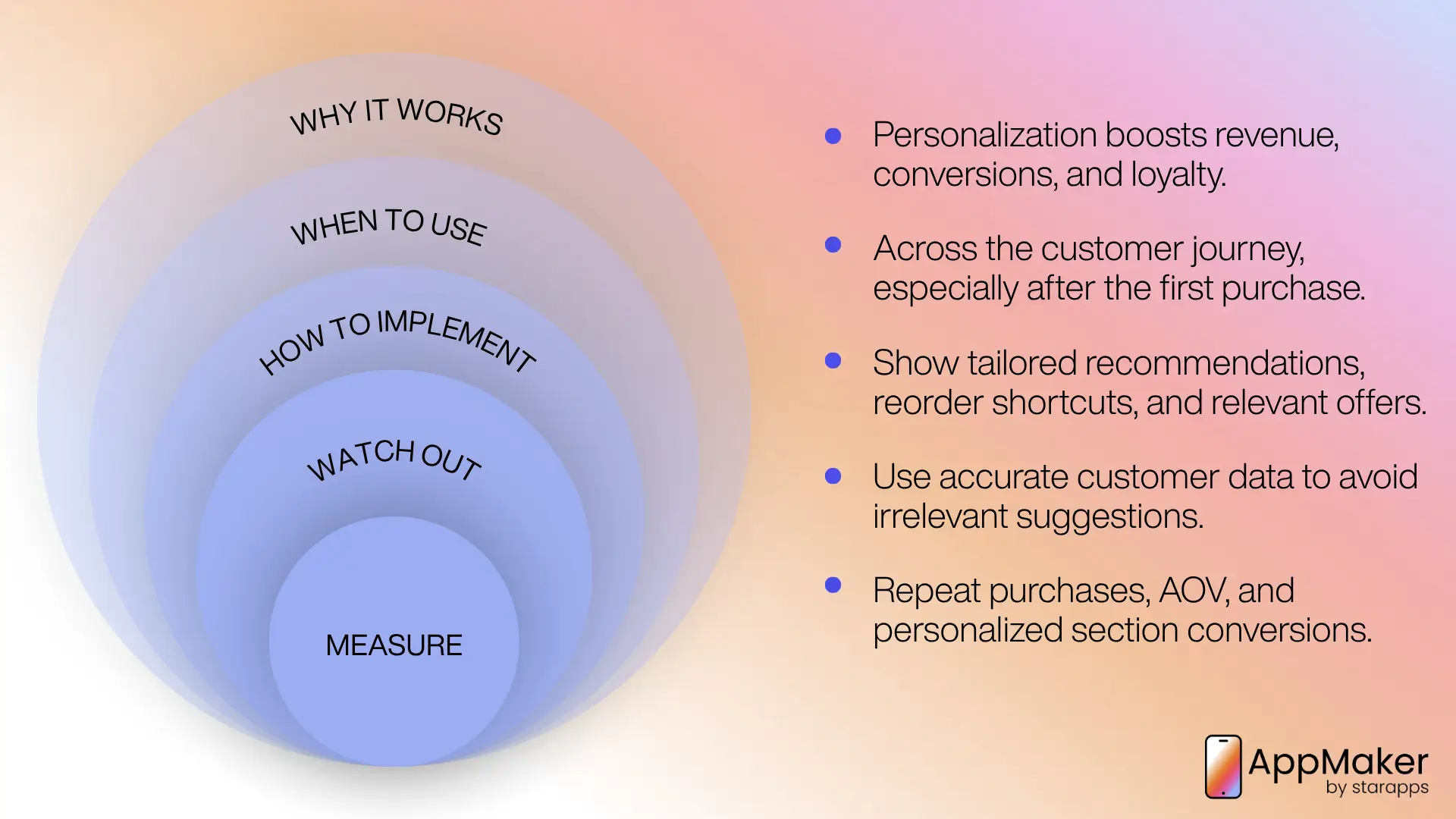
A generic app shows every shopper the same thing. A personalized app adapts to what each user has viewed, bought, and ignored. This is where repeat purchases are won.Why it works: Personalization moves both revenue and loyalty. McKinsey's Next in Personalization research found that companies that excel at personalization generate 40% more revenue from it, 78% of consumers say personalized communication makes them more likely to buy again, and personalization most often delivers a 10% to 15% revenue lift.When to use it: Across the journey, with the biggest payoff once you have first-order data to act on.How to implement it:
- Show recently viewed items, tailored recommendations, and reorder shortcuts on the home screen.
- Change the app layout by customer group, so a new visitor, a one-time buyer, and a loyal regular do not see the same homepage. AppMaker's App Conditional Blocks switch app sections based on Shopify tags and behavior.
- Trigger post-purchase content that fits the product, such as a how-to video, a usage guide, or a restock reminder.
- Match offers to category interest instead of sending one promotion to everyone.
Watch out for: Personalization needs clean data and enough history to be useful. Thin or wrong data produces recommendations that feel off and erode trust, so start with simple, reliable signals.How to measure it: Track repeat purchase rate and average order value (AOV) by segment, plus the conversion rate on personalized home screen sections against generic ones.
Send Push Notifications That Bring Shoppers Back
Push notifications are the app's direct line to the lock screen. Used with care, they are the most reliable way to bring shoppers back. Used carelessly, they drive opt-outs and uninstalls.Why it works: The opt-in itself is a retention signal. Airship's 2026 push notification benchmarks found that opted-in users reached a 2.9x higher Day 30 activation rate than opted-out users, and in health and beauty, opted-in devices showed a 7% lift in purchase events. Permission to reach someone on their phone is an advantage that email and ads cannot match.When to use it: For timely, relevant moments that help the user, including order and shipping updates, back-in-stock alerts, price drops on saved items, and well-timed offers.How to implement it:
- Earn the opt-in during onboarding by showing the value first. This matters more than ever, because Apple's iOS has always required an explicit opt-in and, since Android 13, Google's Android requires one too. A default audience no longer exists on either platform.
- Segment every send. A back-in-stock alert should only reach users who viewed or wanted that product.
- Automate behavioral triggers: cart reminders, browse reminders, replenishment nudges, and win-back messages.
- Use deep links so a tap lands the user on the exact product or collection, not a generic home screen.
- Keep service messages, such as delivery updates, separate from promotions so neither feels like spam.
Watch out for: Frequency is the fastest way to lose your audience. Every extra promotional send raises the opt-out and uninstall risk, and once a user opts out, you cannot reach them again. Treat the opt-out rate as a hard guardrail.How to measure it: Track opt-in rate, direct open rate, notification-driven sessions, and revenue per campaign, with opt-out and uninstall rate as guardrails. AppMaker's push notification tools support segmented, automated campaigns with this reporting.
Build Loyalty With Rewards And Tiers
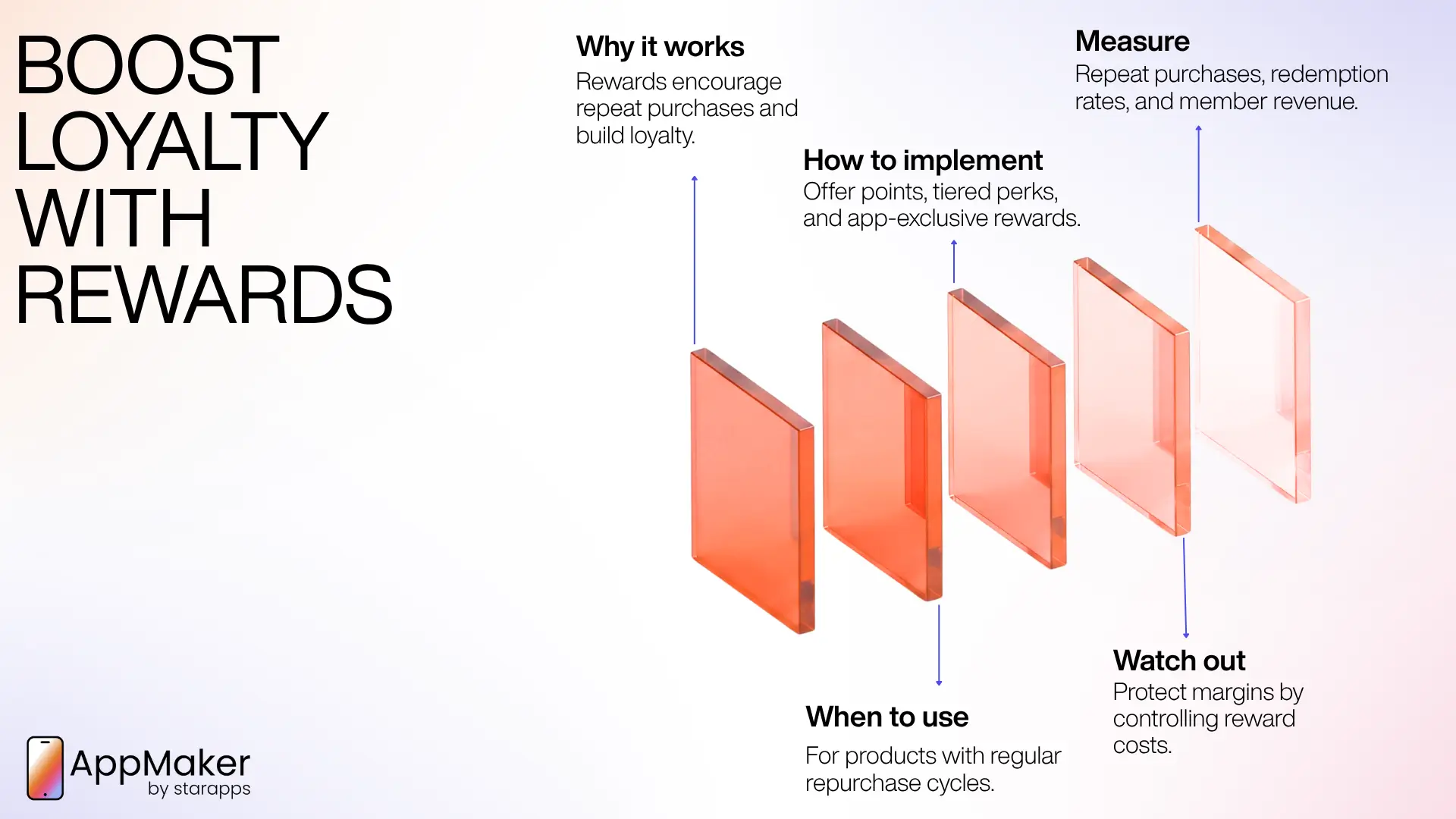
A loyalty program gives repeat buyers a reason to keep choosing you, and it makes the app the natural home for their points and perks.Why it works: Rewards shift behavior from one-off buying to habitual buying. Bain's loyalty research shows retained customers grow more valuable over time, and a program is a direct way to lift purchase frequency. The app adds a layer that email cannot, since points, tiers, and status can sit on the home screen and update in real time.When to use it: Once you have steady repeat demand and products people buy more than once. Loyalty fits consumables, apparel, beauty, and anything with a natural repurchase cycle.How to implement it:
- Award points for purchases, reviews, referrals, and app actions, and make the balance visible inside the app.
- Build simple tiers that unlock better perks as customers spend more, so shoppers have a goal to work toward.
- Reserve some rewards for app users only, so the app becomes the best place to be a loyal customer.
- Surface loyalty status in the app rather than burying it in a menu.
Watch out for: A badly costed program buys sales you would have made anyway and eats margin. Reward behavior you want more of, such as reviews, referrals, and reorders, not just raw spend, and model the cost before you launch.How to measure it: Track repeat purchase rate and purchase frequency for members against non-members, redemption rate, and the share of revenue from members.
Automate Replenishment And Reorder Reminders
For consumable products, the biggest retention win is reminding people to buy again at the right time. Replenishment turns a one-time purchase into a predictable rhythm.Why it works: Many DTC products run out on a schedule. A reminder that arrives just before a customer runs low removes the effort of remembering and captures the reorder before a competitor does. It is a clear, low-cost path to repeat revenue.When to use it: For any product with a repeat cycle, such as pet food, supplements, skincare, coffee, and household goods. Pet and organic food brands are strong examples of this model.How to implement it:
- Estimate the repurchase window for each product from past order data, then time a reminder a few days before the expected run-out.
- Send the reminder as a push notification with a one-tap reorder link.
- Add a reorder shortcut on the app home screen so past purchases are always one tap away.
- Offer a subscription option for customers who want the reorder to happen automatically.
Watch out for: This only works for products with a genuine repeat cycle. Forcing reorder prompts on one-time or long-lifespan purchases feels tone-deaf. Get the timing right too, since a reminder that lands too early or too late is easy to ignore.
How to measure it: Track reorder rate, the time between first and second purchase, and the conversion rate of replenishment reminders.
Offer App-Exclusive Deals And Early Access
Exclusive offers give users a concrete reason to install the app and to keep opening it. Access and scarcity, used honestly, build a habit.Why it works: When the best price, the earliest drop, or a members-only sale lives in the app, users open the app first. That raises session frequency, which is one of the strongest signals of future retention.When to use it: During launches, restocks, seasonal sales, and loyalty milestones, and to convert a first web buyer into an app user.How to implement it:
- Run early access windows for app users on new products and major sales.
- Offer app-only bundles or perks, and make the exclusivity clear in the message.
- Use countdown timers and limited-stock cues only for genuine, time-bound offers.
- Announce each exclusive with a targeted push to the right segment.
Watch out for: Leaning on discounts trains customers to wait for the next deal and squeezes margin. Favor access, early drops, and perks over constant price cuts.How to measure it: Track session frequency, conversion during exclusive windows, and the incremental revenue from app-only offers against your standard promotions.
Segment Customers For Smarter Retention
Segmentation is the engine under push, personalization, loyalty, and re-engagement. When you group customers by behavior and value, every message, offer, and reminder gets more relevant.Why it works: One message for everyone wastes reach and annoys good customers. Segmentation lets you treat a first-time buyer, a loyal regular, and a lapsing customer differently, which lifts response and protects the relationship with your best shoppers.When to use it: As soon as you have first-order data.How to implement it:
- Use RFM segmentation, which scores customers on recency, frequency, and monetary value. It quickly separates your champions, your at-risk customers, and your one-time buyers.
- Build behavior segments from app actions, such as category browsed, cart abandoned, or product wishlisted.
- Act on each segment with a fitting move. Reward champions, nudge at-risk customers, and give one-time buyers a reason to return.
- Keep segments dynamic so users move between them as their behavior changes.
Watch out for: Too many tiny segments are impossible to maintain and rarely beat a few well-chosen ones. Start with a handful that map to clear actions.
How to measure it: Track retention and repeat purchase rate per segment, and the response rate of segmented campaigns against broad sends.
Win Back Lapsing And Inactive Customers
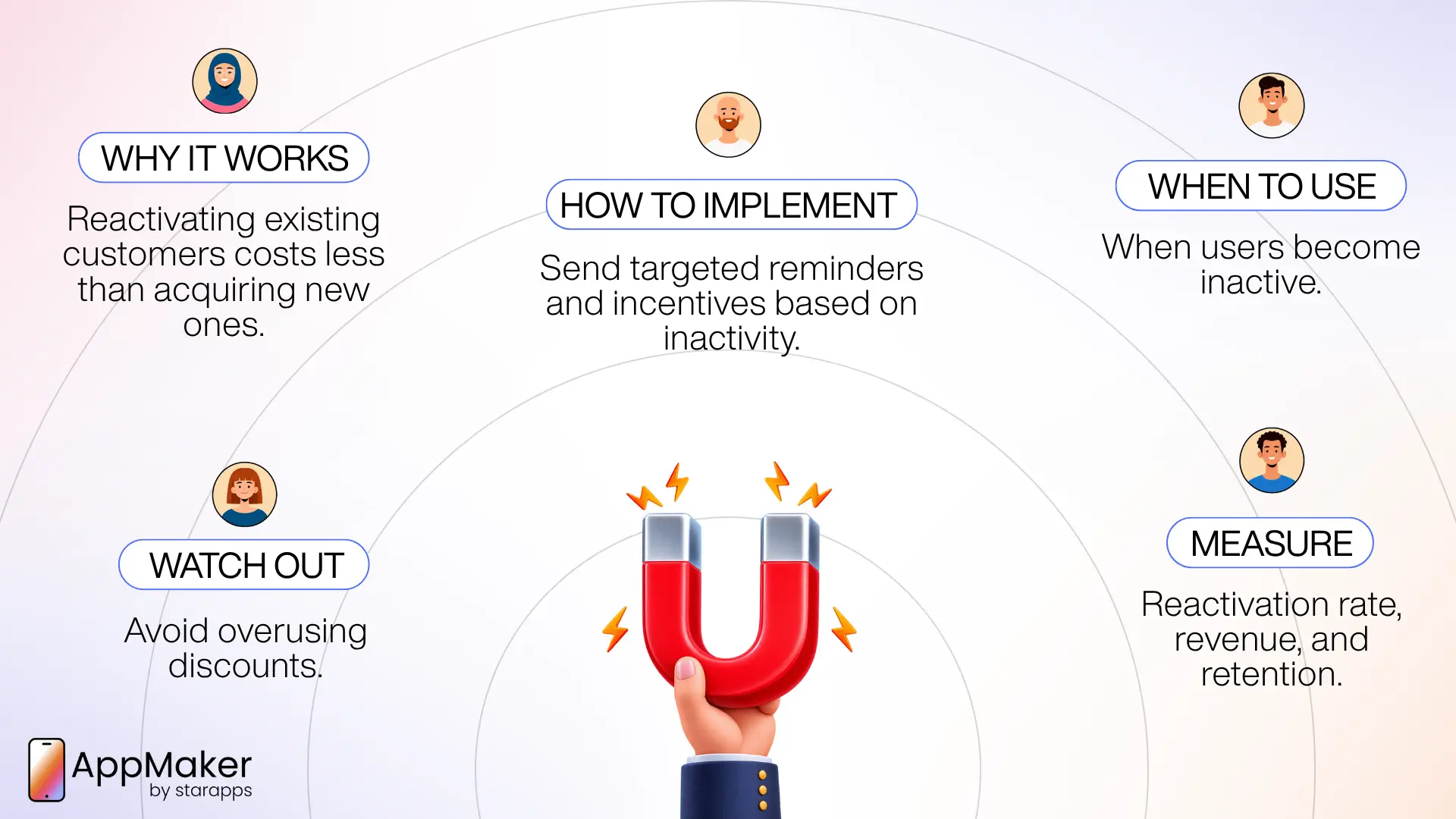
Some users always go quiet. A re-engagement campaign reaches them before they churn for good, usually at a fraction of the cost of acquiring someone new.Why it works: A lapsing customer already knows and trusts your brand, so bringing them back costs far less than winning a stranger. A timely, relevant nudge can restart the buying habit before the user forgets the app exists.When to use it: When a user crosses your inactivity threshold, meaning no session or purchase within a window that fits your category's normal cycle.How to implement it:
- Define lapse windows per segment, since a weekly buyer and a quarterly buyer go quiet on different timelines.
- Trigger a staged win-back flow: a helpful reminder first, then a stronger incentive only if needed.
- Lead with relevance, such as a restock of a product they bought, rather than a blanket discount.
- Suppress users who have clearly churned to protect margin and avoid wasted sends.
Watch out for: Opening every win-back with a discount teaches customers to lapse on purpose to earn one. Save the incentive for the final step, after relevance alone has not worked.How to measure it: Track reactivation rate, win-back revenue, and the longer-term retention of reactivated users, to confirm they stay rather than return once.
Optimize For Repeat Purchases
Everything in this guide points to one outcome: a second, third, and fourth order. The gap between the first and second purchase is the hardest to close, so treat it as its own project.Why it works: Repeat buyers convert more easily because they already trust the brand and the checkout. McKinsey's research found personalization is especially effective at driving repeat engagement and loyalty over time, creating a loop where each interaction produces data for a better next one. Closing the first-to-second gap is what sets a brand's lifetime value trajectory.When to use it: Continuously, with the most focus on the window right after the first order.How to implement it:
- Make reordering effortless with saved details, one-tap checkout, and a visible order history.
- Follow the first order with a fitting cross-sell or a replenishment reminder at the right time.
- Lower the second-purchase barrier with a first-repeat perk or points earned on the first order.
- Keep the catalog fresh so returning users always find something new.
Watch out for: A heavy second-order discount can anchor customers to a lower price and hurt long-term value. Use it sparingly and test the effect on repeat margin, not just repeat rate.How to measure it: Track time to second purchase, repeat purchase rate, purchase frequency, and customer lifetime value (CLV).
Prevent Churn Before It Happens
Churn prevention is the defensive side of retention. Instead of reacting after a customer leaves, you catch the warning signs and act early.Why it works: Behavior usually fades before a customer formally lapses. Longer gaps between sessions, skipped reorders, and falling engagement are early signals. Acting on them while the relationship is still warm is far cheaper than a full win-back.When to use it: Always, as an ongoing monitor running under your other strategies.
How to implement it:
- Define churn for your model. For a one-time-purchase catalog, repeat purchase rate matters more than session-based retention.
- Watch leading indicators: falling session frequency, longer reorder gaps, and reduced push engagement.
- Trigger early interventions for at-risk segments, such as a helpful reminder, a loyalty perk, or a service check-in.
- Fix the root causes churn exposes, including delivery issues, stockouts, and a clumsy checkout.
Watch out for: Churn signals are not certainty. Some quiet users were never going to return, so size each intervention to the segment's value and do not spend heavily rescuing low-value, one-time buyers.How to measure it: Track churn rate, retention by cohort, and the recovery rate of at-risk users who received an intervention.
Retention Metrics To Track (And How To Calculate Them)
You cannot improve what you do not measure. These are the core metrics for a DTC retention program.
| Metric | What it measures | How to calculate it |
|---|---|---|
| Retention rate | Retention rate | ((Customers at end of period minus new customers acquired) divided by customers at start) times 100 |
| Repeat purchase rate (RPR) | The share of customers who buy more than once | (Customers with more than one order divided by total customers) times 100 |
| Time to second purchase | The average gap between a customer's first and second order | Average of (second order date minus first order date) across repeat buyers |
| Churn rate | The share of customers lost in a period | (Customers lost divided by customers at start) times 100 |
| Customer lifetime value (CLV) | The total value a customer brings over their relationship | AOV times purchase frequency times average customer lifespan, adjusted for gross margin |
| Cohort retention | The share of one start group still active over later periods | Active customers from a cohort divided by the original cohort size, tracked each period |
| Stickiness | How often active users return | Daily active users divided by monthly active users (DAU divided by MAU) |
For most DTC brands, repeat purchase rate and time to second purchase are the two to lead with, because they track the behavior that generates revenue. Read the metrics together, not in isolation. A high retention rate with a low repeat purchase rate, for example, means users open the app but do not buy, which points to a conversion problem rather than an engagement one. AppMaker's app analytics surface these numbers so you can watch them over time.
Get Retention Measurement And Attribution Right
Good retention work can still look flat if the measurement is wrong. A few practices keep your numbers honest.
- Judge against a holdout: To know whether a campaign actually caused a purchase, hold back a small control group and compare. Many app users would have bought anyway, so a lift over a holdout is far more trustworthy than a raw conversion count.
- Get deep-link attribution right: When a push or email opens a specific product in the app, make sure the resulting order is credited to that message. Broken deep-link tracking makes your best campaigns look like your worst.
- Treat vendor-reported results as directional: Platform case studies and benchmarks, including the AppMaker figures in this guide, are self-reported and rarely show the baseline. Use them to set direction, then prove the effect on your own cohorts.
- Keep guardrail metrics in every report: Alongside revenue, track opt-out rate, uninstall rate, and unsubscribe rate. A campaign that lifts sales this week but raises opt-outs can cost you the channel.
Test And Experiment To Improve Retention
Retention is not a one-time setup. The brands that win treat it as a cycle of small, measured experiments. Every audience is different, so benchmarks are a starting point, not an answer. Testing replaces opinion with evidence and compounds small wins into a meaningful gain over time.
How to implement it:
- Run A/B tests on one change at a time, such as onboarding steps, push copy, offer size, or reminder timing.
- Use cohort analysis to judge whether a change improved retention for users who joined after it shipped.
- Pick one primary metric per test so the result is clear. For onboarding, that is usually first-week retention. For push, it is notification-driven revenue, with opt-out as a guardrail.
- Keep a simple log of what you tested, what you learned, and what you shipped, so the program builds on itself.
Watch out for: Calling a test early, before it reaches enough data, produces false winners. Decide the sample size and the success metric before you start.
How to measure it: Define success up front, run the test until the result is reliable, roll out the winner, and start the next one.
Where AppMaker Fits
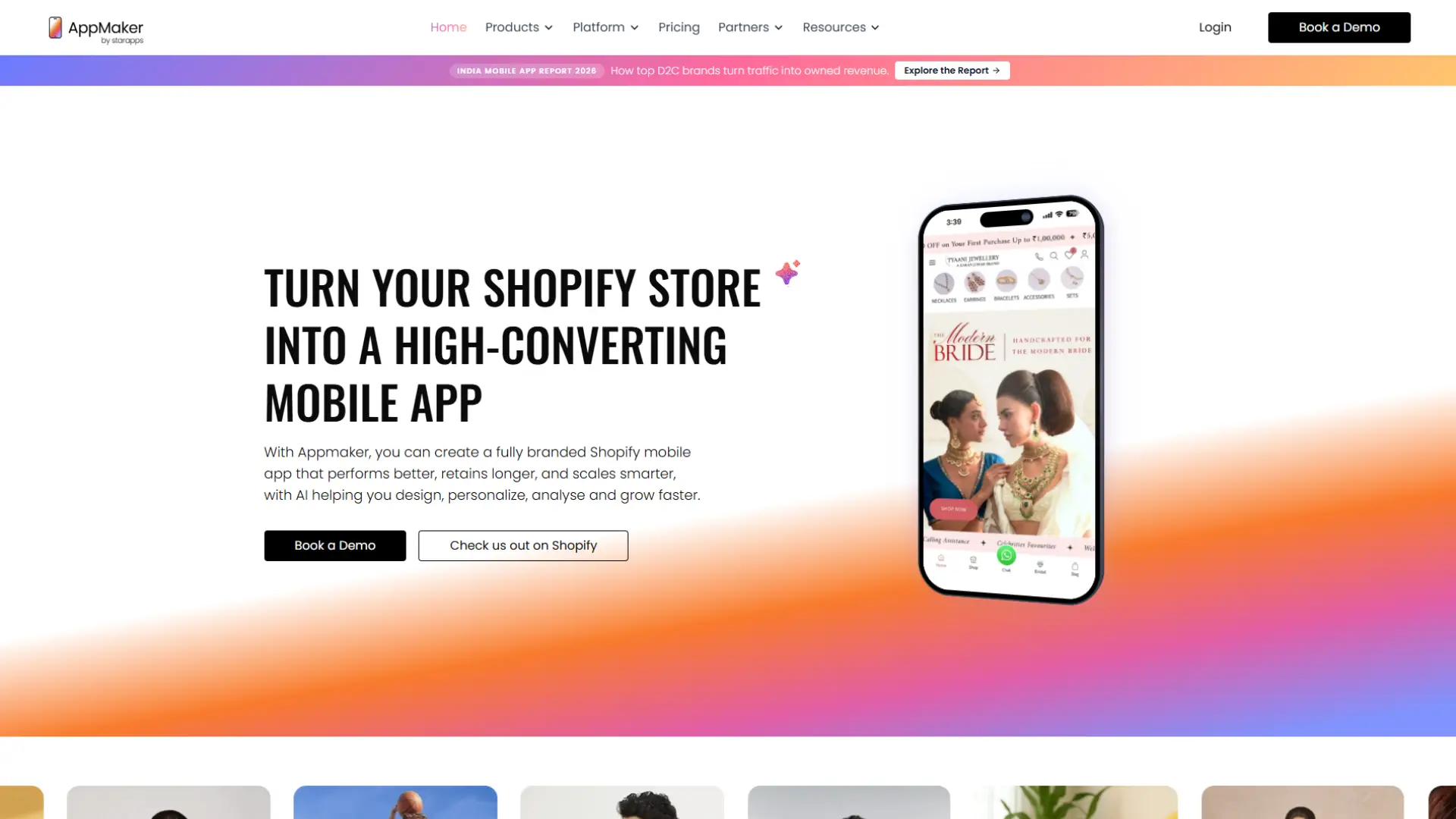
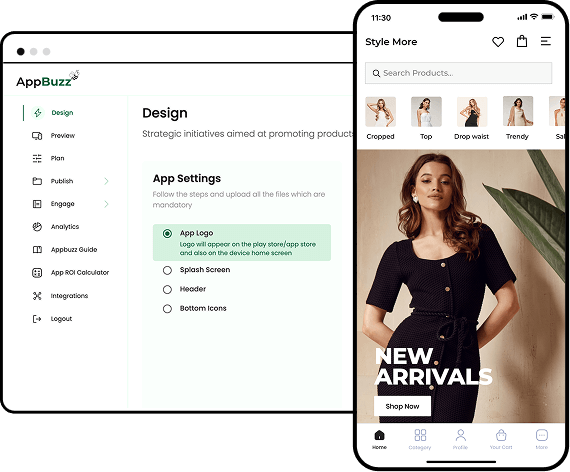
AppMaker is a Shopify mobile app builder that turns a store into a branded native app for iOS and Android with no code. It belongs in a retention conversation because its features line up with the strategies in this guide.
- Push notifications: segmented, automated push campaigns with deep links for cart, browse, back-in-stock, and replenishment triggers.
- Personalization and segmentation: App Conditional Blocks change what each customer group sees, using Shopify tags and behavior, so a new buyer and a loyal regular get different home screens.
- Reorder and loyalty modules: home screen reorder shortcuts and loyalty blocks support replenishment and rewards for repeat-purchase brands.
- Analytics: built-in app analytics track the retention, repeat purchase, and engagement metrics this guide describes.
- Real-time sync and deep linking: the app stays in step with the Shopify catalog, and links land users on the exact product.
The outcomes brands report on the platform show why the app channel matters for retention. AppMaker reports that Supertails sees 67% of total orders through its app, a 2x higher repeat rate than website users, and a 2.5x higher conversion rate than mobile web, and that XYXX sees a 5.3x higher conversion rate on the app than on mobile web, with a 31% higher app AOV. These are vendor-reported relative uplifts without published baselines, so use them as direction and confirm the effect on your own data. For market-specific benchmarks, AppMaker also publishes the India Mobile App Report 2026. You can review the full feature set on the AppMaker features page or the Shopify App Store listing.
An app does not replace your other channels. For your most valuable customers, it is the best place to run the retention strategies in this guide.
Frequently Asked Questions
What are mobile app retention strategies for DTC brands?
They are the methods a brand uses to keep app users active and buying after the first order, including onboarding, personalization, push notifications, loyalty, replenishment reminders, segmentation, re-engagement, and churn prevention. The shared goal is turning first-time buyers into repeat customers.
How do you get existing customers to use your app?
Prompt the install right after a web purchase, add app links to order and shipping emails and SMS, put a QR code on packaging, and offer an app-only reward or early access. Focus the push on customers who have already bought once, not every casual visitor.
What is the most important app retention milestone for DTC brands?
The second purchase. The gap between the first and second order is the hardest to close, and crossing it is the strongest early sign a customer will stick. Measure time to second purchase and work to shorten it.
How do push notifications improve app retention?
They give you a direct, permission-based line to the customer. Airship found opted-in users reached a 2.9x higher Day 30 activation rate than opted-out users. Keep sends relevant and well-timed, and treat the opt-out rate as a guardrail so users stay subscribed.
How soon do most app users churn?
Fast. CleverTap's e-commerce benchmarks found 42% of new users uninstall a shopping app within 30 days of installing it. That is why onboarding and the first 30 days carry the most weight in any retention plan.
What is the difference between retention rate and repeat purchase rate?
Retention rate measures how many customers stay active over a period. Repeat purchase rate measures how many actually buy more than once. For DTC brands with episodic buying, repeat purchase rate is often more useful, because it tracks revenue behavior rather than app visits.
Do loyalty programs increase app retention?
Yes, when they reward the behavior you want and live inside the app. Points, tiers, and app-only perks give repeat buyers a reason to keep choosing you, and visible status makes the app the natural home for loyal customers. Cost the program carefully so it does not just discount sales you would have made anyway.
Which retention metric should DTC brands track first?
Start with repeat purchase rate, measured by cohort. It is the clearest signal that first orders are becoming repeat ones. Pair it with customer lifetime value to see the money behind the behavior, then add churn and cohort retention as the program matures.