

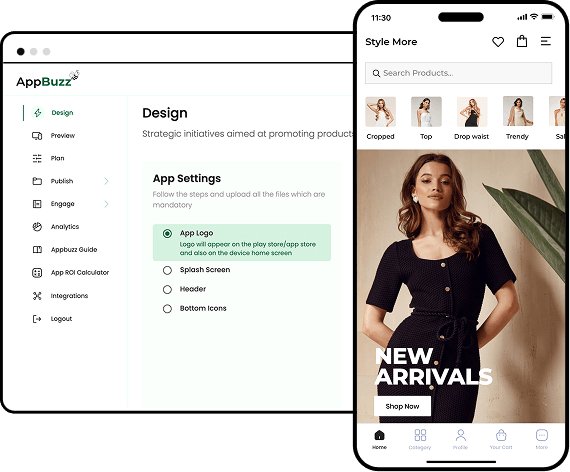
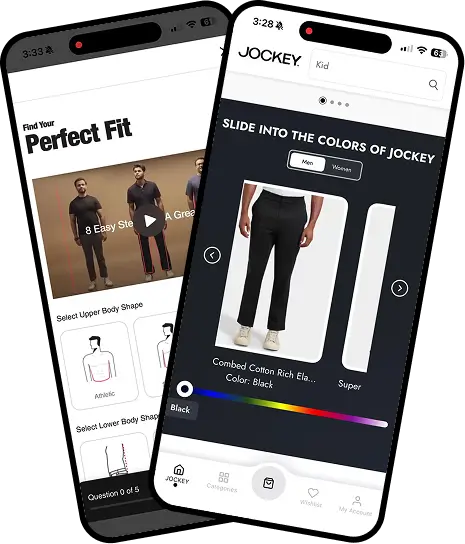























Customer acquisition costs are rising, while mobile web conversion rates continue frustrating scaling Shopify brands. Retention feels harder when shoppers browse on phones but rarely return to complete purchases. Without a native app strategy, revenue potential from repeat customers often remains underutilized.
In Q3 2025, U.S. retail e-commerce sales reached $310.3 billion, accounting for $1.89 trillion in total retail sales. That growth signals intensifying competition, where brands must control retention channels instead of relying only on paid traffic.
Understanding mobile commerce app development helps you capture a larger share of that growing digital spend. In this article, you’ll learn how to move from web-only selling to a revenue-driven mobile app strategy.
Quick Overview
- Web-only Shopify stores struggle with low mobile conversions, weak retention, and rising acquisition costs.
- Mobile apps convert at 3–8% versus 0.5–1.5% on mobile web and enable direct push-driven re-engagement.
- The right build path, UX structure, real-time sync, and lifecycle marketing determine app-driven revenue growth.
- For brands, native apps unlock higher repeat rates, stronger AOV, and more predictable retention-based scaling.
Why Web-Only Shopify Stores Are Hitting a Growth Ceiling?
Relying solely on mobile web limits retention, engagement depth, and repeat purchase momentum for scaling Shopify brands.Here are the structural reasons growth begins to plateau without a native app strategy:
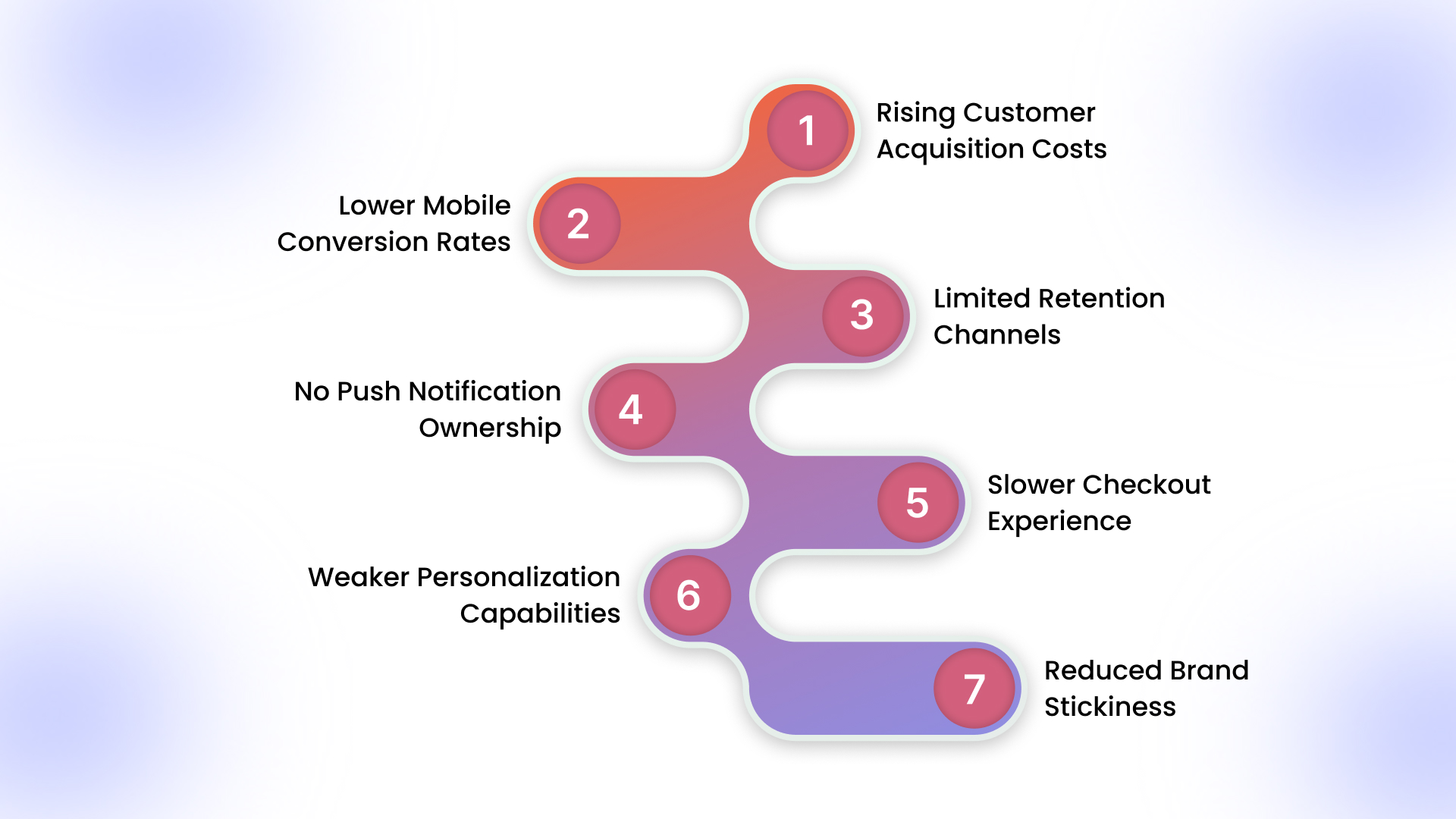
- Rising Customer Acquisition Costs: Paid channels across search and social continue to increase costs, reducing margin efficiency for scaling brands.
- Lower Mobile Conversion Rates: Appmaker study shows Mobile web conversion rates typically range between 0.5–1.5%, while mobile apps convert between 3-8% due to faster performance and simplified checkout flows.
- Limited Retention Channels: Email open rates fluctuate, while SMS fatigue reduces effectiveness over repeated campaigns.
- No Push Notification Ownership: Without an app, you lose direct, real-time engagement that drives repeat purchases instantly.
- Slower Checkout Experience: Browser redirects, autofill errors, and multi-step forms increase abandonment on smaller screens.
- Weaker Personalization Capabilities: Web sessions rely heavily on cookies, limiting persistent behavior-based customization.
- Reduced Brand Stickiness: An app icon on a customer’s home screen reinforces brand recall daily without additional spend.
To see where the gap truly lies, you need to understand how mobile commerce itself is evolving in 2026.
What Mobile Commerce App Development Means in 2026?
Mobile commerce app development in 2026 means designing retention-focused, performance-driven native experiences rather than replicating your Shopify website.Here are the structural shifts redefining how you should approach it this year:
- Mobile dominance is accelerating: Mobile’s share of total e-commerce has grown from 43 percent in 2018 to a projected 63% by 2028, signaling a structural buying shift.
- Traffic alone is no longer enough: As mobile captures a larger revenue share, conversion optimization inside owned apps becomes critical for sustainable margin growth.
- Speed defines competitiveness: Native apps outperform mobile websites in load speed, reducing friction during product discovery and checkout flows.
- Personalization is expected, not optional: Modern commerce apps must dynamically adjust product feeds, promotions, and messaging based on behavior signals.
- Retention channels matter more than acquisition: Push notifications, in-app campaigns, and lifecycle triggers now drive repeat purchases more reliably than email.
- Integration depth determines scalability: Real-time syncing with Shopify products, inventory, and customer data ensures operational consistency without manual intervention.
Understanding the shift is one thing, but choosing the right development path determines how practical your strategy becomes.
Native Custom Development vs PWA vs No-Code Platforms
Choosing the right development path determines your cost structure, speed to market, and long-term scalability.Here is a clear comparison to help you evaluate the best fit for your Shopify growth stage:
Once you know which direction fits your budget and scale, the next step is mapping out how to actually build your Shopify app.
How to Build a Mobile Commerce App for Your Shopify Store?
Building a mobile app for your Shopify store requires structured planning, clear revenue goals, and the right execution model.Here is a step-by-step roadmap to help you move from strategy to launch confidently:
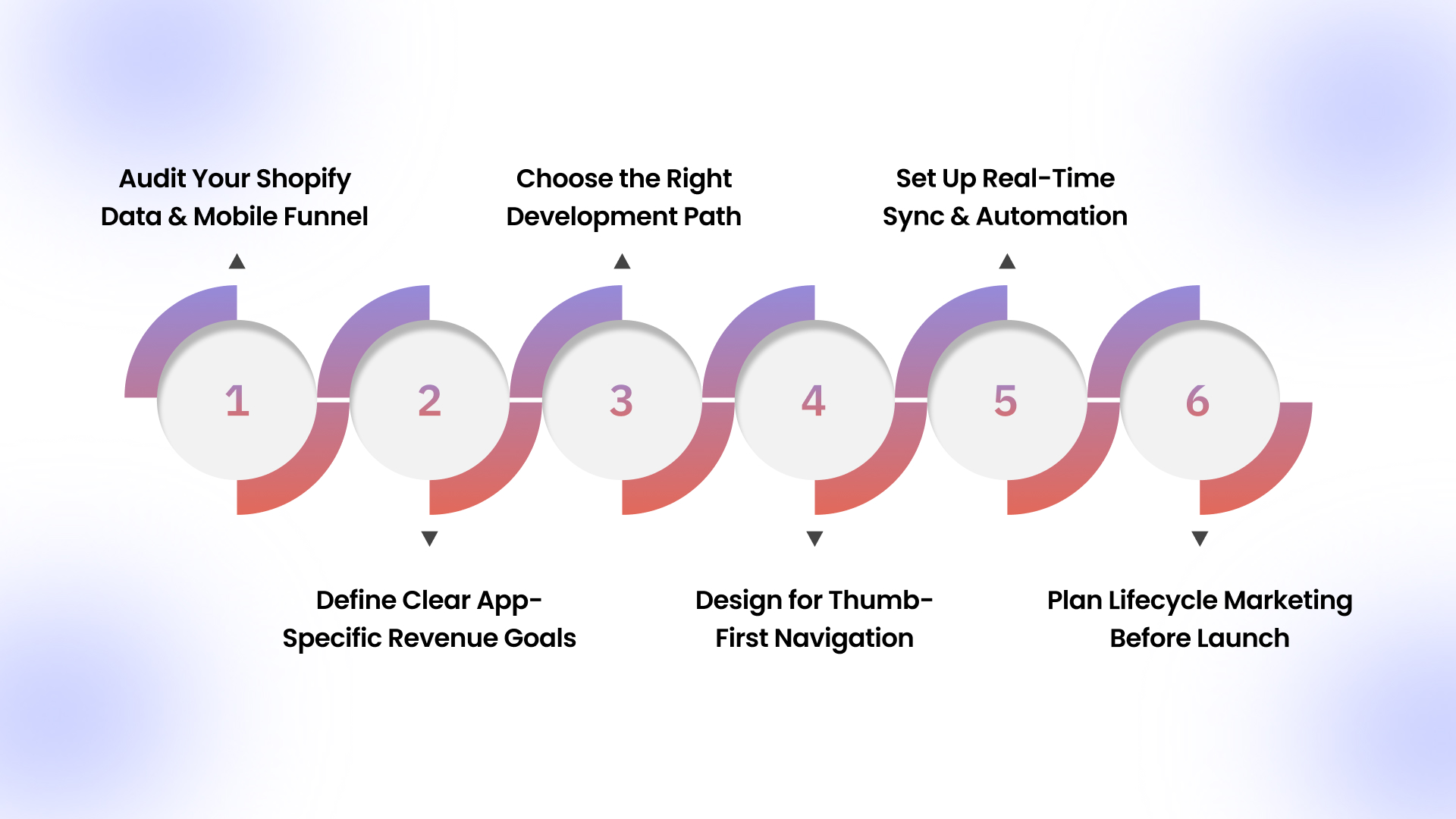
Step 1: Audit Your Shopify Data and Mobile Funnel
Before building anything, analyze your traffic sources, mobile conversion rates, and repeat purchase behavior.Here is what you should evaluate first:
- Traffic split: Review mobile versus desktop sessions and identify conversion gaps.
- Cart abandonment rate: Measure drop-offs specifically on mobile checkout flows.
- Repeat purchase frequency: Understand how often existing customers return without push reminders.
- Top-selling categories: Identify products that can drive app-exclusive promotions.
- Customer acquisition cost: Calculate how much you spend to generate one paying customer.
Step 2: Define Clear App-Specific Revenue Goals
Your mobile app should solve specific growth bottlenecks, not just replicate your website.Here are the goal categories you should define early:
- Retention improvement: Increase repeat purchases through push notification campaigns.
- AOV growth: Encourage bundled purchases and personalized product recommendations.
- Checkout acceleration: Reduce friction with simplified, app-native checkout experiences.
- Customer lifetime value: Strengthen loyalty through app-exclusive incentives.
- Owned audience growth: Build a direct communication channel beyond paid ads.
Step 3: Choose the Right Development Path
Your technical approach determines cost, timeline, and long-term operational complexity.Here are the main paths you should evaluate:
- Custom native development: Suitable for large budgets with dedicated developers.
- PWA solution: Useful for lightweight app-like functionality without app store presence.
- No-code native platform: Ideal for Shopify brands seeking speed and lower technical dependency.
Step 4: Design for Thumb-First Navigation
App design must prioritize speed, clarity, and minimal friction on smaller screens. Here are key UX elements to implement:
- One-tap checkout: Reduce form fields and enable stored payment options.
- Persistent cart visibility: Keep the cart accessible throughout browsing.
- Smart search functionality: Allow predictive search with real-time suggestions.
- Simplified navigation: Limit menu layers to prevent drop-offs.
- Visual product discovery: Use banners, reels, and personalized feeds effectively.
Step 5: Set Up Real-Time Sync and Automation
Operational accuracy ensures consistent inventory, pricing, and promotions across channels. Here is what must stay synchronized:
- Product listings: Sync titles, images, variants, and pricing automatically.
- Inventory updates: Prevent overselling through real-time stock adjustments.
- Customer data: Maintain consistent order history and profile information.
- Promotional campaigns: Align discounts across web and app platforms.
- Analytics tracking: Monitor app-specific metrics like retention and session depth.
Step 6: Plan Lifecycle Marketing Before Launch
An app without an engagement strategy limits its revenue potential significantly. Here are lifecycle tactics to prepare in advance:
- Welcome push campaigns: Onboard new app users with incentive-based messaging.
- Abandoned cart reminders: Trigger push alerts for incomplete purchases.
- Back-in-stock notifications: Drive urgency for popular products.
- App-exclusive offers: Encourage downloads through limited promotions.
- Behavior-based triggers: Personalize messages based on browsing and purchase patterns.
For Shopify brands looking to build a mobile commerce app without heavy development costs, Appmaker enables you to launch native iOS and Android apps with real-time Shopify sync and built-in lifecycle tools.
Execution alone is not enough; design decisions inside the app will directly shape your conversion performance.
UX Principles That Increase Conversion in Commerce Apps
Conversion-focused app design prioritizes speed, clarity, and behavioral triggers that encourage faster purchasing decisions.Here are the UX principles that directly impact revenue performance inside commerce apps:
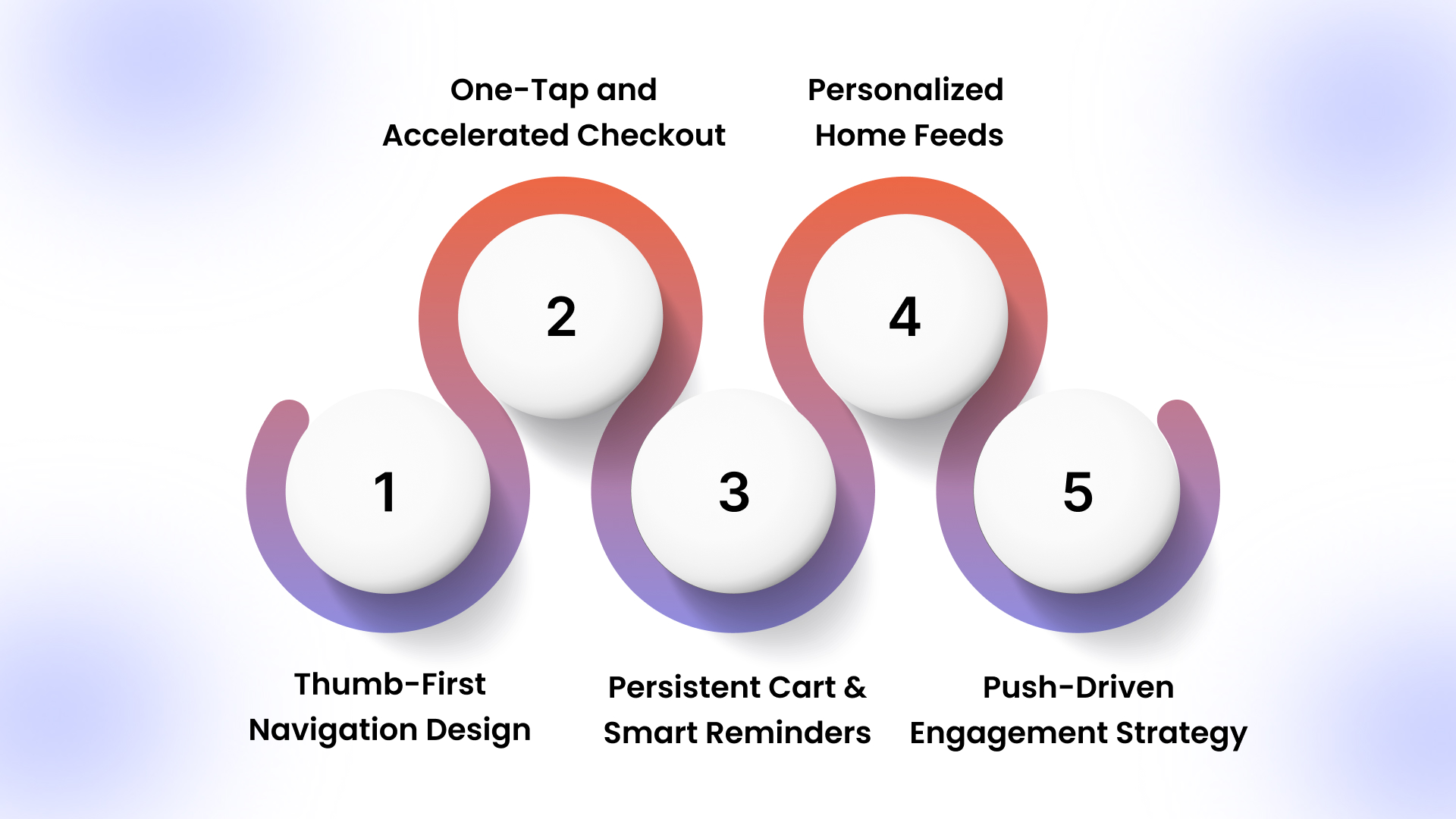
Thumb-First Navigation Design
- Mobile shoppers use one hand, so navigation must support natural thumb movement patterns.
- Primary actions like search, cart access, and checkout should stay within comfortable screen reach.
- Simplified menus reduce cognitive load and improve product discovery across categories.
One-Tap and Accelerated Checkout
- Checkout friction remains a primary cause of mobile cart abandonment across Shopify stores.
- Saved payment credentials and autofilled shipping details shorten the buying journey considerably.
- A faster checkout experience increases completed transactions and strengthens customer satisfaction.
Persistent Cart and Smart Reminders
- App users expect their carts to remain saved across sessions and browsing attempts.
- Persistent carts reduce hesitation when shoppers evaluate options before committing to purchase.
- Timely in-app nudges and reminders encourage customers to return and finalize pending orders.
Personalized Home Feeds
- Static product grids no longer meet evolving expectations of mobile-first shoppers.
- Behavior-based personalization surfaces relevant products based on browsing and purchase history.
- Targeted recommendations increase session depth and improve average order value consistently.
Push-Driven Engagement Strategy
- Push notifications act as direct revenue triggers when executed with clear intent.
- Behavioral triggers such as abandoned carts and restocks drive measurable repeat purchases.
- According to Appmaker's study, push notifications deliver 5–10X higher click-through rates than email or paid marketing channels.
- A structured push strategy strengthens retention and reduces reliance on paid re-acquisition.
Even the best-designed app needs to justify its financial commitment, so cost clarity becomes the next consideration
Expected ROI: When Does an App Make Sense for Shopify Brands?
Evaluating ROI helps you determine whether a mobile app will meaningfully impact retention, revenue, and long-term profitability.Here are the conditions where investing in an app makes strong financial sense:
- Mobile Traffic Dominates Your Store: Appmaker research has shown that nearly 9 out of 10 visitors shop through their mobile devices, making mobile optimization critical for revenue growth.
- Repeat Purchases Drive Profitability: Brands with strong returning customer segments benefit more from push-driven re-engagement strategies.
- Higher Revenue Per User Potential: Mobiloud's report shows that apps drive 3.5–7x higher average revenue per user compared to mobile web visitors.
- Stronger Conversion and AOV Performance: The report has also shown that apps deliver 1.7–3x higher conversion rates and 10–50% higher average order values.
- Paid Acquisition Costs Are Rising: When advertising costs increase, improving retention often yields stronger margin efficiency.
- You Operate Between $1M–$10M Revenue: At this stage, app-driven retention can significantly accelerate predictable revenue scaling.
If the numbers align, the final question becomes how to execute without adding technical burden or slowing growth.
A Smarter Way for Shopify Brands to Approach Mobile Commerce
Building a mobile commerce app should increase retention and revenue without increasing operational burden.Here is how Shopify brands can execute efficiently using the right tools:
- Appmaker Studio for Fast Native Launch: Build fully native iOS and Android apps through Appmaker Studio without relying on long development cycles.
- Real-Time Shopify Sync for Accuracy: Automatic synchronization ensures products, pricing, and customer data remain consistent across web and app channels.
- Eidolon AI for Rapid Design Deployment: Convert Figma files or screenshots into reusable layouts, reducing design time and launch friction.
- Rubik’s AI for Behavioral Personalization: Dynamically adjust layouts, product recommendations, and content based on real-time browsing and purchase behavior.
- Push Notifications for Revenue Acceleration: Built-in push tools trigger abandoned cart alerts and restock reminders, delivering 5–10X higher click-through rates than email or paid campaigns.
- Proven Revenue Contribution: In high-retention categories like fashion and pet supplies, apps contribute up to 50–70% of total revenue.
- Stronger Conversion and Repeat Performance: Brands report 2.5x to 3x higher conversion rates and up to 2x improvement in repeat purchases after launching native apps.
- Flexible Customization Through Code Blocks and Conditional Blocks: Introduce custom logic and targeted experiences without rebuilding your entire application.
For Shopify brands operating between $1M and $10M annually, these performance lifts directly strengthen margin efficiency and predictable growth.
Wrapping Up
Mobile commerce app development is no longer a growth experiment but a structural shift in how customers prefer to shop. When mobile drives most traffic and has stronger in-app conversion rates, delaying an app strategy limits long-term profitability.
Appmaker helps you launch, personalize, and scale a native Shopify app without heavy development overhead.
If you are ready to move beyond mobile web limitations and build a high-converting native app, Book a Demo and see how Appmaker fits your growth stage.
FAQs
What is mobile commerce app development?
Mobile commerce app development refers to building native iOS and Android applications that allow customers to browse and purchase directly from their mobile devices. It focuses on performance, personalization, and retention compared to traditional mobile websites.How long does it take to build a mobile commerce app for Shopify?
Development timelines vary depending on your approach, but no-code platforms can significantly reduce launch time compared to custom native builds. Custom development may take several months, while structured app builders shorten that cycle.Is a mobile app better than a mobile website for eCommerce?
Mobile apps generally deliver higher conversion rates, stronger repeat purchases, and improved customer engagement compared to mobile web experiences. They also enable push notifications and deeper personalization.How much does mobile commerce app development cost?
Costs depend on whether you choose custom development, a PWA, or a no-code native solution. Custom builds involve higher upfront and maintenance expenses, while platform-based models operate on subscription pricing.Can I convert my Shopify store into a mobile app without developers?
Yes, no-code mobile app builders allow you to convert your Shopify store into a native app without writing code. These platforms handle syncing, publishing, and performance management automatically.