
























Key Takeaways
- Shopify only logs abandoned checkouts after an email is captured, so most in-app drop-off never reaches your admin unless you instrument it.
- Extra costs revealed late are the biggest recoverable leak, outranking every other abandonment reason among shoppers who were genuinely ready to buy.
- Form-field count hurts checkout more than step count. Eight fields is the working target; most stores carry three more than they need.
- Preloading the checkout session on add-to-cart is the highest-leverage app fix, turning the native-to-web handoff from dead time into instant load.
- Push works through segmentation and timing, not volume. Median open rates sit near 3%, but targeted triggers multiply purchases several times over.
- Ecommerce app UX is broadly mediocre across leading brands, which means basic cart, search, and zoom fixes still create competitive separation.
- In India, cash on delivery lowers abandonment while destroying margins through returns. Nudge prepaid via UPI instead of removing COD outright.
Most advice about cart abandonment was written for websites. It gets recycled for apps without anyone checking whether it still applies.
It usually doesn't. A Shopify mobile app has a different funnel, a different checkout architecture, a different recovery channel, and a different definition of the metric itself. Copying web CRO tactics into an app is why so many merchants run "abandoned cart campaigns" for six months and see nothing move.
This guide is built from primary research: Baymard Institute's checkout and mobile-app UX studies, Shopify's own checkout data and developer documentation, Airship's push notification benchmarks across nine billion app users, Omnisend's 2026 analysis of 150,000 brands, and Unicommerce's 410 million-shipment dataset for India. Every number below is sourced and linked. Where the evidence is thin or contested, we say so.
The Short Answer: How To Reduce Cart Abandonment In A Shopify App
To reduce abandoned cart rate in a Shopify mobile app, fix the checkout handoff first: implement Shopify's Checkout Kit with preloading enabled, surface shipping and taxes before the cart screen, cut checkout to eight or fewer form fields, enable every express wallet your market actually uses, and run a two-to-three message recovery sequence combining push, email, and SMS. Discounting should be the last lever, not the first.
Across ecommerce, 70.22% of carts are abandoned, according to Baymard Institute's average across 50 separate studies. But a large share of that is browsing behaviour you were never going to convert: 42% of US online shoppers say they have abandoned a cart simply because they weren't ready to buy. The addressable portion is smaller than the headline number and far more fixable than most teams assume.
What Cart Abandonment Actually Means Inside A Shopify App
Before you fix anything, get the definition right because Shopify's definition and your team's definition are probably different, and that gap is where six months of wasted effort begins.
Shopify Tracks Abandoned Checkouts, Not Abandoned Carts
Per Shopify's Help Centre, a checkout is considered abandoned when it stays incomplete for more than ten minutes after the customer has provided their email information. Two consequences follow, and both matter enormously for apps:
- Anonymous drop-off is invisible. A shopper who adds to cart, opens the cart screen, and closes the app never appears in Orders → Abandoned checkouts. On mobile, that group is usually the majority.
- Recovery is channel-scoped. Shopify's built-in abandoned checkout recovery is available for the Online Store and Buy Button sales channels. Depending on how your app is architected Storefront API, custom sales channel, headless those automations may not fire for app sessions at all.
Action: place a test order in your app, abandon it deliberately at the email step, and check whether the record appears in your admin and whether the recovery email sends. Do not assume. Merchants routinely discover their app has been generating unrecovered abandonment for a year.
The App Funnel You Should Actually Be Measuring
Cart abandonment rate is a single number hiding five different problems. Break it apart:
| Funnel stage | What it tells you | Common app-specific cause of drop-off |
|---|---|---|
| App open → product viewed | Merchandising and navigation | No clear path to "Shop" or categories; homepage buried under promo tiles |
| Product viewed → add to cart | Product page confidence | No pinch-to-zoom, thin specs, no reviews, unclear delivery date |
| Add to cart → cart opened | Cart discoverability | Cart icon without a badge; no confirmation after add |
| Cart opened → checkout initiated | Cost transparency | Shipping and tax appear for the first time here |
| Checkout initiated → order placed | Checkout execution | Slow checkout load, form friction, missing payment method, errors |
The industry headline of ~70% conflates all five. Your fix list is completely different depending on which stage leaks.
The formula, stated plainly:
Cart abandonment rate = 1 − (completed orders ÷ carts created) Checkout abandonment rate = 1 − (completed orders ÷ checkouts initiated)
Report both. The first tells you about your store; the second tells you about your checkout.
Separate Natural Abandoners From Recoverable Ones
This is the part almost every guide skips, and it changes how you should spend your budget.
Carts get used as wishlists, price calculators, and shortlists. That behaviour is not a bug in your app. You will not discount your way out of it, and chasing it with aggressive retargeting mostly annoys people.
Setting those browsers aside, here is how the remaining, addressable reasons rank in Baymard's data:
| Reason for abandoning (excluding "just browsing") | Share of respondents |
|---|---|
| Extra costs too high: shipping, tax, fees | 40% |
| Delivery was too slow | 20% |
| Didn't trust the site with credit card information | 19% |
| Site wanted them to create an account | 18% |
| Site had errors or crashed | 17% |
| Returns policy wasn't satisfactory | 13% |
| Couldn't see or calculate the total order cost up front | 12% |
| Credit card was declined | 10% |
| Not enough payment methods | 9% |
Source: Baymard Institute, based on a quantitative study of US online shoppers. Respondents could select multiple reasons.
Read that table again with an app in mind. Seven of the ten are things you control inside the product. Two are pricing and logistics decisions. Only one, the declined card, is genuinely outside your reach, and even that is partly a payment-method-mix problem.
Baymard estimates that if retailers fixed the checkout usability issues they have documented as solvable, the average large ecommerce site could gain a 35.26% increase in conversion rate, which across US and EU ecommerce sales works out to roughly $260 billion in recoverable orders.
What Good Looks Like (And The Benchmark Myth To Ignore)
Real reference points
| Benchmark | Figure | Source |
|---|---|---|
| Average documented cart abandonment, all ecommerce | 70.22% | Baymard Institute, 50 studies |
| Mobile conversion rate vs desktop (Apr 2023–Apr 2024) | ~3.0% vs 4.4% | eMarketer, cited by Shopify |
| Share of online orders placed on smartphones (Q1 2025) | 68% | Statista, cited by Shopify |
| Average checkout flow length | 5.1 steps, 11.3 form fields | Baymard checkout benchmark |
| Leading ecommerce apps rated "decent" or better on UX | 29% | Baymard Mobile App UX Benchmark 2026 |
Do Apps Really Convert 3× Better Than Mobile Web?
You have seen it everywhere. Treat it carefully.
The number circulates through vendor marketing and traces back to comparisons that don't control for who is in each group. People who download your app are already your most engaged customers repeat buyers, brand fans, people who came in through a post-purchase prompt. Comparing their conversion rate to the conversion rate of cold mobile-web traffic from a Meta ad measures the audience, not the channel.
Apps do have genuine structural advantages: stored credentials, a lock-screen re-engagement channel, no tab-switching, no cold page loads. Those advantages are real, and they are the reason this guide exists. But if you want to know what your app is worth, measure it honestly:
- Cohort-match. Compare app users to mobile-web users with the same purchase history and acquisition source.
- Run a pre/post on the same customers. Track conversion rate and repeat rate for individuals in the 90 days before and after they installed.
- Hold out a segment. Withhold app install prompts from a random slice of your list and compare revenue per customer over a quarter.
A defensible internal number beats a borrowed vendor statistic every time, including in the board deck.
The 10 Fixes, Ordered By Leverage
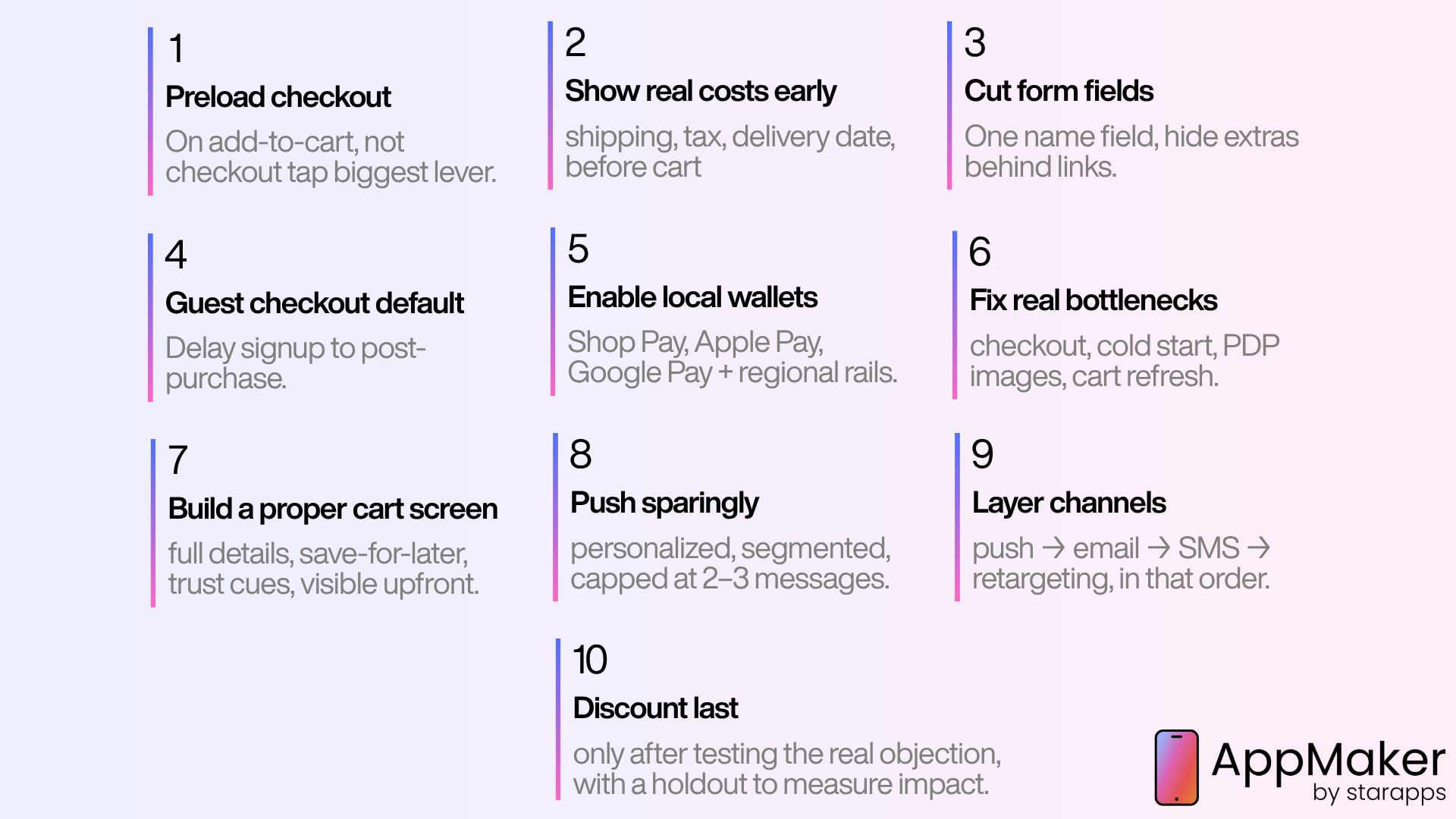
Work down this list. The order is deliberate: the first three items typically move more revenue than the last five combined, and the last item is deliberately last.
1. Implement Shopify's Checkout Kit With Preloading Enabled
This is the single highest-leverage technical change available to a Shopify app team, and it is the one most "reduce cart abandonment" articles never mention.
Here's the architectural reality. Your app can be fully native native product lists, native cart, native everything, but Shopify's checkout is a web checkout. It has to be, because that's where Shopify Payments, fraud analysis, tax logic, Shopify Functions, and checkout UI extensions live. So at the moment your shopper taps "Checkout," your beautiful native app hands them to a web view.
Handled badly, that handoff is where your funnel dies: a spinner, a flash of white, a layout that suddenly doesn't match your brand, and a shopper who has just been reminded they're using an app that's pretending.
Shopify's Checkout Kit (you'll still see it called Checkout Sheet Kit; Shopify is mid-rename; available for Swift, Android and React Native) exists to solve exactly this. It renders Shopify's one-page checkout in an optimised native sheet, preserves all your store customisations and checkout UI extensions, Shopify Functions, and branding matches the device's light or dark appearance, and exposes checkout lifecycle and pixel events so you can finally see what's happening.
The preloading feature is where the conversion lives. Initialising a checkout session requires a round trip to Shopify's servers. On a patchy 4G connection in a metro at 7 pm, that's dead time in front of a shopper who is one tap from buying. The Kit lets you call preload(checkoutUrl) to warm the session in the background the moment they add to cart, not the moment they tap checkout. It is enabled by default.
Stikky, a Shopify partner building native apps, reported that enabling preloading cut checkout load time by more than 90%, that merchants saw conversion increases of up to 15%, and that they eliminated 75% of their own checkout-related code in the process.
Implementation checklist:
- Preload the checkout URL on add-to-cart, not on checkout tap
- Pass authenticated buyer identity so returning customers skip re-entry
- Match the sheet's colour scheme to your brand, not the default web theme
- Subscribe to checkout lifecycle events and pipe them into your analytics
- Test on a throttled connection and a three-year-old Android device, not your flagship phone on office Wi-Fi
If you're weighing up how much of your app should be native in the first place, our breakdown of native vs hybrid apps for Shopify stores covers the trade-offs.
2. Show True Landed Cost Before The Cart Screen
The largest addressable reason for abandonment is extra costs revealed too late. A related 12% said they simply couldn't calculate the total order cost up front.
Note what shoppers are actually reporting. It is not that shipping exists. It is that shipping appeared after they had mentally committed. That is a trust event, not a pricing event, and trust events cost you the next visit as well as this one.
What to do in the app:
- Put a delivery and cost estimate on the product page: Ask for a pincode or ZIP once, store it on the device, and reuse it everywhere. A shopper should never have to tell you where they live twice.
- Show the free-shipping threshold as progress, not as a banner: "₹340 away from free delivery" outperforms "Free shipping over ₹1,500" because it does the arithmetic for them.
- Give a date, not a range: Two-thirds of global shoppers expect orders within 24 hours and 45% actively look for businesses that show anticipated delivery times. "Arrives Tuesday, 29 July" beats "3–5 business days" every time.
- Show tax treatment explicitly: Tax-inclusive or tax-added; say which, on the product page.
The one thing not to do: hide costs deeper to protect the add-to-cart rate. You will improve a vanity metric and pay for it at checkout.
A note on how this compounds. Reducing surprise at checkout also reduces support tickets, chargebacks, and one-star reviews mentioning "hidden charges." The revenue effect is real, but the retention effect is larger and slower to show up in a dashboard.
3. Cut Form Fields, Not Checkout Steps
Almost every listicle tells you to reduce checkout to two or three steps. Baymard tested this over a decade and found the premise is wrong.
Their conclusion: the number of form fields users must consider affects checkout usability far more than the number of steps. Steps only start to hurt beyond eight. Fields hurt immediately, and they hurt more on a phone, where every unnecessary input means another keyboard toggle and another chance to tap the wrong thing.
The gap is large. The average checkout in Baymard's benchmark carried 11.3 form fields when most stores need only eight. Here is where the excess comes from, with the share of sites getting each one wrong:
| Field pattern | Sites doing it wrong | Why it costs you |
|---|---|---|
| Separate first/last name fields | 89% | 42% of test participants typed their full name into "First Name" at least once. With a single "Full Name" field, only 4% hesitated. |
| "Address Line 2" shown by default | 75% | 30% of participants came to a full stop at this field and second-guessed their Line 1 entry. |
| Coupon code field shown by default | 35% of sites that have one | Some participants left the site entirely to hunt for a code. Once they leave checkout, many don't return. |
| Billing address shown separately by default | 24% | Most shoppers have one address. Showing two sets of fields makes the form look twice as long as it is. |
| Account creation before purchase | 84% don't delay it | Forces shoppers to consider "Create a password" and "Date of birth" mid-purchase. |
The app version of this fix:
- One "Full Name" field
- "Add apartment, suite, floor" behind a link
- Coupon code behind a link or, better, apply eligible discounts automatically
- Billing address defaults to shipping and stays hidden
- Use the device: OS-level address autofill, saved cards, pincode-to-city lookup
- Never ask for a landline. Never ask for a company name on a D2C store. Never ask for anything you don't use.
4. Make Guest Checkout The Default And Delay Account Creation
The failure mode is subtler than a hard signup wall. When account creation is offered prominently at the account-selection step, guest-intent shoppers pick it anyway (the button often says "New customer," and they are one), then face a long form and stall.
The pattern that works:
- Guest checkout is the visible default
- Tell shoppers at the account step that they'll be able to save their details after ordering; otherwise, some will hunt for the signup they think they're missing
- Offer one-tap account creation on the confirmation screen, where you already have their details and only need a password or passkey
- Explain the benefit in concrete terms: order tracking, faster reorder, saved addresses
5. Enable Every Express Wallet Your Market Actually Uses
Only a few of shoppers name "not enough payment methods" as an abandonment reason, which sounds minor until you notice it is a floor, not a ceiling. People don't always know why they gave up; they just know it felt like effort.
The stronger evidence is on the positive side. Shopify reports that Shop Pay delivers an average 9% conversion lift across all checkouts and 18% for returning customers, autofilling in roughly 0.7 seconds and cutting repeat checkout time by 60%. An external study by a major consulting firm found Shop Pay lifts conversion by as much as 50% versus guest checkout and outperforms other accelerated checkouts by at least 10%.
Get the mix right for where you actually sell:
| Market | Non-negotiable | Worth testing |
|---|---|---|
| Global / US / EU | Shop Pay, Apple Pay, Google Pay | PayPal, BNPL above ~$100 AOV |
| India | UPI (intent-based, not just QR), Shop Pay, cards | Wallets, EMI, BNPL, COD with prepaid nudge |
| SEA / LATAM | Local rails (PIX, Boleto, GrabPay, etc.) | Regional BNPL |
Two app-specific details that matter more than the list itself:
- Surface wallet buttons on the product page and cart, not only inside checkout. A shopper who never reaches your checkout can't use the wallet you enabled there.
- In India, use UPI intent deep links. Handing off directly to the shopper's UPI app and returning cleanly to yours is a meaningfully shorter path than a QR code on a phone screen the shopper is holding.
Adding more options is not automatically better. Irrelevant methods add visual noise to a small screen. Pull your last 90 days of orders, see what people actually used, and optimise for the top three.
6. Fix Performance Where It Breaks, Not Where It's Convenient
Speed is the most over-asserted and under-measured factor in this entire category. The honest position:
What the evidence supports. Google and Deloitte's Milliseconds Make Millions study analysed 37 brands and found that a 0.1-second improvement in mobile site speed produced an 8.4% lift in retail conversions and a 9.2% lift in retail average order value. The funnel effects are the interesting part: progression from product listing to product detail rose 3.2%, and progression from product detail to add-to-basket rose 9.1% for retail and 40.1% for luxury. One tenth of a second is below the threshold of conscious perception, and it still moved every step of the journey.
The caveat that matters. That study measured mobile web, not native apps, across a four-week window. The direction transfers; the exact multipliers do not. Anyone quoting "every second costs you X% of app conversions" is extrapolating from web data.
Where app performance actually breaks in the order it costs you money:
- Checkout initialisation. Covered in fix #1. This is the expensive one.
- Cold start. The first launch after install, when your least-committed users are deciding whether this app was worth the download.
- Product image loading on the PDP. The single screen where purchase confidence is formed.
- Cart screen refresh. Every re-render that shows a spinner where a price should be is a moment of doubt.
- Third-party SDKs. Analytics, attribution, chat, reviews, A/B testing. Each one is small. Together they're your slowest screen.
If your app renders any web content, Google's Core Web Vitals thresholds apply and are worth holding yourself to: Interaction to Next Paint under 200ms, Largest Contentful Paint under 2.5 seconds, Cumulative Layout Shift under 0.1.
Test on the devices your customers own. In most Shopify markets, India especially, the modal shopper is on a mid-range Android with three years of use on it, on mobile data, in a building with bad reception. Your app is fast on a flagship in an office. That is not the test.
7. Rebuild The Cart As A Real Screen
Some of the specific failure rates are hard to believe for billion-dollar retailers:
- 80% don't support pinch-to-zoom on product images. Shoppers who can't inspect a product abandon it.
- 90% don't provide a submit button next to the search field, leaving people hunting for a way to run their own search.
- 40% don't provide a clearly visible path to browse all categories. In testing, 60% of participants couldn't find a way to start browsing categories in the Amazon app.
- 76% show overly prominent homepage ads that bury the actual catalogue.
- 33% don't persist the search query on the results page, so refining a search means retyping it.
These are pre-cart problems, and they matter here because a shopper who reaches your cart uncertain about size, fit, or finish is a shopper who abandons at the payment screen. The doubt was created three screens earlier.
Cart screen essentials for a Shopify app:
- Product thumbnail, variant, quantity, and per-line price all visible without scrolling
- Editable quantity and variant without leaving the screen
- "Save for later" or a wishlist because 42% of abandoners are browsing, and giving them a legitimate place to park an item cleans up your data and gives you a re-engagement hook
- Delivery estimate and total, including tax and shipping, before the checkout button
- Trust cues where hesitation happens: return window, payment security, support access
- Cross-sells that offer genuine alternatives, not just accessories
- A persistent cart badge with an item count
You can build and iterate most of this without a release cycle using conditional blocks and code blocks, which matters more than it sounds. Cart optimisation is iterative, and a two-week app-store review loop kills iteration.
8. Use Push Notifications Like A Scalpel
Push is the reason apps beat mobile web at recovery. It is also the fastest way to get uninstalled. Both things are true, and the benchmark data explains why.
The reality check. Airship's 2025 benchmarks, drawn from apps with at least 1,000 active users, covering more than nine billion app users across 13 verticals, put the median direct open rate at roughly 3.4% on Android and 3.1% on iOS. If someone has told you push notifications get 90% open rates, they were describing delivery, not engagement.
But the leverage is real, and it is in targeting, not volume. From the same dataset:
| Lever | Measured effect |
|---|---|
| Being opted in at all | Opted-in customers make 13% more purchases than opted-out customers; top-performing apps see up to 39% |
| Personalisation | +37% average increase in notification open rates |
| Segmentation | Purchases attributed to push lift 4–72%, and as high as 350% |
| Zero-party data in targeting | 91% lift in purchases attributed to push |
| Rich push (image or preview) | +22% average lift in direct open rates |
| Onboarding campaign before the permission prompt | Opt-in rates up to 40% above category average |
| In-app message to opted-out users | +14% average increase in opt-in |
Omnisend's 2026 report covering 458 million push notifications shows the same pattern from the automation side: push automation click-to-conversion rose from 13.9% in 2024 to 22.9% in 2025, and automated push delivered nearly 10× the conversion rate, 7× the ROI, and 37% higher open rates than campaign blasts. (Note: Omnisend's push data is web push; native app push behaves differently, but the automation-versus-blast gap holds across both.)
A cart recovery sequence that respects the data:
| Timing | Channel | Message | Incentive |
|---|---|---|---|
| 30–60 min | Push, deep-linked to the cart | Name the actual product. "Your [product] is still in the cart" beats "You left something behind." | None |
| 12–24 hr | Push or email | Address the likely objection: free-shipping threshold, return policy, delivery date | None |
| 48–72 hr | Email or SMS/WhatsApp | Final reminder, optionally with a modest incentive | Only if the customer is worth it |
Three rules that matter more than the schedule:
- Deep-link to the cart, never the home screen. Sending a recovery push to your homepage undoes the entire point.
- Stop the sequence on purchase. Instantly, across all channels. Nothing erodes trust like a discount offer arriving after someone paid full price.
- Cap frequency. Airship's global consumer survey found the top two reasons people opt out of brand communications, consistent across seven countries, were that messages came too often or weren't relevant. Two or three well-aimed messages beat five.
Segmented, event-triggered campaigns are what AppMaker's push notification engine is built for, and it's worth wiring these to real cart events rather than time-based blasts.
9. Build A Recovery Layer Beyond Shopify's Defaults
Given the channel limitation covered earlier, treat Shopify's built-in abandoned checkout email as a backstop, not a strategy.
Channel roles:
| Channel | Realistic role |
|---|---|
| Push | Fastest first touch; only channel that reaches the lock screen for free |
| Best for detail: full cart contents, sizing, policy reassurance | |
| SMS / WhatsApp | High visibility, high cost, high irritation risk. Reserve for the final message |
| Retargeting ads | Only channel that reaches people who deleted the app |
The broader point from Omnisend's dataset of 150,000 brands: automations made up just 2% of email sends but drove 30% of email revenue, and abandoned cart plus welcome flows together produced 76% of all automation-generated orders. Two flows. Three-quarters of the automated revenue. If you build nothing else, build those.
10. Discount Last, And With Rules
Discounting recovers carts. It also teaches your customers to abandon carts.
Every merchant who has run an unconditional "10% off if you come back" flow for a year has the same story: recovery rate looks fine, full-price conversion quietly erodes, and a segment of customers now abandons deliberately because they've learned the coupon is coming.
Rules that keep discounting honest:
- Never on the first reminder. The first message tests whether the problem was distraction; most often it was.
- Match the incentive to the objection. If they abandoned over shipping cost, offer free shipping, not 10% off. Solving the stated problem converts better and costs less.
- Cap by customer. Exclude anyone who has redeemed a recovery offer in the last 60 days.
- Set a floor. Below a certain margin, let the cart go.
- Measure incrementality, not recovery rate. Hold out a random 10% of abandoners from the discount arm. If they convert at a similar rate, you were paying people to do what they'd have done anyway.
Loyalty and store credit are usually better than percentage-off, because they buy a second purchase instead of discounting the first. Our roundup of customer retention apps for Shopify covers tooling for this.
The India Layer: COD, UPI And The RTO Trap
If you sell in India, there is a fixed list item that doesn't exist anywhere else, and getting it wrong is expensive in a way your cart abandonment dashboard will never show you.
Cash on delivery reduces cart abandonment: It is the trust bridge for first-time buyers, particularly in Tier 2 and Tier 3 cities. Removing it will visibly lift your abandonment rate.
And it destroys the economics behind the scenes: Unicommerce's FY2026 dataset, built from 410 million shipments across 6,000+ D2C brands, found that during the festive quarter, COD orders came back at 58%, against under 15% for prepaid. Return-to-origin peaked at 39.2% in November 2025 and fell to 21.0% by March 2026 for brands that made three operational changes, one of which was a prepaid incentive at checkout.
A recovered COD cart that returns to origin is worse than an abandoned cart. You paid forward shipping, reverse shipping, and handling for zero revenue, and blocked inventory in transit.
The app-native play is prepaid nudging, not COD removal:
- Make UPI the path of least resistance: UPI processed 24,162 crore transactions in FY2026 according to NPCI, with person-to-merchant payments accounting for 63% of volume. Your customers already pay this way daily. A one-tap UPI intent handoff from inside your app is genuinely faster than counting cash at the door.
- Price the difference, don't punish the choice: A small prepaid discount reads better than a COD surcharge and converts better in practice.
- Use delivery speed as the incentive: Faster dispatch for prepaid orders is honest, costs nothing, and appeals to the shopper's actual motive.
- Nudge post-order, before dispatch: A push or WhatsApp message offering a switch to prepaid catches people after commitment but before you've spent on logistics.
- Segment by pincode: You know which zones return. Restrict COD there and keep it open where it performs.
Tier 2 and Tier 3 cities drove 66% of incremental order volume in FY2026, so this isn't a niche problem; it's where the growth is. AppMaker's India Mobile App Report goes deeper on app conversion and retention benchmarks for Indian D2C brands.
Instrument It Properly, Or You're Guessing
You cannot improve what Shopify isn't showing you. Before running any of the fixes above, get these events firing from the app itself.
Minimum event schema:
| Event | Key properties |
|---|---|
| product_viewed | product_id, variant, price, source |
| add_to_cart | product_id, variant, quantity, cart_value |
| cart_viewed | cart_value, item_count, time_since_add |
| checkout_initiated | cart_value, item_count |
| checkout_loaded | load_time_ms the metric almost nobody tracks |
| payment_method_selected | method |
| checkout_error | error_type, step |
| order_completed | order_value, payment_method, first_purchase |
| app_backgrounded_in_checkout | step_reached |
That last one is the most underrated event in mobile commerce. The difference between "abandoned at checkout" and "took a call during checkout and never came back" is a completely different fix, and only the app can see it.
Cuts that reveal the actual problem:
- New versus returning customers (first-time app buyers abandon for different reasons)
- iOS versus Android (payment availability and performance both diverge)
- Device tier and connection type
- Payment method attempted
- Time of day
- Push opt-in status
Then pick one metric as your north star. Checkout-initiated-to-order-completed is usually the right one, because it isolates execution from browsing noise. Track cart-level abandonment as a secondary diagnostic.
Our guide on analysing app stats to find where users drop off covers the tooling; AppMaker's analytics surfaces the app-side funnel Shopify's admin can't.
The 90-Day Rollout Plan
| Weeks | Focus | Actions | Metric to watch |
|---|---|---|---|
| 1–2 | Measure | Fire the event schema. Audit whether Shopify's abandoned checkout automation covers your app channel. Establish baseline by stage. | Baseline funnel |
| 3–4 | Quick wins | Enable all relevant express wallets. Confirm guest checkout is default. Show shipping estimate on PDP. Set up basic cart push. | Checkout initiation rate |
| 5–8 | The big lever | Implement Checkout Kit with preloading. Cut checkout to ≤8 fields. Hide Address Line 2, coupon field, billing address. | Checkout load time, checkout completion |
| 9–12 | Depth | Multi-step recovery sequence with segmentation. Cart screen rebuild. Trust signals. Prepaid nudges if India. | Recovery rate, cart-to-checkout rate |
| Ongoing | Compound | Performance audits each release. Test one variable at a time. Review incrementality quarterly. | Revenue per app user |
Mistakes That Quietly Raise Cart Abandonment
- Sending recovery notifications to the home screen instead of the cart. Costs you most of the recovery.
- Requesting push permission on first launch. Airship's data shows onboarding-first flows achieve opt-in rates up to 40% above category average. Asking cold burns the permission permanently. iOS gives you one prompt.
- Testing only on flagship devices. Your funnel breaks on the phones you don't own.
- Adding SDKs without a performance budget. Every integration is a tax on your slowest screen.
- Treating a 70% abandonment rate as a crisis. It's the industry norm, and a substantial slice of it is ordinary browsing carts used as wishlists and price checks. Chasing the unaddressable portion wastes budget that belongs on checkout execution.
- Optimising add-to-cart rate in isolation. Easy to inflate by hiding costs. Guarantees a worse checkout completion rate.
- Letting recovery flows run after purchase. Instant suppression across every channel, or you're paying to annoy customers who already bought.
- Copying a competitor's checkout. Baymard's benchmark of 60 leading sites found the average one has 39 potential areas for checkout improvement. The site you're copying is probably wrong too.
Where To Start This Week
If you take one thing from this guide: stop optimising the cart screen and start optimising the handoff to checkout. That's where Shopify apps lose the most money and where almost nobody is looking.
Three actions, in order:
- Audit the handoff. Time your checkout load on a mid-range Android on mobile data. If it's over two seconds, that's your project.
- Check your channel coverage. Abandon a test checkout in your app and confirm the recovery email actually sends.
- Pull your reason data. Fire the event schema above for two weeks. Then fix what the data says, not what the listicles say.
Ready to build a Shopify app that converts instead of leaking? AppMaker gives Shopify brands a fully branded native app with Checkout Kit integration, enterprise-grade push notifications, app-side funnel analytics, and 160+ integrations without a release cycle for every change.
Frequently Asked Questions
What is a good cart abandonment rate for a Shopify mobile app?
There is no credible published benchmark specifically for Shopify mobile apps, and anyone quoting one is estimating. The defensible reference point is Baymard Institute's 70.22% average across 50 studies for ecommerce overall. Rather than chasing an external number, benchmark against your own baseline and track checkout-initiated-to-order-completed month over month.
Does Shopify track abandoned carts in my mobile app automatically?
Not fully. Shopify records an abandoned checkout ten minutes after a shopper provides their email and doesn't complete payment. Anonymous cart abandonment isn't captured, and abandoned checkout recovery is scoped to the Online Store and Buy Button channels so depending on your app's architecture, it may not fire at all. Test it before you rely on it.
What is the single highest-impact fix?
For most Shopify apps, implementing Checkout Kit with preloading enabled. It removes the slowest, most fragile moment in the funnel. One partner reported checkout load times dropping over 90% with conversion up to 15% higher.
How soon should I send an abandoned cart push notification?
Within 30 to 60 minutes for the first message, deep-linked to the cart, with no discount. A second at 12–24 hours addressing the likely objection. A third at 48–72 hours if the customer's value justifies it. Stop immediately on purchase.
Do push notifications actually recover carts?
Yes, but not at the rates vendors quote. Airship's benchmark across nine billion app users puts median direct open rates near 3%. The uplift comes from targeting: segmentation lifts purchases attributed to push by 4–72%, and personalisation raises open rates 37% on average. Blast sends underperform and drive uninstalls.
Should I always offer a discount to recover a cart?
No. Reserve incentives for later-stage reminders and match them to the stated objection: free shipping for a shipping complaint beats a percentage off. Run a holdout group to check whether the discount is generating incremental orders or subsidising ones you'd have won anyway.
How much does app speed really affect abandonment?
The strongest evidence is Google and Deloitte's Milliseconds Make Millions study: a 0.1-second improvement in mobile speed lifted retail conversions 8.4% and AOV 9.2% across 37 brands. That study measured mobile web, so treat the direction as transferable and the exact figures as indicative. In apps, checkout initialisation is usually the costliest delay.
Is guest checkout still worth enabling if users already downloaded my app?
Yes. 18% of shoppers abandon over forced account creation, and an app install is not the same as a willingness to create a password mid-purchase. Keep guest checkout as the default and offer one-tap account creation on the confirmation screen, which 84% of sites still get wrong.
Should I remove cash on delivery to reduce abandonment?
In India, generally not, but do make prepaid the easier path. Unicommerce found COD orders returned at 58% during the festive quarter versus under 15% for prepaid. A recovered COD order that returns to origin costs more than an abandoned cart. Nudge with UPI, prepaid pricing and faster dispatch, and restrict COD by pincode performance.
How many payment options should a Shopify app offer?
Enough to cover the top three methods your customers actually use, which you can pull from your last 90 days of orders. On a small screen, irrelevant options are clutter, not choice. Prioritise express wallets that skip form entry entirely. Shopify reports Shop Pay alone delivers an average 9% conversion lift.
Can personalisation alone fix a high abandonment rate?
No. Personalisation improves relevance at the margin, but it cannot compensate for hidden shipping costs, a slow checkout or a missing payment method. Fix cost transparency, checkout friction and performance first; personalisation compounds on top of a working funnel, not in place of one.