
























Key Takeaways
- Mobile commerce optimization reduces friction and adds value across mobile web and apps to grow conversion, AOV, retention, and lifetime value.
- Mobile drives the majority of ecommerce traffic but underconverts versus desktop; closing that gap is where most recoverable revenue lives.
- Speed is revenue: a 0.1-second mobile load improvement lifted retail conversions 8.4% in Google/Deloitte research.
- Roughly 70% of online carts are abandoned, with unexpected costs and forced account creation as the leading causes.
- Native apps consistently outperform mobile web on conversion and retention, making them the strongest engine for repeat purchases and LTV.
- Segmented push notifications are the highest-ROI owned retention channel free to send, instantly visible, and directly deep-linked into your store.
- Measure app ROI by isolating incremental revenue from higher conversion, AOV, and repeat rate against total app cost.
Mobile is where your customers already shop. The question is whether your store is built to convert them or quietly leaking revenue on every small screen.
Mobile commerce optimization is the systematic practice of improving how people browse, discover, and buy on mobile devices across responsive web and native apps to lift conversion rate, average order value, retention, and lifetime value. For Shopify and DTC brands, it has moved from a nice-to-have to the single highest-leverage growth discipline available, because mobile now carries the majority of both traffic and revenue.
This guide covers the entire journey: UX, discovery, checkout, cart recovery, personalization, push, retention, loyalty, AOV, LTV, analytics, experimentation, and ROI. It's built to be the resource you return to.
What Is Mobile Commerce Optimization?
Mobile commerce optimization is the practice of systematically improving how shoppers browse, discover, add to cart, check out, and return to buy again on a smartphone, so that a brand converts more of the mobile demand it already pays for and grows the lifetime value of each mobile customer.
It is broader than making a website "mobile friendly". It spans the entire journey: page speed and mobile user experience (UX), product discovery, onboarding, checkout friction, cart recovery, personalisation, push notifications, loyalty, retention, and the analytics and experimentation loop that ties it all together. The goal is not a single metric. It is a compounding one, moving conversion rate, average order value (AOV), repeat purchase rate, and customer lifetime value (LTV) together while lowering the cost of each incremental sale.
| Discipline | Core question | Primary metrics |
|---|---|---|
| UX & performance | Is buying fast and effortless? | Load time, bounce rate, checkout completion |
| Conversion | Are visits becoming orders? | Conversion rate, cart abandonment |
| Retention & loyalty | Do customers return? | Repeat purchase rate, retention curve |
| Monetization | Is revenue per customer growing? | AOV, LTV, ROI |
For Shopify and direct-to-consumer (DTC) brands, this matters more than for almost anyone else, because the majority of your traffic is already on a phone, and the mobile web tends to convert that traffic at roughly half the rate of desktop. Closing that gap is the single largest revenue lever most stores have not fully pulled.
Why Mobile Optimization Is Non-Negotiable For Shopify Brands
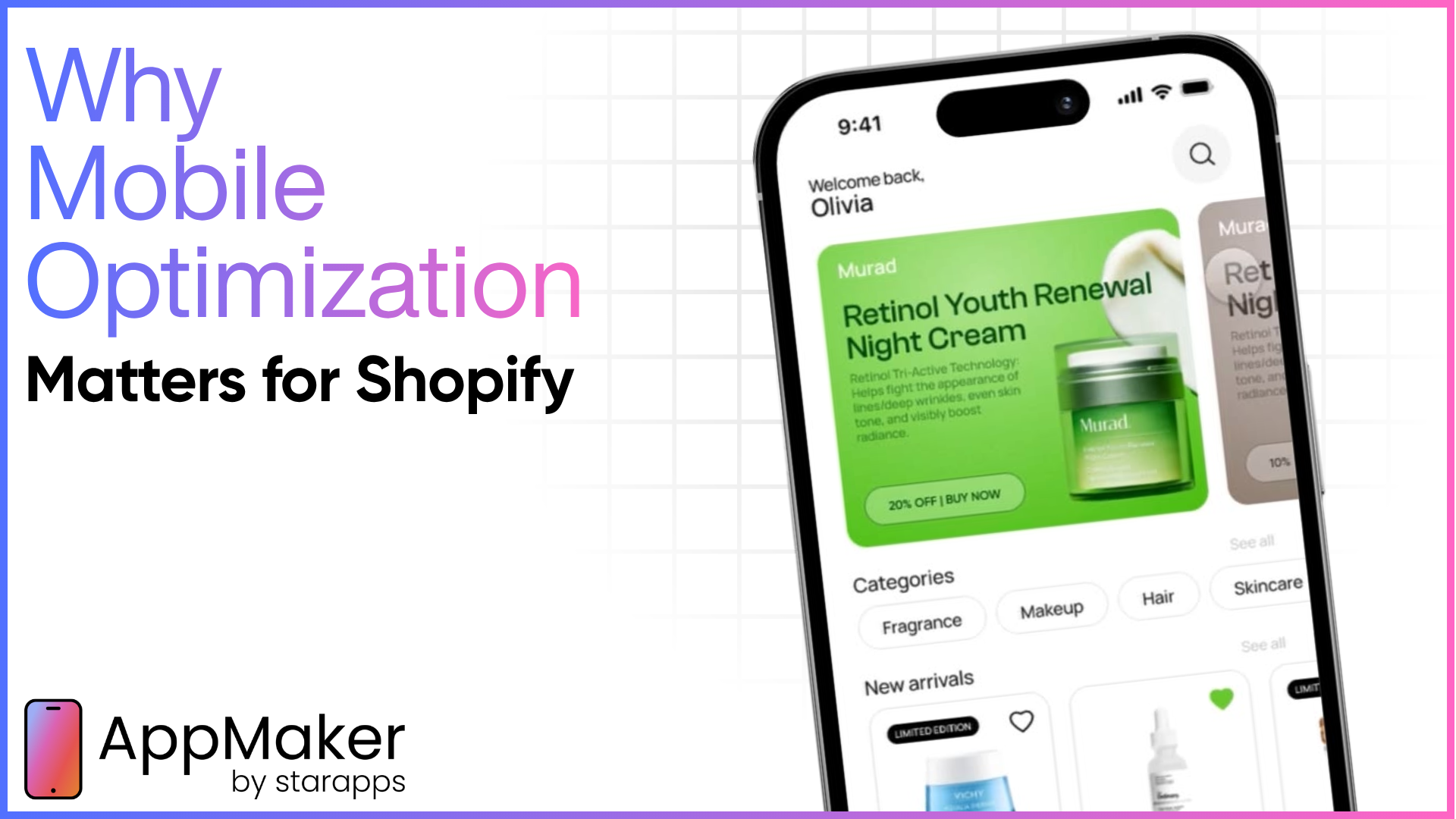
Mobile stopped being an emerging channel some time ago. The current data makes the point plainly.
Worldwide mobile e-commerce sales reached an estimated $2.51 trillion in 2025, up 21.3% year over year, according to Capital One Shopping research. During the 2025 holiday season in the United States, smartphones accounted for 56.4% of all online transactions, up from 54.5% a year earlier, based on Adobe Analytics data covering more than one trillion visits to US retail sites. On Christmas Day, mobile drove 66.5% of online sales.
So the demand has moved to the phone. The problem is what happens next.
Shoppers add to cart on mobile more readily than on desktop, but they complete far less often. Mobile cart abandonment runs materially higher than desktop, and the gap is where most stores lose money they have already spent to acquire. The honest framing for any operator is this: it is no longer "should we invest in mobile", because that was settled years ago. It is "how do we convert the mobile demand we are already paying for, and keep those customers long enough to be profitable?".
That is what mobile commerce optimization is for. The rest of this guide walks the journey stage by stage, with the numbers that justify each priority and the levers that actually move them.
The Mobile Commerce Funnel, And Where Money Leaks
It helps to see the whole funnel before optimising any single part of it, because a gain at one stage is wasted if the next stage leaks worse.
| Journey stage | What the shopper is doing | The main thing that leaks it | The primary lever |
|---|---|---|---|
| Arrival and speed | Landing from ads, search, social, or an app icon | Slow load, layout shift, friction on first paint | Performance, Core Web Vitals, native app speed |
| Discovery | Browsing collections, searching, filtering | Poor search, weak merchandising, choice overload | On-site search, personalised merchandising |
| Onboarding (app) | First session after install | No first-session value, permission fatigue | Value-first onboarding, soft push prompt |
| Product to cart | Evaluating a product, adding to cart | Weak product pages, unclear cost, low trust | Product page UX, upfront pricing, social proof |
| Checkout | Entering details and paying | Long forms, surprise fees, forced accounts | Fewer fields, express pay, guest checkout |
| Recovery | Left without buying | No timely, relevant nudge | Push and lifecycle recovery |
| Retention and loyalty | Deciding whether to return | No reason to come back, no owned channel | Push, loyalty, app-exclusive offers |
| Measurement | Every stage above | No cohort view, guesswork over testing | Analytics and structured experimentation |
Every row below gets its own section. Read them for a full playbook, or jump to the stage that is leaking hardest for your store right now.
The Mobile Commerce Optimization Framework
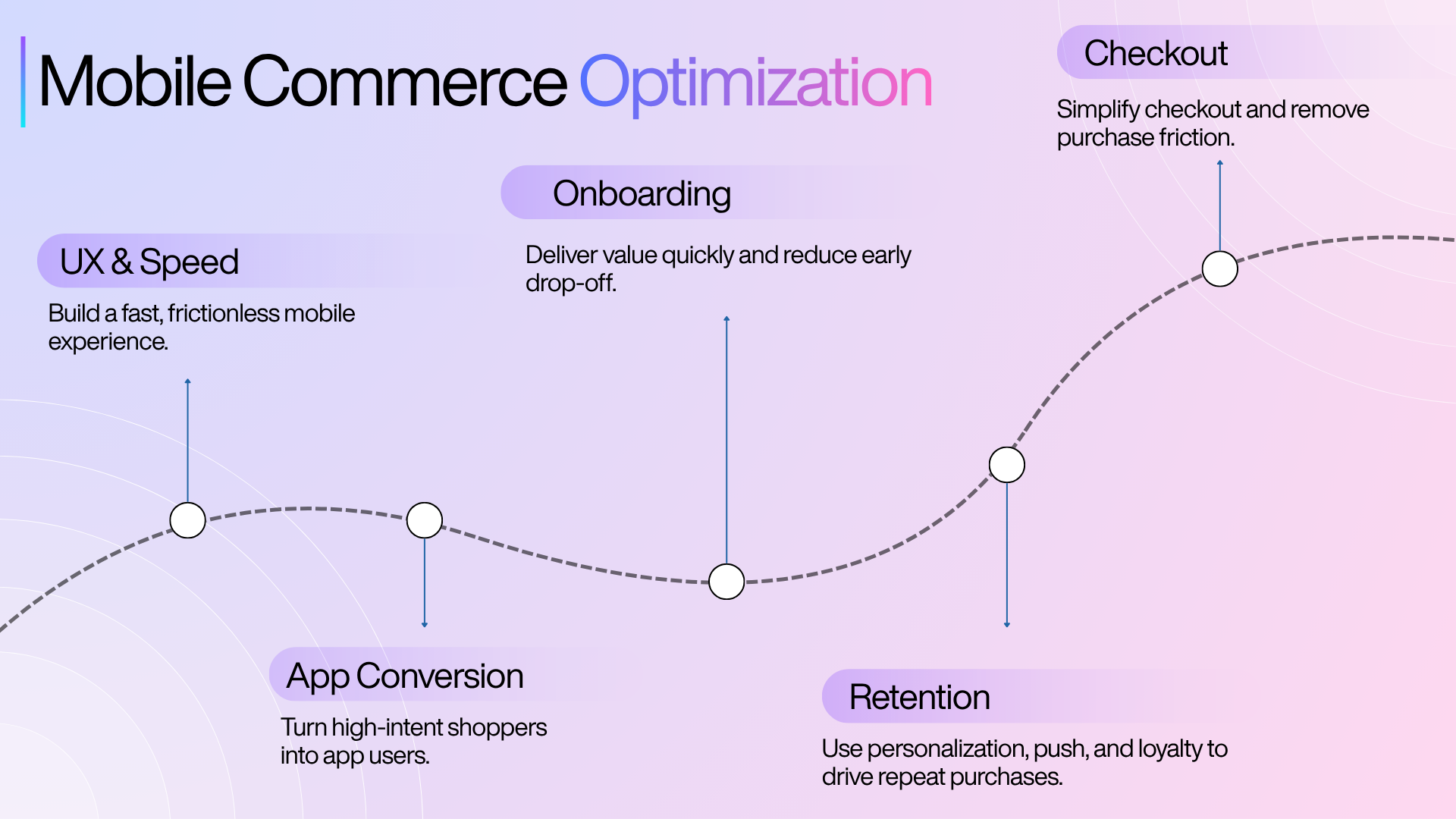
Use this five-stage framework, mapped to the full customer journey.
Stage 1: Mobile Ux And Page Speed: The Foundation Everything Else Sits On
You have seconds before a shopper bounces.
In the Milliseconds Make Millions study, Google and Deloitte analysed mobile site data from 37 retail, travel, luxury, and lead generation brands. A 0.1 second improvement in mobile load time was associated with a retail conversion increase of 8.4% and an average order value increase of 9.2%. Travel conversions rose 10.1%. Critically, this was not the difference between a broken site and a fast one. It was a marginal improvement on already-functioning sites, which means almost every store has speed-based revenue left on the table.
The study also showed where speed matters most in the funnel. Progression from the product details page to the add-to-basket step rose 9.1% with the same 0.1-second improvement, so pre-checkout speed is where retail shoppers are most sensitive.
For a Shopify brand, the practical mobile UX priorities are:
- Core Web Vitals. Google's field standard is Largest Contentful Paint within 2.5 seconds, low interaction latency, and minimal layout shift for at least 75% of real visits. Measure the field record, not just a lab score.
- Product page performance. Because retail sensitivity peaks before checkout, prioritise the speed and clarity of collection and product pages over marginal homepage gains.
- Touch-first design. Large tap targets, thumb-reachable primary actions, minimal typing, and no interstitials that block the first meaningful interaction.
- Ruthless simplicity. Every element competes with a notification, a tab switch, and a short attention window. Remove anything that does not help the shopper move forward.
This is also the structural reason native apps convert better. A native app stores interface elements and product data on the device, so screens load from local files rather than re-rendering through a browser engine on every tap. The result is a consistently faster, smoother experience that a mobile website cannot fully match, and speed compounds through every downstream stage of the funnel.
A native app changes the math on your most valuable customers.
| Factor | Mobile Web | Native App |
|---|---|---|
| Conversion rate | Baseline | Typically higher |
| Session persistence | Weak (re-login) | Strong (stays logged in) |
| Push notifications | Limited | Native, high-visibility |
| Load speed | Network-dependent | Cached, near-instant |
| Repeat purchase rate | Lower | Higher |
| Best role | Discovery, first purchase | Retention, loyalty, LTV |
Stage 2: App Conversion: Why The App Channel Converts Higher
The single most consistent finding in mobile commerce is that app users convert, browse, and repeat at higher rates than mobile web users. The exact multiple varies by source and methodology, so it is worth being precise rather than repeating an inflated headline.
The most defensible way to state it: shopping apps consistently outperform mobile websites on conversion, and the download segment of a brand's audience is more valuable than its anonymous mobile web traffic. There are two honest reasons for the gap, and only one of them is the technology.
First, selection. People who install a brand's app are already more invested. They have shown intent that an anonymous mobile web visitor has not, so a share of the conversion difference is who these users are, not what the app did.
Second, friction and flow. On top of that selection effect, the app genuinely removes friction. There is no re-loading, no re-entering payment details, no competing browser tabs, and there is a persistent login. Add an owned re-engagement channel through push, and the app compounds value in a way the mobile web structurally cannot.
The takeaway for a Shopify operator is not "an app triples conversion for all your traffic". It is more useful than that: your most valuable, highest-intent customers convert and repeat far better inside an app, and an app is how you turn one-time mobile buyers into a retained, reachable base. That is the return, and it shows up in retention and LTV as much as in the first conversion. For the practical build path, see our guide to choosing a Shopify mobile app builder.
Stage 3: Onboarding: The First Session Decides Everything
If you launch an app, onboarding is not a nice-to-have. It is the stage that determines whether retention is even possible, because the drop-off immediately after install is severe.
Across consumer apps, retention falls fast. The average app loses around 75% of daily active users within the first three days after install, based on UXCam's compilation of AppsFlyer and Adjust data. Day 1 retention across categories sits around 25%, falling to roughly 5.7% by Day 30, per Business of Apps. Shopping apps tend to sit above the all-category average because shoppers return to buy, but the shape of the curve is the same: the first session is where you win or lose the user.
Good mobile onboarding does a few specific things:
- Delivers value before asking for anything. Let the shopper browse and feel the app's speed before you request profile data or permissions. Value first, friction later.
- Uses a soft push prompt. Do not fire the system permission dialogue the instant the app opens. Ask in-context, after the user has seen why notifications would help, so the one-shot iOS prompt lands when they are ready to say yes. Airship's benchmarks show why this is worth getting right: opt-in rates vary widely by platform, and the permission is difficult to recover once declined.
- Reaches the activation event quickly. Identify the single in-app action that correlates with retention (often a first browse-to-cart, a wishlist save, or account creation) and design the first session to reach it fast.
Onboarding is also where personalisation should begin. A short, well-designed flow that captures a preference or two lets the app tailor the very first homepage a user sees, which lifts the odds of a first session that ends in intent rather than an uninstall.
Stage 4: Retention: Where Mobile Commerce Economics Are Actually Decided
Acquisition gets the attention, but retention is where the money is made, because a retained mobile customer buys again through a channel you own, at almost no incremental acquisition cost.
The benchmark reality sets the challenge. With the median app retaining only a few percent of installs by Day 30, retention is not something that happens on its own. It is engineered, and the strongest levers are the ones already covered in this guide working together:
- A fast, low-friction experience that is pleasant to return to.
- An owned re-engagement channel through push that brings users back with relevant, timely reasons.
- Personalisation that makes each return feel tailored rather than generic.
- Loyalty and app-exclusive value that give a concrete reason to come back to the app specifically.
The reason the app channel matters so much for retention is compounding. Selection, lower friction, personalisation, and push do not add up. They multiply. A retained app user is reachable, recognised, and one tap from buying, which is why app cohorts tend to show stronger repeat behaviour than mobile web cohorts. The economics of mobile commerce are decided here, not at first conversion. AppMaker's own analysis of mobile app retention strategies breaks down the tactics that reduce early churn.
Stage 5: Checkout: The Highest-Leverage Fix On Mobile
If you optimise one stage, optimise checkout. It is where intent is highest, friction is most concentrated, and the recoverable revenue is largest.
Start with the scale of the problem. The average documented cart abandonment rate is 70.22%, calculated by Baymard Institute across 50 separate studies. That means roughly seven in ten shoppers who add to cart leave without buying, and the rate has hovered near 70% for over a decade.
Some of that is unavoidable. Baymard found that 42% of US online shoppers have abandoned a cart simply because they were "just browsing / not ready to buy". You cannot fix window shopping. But the remaining reasons are mostly fixable, and many can be solved through design alone. Excluding the "just browsing" group, Baymard's documented reasons for abandonment are:
| Reason for abandonment | Share of shoppers |
|---|---|
| Extra costs too high (shipping, tax, fees) | 40% |
| Delivery was too slow | 20% |
| Did not trust the site with card information | 19% |
| Site wanted me to create an account | 18% |
| Too long or complicated checkout process | 17% |
| Website had errors or crashed | 17% |
| Returns policy was not satisfactory | 13% |
| Could not see or calculate total cost up front | 12% |
Source: Baymard Institute.
Read that table as a to-do list. The single biggest lever is showing the true, all-in cost early, so extra costs at the final step do not feel like a surprise. After that, the checkout flow itself is the prize. Baymard's large-scale testing shows an ideal checkout can be as short as 12 to 14 form elements, yet the average US checkout displays 23.48 elements by default. Cutting that down is one of the highest-return design changes available.
The stakes are quantified. Baymard estimates that better checkout design alone could deliver an average 35.26% increase in conversion rate for a large e-commerce site, equal to $260 billion in recoverable orders across the US and EU.
Concrete mobile checkout priorities for a Shopify brand:
- Show total cost up front, including shipping and tax, before the final step.
- Minimise form fields. Use address autocomplete, combine fields, and hide optional fields by default.
- Offer guest checkout. Do not force account creation. Offer it after the purchase instead.
- Lead with express and mobile-native payment. One-tap wallets remove the single most painful mobile task, typing card details on a phone.
- Support flexible payment where it fits. Buy Now Pay Later hit an all-time high during the 2025 US holiday season, contributing $20 billion in online spend, and smartphones drove 82.2% of those BNPL purchases, per Adobe. On mobile specifically, flexible payment is disproportionately a mobile behaviour.
An app changes the checkout maths further, because a logged-in user with saved details and a stored payment method skips almost every field that causes mobile abandonment.
Product Discovery And Merchandising On A Small Screen
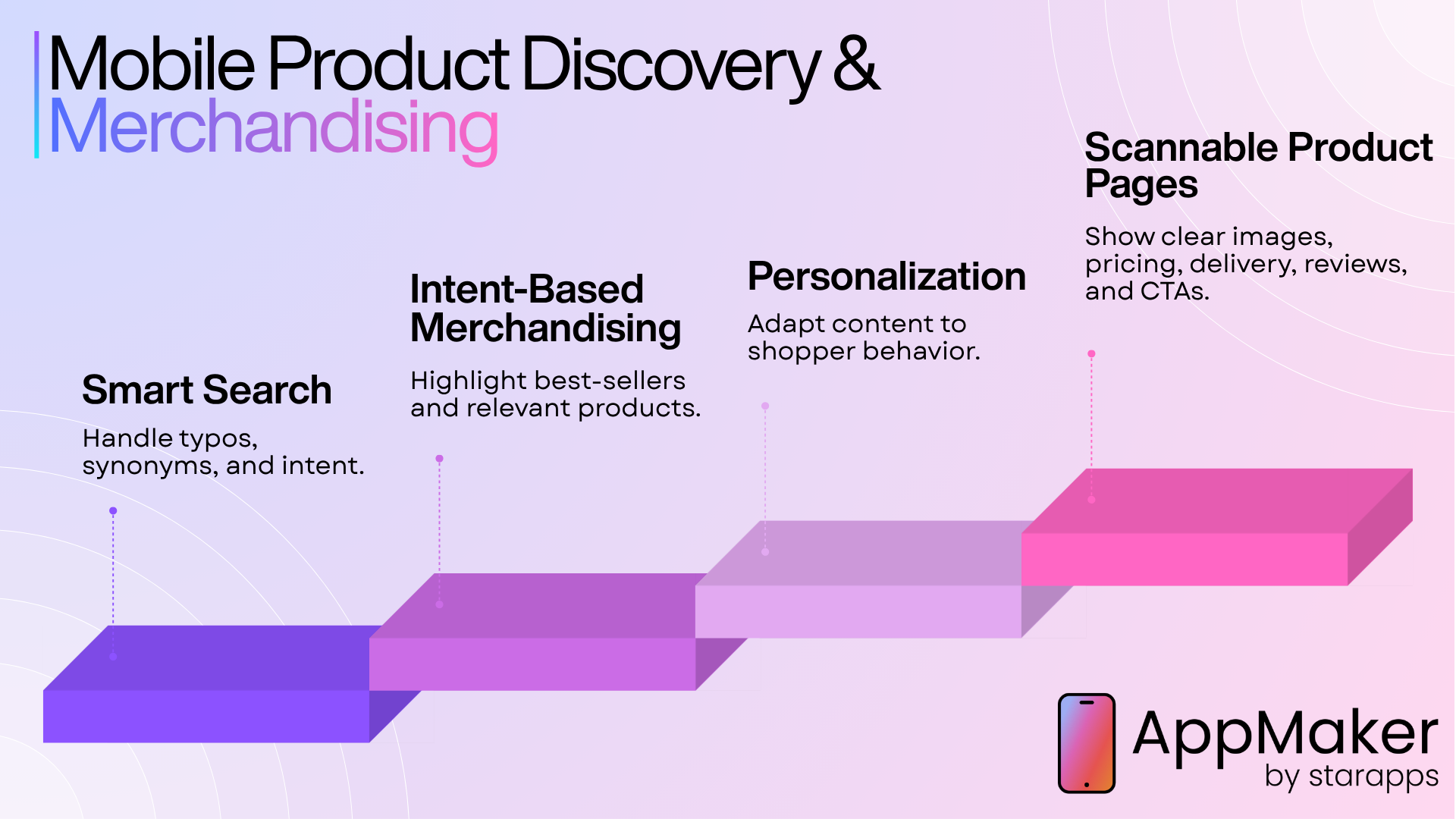
Discovery is the quiet conversion killer on mobile. A shopper who cannot find, filter, or trust a product will not add it to cart, no matter how fast the page loads.
On a phone, the constraints are real: limited screen space, no hover, and a shopper who will not scroll through a hundred results. The levers that matter most:
- On-site search that works. Mobile shoppers who search convert at higher rates because they signal intent, but only if search understands synonyms, handles typos, and returns relevant results. Weak search silently caps mobile revenue.
- Merchandising for intent, not inventory. Surface best-sellers, new arrivals, and personalised picks near the top. Do not make the shopper do the work of finding what they are most likely to want.
- Personalised layouts. Homepages, banners, and collections that adapt to browsing and purchase history outperform a single static layout for everyone. This is where an app's persistent identity gives it an edge over cookie-dependent mobile web.
- Rich, scannable product pages. Clear imagery, upfront pricing, delivery expectations, reviews, and a prominent add-to-cart action. Trust and clarity here directly reduce checkout-stage abandonment later.
Mobile Ux Checklist: What Great Shopping Experiences Get Right
Great mobile UX is invisible; shoppers only notice when it's broken. Audit against this checklist:
Speed: LCP under 2.5s, next-gen image formats, lazy loading
Discovery: drastic
- Persistent, predictive search
- Filters and sorting sized for small screens
- No more than 2–3 taps from home to product
Product pages
- Swipeable, zoomable galleries
- Reviews and social proof above the fold
- Clear inventory, shipping, and return information
Checkout
- Express wallets first
- Minimal fields with autofill
- Progress clarity, no forced signup
Every fix here chips away at the ∼70% abandonment average and lifts the conversion rate you'll track later.
Personalised discovery is not a luxury feature bolted on at the end. It is how you compress a long browse into a short path to cart on a device where attention is scarce.
Personalisation: The Multiplier Across Every Stage
Personalisation is not a single feature. It is a multiplier that makes discovery, merchandising, recovery, and retention all work harder, because a relevant experience converts better than a generic one at every stage.
On mobile, personalisation is both harder and more valuable. Harder, because mobile web relies on cookies and session data that are increasingly unreliable. More valuable, because screen space is scarce, so showing the right thing first matters more than on desktop.
Where personalisation earns its keep:
- Adaptive homepages and banners that reshape around what a shopper browses and buys, rather than showing everyone the same layout.
- Behaviour-triggered messaging that responds to real actions, such as an abandoned cart, a wishlist item back in stock, or a price drop on a viewed product.
- Personalised product recommendations that shorten the path from browse to cart.
- Segmented campaigns that send the right offer to the right cohort instead of blasting the whole list.
This is a structural advantage of the app channel. Because an app has a persistent, logged-in identity, it can personalise reliably where mobile web increasingly cannot. AppMaker's approach builds this in: John AI acts as an in-app analytics and campaign assistant, so teams can adapt content and target segments without waiting on a development cycle.
Cart Abandonment Recovery: Catching The Intent You Already Earned
Prevention comes first, but no checkout converts everyone. Recovery is how you win back shoppers who left with genuine intent, and the channel you use decides how much you recover.
The behaviour to exploit is timing. Abandoned-cart outreach works best when it is fast and relevant, while the product is still in mind. Email remains the workhorse and is worth automating well. But on mobile, the more direct channel is push.
A push notification lands on the lock screen, the most valuable real estate on the device, without competing in a crowded inbox. For a brand with an app, an abandoned-cart push is often the fastest, highest-visibility recovery message available, and it costs nothing per send. Behaviour-triggered notifications tied to a specific cart, browsing session, or price drop consistently outperform generic broadcasts.
The layered recovery approach that works:
- Real-time, behaviour-triggered push for app users who abandoned, sent while intent is fresh.
- Automated email sequences for the broader base, with the first message sent promptly rather than a day later.
- Segmented offers reserved for genuine hesitation, not handed to every shopper by default, so you do not train customers to abandon in order to earn a discount.
Recovery is not a bolt-on. It is the natural partner of checkout optimisation: fix the leaks you can, then catch the intent that still slips through. For how push fits into a wider re-engagement plan, see our guide to Shopify mobile app growth strategies.
Push Notifications: The Owned Channel That Makes Apps Pay Off
Push notifications are the mechanism that turns an app from a second storefront into a retention engine. They are the reason the app channel compounds, and the data on their impact is strong.
The headline finding, from Airship's study of tens of millions of users: retention was nearly three times higher for users who received one or more push notifications in their first 90 days, compared with users who received none. Push is not a nudge at the margins. It is one of the single largest measurable drivers of whether a user stays.
Opt-in is where it starts, and it is not automatic. Airship's benchmark data shows median opt-in rates of around 61.4% on Android and 49.8% on iOS in 2024, with wide variation by category. The platform gap is the reason a soft prompt matters so much: on iOS, roughly half of users decline, and the system permission is hard to recover once refused.
What separates push that works from push that gets muted:
- Segment, do not broadcast: Relevance is the whole game. Highly segmented campaigns dramatically outperform untargeted blasts, yet a large share of push is still sent to everyone at once.
- Trigger on behaviour: Cart abandonment, back-in-stock, price drops, and post-purchase moments outperform calendar-based sends.
- Respect frequency: Over-messaging is the fastest way to earn an opt-out. Cap frequency and reserve interruption for genuinely useful, timely messages.
- Use rich formats where they fit: Images and richer notifications can lift engagement over plain text.
Push is also the connective tissue of the whole funnel. It is the recovery channel for abandoned carts, the delivery mechanism for app-exclusive offers, and the reason retention is possible at all. For a deeper treatment, see our mobile app retention strategies guide.
Loyalty, App-Exclusive Offers, And AOV
Loyalty and app-exclusive value do two jobs at once: they give shoppers a reason to install and return to the app, and they lift average order value and repeat purchase rate among your most engaged customers.
The logic is straightforward. Your app audience is self-selected to be your best customers, so concentrating loyalty rewards, early access, and exclusive offers in the app both rewards that value and pulls more customers into your highest-converting, most retainable channel.
Levers that lift AOV and repeat purchases on mobile:
- App-exclusive offers and early access that make the app the best place to buy, not just another place.
- Loyalty programmes that are visible and easy to engage with inside the app, so points and status are a reason to open it.
- Bundling and thoughtful cross-sell at the cart and product stage, which lift order value without adding checkout friction.
- Post-purchase engagement that turns a first order into a second, using push and personalisation rather than paid re-acquisition.
Every one of these moves AOV and repeat rate, which is what turns a channel with a higher conversion rate into a channel with materially higher lifetime value.
LTV, ROI And The Business Case For Mobile Optimisation
All of the above ladders up to two numbers a founder or operator actually cares about: customer lifetime value and return on investment. Mobile commerce optimization is worth doing only if it moves them, and the mechanism by which it does is worth stating plainly.
LTV rises when the levers in this guide combine. Higher conversion turns more of your existing traffic into customers. Higher AOV increases the value of each order. Higher retention and repeat rate multiply the number of orders per customer over time. Because these compound, a brand that improves several of them together sees LTV move more than any single metric would suggest.
ROI comes from the fact that most of these gains come from traffic and customers you have already paid to acquire. Recovering abandoned carts, converting more mobile visitors, lifting order value, and re-engaging existing users through an owned push channel are all far cheaper than buying new customers. The Deloitte and Google speed finding is the clearest illustration: an 8.4% retail conversion lift from a 0.1 second speed improvement is 8.4% more revenue from the same traffic at the same acquisition cost.
This is where a purpose-built platform earns its place. AppMaker is designed around mobile commerce performance and return, pairing a no-code studio and deep customisation with AI-assisted design through Eidolon AI and an in-app analytics and campaign assistant in John AI, so teams can tie decisions to revenue, LTV, and campaign outcomes rather than to dashboards alone. The point of the tooling is not features for their own sake. It is to make the optimisation loop, from insight to action, fast enough to actually run.
Analytics And Experimentation: The Loop That Ties It Together
None of this works as a one-time project. Mobile commerce optimization is a loop, and the loop only turns if you can measure the right things and test changes systematically.
The metrics that matter, by stage:
| Metric | What it tells you | Where it maps in this guide |
|---|---|---|
| Mobile conversion rate | Whether you are converting the traffic you have | UX, checkout, app conversion |
| Cart and checkout abandonment | Where and how badly checkout leaks | Checkout, recovery |
| Average order value (AOV) | Value per order | Loyalty, bundling, cross-sell |
| Retention (Day 1, 7, 30) | Whether users come back | Onboarding, retention, push |
| Repeat purchase rate | Whether customers buy again | Retention, loyalty |
| Push opt-in and reaction | Health of your owned channel | Push, onboarding |
| Customer lifetime value (LTV) | The compounding outcome | The whole funnel |
Two practices separate teams that improve from teams that guess:
- Cohort analysis. Group users by install date or first action to see where engagement drops and whether changes actually help, rather than reading a single blended average that hides the truth.
- Structured experimentation. Test one meaningful change at a time, against a clear metric, so you learn what caused a result. The brands that compound gains are the ones that test faster than their competitors, not the ones with the most opinions.
An in-app analytics assistant like John AI is useful here precisely because it shortens the distance between a question ("which products drive the most repeat purchases?") and an answer you can act on, which is what keeps the optimisation loop turning at a useful pace.
Optimising For AI Answer Engines And Search
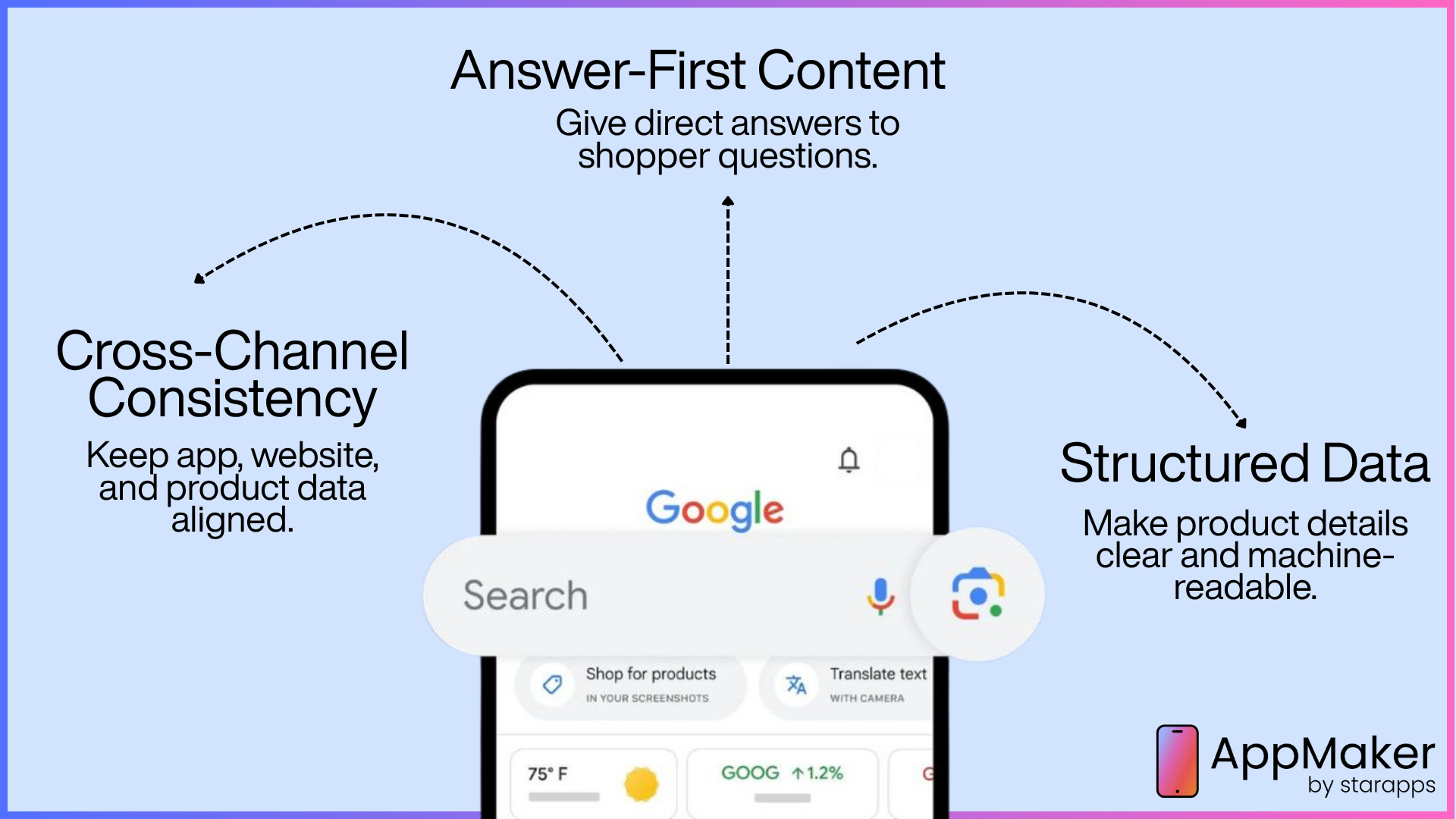
One shift deserves its own note, because it is changing how discovery works. Shoppers increasingly research and find products through generative AI tools, not only through traditional search.
Adobe reported that during the 2025 US holiday season, traffic to retail sites from generative AI tools rose 693.4% year over year, and that these visitors converted at a higher rate than non-AI traffic once they landed. The base is still modest, but the trajectory is steep, and it means product information needs to be structured so that answer engines can read and cite it.
For a Shopify brand, the practical implications are:
- Structured data. Clear, machine-readable product information (pricing, availability, reviews, specifications) helps both traditional search and AI answer engines understand and surface your products.
- Answer-first content. Concise, direct answers to real shopper questions are what AI systems retrieve and cite. Bury the answer, and you are invisible to them.
- Consistency across channels. An app, a mobile site, and structured product data that agree with each other present a coherent entity that both search and AI systems can trust.
Optimising for answer engines is not separate from mobile commerce optimization. It is the discovery stage of the same funnel, evolving to meet how people now shop.
A 90-Day Optimization Roadmap
Days 1–30: Diagnose and fix leaks
- Audit Core Web Vitals; fix the worst speed offenders
- Segment analytics by device; find where mobile conversion lags
- Streamline checkout: express wallets, guest checkout, no surprise costs
Days 31–60: Build retention infrastructure
- Launch or refine a native app to capture repeat buyers
- Set up segmented push flows (cart, back-in-stock, shipping)
- Stand up a loyalty program
Days 61–90: Grow revenue per customer
- Add AOV levers: bundles, thresholds, one-tap upsells
- Launch app-exclusive offers to drive adoption
- Build an ROI dashboard tracking conversion, AOV, RPR, and LTV by channel
Run it as a repeating quarterly loop. Optimization only compounds when it's continuous.
How AppMaker Fits In
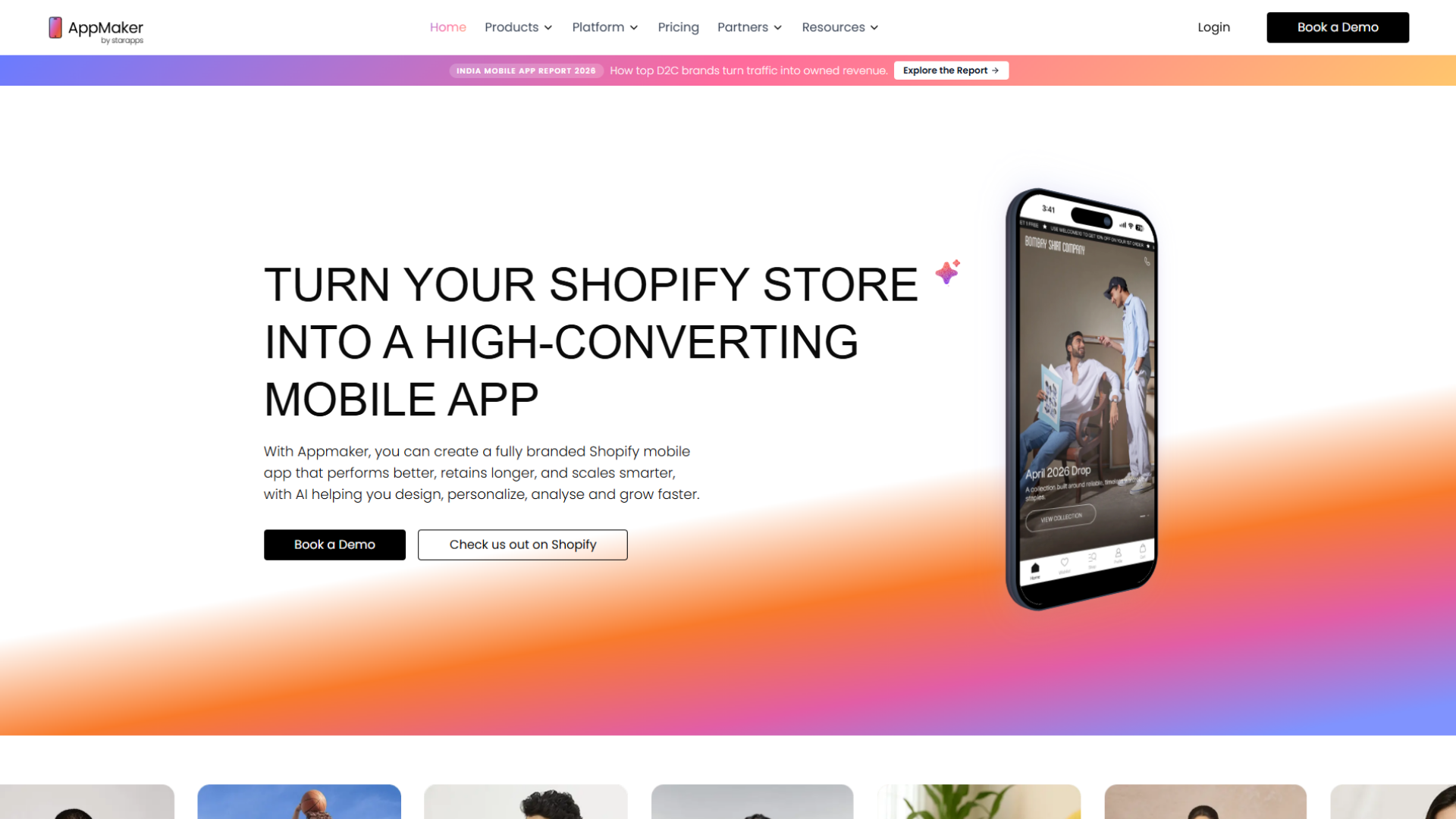
AppMaker converts an existing Shopify store into a high-performance native iOS and Android app no rebuild required. Catalog, checkout, customer data, and Shopify apps sync automatically, so you gain the app channel's conversion, retention, and LTV advantages while keeping Shopify as your single source of truth.
For Shopify and DTC brands, that makes the harder parts of this guide native push, persistent login, app-exclusive offers, loyalty, and measurable ROI operational in weeks rather than quarters. It's built as a mobile commerce performance platform: the goal isn't just shipping an app; it's measurable lift in the metrics that define the business.
Frequently Asked Questions
What Is Mobile Commerce Optimization?
Mobile commerce optimization is the practice of improving every stage of the smartphone shopping journey, from page speed and product discovery to checkout, recovery, retention, and loyalty, so a brand converts more of its mobile traffic and grows the lifetime value of each mobile customer. It is broader than a mobile-friendly website and treats conversion, AOV, retention, and LTV as one connected system.
Why Does Mobile Convert Lower Than Desktop?
Mobile shoppers browse and add to cart readily but complete less often, largely because of friction: small screens, typing on a phone, slower pages, surprise costs at checkout, and constant distraction from other apps. The intent is there. The friction is the problem, which is why speed and checkout simplification are the highest-leverage fixes, and why apps, which remove much of that friction, convert higher.
Do Mobile Apps Really Convert Better Than Mobile Websites?
Yes, consistently, though the size of the gap varies by source and methodology. Two things drive it: selection, because people who install an app are already more invested, and friction, because apps remove re-loading, re-entering payment details, and competing tabs, while adding an owned push channel. The most useful framing is that your highest-intent customers convert and repeat far better inside an app, so the return shows up in retention and LTV as much as first conversion.
What Is A Good Mobile Cart Abandonment Rate?
The average documented cart abandonment rate across devices is about 70%, per Baymard Institute, and mobile typically runs higher than desktop. A large share of that is unavoidable browsing, but the fixable causes (surprise costs, slow delivery, forced accounts, long checkouts) mean most stores can beat the average with focused checkout work. Baymard estimates better checkout design alone can lift conversion by around 35% for a large site.
How Do Push Notifications Affect Retention?
Strongly. Airship's research found retention was nearly three times higher for users who received at least one push notification in their first 90 days than for those who received none. The caveat is relevance and restraint: segmented, behaviour-triggered notifications sent at a sensible frequency drive retention, while untargeted or over-frequent blasts drive opt-outs.
How Does Mobile Commerce Optimization Improve ROI And LTV?
It lifts conversion, AOV, retention, and repeat rate together, and because these compound, lifetime value moves more than any single metric would suggest. The ROI is strong because most of the gains come from traffic and customers you have already paid to acquire; recovering carts, converting existing visitors, and re-engaging users through an owned channel is far cheaper than buying new customers.
Where Should A Shopify Brand Start?
Start where you leak hardest. For most stores, that is mobile page speed and checkout, because both are high-leverage and measurable. Fix speed on product and collection pages, cut checkout to the essential fields, show total cost up front, and offer express payment and guest checkout. Then build the owned re-engagement layer, an app with push, personalisation, and loyalty, to convert those first purchases into retained, higher-LTV customers.