

























Mobile apps are everywhere, but most struggle to keep users engaged. People download an app, use it once or twice, and then move on. Growth becomes difficult, especially for e-commerce and D2C brands that rely on repeat visits. The reality is stark: the average app loses 77% of daily active users within the first three days after install.
For these brands, early churn can mean lost sales, missed repeat orders, and wasted marketing spend. Understanding why users leave and how to keep them coming back is essential.
In this blog, we’ll explore 8 proven mobile app retention strategies, from personalized onboarding and AI-driven experiences to gamification and smart messaging, to help you turn casual visitors into loyal customers.
Overview
- Mobile app retention determines whether users return or drop off, making early engagement essential for growth.
- Tracking DAU/MAU, churn, session behavior, and LTV helps identify which users are forming habits.
- Personalized onboarding, AI-driven content, gamification, and smart messaging turn casual visitors into repeat users.
- Poor onboarding, feature overload, misaligned business goals, and ignoring market factors can silently reduce retention.
- Continuous testing, feedback loops, and re-engagement campaigns ensure strategies adapt to real user behavior and drive long-term loyalty.
What Is Mobile Retention and How to Measure It?
Retention tells you whether users come back after install or vanish after the first session. Churn shows where that relationship breaks. For mobile apps, especially D2C and ecommerce, this gap usually appears within the first 7 days.
Industry data, as per Mobile App Trends: 2025 Edition by Adjust, an AppLovin company, shows that e-commerce apps average just 1.37 sessions per user on Day 0, meaning early interaction depth is already limited. If users don’t return early, no amount of re-engagement later will fix it.
Which metrics actually matter for retention strategy?
Not every metric helps you improve retention. The ones that matter are the signals that show whether users are forming a habit or slowly drifting away. This matters even more when you consider that 80% of shoppers have 3+ shopping apps installed, as per the 2025 BFCM Strategy Report.
The key retention-focused metrics include:
- DAU/MAU Ratio: Highlights how frequently users return. For ecommerce apps, crossing the mark usually indicates intent-driven opens, checking orders, restocks, or active offers rather than passive browsing. Apps convert 3–8% versus low mobile-web conversion rates, demonstrating why a dedicated app experience drives higher ROI.
- Day 1–7 Churn Rate: Exposes early friction. Spikes often signal onboarding gaps, slow load times, or irrelevant first-session experiences. Reducing early churn even slightly can boost repeat purchases and lower acquisition costs.
- Session Frequency vs. Duration: Shows engagement quality. In commerce apps, frequent short sessions usually reflect stronger retention than one-off, long sessions.
- User Lifetime Value (LTV): Connects behavior to revenue, showing which actions lead to repeat purchases and long-term app usage.
- Cohort & Behavioral Analysis: Groups users by signup source or in-app actions. It helps identify which onboarding flows, personalized layouts, or notifications consistently convert first-time users into regulars. Here, push notifications outperform email 5–10x in driving repeat visits and purchases, proving app-first retention is highly effective.
Now that we understand the key metrics that reveal user behavior, let’s explore real retention benchmarks. We will also learn why these numbers matter for your app’s growth and revenue.
Also Read: How to Improve App Engagement in 2026: 8 Proven Strategies
Mobile App Retention – Key Stats & Why It Matters
Mobile app retention drops faster than most teams anticipate. Industry benchmarks show Day 1 retention averaging 25%, falling to 10–15% by Day 7, and often dipping below 10% by Day 30. For ecommerce and D2C apps, this directly affects repeat purchases, order frequency, and customer lifetime value.
Retention matters because every returning user lowers acquisition dependency and increases revenue per install. An app with strong retention can grow without constantly buying traffic. However, one with poor retention cannot scale sustainably.
Having covered industry retention stats, the next step is to dive into actionable strategies that consistently convert first-time users into loyal, repeat customers.
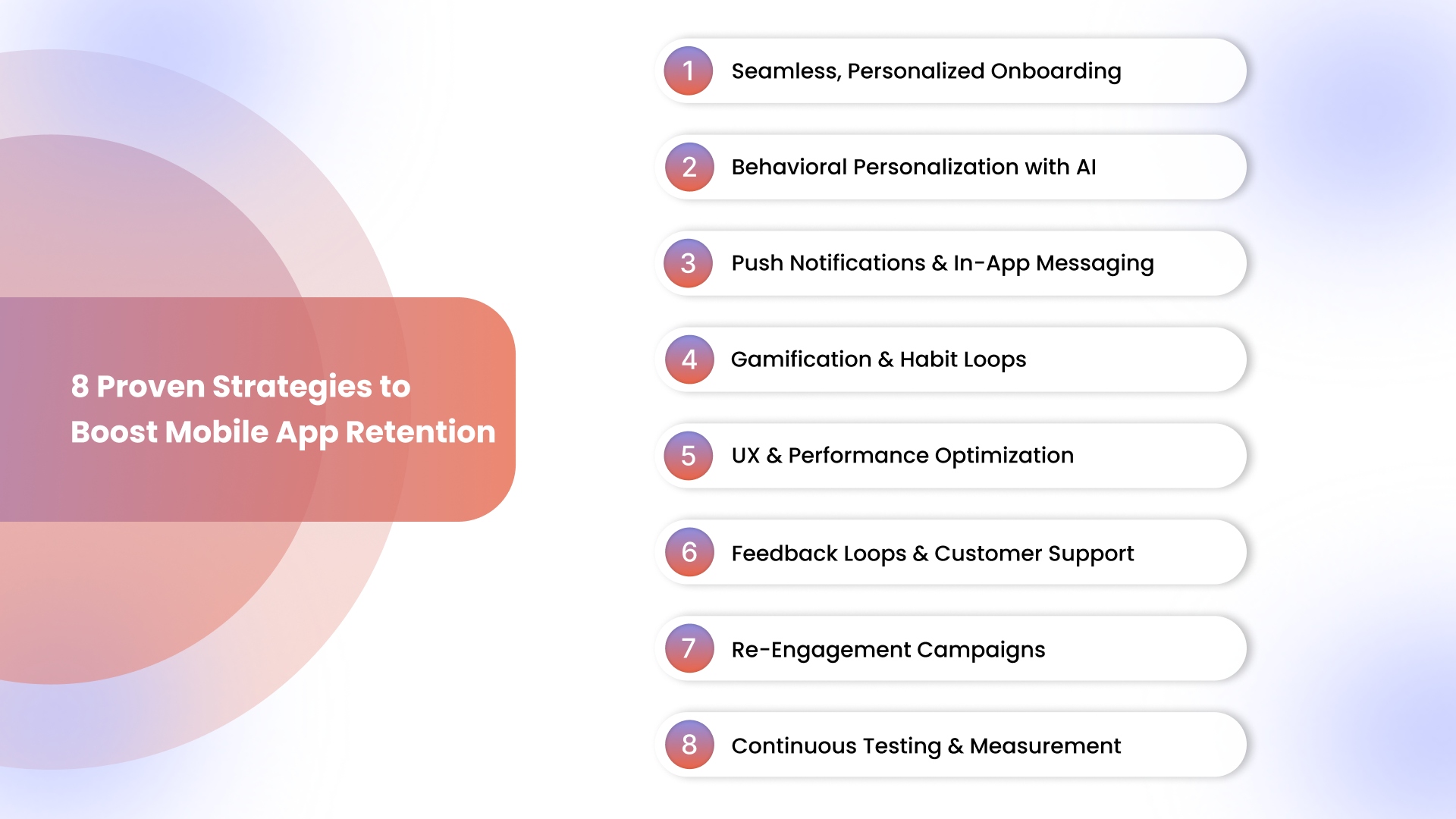
8 Proven Strategies to Boost Mobile App Retention in 2026
Retention doesn’t happen by chance. The eight actionable strategies below will guide you in converting first-time users into loyal, repeat customers, boosting engagement, revenue, and long-term growth.
1. Seamless, Personalized Onboarding
Your app’s onboarding is where users form their first impression. Guiding them through key features while showing immediate, relevant value helps reduce Day 1 churn and encourages habitual engagement. For D2C and e-commerce apps, making early sessions feel tailored can make users feel understood and valued.
How to approach it:
- Tailor the journey: Show users the features that matter most based on their profile or signup path.
- Deliver value fast: Let users experience a meaningful feature immediately, like creating a wishlist or personal plan.
- Guide progressively: Reveal advanced features step by step to avoid overwhelm.
- Use contextual tips: Offer hints and suggestions that feel natural within the flow, helping users explore without friction.
2. Behavioral Personalization with AI
Generic app experiences rarely keep users coming back. By utilizing AI tools like AppMaker’s Eidolon AI and Rubik AI, you can dynamically tailor layouts, product recommendations, and content to each user’s behavior. Engagement hooks, such as highlighting trending items or nudging users to complete an abandoned checklist, help turn casual visits into habitual interactions.
How to approach it:
- Dynamic layouts: Adjust home screens and sections based on user activity.
- Smart recommendations: Suggest products or content aligned with past behavior.
- Behavioral nudges: Prompt users to complete key actions like checkouts or forms.
- Trending highlights: Showcase popular items or features that resonate with similar users.
3. Push Notifications & In-App Messaging
Messaging works only when it’s timely, relevant, and personalized. Well-targeted push notifications, like alerting users about a flash sale on items they viewed, and in-app messages triggered by behavior, such as completing profile setup, keep users engaged. In fact, push notifications outperform email 5–10x in driving repeat purchases, making them one of the most effective retention tools for ecommerce and D2C apps.
How to approach it:
- Contextual timing: Send messages when users are most likely to act.
- Behavioral triggers: Guide users based on actions like cart abandonment or wishlist updates.
- Segmentation: Personalize content for different user types or purchase behavior.
- Test and iterate: Experiment with copy, frequency, and timing to maximize engagement.
4. Gamification & Habit Loops
Repeatable, rewarding experiences turn casual users into loyal ones. Engagement hooks, streaks, micro-rewards, and loyalty programs create habit-forming interactions. In fact, Gaming app session lengths increased to 30.75 minutes on average in 2024, as per Mobile App Trends: 2025 Edition by Adjust, an AppLovin company. This rise shows how strong loops keep users engaged.
How to approach it:
- Progress tracking: Show streaks, points, or levels for completed actions.
- Micro-rewards: Offer badges or discounts for repeat engagement.
- Loyalty integration: Tie rewards to purchases or app milestones.
- Encourage routine: Design actions that can become daily or weekly habits.
Also Read: How to Create a Business Mobile App Easily in 2026
5. UX & Performance Optimization
Even perfect strategies fail if the app underperforms. Smooth navigation, fast load times, and crash-free experiences are important, especially for Shopify D2C apps where product pages and checkout must load instantly.
How to approach it:
- Optimize speed: Compress images and simplify page load.
- Intuitive navigation: Make key features easy to find.
- Stability checks: Monitor and fix crashes or bugs proactively.
- Mobile-first design: Ensure layouts and interactions feel native on all devices.
6. Feedback Loops & Customer Support
Listening to your users is essential for retention. Quick in-app surveys, feedback prompts, and AI-powered support help users resolve issues fast, while giving you insights to improve features and reduce churn.
How to approach it:
- Instant surveys: Ask for feedback immediately after key actions, like completing a purchase.
- Behavior-triggered prompts: Request input when users encounter friction or drop off.
- AI support: Offer real-time help for common issues to prevent frustration.
- Actionable insights: Use responses to refine features and personalization.
7. Re-Engagement Campaigns
Dormant users can return with carefully timed messages, emails, or offers. Segment users by inactivity to craft the right incentive, increasing the chances of winning them back.
How to approach it:
- Segment by inactivity: Tailor messages for short- vs long-term dormant users.
- Personalized nudges: Highlight relevant products or features they previously engaged with.
- Exclusive offers: Provide discounts or rewards to entice reactivation.
- Monitor outcomes: Track which campaigns revive the most users and iterate.
8. Continuous Testing & Measurement
Retention improves when you test and measure consistently. A/B testing, cohort analysis, and benchmarking help refine onboarding, messaging, and engagement strategies based on real user behavior.
How to approach it:
- A/B test flows: Experiment with onboarding, push timing, or reward mechanisms.
- Cohort analysis: Track user segments to identify what drives engagement.
- Benchmark retention: Compare your metrics to industry standards for context.
- Tie to revenue: Measure retention against LTV and repeat purchase frequency to guide decisions.
Executing these retention improvements consistently often requires a platform that combines analytics, experimentation, and real-time action. AppMaker enables ecommerce teams to test, iterate, and respond to user behavior inside their mobile apps without engineering bottlenecks.
Having explored eight high-impact strategies, let’s turn to common pitfalls that c, an silently undermine your retention efforts if overlooked.
4 Common Mobile App Retention Mistakes You Must Avoid
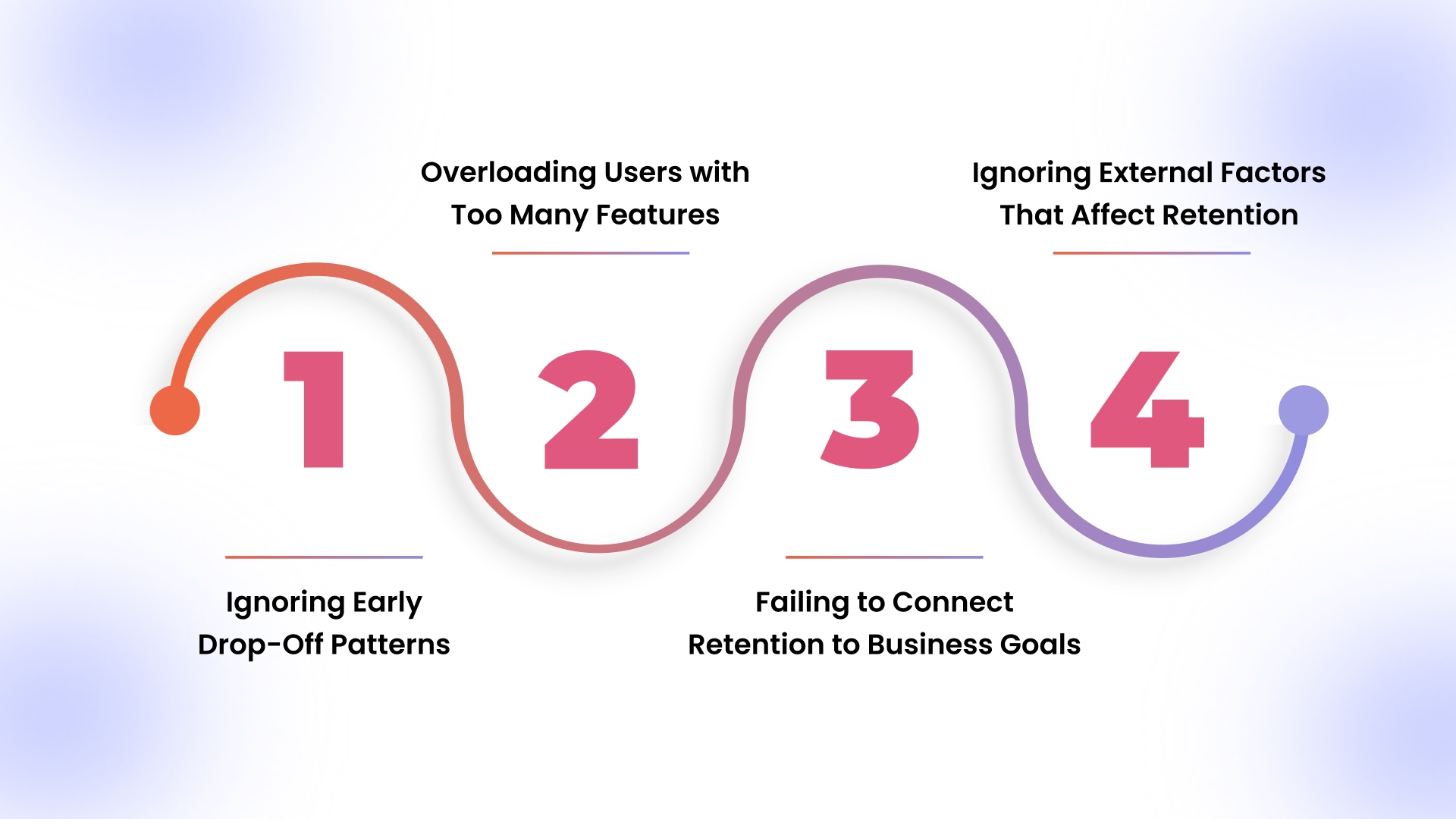
Even the best strategies won’t work if you fall into hidden traps. Here are four mistakes that can silently affect your app’s ability to turn users into regulars.
1. Ignoring Early Drop-Off Patterns
Focusing only on long-term retention while ignoring Day 1–7 churn is a costly mistake. Early disengagement often signals onboarding friction or unclear value. For example, a subscription-based wellness app may lose most new users within the first week if they aren’t guided to set up a daily routine. Tracking early drop-offs lets you intervene before habits form elsewhere.
2. Overloading Users with Too Many Features
Presenting too many options or complex menus overwhelms users. E-commerce apps with cluttered navigation risk confusing shoppers. Simplify flows, highlight key actions, and make the path to value obvious to keep users engaged rather than lost.
3. Failing to Connect Retention to Business Goals
High engagement metrics mean little if they don’t translate into revenue, repeat purchases, or subscriptions. An app may have strong DAU/MAU ratios yet fail to increase sales. Align retention initiatives with measurable business outcomes to ensure engagement drives real growth.
4. Ignoring External Factors That Affect Retention
Retention isn’t shaped by your app alone. Market trends, seasonal demand, competitor promotions, or app store visibility can influence usage. For instance, a seasonal product app may see drops in retention if stock or promotions aren’t timed well. Accounting for these external factors lets you adjust proactively and maintain steady engagement.
Understanding these external factors highlights the need for a platform that turns retention strategy into actionable, real-time execution.
Executing Mobile App Retention Strategies at Scale with AppMaker
While retention strategies sound effective in theory, executing them consistently requires real-time data, personalization, and seamless Shopify integration. AppMaker enables ecommerce and D2C brands to operationalize mobile app retention strategies without engineering complexity, helping teams act on user behavior as it happens: an approach that has already supported ₹1,000Cr+ in GMV through mobile apps in 2025.
- John AI: An in-dashboard AI assistant that helps teams quickly interpret app engagement data, identify performance gaps, and act faster on retention opportunities without manual analysis or complex reporting.
- Real-time Shopify Sync: Keeps products, inventory, and user activity updated instantly to support timely engagement.
- AI-Driven Personalization: Eidolon AI and Rubik AI tailor layouts, content, and recommendations based on user behavior.
- Behavior-Triggered Messaging: Push notifications and in-app messages activate based on browsing, cart, and purchase actions.
- Dynamic App Layouts: Home screens and content adapt in real time to user intent.
- No-Code Optimization: Teams can test, iterate, and refine retention flows without developer dependency.
By connecting retention strategy to execution, AppMaker helps brands reduce early churn, encourage repeat usage, and build long-term user habits within their mobile apps.
Also Read: Complete Guide to Ecommerce App Development Cost in 2026
Conclusion
An app succeeds only when users keep coming back. By understanding key metrics like DAU/MAU, churn, session frequency, and LTV, and implementing targeted strategies such as personalized onboarding, AI-driven engagement hooks, gamification, and performance optimization, you can turn first-time users into habitual, loyal customers.
For Shopify-based D2C and e-commerce apps, AppMaker makes executing these retention strategies seamless. From real-time store sync to AI-powered personalization with tools like Eidolon AI and Rubik AI, AppMaker encourages brands to create engaging, high-performing mobile apps without coding.
Take the next step in boosting your app retention; contact us today and start turning casual users into loyal advocates.
FAQs
1. How is app retention significant for an app development company?
High retention shows users find value and engage consistently. For development companies, it proves app quality, boosts credibility, attracts clients, and reduces post-launch issues, supporting long-term client satisfaction and revenue.
2. What are the most effective ways to reduce early churn in mobile apps?
Use personalized onboarding, early-value demonstrations, and progressive guidance. Track Day 1–7 behavior, address friction points, and introduce features gradually to help users quickly see value and stay engaged.
3. How can AI-driven personalization improve user retention in D2C and e-commerce apps?
AI dynamically adjusts content, layouts, and recommendations. Personalized nudges, trending highlights, and behavior-based suggestions turn casual visitors into habitual users. It increases engagement, repeat purchases, and long-term loyalty.
4. Why should businesses combine retention strategies with performance optimization and testing?
Retention fails without smooth performance. Continuous A/B testing, cohort analysis, and app optimization ensure engagement strategies deliver results, keeping the experience fast, intuitive, and reliable for all users.