
























Key Takeaways
- Mobiloud is a webview "site-to-app" converter, not a fully native build, great for some stores, limiting for others.
- Native app builders give you a separate design layer, deeper push, and device features a wrapped site can't reach.
- "Alternative" isn't one category: entry builders start near $99/mo; managed native platforms run into the thousands.
- Your best fit depends on catalog complexity, how much you'll diverge from a template, and self-serve vs. done-for-you.
- Appmaker suits high-growth Shopify Plus brands wanting open, extendable customization over fixed blocks.
- Push notifications matter most for repeat-purchase brands; low-frequency categories should weigh other retention tools.
- Building custom from scratch costs far more than any builder here, which is why most brands buy, not build.
Plenty of Shopify merchants come to a mobile app builder already knowing the outcome they want: a fast app that mirrors their brand, syncs cleanly with their store, and gives them a retention channel that email alone can't. Where they get stuck is architecture.
Mobiloud made its name on one clear promise: take your existing, already-optimized Shopify site and wrap it into an iOS and Android app without rebuilding anything. For a store with a genuinely fast mobile site and no appetite to maintain a second design system, that's a reasonable deal. But merchants often start hunting for a Mobiloud alternative once they hit one of a few walls: they want an app experience that looks and behaves differently from their website, they need native-level performance during flash sales, or the pricing and setup fee stop making sense next to no-code builders that charge neither.
This guide breaks down the ten strongest Mobiloud alternatives for Shopify in 2026, what each does well, where each falls short, and the specific type of store it actually fits. We've tried to be honest about where other platforms are the smarter call.
Quick Answer: Best Mobiloud Alternatives At A Glance
| Platform | Best for | Starting price | Shopify | Key strength |
|---|---|---|---|---|
| Appmaker | Full brand control, high-growth D2C & Plus | ~$999/mo | Native | Open, extendable customization + AI-assisted build |
| Tapcart | Marketing-team-run apps, proven track record | ~$500/mo | Native | Category incumbent, mature no-code studio |
| VennApps | Premium, fully managed native builds | ~$1,999/mo | Native | Done-for-you execution, dedicated account mgmt |
| StoreLab | Guided, support-heavy onboarding | ~$1,999/mo | Native | White-glove setup, dedicated managers |
| Vajro (Superfans) | Live selling + fast launch | ~$1,000/mo | Native | Live-commerce tooling baked in |
| Plobal Apps | Analytics-led retention | ~$199/mo | Native | Deep in-app analytics dashboard |
| Shopney | Fast, affordable launches | ~$149/mo | Native | In-app chat on entry plan |
| OneMobile | Lowest-cost native entry | ~$99/mo | Native | Unlimited push from entry tier |
| Apptile | AI-assisted building on a budget | ~$224/mo | Native | Prompt-to-layout AI + migration support |
| MageNative | Small stores validating ROI | ~$99/mo | Native | Broad feature set at a low price |
| Mobiloud (reference) | Webview site-to-app, no rebuild | ~$299–$949/mo + setup fee | Webview | No duplicate design work |
Short version: For most growing Shopify brands that want native performance without a fully custom build, the real shortlist is Appmaker, Tapcart, and Apptile. For done-for-you managed builds with bigger budgets, look at VennApps and StoreLab. For the lowest-risk first app, MageNative or OneMobile.
How Mobile Commerce Data Changed The Calculus In 2026
- Mobile commerce is on track to represent roughly 59–60% of global e-commerce sales this year, up from 57% in 2024
- Shopping apps convert at a meaningfully higher rate than mobile web, often 2–3x, because they cut out browser friction entirely
- Mobile push notifications land open rates of 45–60%, compared to 20–25% for email
- Building an equivalent experience from scratch costs $50,000–$200,000+, plus ongoing maintenance
Why Shopify Merchants Look For A Mobiloud Alternative
Mobiloud's core pitch is simplicity. It converts your live Shopify store into an app using a webview wrapper, so your site and app stay largely in sync by design. That's a real strength, and worth saying plainly. The trade-offs merchants tend to notice a few months in are just as real:
- No standalone app design layer. Because the app inherits from your web theme, there's limited room to make the experience feel meaningfully "app-native": different navigation, different merchandising, different home screen logic.
- A webview performance ceiling. The app is fundamentally your site inside an app frame, so its speed tracks your website's speed. That matters most during high-traffic sale moments, when a slow site becomes a slow app.
- Setup fees on top of subscription. Site-to-app conversion is a more managed process, which is why it typically carries a setup fee that most no-code builders don't charge at all.
- A longer, more managed launch. Expect a multi-week timeline versus the days-long launches common with drag-and-drop competitors.
What this means for you: None of these are dealbreakers if your priority is minimal duplicate work on an already-fast site. They become dealbreakers the moment you want the app to diverge from the website, or you're scaling past the point where "good enough" performance during peak traffic is acceptable.
How We Evaluated The Best Mobiloud Alternatives
We scored each platform against eight criteria weighted toward what actually drives outcomes for a Shopify store, not feature-sheet length.
| Criteria | Weight | Why it matters |
|---|---|---|
| Shopify compatibility & sync | 20% | Delayed inventory/price/order sync creates operational risk as GMV grows |
| Mobile commerce capabilities | 20% | Push, personalization, retention the reasons an app beats mobile web |
| Customization & design control | 15% | Determines how far the app can diverge from a fixed template |
| Ease of implementation | 15% | Time-to-launch and internal lift required |
| Integration | 10% | Klaviyo, Yotpo, ReCharge, loyalty, reviews your existing retention stack |
| Scalability | 10% | Whether the platform holds up from first app to Shopify Plus |
| Support | 5% | Self-serve vs. managed changes cost and operational burden |
| Value | 5% | Total cost relative to what the store actually needs |
The scores that follow are editorial assessments based on publicly available information and product documentation, not lab benchmarks. They're a starting point for your shortlist, not a substitute for a trial.
The 10 Best Mobiloud Alternatives For Shopify In 2026
1. Appmaker Best for full customization and brand control
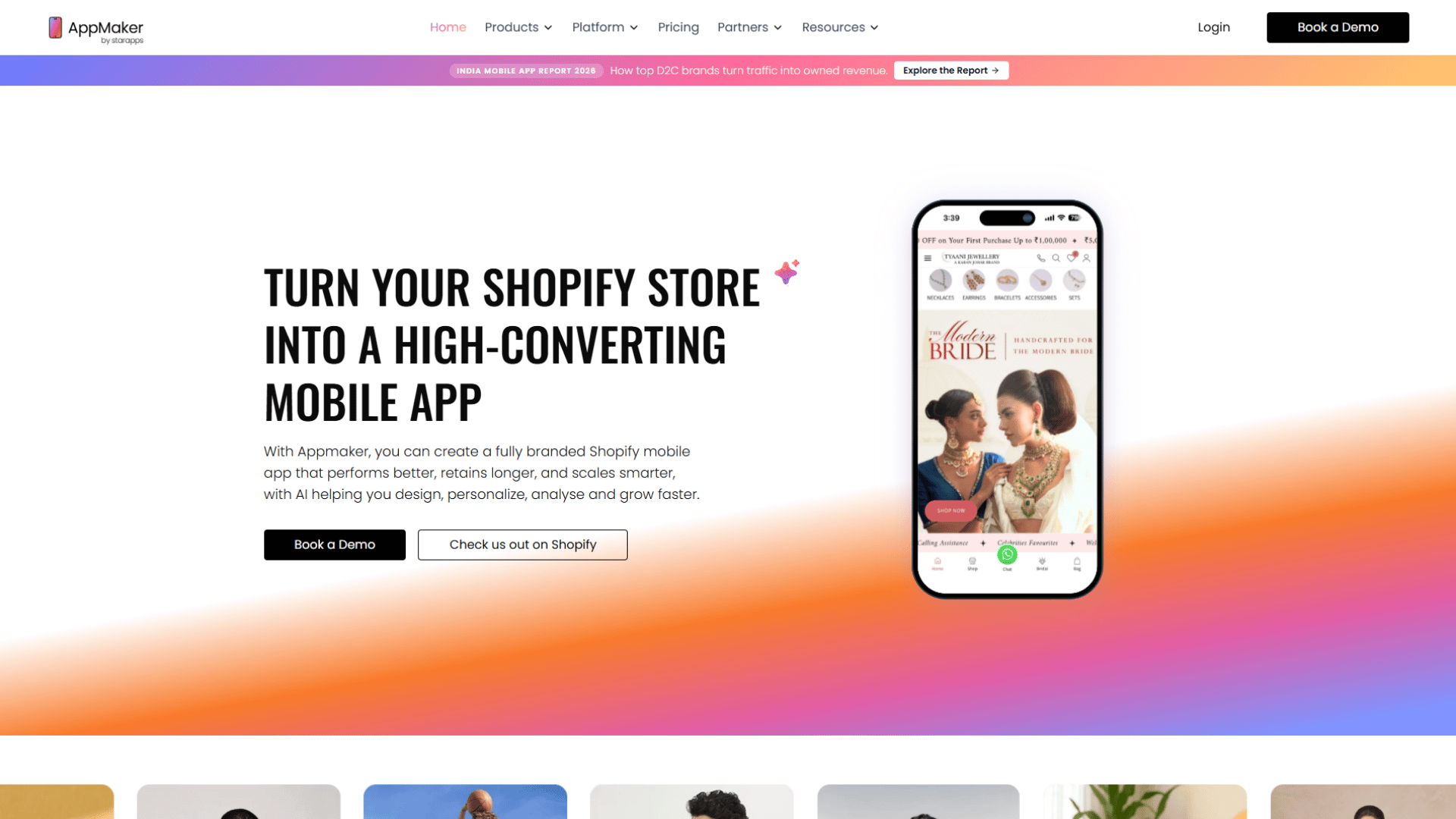
What it is: A Shopify-first native mobile app platform built for brands that have outgrown template builders and want a system that bends to the brand rather than the other way around.
Why it's a Mobiloud alternative: Where Mobiloud renders your website inside an app frame, Appmaker builds a genuinely native app with its own design layer and real-time two-way Shopify sync so pricing, inventory, and orders reflect instantly rather than tracking your site's load. The bigger difference is ceiling: you're not locked into a fixed block library, and the platform is built to support custom code, APIs, and bespoke UX for teams that need it.
Key features:
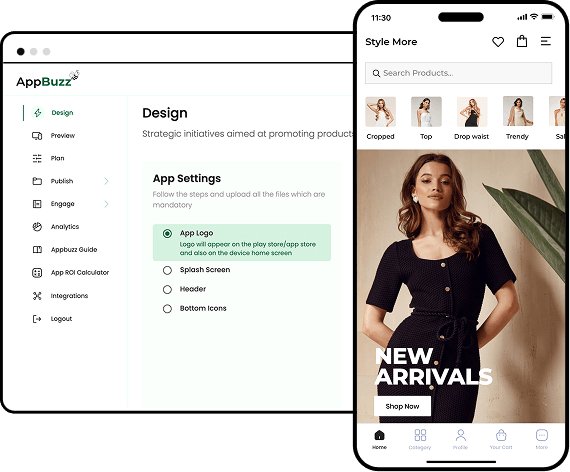
- Appmaker Studio a drag-and-drop builder with real-time preview, so marketing can iterate without waiting on developer cycles.
- Eidolon AI turns screenshots, Figma files, or plain-text prompts into ready-to-use app layouts, cutting early design time.
- Conditional Blocks personalizes app content using Shopify tags and metafields, useful for large or segmented catalogs.
- Extensions & Push: sticky carts, countdown timers, reorder widgets, and automated push campaigns out of the box.
Pricing: Around $999/month, with a percentage of in-app sales on higher tiers and a separate Enterprise tier for deeper integration needs. Confirm current tiers directly, as pricing varies by plan and volume.
Strengths: Deepest realistic customization short of a fully custom build; real-time sync suited to large, variant-heavy catalogs; AI tooling that genuinely shortens setup.
Limitations: It's not the cheapest entry point, and the flexibility is overkill for a small store that just wants a fast, templated app. If you have no plans to diverge from your web design, you're paying for headroom you won't use.
Best for: High-growth Shopify and Shopify Plus brands. Appmaker's roster has included names like boAt, Supertails, and Bombay Shirt Company that want agency-grade customization without commissioning a bespoke build.
Who should avoid it: Very small or early-stage stores still validating whether an app is worth it. Start cheaper, prove the channel, then graduate.
Our take: Appmaker is best thought of as the bridge between no-code builders and fully custom development. If your app is a channel you plan to keep evolving for years, not a one-and-done launch, the open, extendable model earns its price.
2. Tapcart: Best for established, marketing-team-run apps
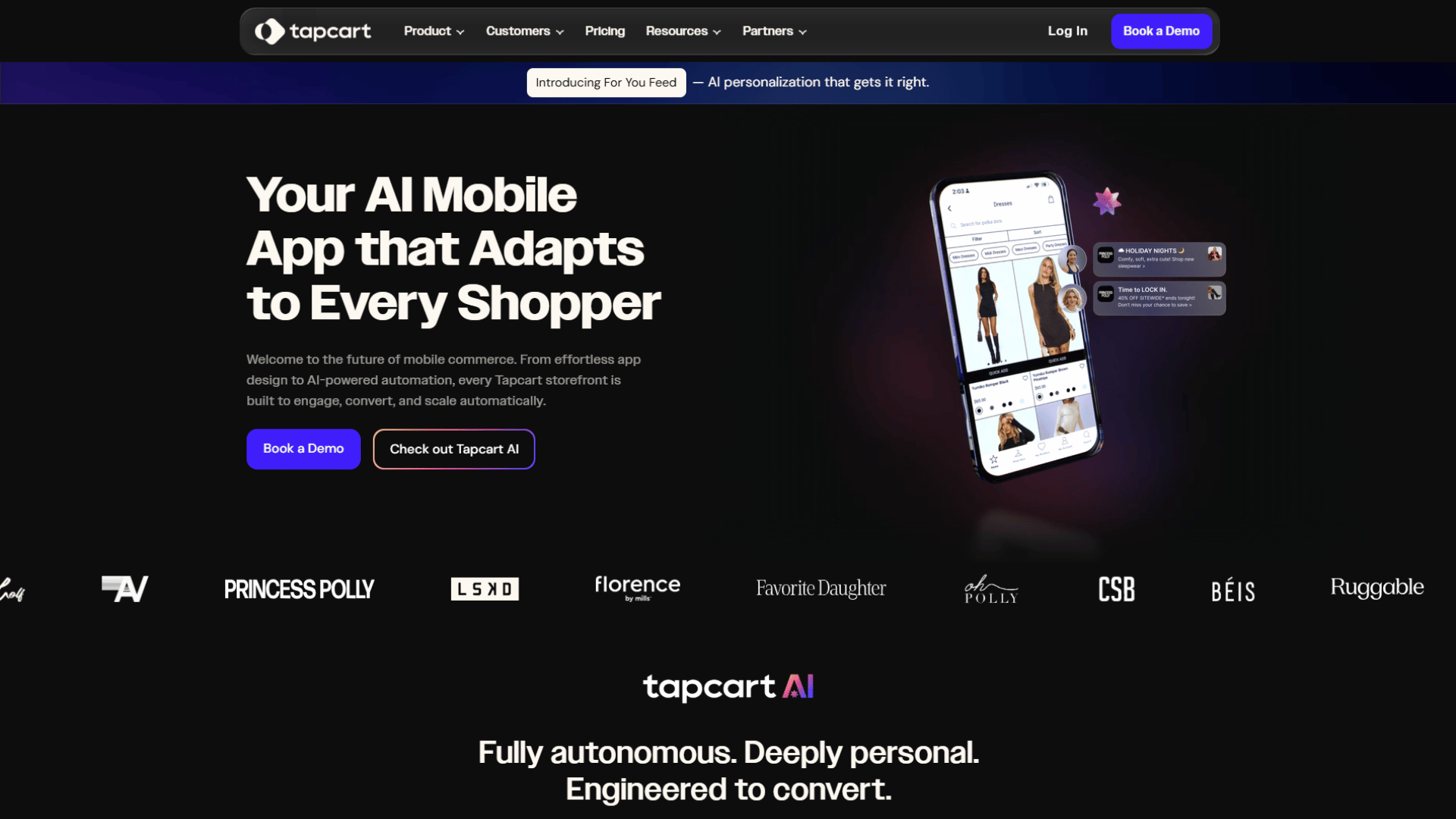
What it is: The category's incumbent. Founded in 2017, Tapcart is the most widely recognized name in Shopify mobile app building and consistently holds a strong Shopify App Store rating across several hundred reviews.
Why it's a Mobiloud alternative: It replaces the webview model with a native app you design through a genuinely no-code studio. The whole product is built around a marketing team owning the app day-to-day rather than a developer maintaining a wrapped site.
Shopify compatibility: Native Shopify and Shopify Plus support with real-time sync across products, collections, inventory, pricing, and customer data, no manual updates as your catalog changes.
Key features:
- App Studio drag-and-drop screen builder for home, product, collection, and navigation layouts with live preview.
- Unlimited push notifications, no per-message or volume caps, which matters for high-frequency senders.
- Segmentation and automation audience targeting and triggered campaigns (e.g., abandoned cart, back-in-stock) on applicable tiers.
- Deep-linking and personalization blocks for tailored landing experiences.
- Broad integration marketplace connects with major retention and reviews tools (Klaviyo, Yotpo, and similar) common in the Shopify stack.
Pricing: Around $500/month at the commonly listed entry point, with higher and enterprise tiers scaling up. Verify current tiers, as Tapcart has revised plan structures over time.
Strengths: Maturity and reliability at scale; the largest track record of any platform here; a workflow marketers genuinely enjoy; strong onboarding.
Limitations: Its template conventions are more fixed than the most open platforms. Teams wanting code-level control, bespoke UX, or unusual layout logic can hit its ceiling. Pricing sits above budget builders without matching the open flexibility of a platform like Appmaker.
Best for: Established brands that want a proven, marketing-owned native app and value stability over cutting-edge customization.
Who should avoid it: Very small stores testing the channel on a tight budget, and engineering-led teams that want source-level control.
Verdict: The safest, most battle-tested pick. If you want low drama and a mature ecosystem, Tapcart is hard to fault; just know you're working within its template system.
3. VennApps Best for premium, fully managed native builds
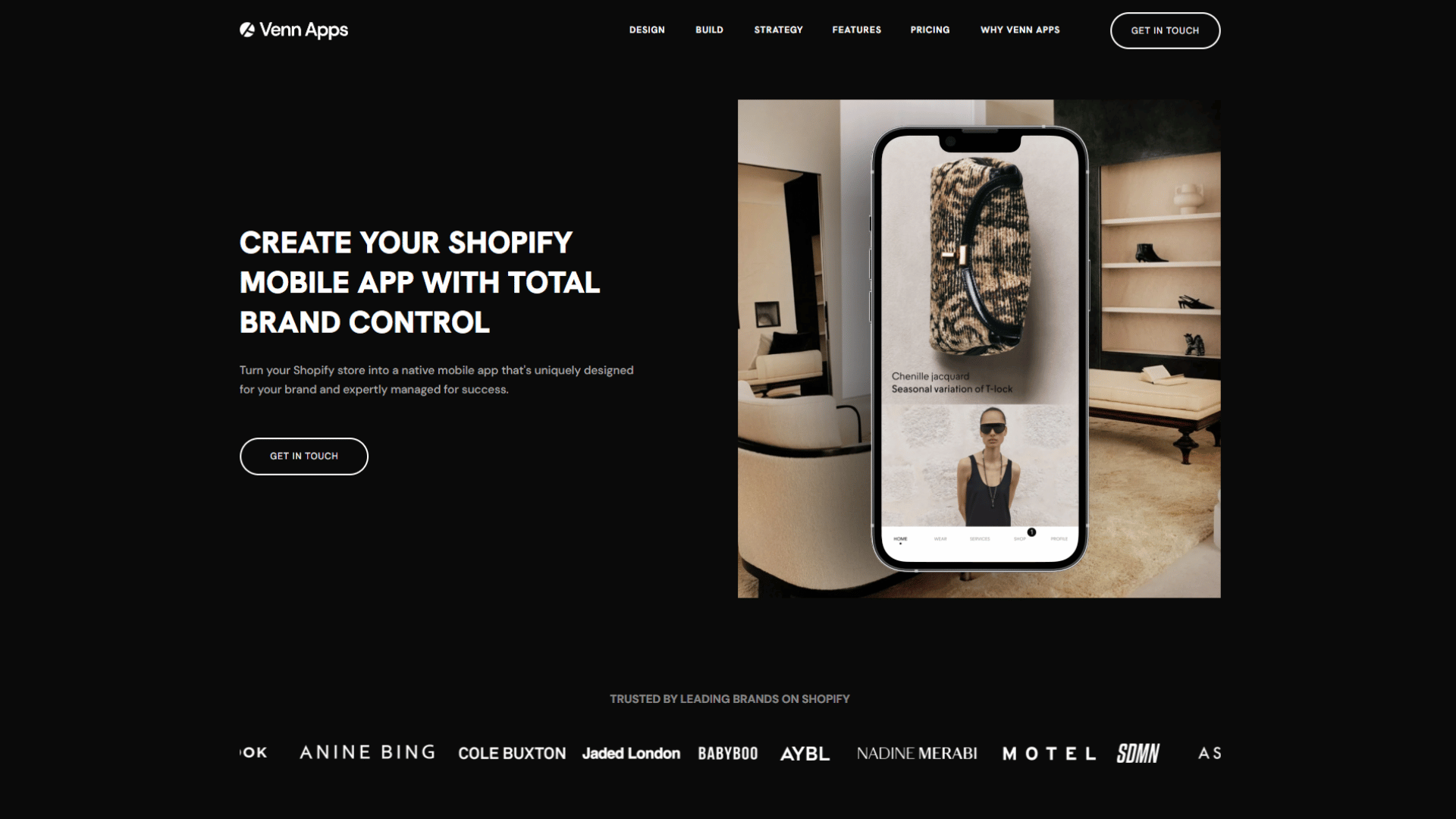
What it is: An enterprise-leaning native platform delivered as a managed service rather than a self-serve builder. You're buying execution and account management as much as software.
Why it's a Mobiloud alternative: It swaps Mobiloud's webview for a fully native build, and swaps self-serve setup for a done-for-you model with strategic guidance built in.
Shopify compatibility: Native Shopify integration with automatic sync of catalog, pricing, and orders; multi-language and multi-currency support suited to international brands.
Key features:
- Fully managed native build: the VennApps team handles design and launch rather than handing you an editor.
- Dedicated account manager on higher tiers, providing roadmap and growth input, not just support tickets.
- Extensive third-party integrations: Klaviyo, Yotpo, LoyaltyLion, Shopify POS, and other retention and loyalty tools.
- Targeted push notifications with segmentation.
- Enterprise onboarding for brands migrating from another platform or launching at scale.
Pricing: Around $1,999/month, with enterprise tiers higher depending on integration depth and account management needs.
Strengths: Dependable, hands-off delivery; strong integration coverage; a genuine partner relationship for teams that want one.
Limitations: Reviewers frequently note it lacks a single signature differentiator versus AI-first or live-selling-focused competitors; you're paying for reliability and service, not a headline feature. Premium pricing puts it out of reach for smaller stores.
Best for: Established, well-funded brands that want a native app built and managed for them, with a dedicated point of contact.
Who should avoid it: Cost-sensitive merchants, and hands-on teams who'd rather control the build themselves; the managed model would be paying for a service you don't need.
Verdict: A dependable, no-surprises managed option. Choose it for the delivery model and account relationship rather than for a standout capability.
4. StoreLab Best for guided, support-driven setup
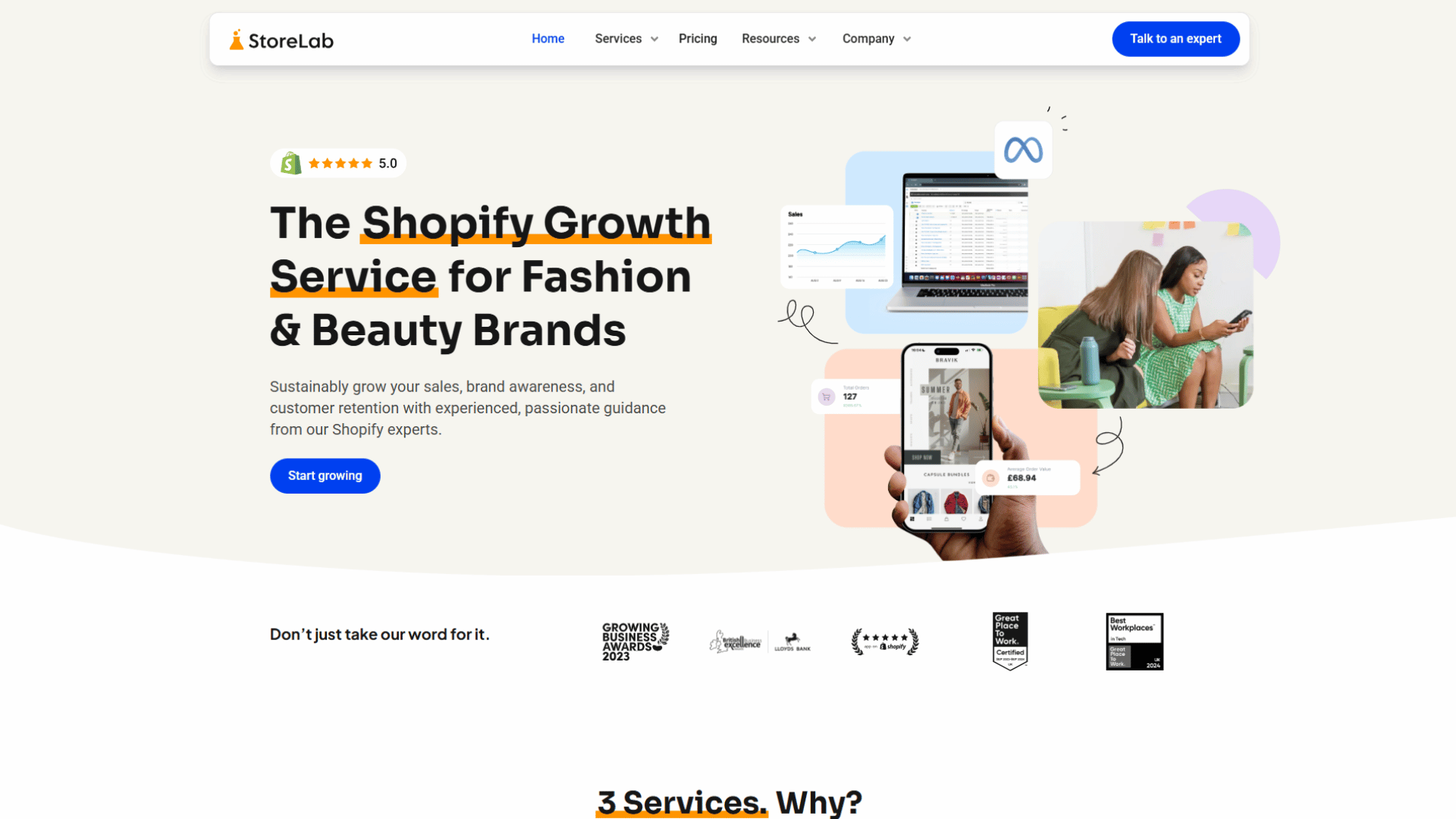
What it is: A mid-to-premium native platform built around white-glove onboarding, positioned for brands whose main constraint is internal bandwidth rather than budget.
Why it's a Mobiloud alternative: Native architecture plus a guided, managed setup that removes the DIY lift, with dedicated account managers included as standard rather than gated behind top tiers.
Shopify compatibility: Native Shopify integration with catalog and order sync; standard engagement tooling built for Shopify merchants.
Key features:
- Dedicated account managers as standard a differentiator at its price point.
- Guided onboarding that walks merchants through setup rather than dropping them into a blank editor.
- Abandoned-cart push reminders on some plans, going a step beyond basic engagement tooling.
- Automated push campaigns and standard retention features.
Pricing: Around $1,999/month.
Strengths: Consistently praised for ease of use and responsive support. A strong fit when you want the platform team to do the heavy lifting.
Limitations: Frequently flagged as lighter on advanced features than higher-customization rivals. Stores with unusual technical or merchandising requirements sometimes outgrow it and migrate to a more flexible platform later.
Best for: Mid-market stores that prioritize hand-holding and ongoing support over deep technical customization, and don't anticipate needing specialized features.
Who should avoid it: Brands that expect complex, bespoke requirements, or that want to minimize monthly cost; the price is premium for the feature depth.
Verdict: Buy StoreLab for the relationship and the guided experience. Just confirm its feature ceiling matches your two-year roadmap before committing.
5. Vajro (Superfans) Best for live selling and fast setup
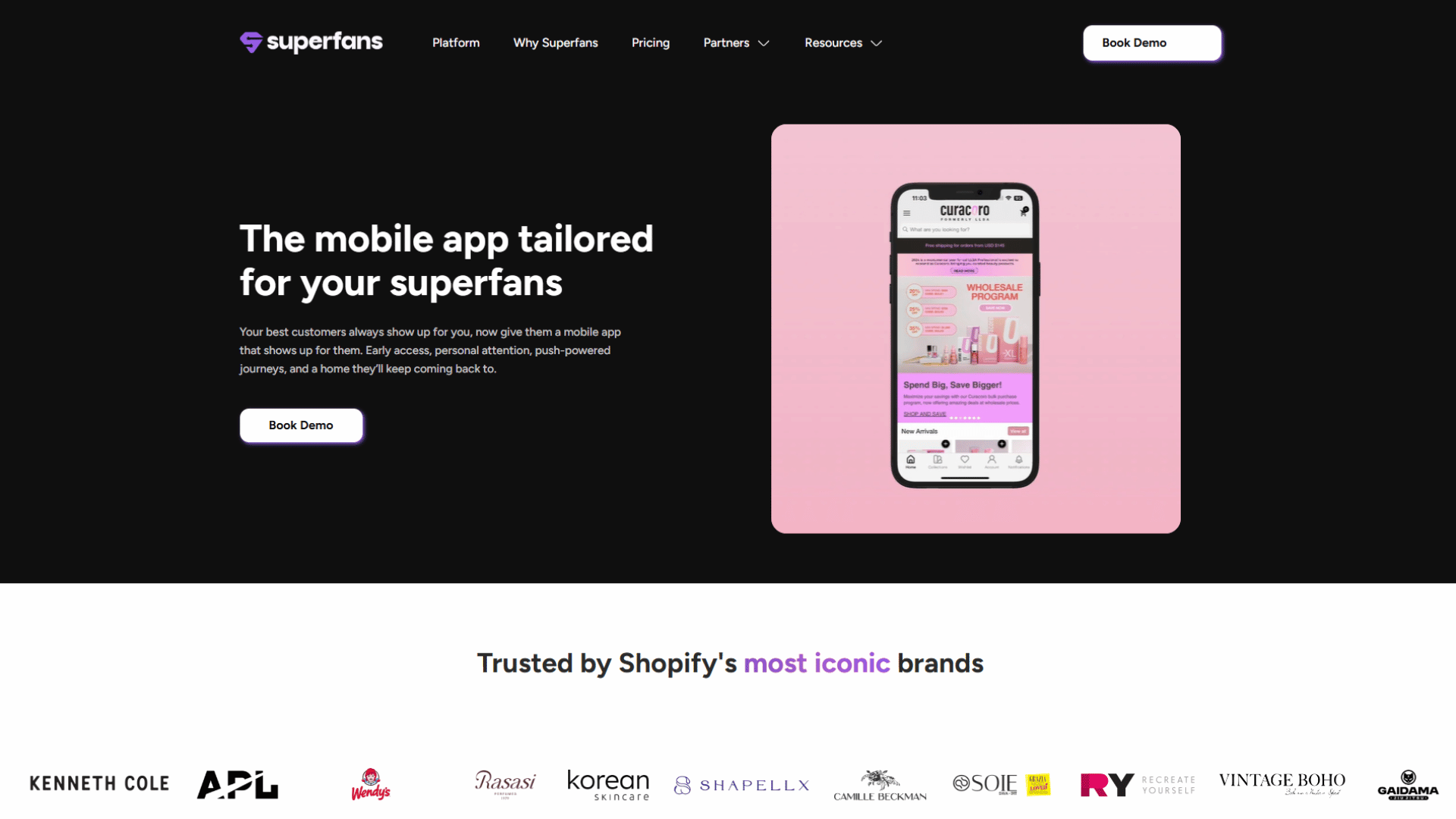
What it is: A no-code native builder now operating under the Superfans brand, known for a live-preview editor that produces a launch-ready layout quickly, and for leaning hard into live commerce.
Why it's a Mobiloud alternative: Native app, days-not-weeks launch, and live-selling functionality that Mobiloud's webview model doesn't prioritize.
Shopify compatibility: Native Shopify integration with automatic product and order sync; built to launch fast on an existing catalog.
Key features:
- Live-selling / livestream shopping: the platform's signature capability, built for influencer- and event-driven sales.
- Live-preview editor: configure a launch-ready layout without code, seeing changes in real time.
- Automated, targeted push notifications with segmentation.
- Fast, guided setup positioned closer to Shopney and OneMobile on speed than to managed platforms.
Pricing: Around $1,000/month. Confirm current plan structure under the Superfans brand.
Strengths: Genuinely differentiated on live commerce; quick to launch; approachable for non-technical teams.
Limitations: If you don't run live sales, you're paying for a specialty you won't use; general-purpose builders may offer better value per dollar. Customization depth trails open platforms.
Best for: Growing stores that want live-commerce features baked in alongside standard app functionality, without a steep learning curve.
Who should avoid it: Brands with no live-selling motion, and those needing deep bespoke UX.
Verdict: The clearest specialist pick on this list. If live selling is (or will be) part of your strategy, it earns its price; if not, look elsewhere.
6. Plobal Apps Best for analytics-led retention
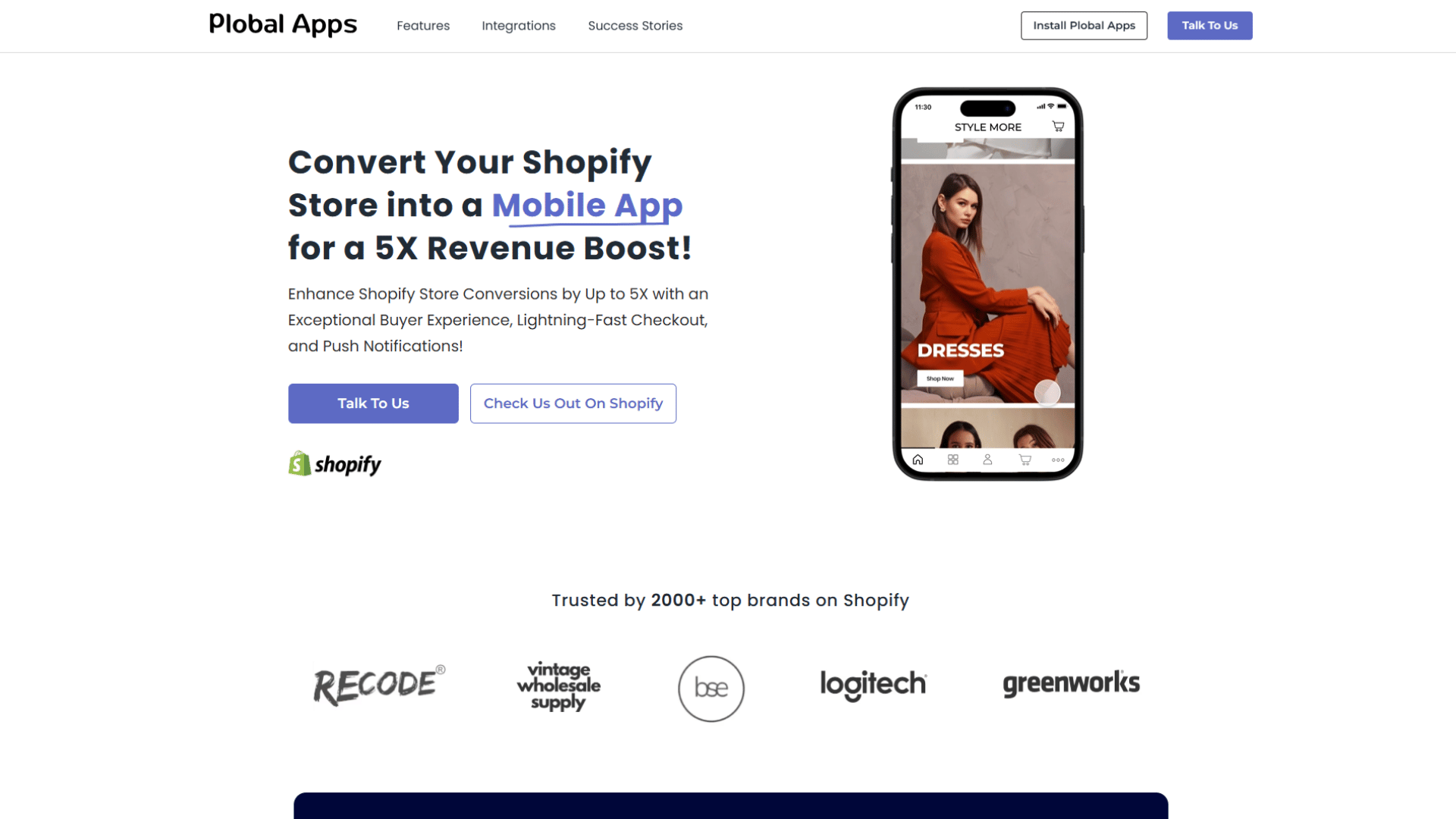
What it is: One of the more established builders in the space, centered on branded design paired with performance measurement.
Why it's a Mobiloud alternative: Native app with real-time sync and its distinguishing strength: a built-in analytics layer that reduces the need for a separate BI tool.
Shopify compatibility: Native Shopify integration with real-time product sync; connects cleanly into a retention-focused Shopify stack.
Key features:
- In-app analytics dashboard built specifically to track engagement, revenue, and campaign performance without bolting on external reporting.
- Drag-and-drop customization for branded layouts.
- Automated push campaigns with segmentation.
- Retention-stack integrations: Klaviyo, Yotpo, ReCharge, and Gorgias among them.
Pricing: Around $199/month at the accessible entry point.
Strengths: Analytics depth that's unusual at this price; a natural fit for data-driven marketing teams that want to optimize campaigns in-platform.
Limitations: Design flexibility is solid but not class-leading; brands wanting fully bespoke UX will look further up the list. Newer AI tooling is lighter than AI-first competitors.
Best for: Mid-market stores that want an assisted, well-analytics-equipped build at a mid-range price.
Who should avoid it: Teams whose priority is bespoke design over measurement, or who already run a mature BI stack and won't use the native dashboard.
Verdict: The value pick for retention-minded operators who want to see and act on app performance without extra tooling.
7. Shopney Best for fast, affordable launches
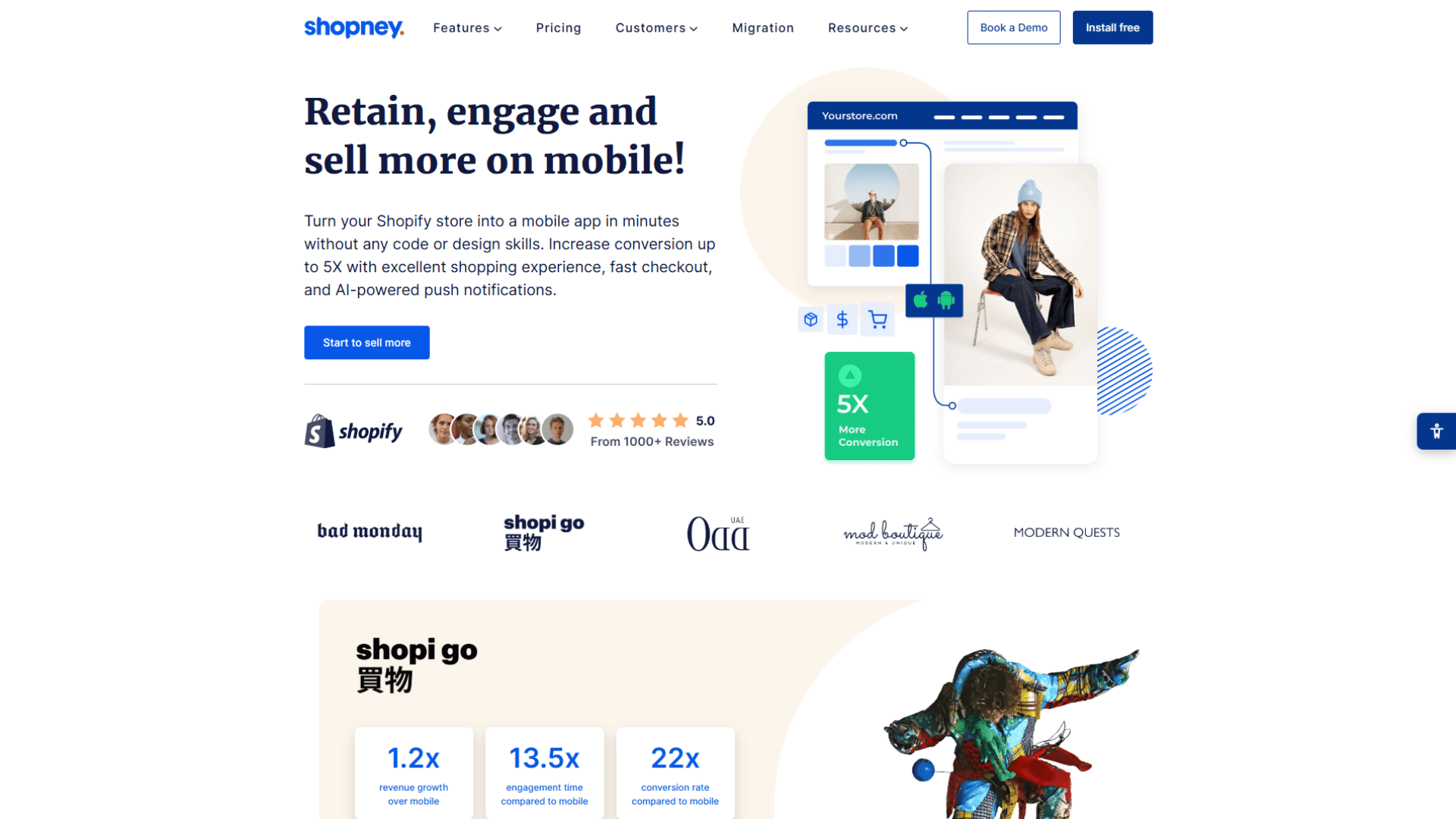
What it is: A no-code, drag-and-drop native builder that closely mirrors the Shopify storefront inside the app, designed for a guided rather than blank-canvas setup.
Why it's a Mobiloud alternative: Native, quick to launch, and far lighter on setup lift than a managed webview conversion at a fraction of the cost.
Shopify compatibility: Native Shopify integration; layouts mirror your storefront so the app feels familiar to existing customers immediately.
Key features:
- Drag-and-drop editor with a guided setup flow for teams without design resources.
- In-app chat included on the entry plan, a standout, since many rivals reserve live chat for higher tiers.
- Real-time product and order sync.
- Push notifications and standard engagement tooling.
- Theme-mirroring design to shorten the build.
Pricing: Around $149/month.
Strengths: Excellent for lean teams; direct in-app customer communication from day one; fast, low-friction launch.
Limitations: Lighter on advanced customization and automation; growing brands with complex merchandising can outgrow it.
Best for: Stores with limited IT or design resources that want a fast, guided launch and native basics done well.
Who should avoid it: Larger brands needing deep personalization, custom code, or sophisticated segmentation.
Verdict: A strong entry-to-mid option, and the in-app chat on the base plan is a genuine, uncommon advantage at this price.
8. OneMobile Best budget entry point
What it is: One of the lowest-cost routes into native mobile commerce, built around an AI-assisted builder with more retention tooling than its price suggests.
Why it's a Mobiloud alternative: Native app at a fraction of Mobiloud's total cost (no setup fee), with a surprising amount of marketing and retention functionality at the entry tier.
Shopify compatibility: Native Shopify integration with catalog and order sync; built for a quick launch on an existing store.
Key features:
- Unlimited push notifications from the entry plan; most rivals gate this behind higher tiers.
- AI-assisted builder for faster initial setup.
- App-promotion toolkit: Facebook and Google ad integrations plus ready-to-use QR code templates to market the app itself after launch.
- Real-time sync and standard engagement features.
Pricing: Around $99/month.
Strengths: Standout value; unusually generous push and app-marketing tooling for the price; a low-commitment way to go native.
Limitations: Not built for deep customization or complex, variant-heavy catalogs; you trade ceiling for cost. Support is more self-serve than managed platforms.
Best for: Small to mid-sized stores that want native functionality and retention tools without a big monthly commitment.
Who should avoid it: High-growth brands with complex catalogs or bespoke design needs.
Verdict: The best pure value at the bottom of the market, especially the unlimited push and app-promotion tooling most competitors charge more for.
9. Apptile Best for AI-assisted building at a low price
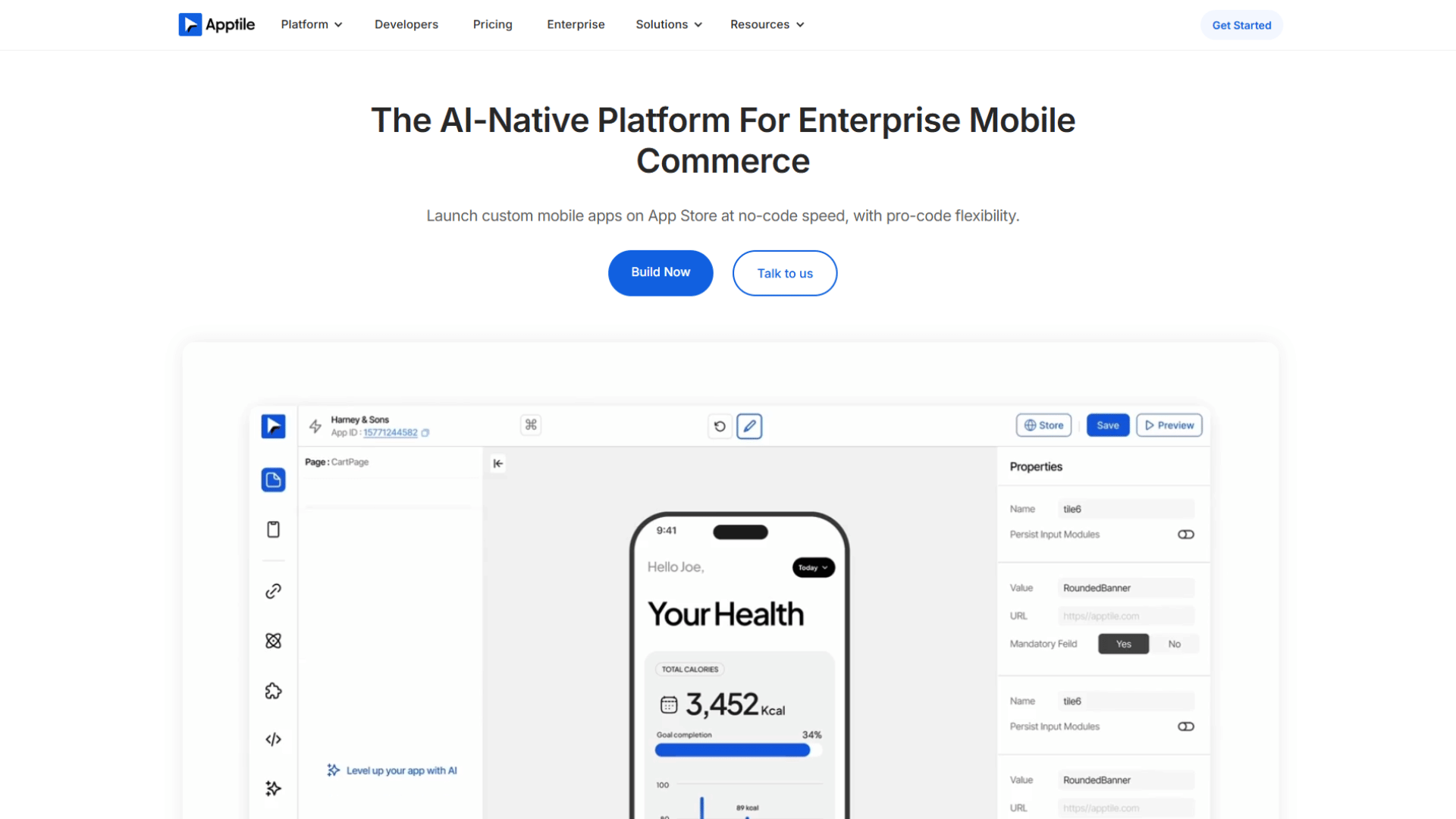
What it is: A no-code native builder that leans harder into generative AI than most rivals, positioned as a bridge between budget tools and open platforms.
Why it's a Mobiloud alternative: Native, AI-accelerated, and priced below premium platforms with a rare path toward code-level control as you grow.
Shopify compatibility: Native Shopify integration with real-time sync; explicit migration support from other Shopify app builders.
Key features:
- Tile AI generates entire app sections or layouts from plain-text prompts, cutting design time beyond a standard no-code editor.
- Direct migration support from Tapcart, OneMobile, Shopney, and Vajro is useful for switching without rebuilding from scratch.
- Code-level and source-code access on higher tiers uncommon at this price, giving technical teams room to extend beyond the no-code editor.
- Live selling and real-time sync included in broad feature coverage.
- Strong Shopify App Store rating across 100+ reviews (verify current figures).
Pricing: Around $224/month.
Strengths: Rare combination of AI-assisted speed, broad features, code access, and migration tooling at a mid-tier price.
Limitations: Younger than incumbents like Tapcart, with a smaller track record at large enterprise scale; the deepest customization still sits with open platforms like Appmaker.
Best for: Cost-conscious stores that still want broad features and room to grow into code-level control.
Who should avoid it: Enterprise brands needing a long proven track record at scale, or fully managed done-for-you delivery.
Verdict: The standout value for AI-assisted building, and the code access plus migration support make it a smart middle path between budget builders and open platforms.
10. MageNative Best for small stores validating mobile ROI
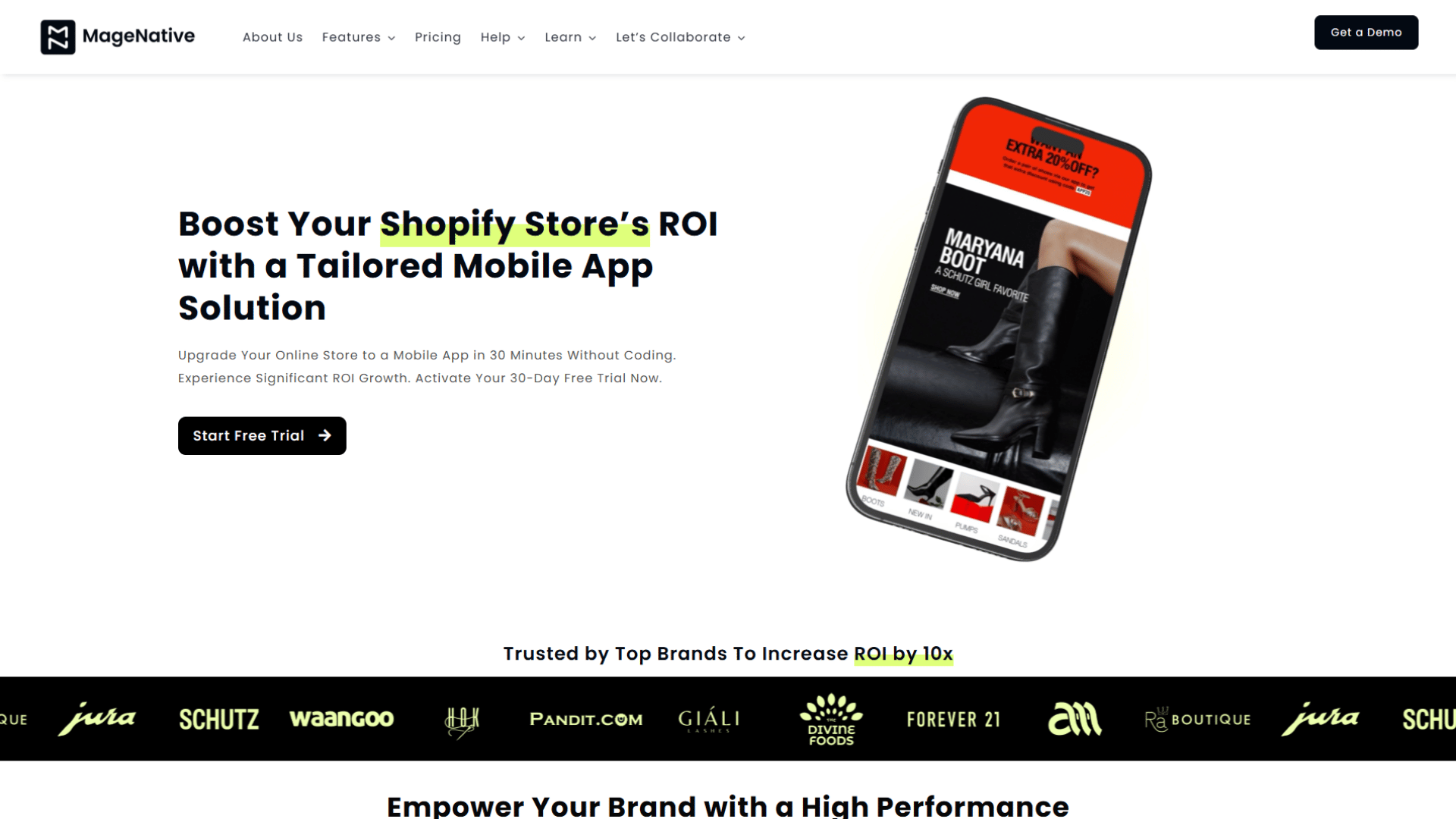
What it is: A low-cost native builder that packs an unusually broad feature set into an entry price, designed as a low-risk way to test whether an app channel is worth deeper investment.
Why it's a Mobiloud alternative: Native app, fast launch, minimal overhead, and a wide feature list well below what comparable feature sets cost elsewhere.
Shopify compatibility: Native Shopify integration with catalog sync and native connections into Shopify's review ecosystem.
Key features:
- Drag-and-drop Design Blocks for no-code layout building.
- AR product previews and image / visual search advanced discovery features rare at this price.
- Live video selling built in.
- Native review displays: Okendo and Judge.me shown directly inside the app, valuable for social-proof-driven categories.
- Push notifications and standard engagement tooling.
Pricing: Around $99/month.
Strengths: Feature breadth far above its price point; review-ecosystem integration; genuinely low-risk way to prove the channel.
Limitations: Best suited to smaller catalogs and traffic levels; heavier stores will want more customization depth, performance headroom, and hands-on support.
Best for: Small stores or lean catalogs that need a fast, cheap launch to validate app-driven revenue before committing to a pricier platform.
Who should avoid it: High-traffic or complex-catalog brands that will quickly outgrow its ceiling.
Verdict: The best low-risk validation option. Prove the channel here, then graduate to a platform like Apptile or Appmaker once the numbers justify deeper investment.
Native App Vs. Webview Wrapper: Why This Distinction Decides Your Shortlist
This is the single most important concept when evaluating a Mobiloud alternative, so it's worth being precise.
Native apps (Appmaker, Tapcart, Vajro, Apptile, and most others here) are standalone applications with their own interface layer. That gives them direct access to device features, push notifications, camera, biometrics, offline caching, and performance that doesn't depend on your website's speed.
Webview wrappers (Mobiloud's core approach) render your existing mobile site inside an app frame. The upside is near-zero duplicate design work. The trade-off is that performance is capped by how fast your website loads: a slow site produces a slow app.
For routine browsing, the perceived gap has narrowed to the point most shoppers can't tell the difference. It reopens under pressure during high-traffic sale events, webview performance rises and falls with your web infrastructure, and in how deep native push can go.
Bottom line: Choose webview if you already have a fast mobile site and your priority is avoiding a second editor. Choose native if push depth, offline access, or long-term design flexibility outweigh maintaining a separate design layer.
Which Mobiloud Alternative Is Best For Your Situation?
Small Shopify stores / lean catalogs (validating the channel): MageNative or OneMobile. Low cost, fast setup, minimal overhead prove the app works before spending more.
Fast-growing brands ($500K–$5M range): Shopney or Plobal Apps. Proven, accessible, and friendly to a marketing team running the app.
Complex catalogs or heavy merchandising ($1M–$10M): Appmaker or Apptile. Real-time sync and customization without commissioning a fully custom build.
Shopify Plus / brand-first, willing to invest ($5M+): Appmaker, VennApps, or StoreLab. Full design control and premium support at the higher end.
Brands that want the deepest customization: Appmaker for open, extendable control; VennApps and StoreLab if you'd rather it be done for you.
Merchants prioritizing speed to launch: Shopney, Vajro, OneMobile, MageNative days, not weeks.
Retention-focused brands: Plobal Apps for analytics depth; Appmaker for personalization via Conditional Blocks.
Live-commerce brands: Vajro (Superfans), which is built around live selling.
What this means in practice: Match the platform to your next two years, not just launch day. The most common expensive mistake is picking a builder for its launch speed, then migrating a year later because it can't grow with the catalog.
Mobiloud Vs. Appmaker: A Direct Comparison
| Factor | Mobiloud | Appmaker |
|---|---|---|
| Shopify focus | Shopify + WordPress/other platforms | Shopify / Shopify Plus first |
| App architecture | Webview wrapper (site-to-app) | Native app with own design layer |
| Customization | Inherits web theme; limited app-native design | Open/extendable; custom code, APIs, bespoke UX |
| Sync | Reflects your live site | Real-time two-way Shopify sync |
| Push notifications | Supported | Supported, with automated campaigns + segmentation |
| Integrations | Shopify apps via your web stack | Native integrations + extensions |
| Analytics | Standard | In-app dashboard + John AI query assistant |
| Setup | Managed, multi-week, setup fee | Guided + AI-assisted, no separate design duplication |
| Scalability | Tied to website performance | Native performance independent of site load |
| Pricing model* | ~$299–$949/mo + setup fee | ~$999/mo, % of in-app sales on higher tiers |
| Best for | Fast existing site, no rebuild wanted | High-growth brands wanting native control |
Where each makes sense: Mobiloud is the better call when you have a genuinely fast, well-optimized mobile site and your goal is to avoid maintaining a second design system. Appmaker is the better call when the app needs to diverge from the website, perform independently of site load during peak sales, and keep evolving.
How Much Does A Shopify Mobile App Cost In 2026?
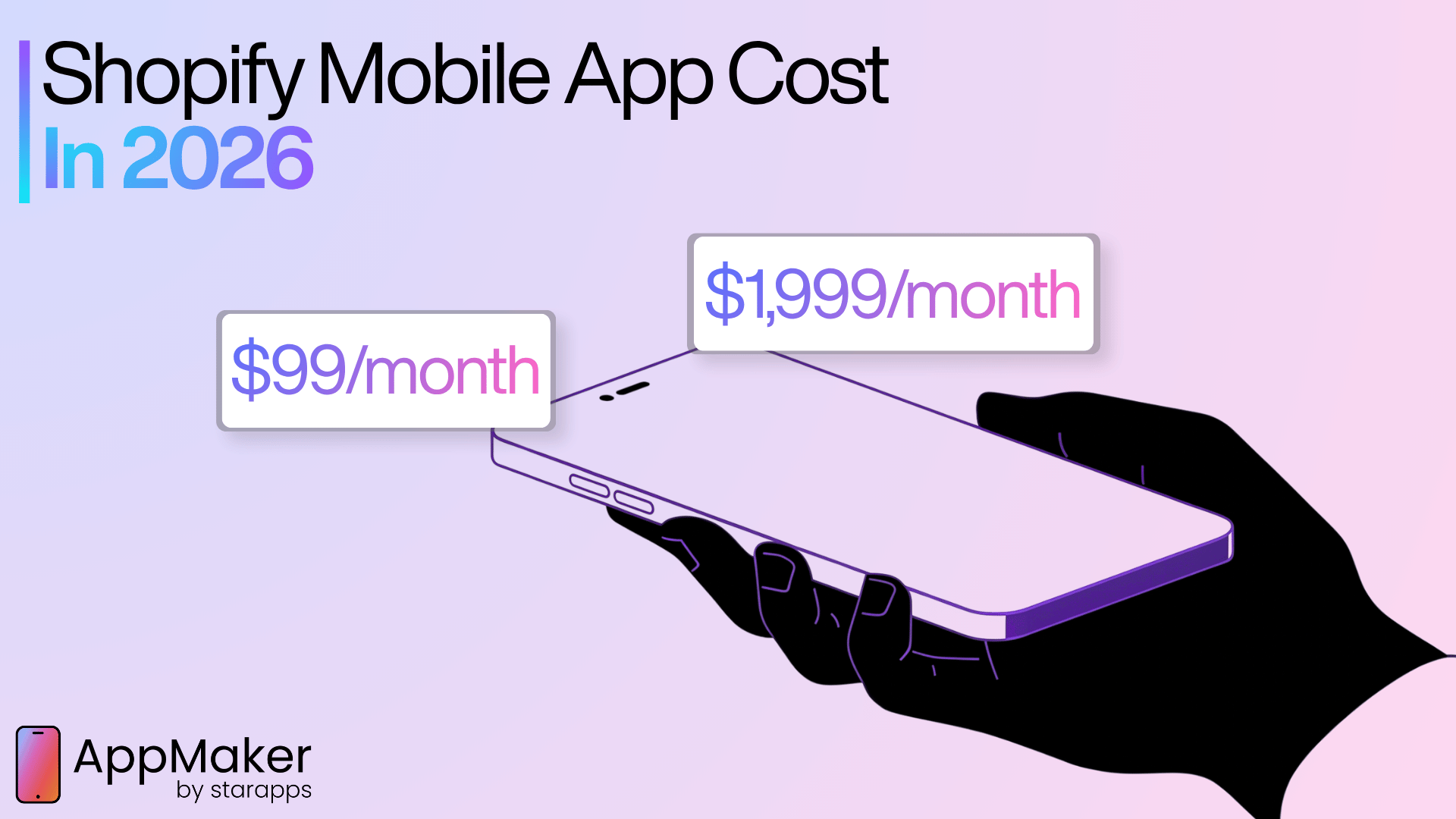
No-code and native builders on this list range from roughly $99/month (OneMobile, MageNative) to ~$1,999/month (VennApps, StoreLab), with most mid-market platforms landing between those poles. Some platforms, such as Appmaker, included a small percentage of in-app sales on higher tiers.
Commissioning a fully custom Shopify app from a development agency is a different order of magnitude, commonly cited in the tens of thousands to $200,000+ range depending on scope, plus ongoing maintenance. That gap is exactly why most growing brands buy a builder instead of building from scratch: the builder delivers 90% of the value at a small fraction of the cost and time.
The Bottom Line
Mobiloud built a genuinely useful product for one specific job: giving brands with an already-optimized mobile site an app without duplicating design work. If that's your situation, it may still be the right tool.
But for Shopify merchants who need real-time sync at scale, native performance during peak traffic, deeper customization, or simply a different price point, the ten alternatives above cover nearly every store size and priority. If you're choosing on lowest cost and speed to prove the channel, start with MageNative or OneMobile. If you want a mature, marketing-run app, Tapcart. And if your app is a channel you intend to keep evolving for years with the design control to match, Appmaker is built for exactly that kind of brand.
Whatever you choose, trial the shortlist before you commit, and pick for where your store is headed, not just where it is today.
Frequently Asked Questions
What is the best Mobiloud alternative for Shopify?
There's no single winner; it depends on your stage. For growing brands that want native customization without a custom build, Appmaker is the strongest fit. For a proven, marketing-run app, Tapcart. For the lowest-risk first app, MageNative or OneMobile.
Is Appmaker a good alternative to Mobiloud?
Yes, particularly for high-growth Shopify and Plus brands. Unlike Mobiloud's webview wrapper, Appmaker builds a native app with its own design layer, real-time two-way sync, and open customization a better fit when the app needs to look and perform differently from the website.
What is the main difference between Mobiloud and a native builder like Appmaker?
Mobiloud wraps your existing Shopify website inside an app, so app performance and design track your site. Appmaker builds a genuinely native app with an independent editor, giving you control over layout, performance, and features beyond what the website supports.
Is Mobiloud a fully native app?
No. Mobiloud uses a webview architecture that displays your existing mobile website inside an app shell rather than building a standalone native interface.
What is the cheapest Mobiloud alternative?
MageNative and OneMobile are the most budget-friendly, both starting around $99/month, well suited to stores still validating whether an app is worth the investment.
What is the cheapest Mobiloud alternative?
Appmaker offers the deepest self-serve customization via open, extendable design plus custom code and API support. VennApps and StoreLab go deep too, but through a managed, done-for-you model rather than hands-on control.
Do all Shopify app builders sync in real time?
Most modern native builders, including Appmaker, Tapcart, and Apptile, offer real-time or near-real-time two-way sync for inventory, pricing, and orders. Always confirm sync behavior for your specific catalog size.
Why do push notifications matter when choosing a builder?
Push is one of the highest-leverage retention channels an app unlocks, but it pays off most for brands with genuine repeat-purchase behavior. For low-frequency purchase categories, features like loyalty, personalizati or reorder widgets may deliver more value than push volume alone.
Can I switch from Mobiloud to another platform?
Yes. Because a mobile app is a separate channel from your Shopify store, migrating means rebuilding the app on a new platform, not re-platforming your store. Several builders (including Apptile) offer direct migration support to reduce setup effort.
What's the typical timeline to launch a Shopify app?
No-codon,e builders typically launch in days once integration is complete. Managed and webview approaches like Mobiloud's generally take a few weeks due to the done-for-you setup.