

























Building a great app is just the start; getting users to find it, engage with it, and stick around is the real motive for every brand. Many apps struggle to turn downloads into active, loyal users, leaving growth uncertain. With 60.42% of the world’s population now owning a smartphone, the potential is huge, but competition is fierce.
Mobile apps marketing bridges that gap, helping your app reach the right people, guide them through meaningful first actions, and turn casual users into repeat customers. It’s about strategy, timing, and data-driven decisions that drive real growth.
This mobile app marketing guide will walk through the complete app marketing lifecycle, essential strategies, and metrics that define success.
Overview
- Mobile apps marketing guides users through the full growth lifecycle, from discovery, acquisition, and activation to retention and revenue optimization.
- Effective growth combines organic, paid, lifecycle, and partnership/referral campaigns, each serving a distinct role in user engagement and long-term growth.
- Activation and retention rely on personalized onboarding, habit-forming journeys, behavioral segmentation, and targeted messaging to reduce drop-off and increase lifetime value.
- Tracking metrics like CPI, CAC, LTV, retention, ROAS, engagement, and conversion ensures campaigns are efficient, profitable, and optimized for sustained growth.
- Privacy-compliant strategies, AI-driven personalization, predictive segmentation, and emerging technologies like AR/VR shape the future of mobile app marketing and improve user experience.
What Is Mobile App Marketing?
Mobile app marketing is the structured lifecycle strategy of acquiring the right users, activating them to experience core value quickly, retaining them through personalized engagement, and optimizing revenue through data-driven experimentation.
Mobile App Marketing vs Mobile Marketing
Many brands use mobile app marketing and mobile marketing interchangeably, but they represent different scopes of strategy. Here’s how they differ:
With the differences clear, the next step is understanding the marketing types that drive discovery, engagement, and long-term app growth.
Also Read: E-commerce Mobile App Development: A 2026 Guide
4 Types of Mobile App Marketing
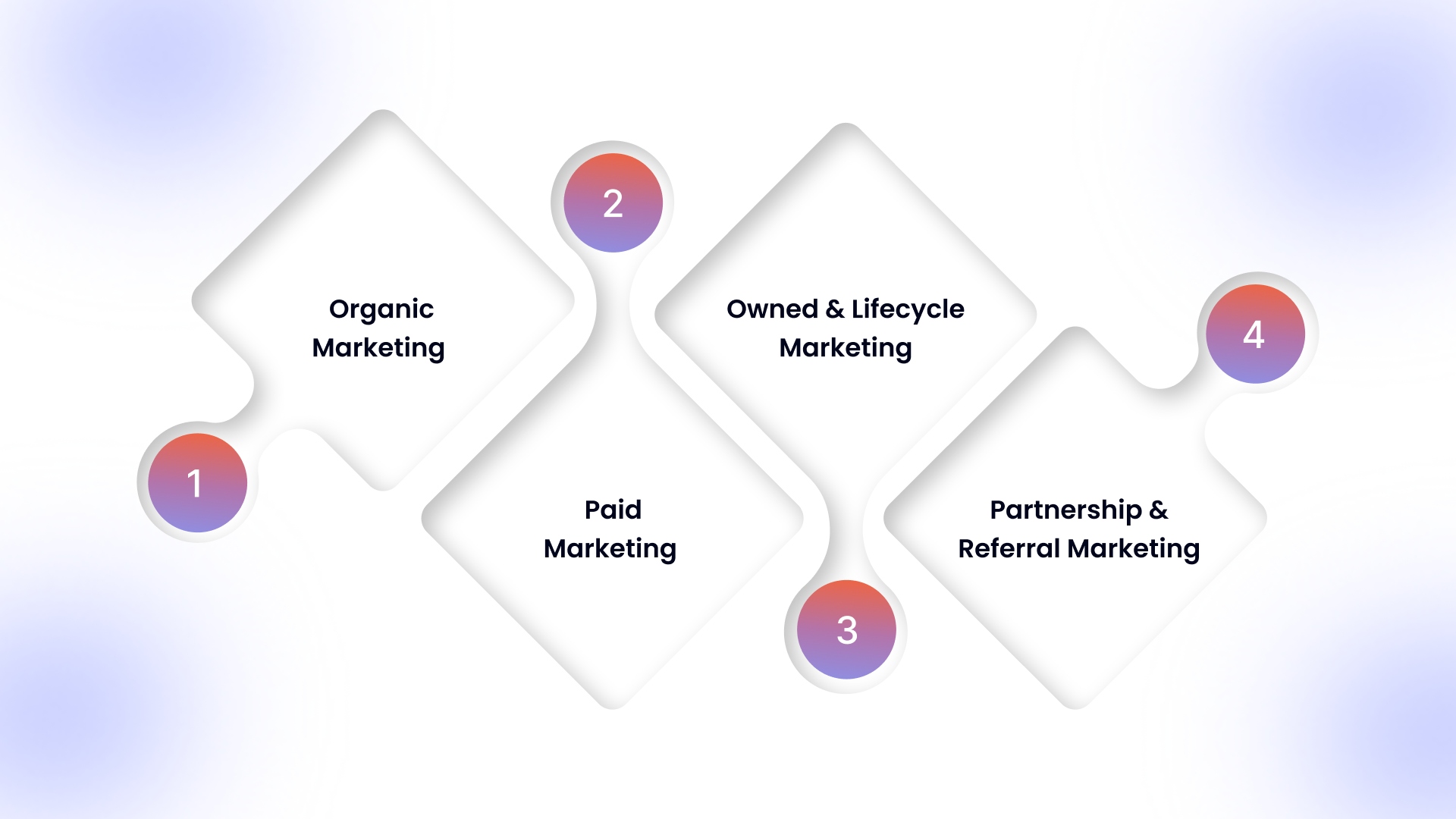
Strong app growth usually combines multiple marketing types. Each one influences a different part of the user journey from discovery to long-term revenue. Let's learn each one of them.
1. Organic Marketing
Organic growth works by capturing existing demand. App Store Optimization (ASO) ranks your app for specific, high-intent keywords inside app stores. Content attracts users searching for solutions before they even visit the store. Community builds ongoing trust that increases retention and word-of-mouth installs.
2. Paid Marketing
Paid growth works by accelerating exposure. Install ads targeting defined audience segments, App Store Ads bid on competitor and category keywords, and social ads test multiple creatives to identify messages that attract high-retention cohorts.
3. Owned & Lifecycle Marketing
Lifecycle marketing works by influencing user behavior after install. Push notifications re-engage users based on inactivity or milestones, email supports upgrades and reactivation, and in-app messages surface features at contextually relevant moments.
4. Partnership & Referral Marketing
Partnership and referral marketing work through borrowed trust. Collaborations expose the app to aligned audiences, while referral incentives motivate existing users to bring in similar, high-intent users at lower acquisition costs.
Having explored each marketing type, it’s time to break down the structured stages that guide users from awareness to revenue.
5 Stages of Mobile App Marketing Strategy
A mobile app marketing strategy unfolds in stages. These stages include awareness, acquisition, activation, retention, and revenue. Each stage plays a critical role in not just attracting users but guiding them through the journey from first discovery to long-term engagement and monetization, ensuring your app delivers value for both users and your business.
1. Awareness
This stage is about visibility within the right context. Nearly 9 out of 10 visitors shop through their mobile devices. Thus, strong positioning, keyword-aligned ASO, category placement, and distribution across relevant channels ensure your app appears when intent already exists.
2. Acquisition
Once discovered, the focus shifts to persuading users to install. This involves channel mix decisions, creative testing to identify winning messages, optimized store pages, and deep links that connect ads to relevant in-app destinations.
3. Activation
An install doesn’t equal usage. Activation focuses on first-session success: reducing friction in onboarding, guiding users toward one meaningful action, and aligning early experience with the promise made during acquisition.
4. Retention
Retention moves beyond first use. Through behavioral segmentation, lifecycle campaigns, and feature nudges, the goal is to increase session frequency and embed the app into regular user habits.
5. Revenue
Revenue happens when app engagement is strong enough to support monetization. To succeed, subscription models, re-engagement campaigns, and referral loops are optimized to increase lifetime value while maintaining user trust.
Executing every stage of mobile app marketing requires the right systems. We, at AppMaker, have generated over 1,000Cr+ GMV through mobile apps for our customers in 2025. We help brands strengthen acquisition funnels, improve onboarding clarity, and build retention flows that convert installs into consistent revenue.
Once you know the stages, planning the right starting steps ensures your strategy targets the right users and avoids wasted effort.
How to Start Mobile App Marketing the Right Way
Many teams rush into ads, creatives, and launch announcements without building the foundation first. Strong marketing mobile apps start with clarity about who you’re targeting, how growth will be measured, and what happens after users install.
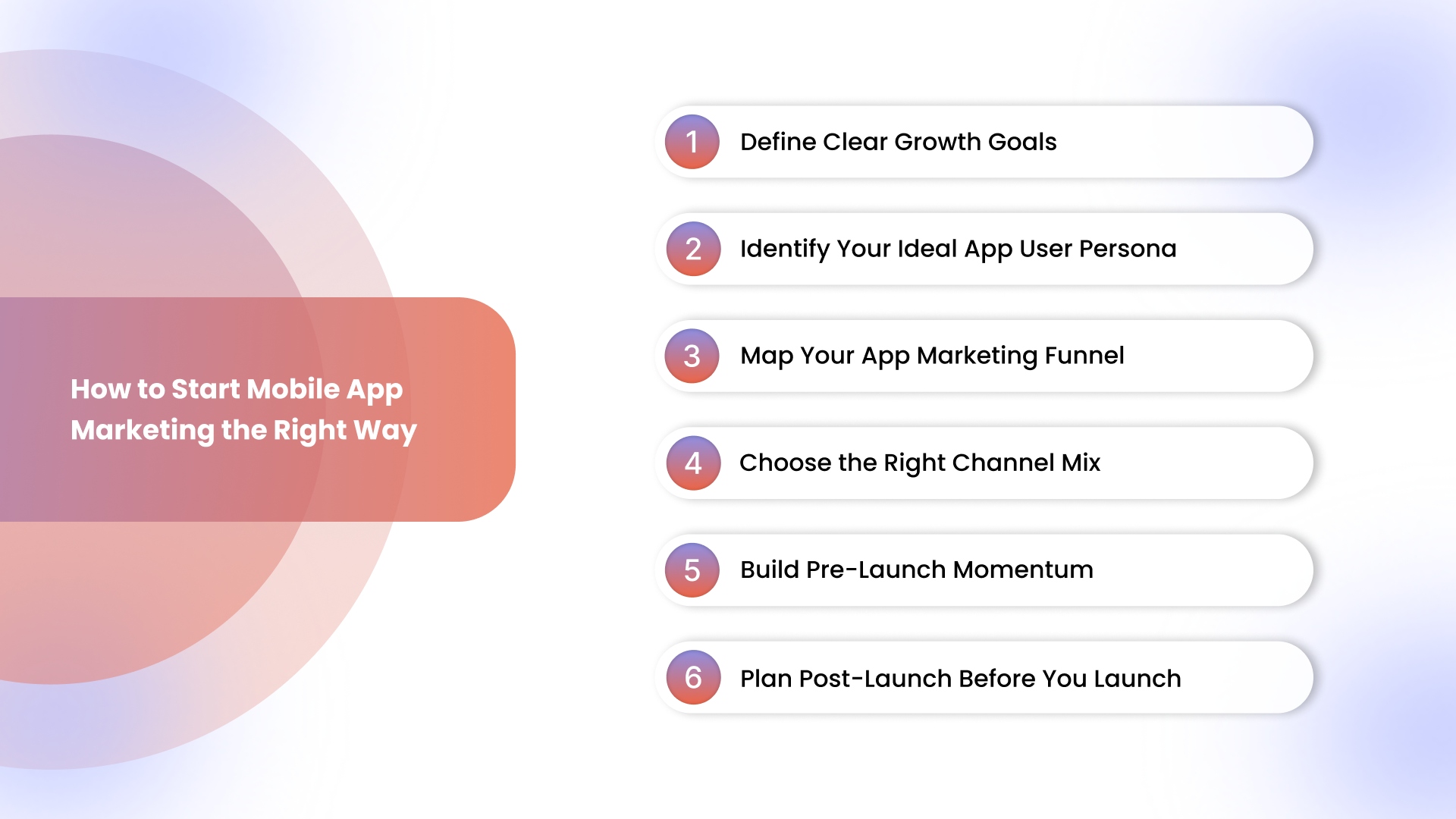
Step 1: Define Clear Growth Goals
Start by deciding what outcome matters most right now. If you optimize for installs, you’ll prioritize volume and lower CPI. If revenue or LTV matters more, targeting, onboarding depth, and monetization timing must align from day one.
Step 2: Identify Your Ideal App User Persona
Go beyond age and location. Understand the user’s trigger moment, the frustration pushing them to seek a solution, and what alternatives they currently use. Clear intent insight improves messaging, creative angles, onboarding clarity, and long-term retention outcomes.
Step 3: Map Your App Marketing Funnel
Break down the journey from first exposure to paid conversion. Identify where users hesitate: store visit, install, onboarding, or first action. Seeing these transitions clearly helps prioritize fixes instead of randomly adjusting ads or product features.
Step 4: Choose the Right Channel Mix
Select channels based on where your ideal users already spend time and how close they are to intent. ASO supports steady discovery, paid ads enable faster testing, and partnerships add credibility without depending entirely on ad spend.
Step 5: Build Pre-Launch Momentum
Creating early awareness reduces launch-day uncertainty. A waitlist, beta access group, or teaser content builds anticipation, generates feedback, and gives you real behavioral data before investing heavily in acquisition campaigns.
Step 6: Plan Post-Launch Before You Launch
Growth doesn’t start with installs; it starts with retention and monetization readiness. Define onboarding improvements, messaging flows, and early experiments in advance so acquisition amplifies strengths instead of exposing unresolved product gaps.
After outlining initial steps, pre-launch strategies establish the groundwork, validate demand, and prepare your app for a smooth market entry.
Also Read: Tips to Improve Customer Loyalty with A Shopify Mobile App
Pre-Launch Strategy: Setting the Foundation
Pre-launch strategy determines whether your app enters the market with clarity or confusion. This stage focuses on validating demand, defining differentiation, building discoverability, and creating early traction before paid growth begins.
1. Market Research & Competitive Gap Analysis
Before investing in an acquisition, you need evidence that demand exists, competitors are positioned weakly, and your app solves a clearly defined, monetizable problem in the market.
Here’s what you need to do:
- Define behavioral segments, not just demographics. Learn what triggers the search, what frustrates them, and which competing apps they currently use.
- Analyze keyword demand, category rankings, estimated revenue, and review sentiment using tools like Sensor Tower and data.ai.
- Identify competitor weaknesses in pricing, onboarding friction, feature gaps, and unclear messaging to uncover differentiation opportunities.
2. Positioning & Value Proposition
Strong positioning determines whether users instantly understand your app’s value or scroll past it without consideration.
Here’s what you need to do:
- Craft a concise value statement answering: who it’s for, what core problem it solves, and why it’s different.
- Audit competitor headlines and visuals to avoid blending into category clichés.
- Ensure store copy, ad creatives, and onboarding reinforce the same central promise.
3. ASO Before Launch
App Store Optimization should begin before launch to build discoverability foundations. It must ensure your listing targets high-intent search queries from day one.
Here’s what you need to do:
- Conduct keyword research, balancing volume, difficulty, and purchase intent. ASO, with a strong keyword strategy, can lead to 87% more organic installs.
- Structure title and subtitle strategically for both ranking and clarity.
- Design screenshots addressing objections, feature hierarchy, and expected outcomes.
4. Conversion-Optimized Landing Page
A pre-launch landing page allows you to validate positioning, collect early demand signals, and test messaging before directing traffic to app stores.
Here’s what you need to do:
- Run paid traffic to test conversion rates across messaging variations.
- Capture emails with clear incentives like early access or exclusive features.
- Track sign-up conversion by traffic source to evaluate message-market alignment.
5. Waitlist & Beta Testing Framework
Early user cohorts help validate product-market fit, refine onboarding clarity, and expose friction points before scaling paid acquisition.
Here’s what you need to do:
- Recruit users matching your primary persona, not random testers.
- Measure first-session completion rates and time-to-core-value.
- Collect structured usability feedback tied to specific flows.
6. PR & Teaser Campaign Strategy
Strategic visibility planning before launch increases credibility, boosts discovery, and improves early store performance signals.
Here’s what you need to do:
- Develop a compelling narrative around the core problem and differentiation.
- Pitch niche publications, creators, and newsletters aligned with your audience.
- Schedule teaser campaigns across email and social to build anticipation.
With foundations set, launch planning converts early visibility into measurable installs, activation, and momentum across all marketing channels.
Launch Strategy: Turning Visibility Into Velocity
A launch is not a one-day event; it is a coordinated growth moment. This phase focuses on converting attention into installs, installs into activation, and early traction into measurable momentum.
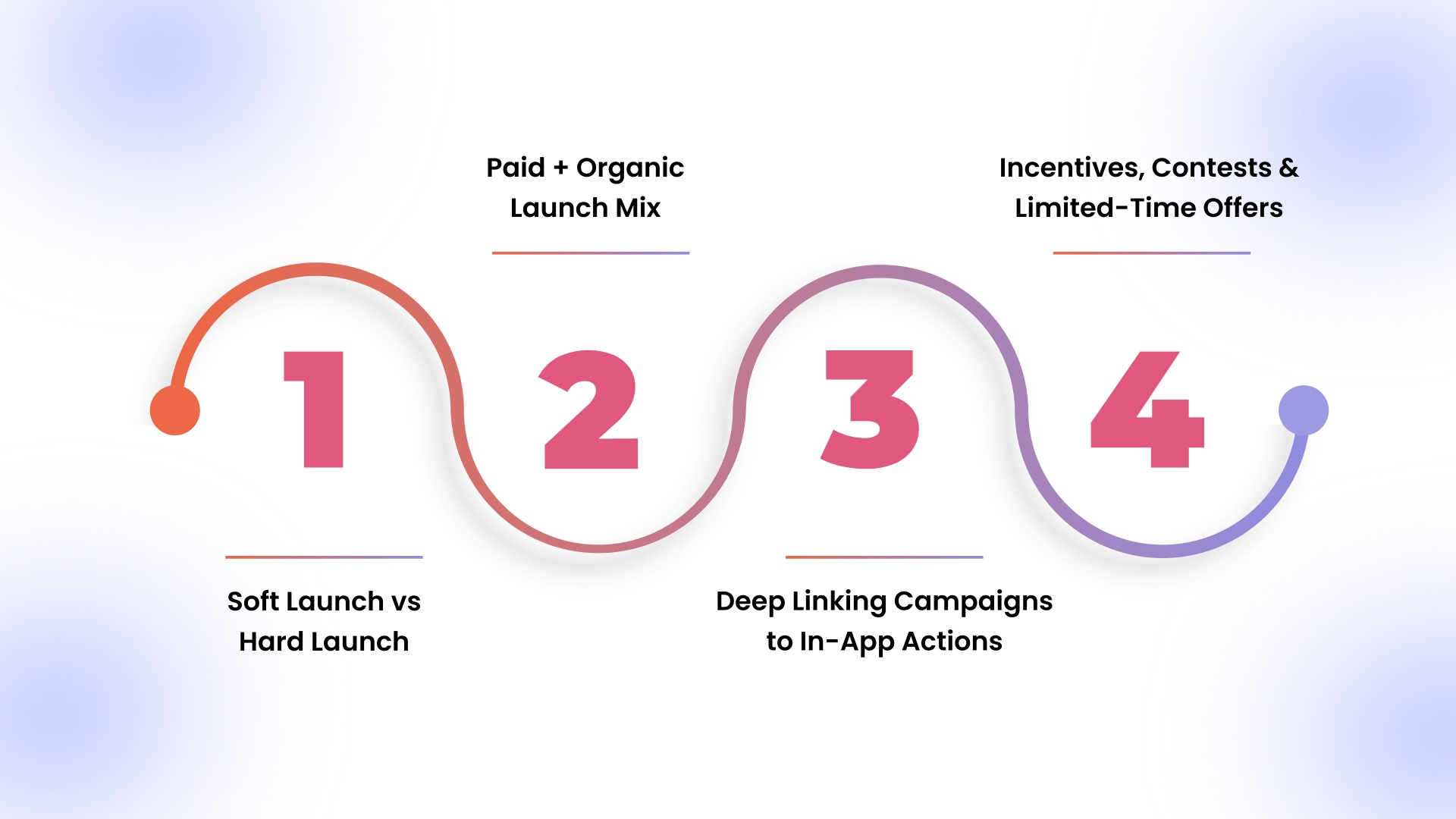
1. Soft Launch vs Hard Launch
Choosing between a soft and hard launch depends on how validated your product and funnel already are. The decision directly impacts user feedback quality, cost efficiency, and early performance signals.
Here’s what you need to know:
- A soft launch allows controlled testing in limited geographies to measure retention, activation, and monetization before scaling.
- A hard launch pushes for maximum visibility across channels simultaneously to capture market attention quickly.
- Use soft launch data to refine onboarding, pricing, and messaging before investing in aggressive user acquisition.
2. Paid + Organic Launch Mix
Relying solely on paid acquisition or organic discovery limits momentum. A coordinated paid and organic strategy ensures early installs while strengthening long-term visibility and ranking signals.
Here’s what you need to know:
- Use paid campaigns to generate controlled install volume and test creative performance quickly.
- Optimize App Store listing assets to convert paid traffic efficiently and boost organic rankings.
- Encourage early reviews and ratings to improve credibility and algorithmic positioning.
3. Deep Linking Campaigns to In-App Actions
Driving installs is only half the launch equation. Directing users to specific in-app actions increases activation speed and improves the first-session experience significantly.
Here’s what you need to know:
- Implement deep links that send users to relevant features instead of generic home screens.
- Align ad creatives with the exact in-app destination to reduce cognitive friction.
- Track post-install events to measure which campaigns drive meaningful user behavior.
4. Incentives, Contests & Limited-Time Offers
Early urgency can support adoption when structured carefully. Limited-time incentives encourage faster decision-making without permanently discounting perceived value.
Here’s what you need to know:
- Offer launch bonuses such as premium trials or exclusive features for early adopters.
- Run referral contests that reward users for inviting qualified friends.
- Set clear deadlines to create urgency while maintaining brand credibility.
After launch, the focus shifts to sustaining growth, deepening engagement, and building systems to retain high-value users efficiently.
Post-Launch Strategy: Scaling, Engaging & Retaining Users
After launch, growth becomes a systems challenge. This phase focuses on scaling acquisition efficiently, strengthening activation depth, and building a retention infrastructure that increases lifetime value while reducing dependency on constant paid acquisition.
1. User Acquisition Strategies That Scale Profitably
Sustainable growth requires structured expansion across channels while protecting margins. It must ensure user volume increases without compromising retention quality or long-term revenue efficiency.
Here’s what you need to do:
- Continuously optimize your organic growth engine through ASO iteration, review velocity improvement, and content distribution aligned with high-intent keywords.
- Scale paid acquisition only when campaigns meet retention-backed ROAS benchmarks, segmenting audiences by funnel stage and creative intent.
- Layer influencer partnerships, referral loops, and regional experiments to diversify acquisition sources and reduce reliance on a single channel.
2. Activation & Onboarding Optimization
Activation determines whether acquisition spend translates into engaged users. This makes early-session clarity and time-to-core-value the primary drivers of retention and monetization stability.
Here’s what you need to do:
- Personalize onboarding flows based on acquisition source and user intent to reduce friction and accelerate meaningful action.
- Design habit-forming journeys that guide users toward repeatable behaviors tied directly to core product value.
- Identify and reduce the first seven-day drop-off points using behavioral analytics, simplified flows, and contextual reminders.
3. Retention & Lifecycle Marketing
Retention systems protect revenue consistency by turning occasional users into habitual ones, reducing churn risk and improving lifetime value without increasing acquisition spend.
Here’s what you need to do:
- Segment users into behavioral cohorts to trigger lifecycle messaging based on activity patterns rather than install date alone.
- Implement a coordinated push, email, and in-app messaging strategy aligned with lifecycle stage and engagement intensity.
- Deploy targeted re-engagement campaigns and loyalty mechanics that reward consistent usage while reactivating dormant cohorts.
Once users are onboarded and engaged, tracking key metrics ensures campaigns are optimized for retention, monetization, and long-term profitability.
Essential Mobile App Marketing Metrics & ROI
Measuring success goes beyond installs. Tracking the right metrics helps you understand acquisition efficiency, user engagement, retention, and overall revenue impact, allowing you to optimize spend and scale profitably. Focus on a few key indicators to guide decisions effectively:
- CPI (Cost Per Install): CPI measures the cost to acquire a single app install through paid channels. Lower CPI is good, but always compare it with retention and LTV to ensure sustainable growth.
- CAC (Customer Acquisition Cost): CAC shows the true cost of acquiring a paying user. It includes all marketing spend divided by paying users, helping identify channels that generate quality users efficiently.
- LTV (Lifetime Value): LTV estimates the total revenue a user generates over their lifetime. Comparing LTV to CAC ensures your acquisition is profitable and your app’s growth is financially viable.
- Retention Rate: Retention tracks how many users return over time, usually measured at Day 1, 7, and 30. High retention indicates strong onboarding, engagement, and long-term monetization potential.
- ROAS (Return on Ad Spend): ROAS measures revenue generated per dollar spent on marketing. It helps evaluate campaign efficiency and determine whether paid acquisition contributes to net growth. A strong mobile app allows you to predictably save on costs while driving a 20%+ higher ROAS.
- Conversion Rate: Conversion rate tracks how many installs lead to meaningful actions, like subscriptions or purchases. Optimizing conversion ensures you maximize value from every acquired user.
- Engagement Rate: Engagement rate measures active interactions within the app. Strong engagement predicts retention, reduces churn, and signals user satisfaction and app relevance.
When these metrics are tracked and optimized consistently, the impact is reflected directly in revenue contribution, conversion rate lift, and repeat behavior.
Across categories like Fashion, Pet Supplies, Personal Care, and Food & Nutrition, AppMaker-powered apps contribute 45–70% of total revenue. Brands have seen conversion rates improve by 2.5x to 4x and repeat purchase rates increase up to 3x through structured lifecycle optimization and retention-focused app experiences.
Next, as marketing grows, maintaining privacy and compliance safeguards user trust while allowing you to continue personalized, data-driven engagement.
Also Read: 10 Mobile App Engagement Metrics That You Should Track in 2026
Privacy & Compliance Rules in Mobile App Marketing in 2026
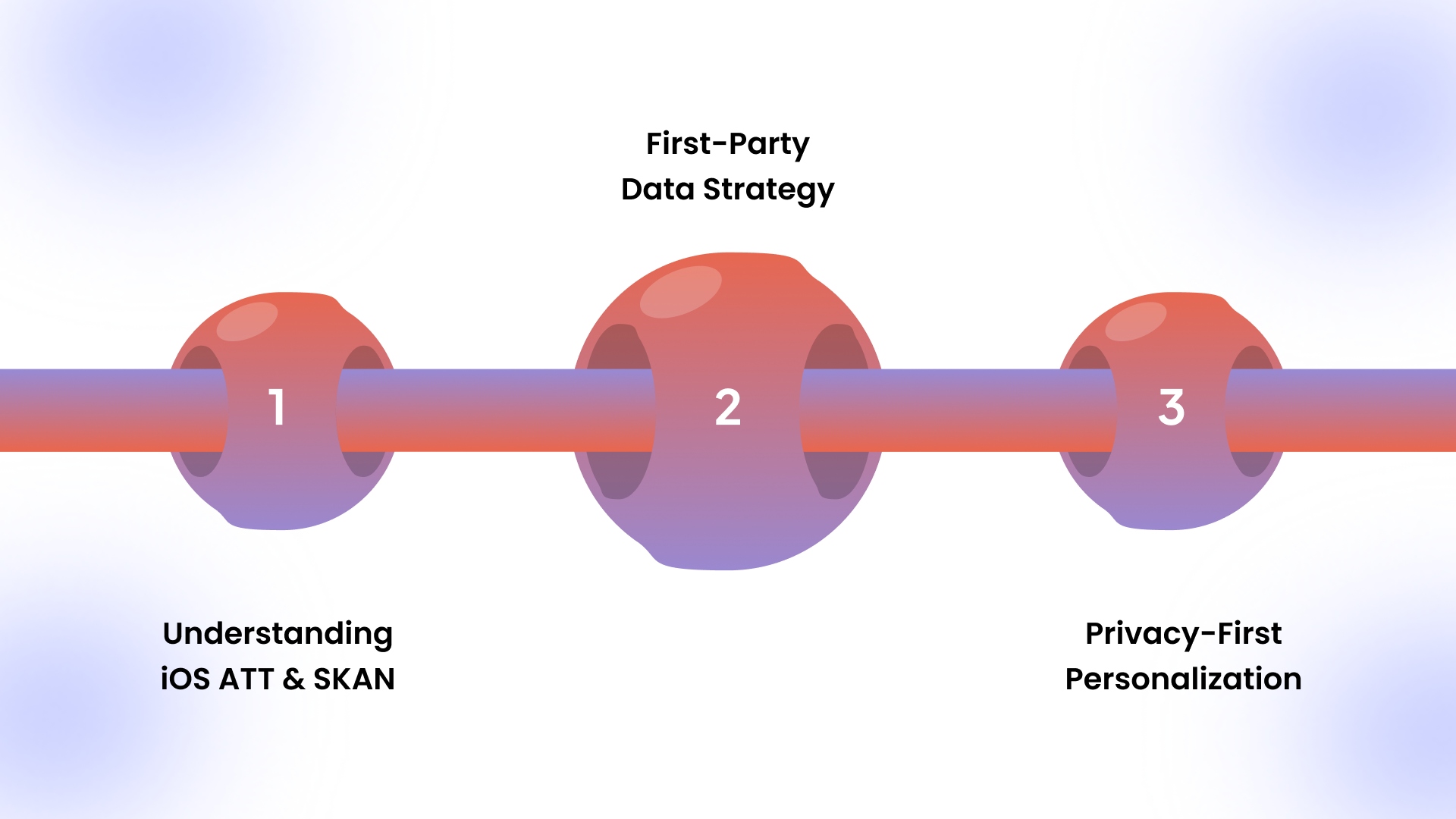
Privacy and data protection shape user trust and app growth. A compliant strategy ensures marketing campaigns remain effective while respecting user rights.
1. Understanding iOS ATT & SKAN
Apple’s App Tracking Transparency (ATT) and SKAdNetwork (SKAN) frameworks require explicit user consent for tracking, impacting ad attribution and targeting precision. Prepare by designing campaigns that utilize aggregated SKAN data while minimizing dependency on IDFA.
2. First-Party Data Strategy
Collecting and using your own user data: emails, in-app behavior, and purchase history, reduces reliance on third-party tracking. Segment audiences based on activity patterns and consent, enabling personalized marketing without privacy risks.
3. Privacy-First Personalization
Tailor messaging and recommendations using anonymized or aggregated data to maintain relevance. Employ AI and predictive modeling to deliver timely, contextual experiences that respect user privacy while boosting engagement and retention.
Having addressed compliance, it’s time to explore emerging technologies and AI-powered strategies shaping the next frontier of app marketing.
The Future of Mobile App Marketing 2026 & Beyond
Mobile app marketing is no longer just campaigns and installs. Technology is shaping how, when, and why users engage. Brands that use AI, AR/VR, and conversational tools early can outpace competitors, drive retention, and increase revenue velocity.
Key Strategies to Lead in 2026:
- AI-Powered Personalization: Use machine learning to deliver hyper-relevant content, recommendations, and offers in real time, boosting engagement, retention, and conversion without intrusive tracking.
- Predictive Segmentation: Anticipate user behaviors like churn or upsell potential to preemptively trigger targeted campaigns that maximize lifetime value.
- AR & VR Experiences: Introduce immersive, interactive features that increase session depth, drive repeat usage, and generate organic sharing for viral reach.
- Conversational & Chatbot Marketing: Implement AI-driven chat flows for onboarding, support, and engagement, enabling instant guidance and frictionless interactions that improve first-session success.
With future trends in mind, AppMaker provides tools to execute every marketing stage efficiently, transforming strategy into actionable, measurable growth.
How AppMaker Strengthens Your Mobile App Marketing
Executing a mobile app marketing strategy, from pre-launch research to post-launch retention, requires precision, insight, and speed. AppMaker helps brands plan, launch, and scale campaigns effectively, ensuring every marketing step drives installs, engagement, and revenue.
Here’s how our platform supports marketers:
- Eidolon AI: Converts Figma files or screenshots into app layouts optimized for onboarding and engagement, reducing friction during acquisition and activation.
- John AI: Provides real-time insights into user behavior, campaign performance, and retention trends for data-driven marketing decisions.
- Deep Customization: AppMaker Studio gives full control over UI, UX, workflows, and integrations, with code-level flexibility to optimize onboarding, feature discovery, and in-app journeys.
- Growth Partnership: We don’t just launch apps. We refine acquisition funnels, improve activation, and scale retention systems to turn your app into a consistent revenue channel.
- Advanced Push Notifications: Trigger behavior-based messages using user actions, inactivity, or purchase signals to drive repeat sessions, feature adoption, and conversions.
With AppMaker, brands can execute a full mobile marketing lifecycle with clarity and measurable results, keeping users engaged at every stage.
Conclusion
Mobile app marketing succeeds when every stage, from discovery and acquisition to activation, retention, and monetization, is planned and optimized. Brands that combine pre-launch research, ASO, onboarding design, and post-launch engagement see higher retention, stronger conversions, and sustainable revenue growth.
AppMaker helps brands execute this full lifecycle efficiently. With our useful tools, every campaign, message, and feature is made user-focused and data-driven, removing guesswork from growth strategies.
To maximize your app’s potential, reach out to us to explore how AppMaker can simplify marketing workflows, boost engagement, and scale your revenue across the app lifecycle.
FAQs
1. What are the best benefits of mobile app marketing?
Mobile app marketing drives higher user engagement, improved retention, and direct revenue growth. It allows brands to communicate in real time via push notifications, personalize content with AI, and gain actionable insights from in-app behavior to optimize campaigns continuously.
2. What are the challenges of mobile app marketing?
Key challenges include high competition in app stores, short user attention spans, and optimizing for retention post-install. Tracking ROI accurately, maintaining user privacy compliance, and continuously refining onboarding and messaging are also major hurdles for sustainable growth.
3. How can mobile apps improve cross-channel marketing effectiveness?
Apps act as a centralized hub for campaigns, enabling brands to sync email, social, and paid channels. In-app analytics and deep linking provide insight into user behavior, helping optimize engagement across all touchpoints.
4. How does AI enhance mobile app marketing performance?
AI predicts user behavior, personalizes content, and automates campaigns. It enables brands to serve the right message, recommend the right products, and optimize acquisition and retention strategies in real time.