
























Most ecommerce stores get plenty of traffic, yet sales often lag behind expectations. You’ve launched ads, posted on socials, and updated your product pages, but visitors leave without buying, carts pile up, and repeat sales feel unpredictable.
With the global ecommerce market projected to reach $6.8 trillion by 2028, there’s a huge opportunity for brands that know exactly where to focus. This means knowing exactly which actions boost visibility, speed up conversions, and keep customers coming back.
In this blog, we’ll break down practical ecommerce growth strategies that actually work, helping you turn casual visitors into repeat buyers.
Overview
- Brands improve sales when they identify friction across discovery, product evaluation, checkout, and post-purchase experience, then prioritize fixes that directly influence shopper decisions.
- Search visibility, social discovery, and intent-driven content help attract qualified visitors while improving product understanding and reducing early browsing drop-offs.
- Clear product information, authentic reviews, live support, and simplified mobile checkout remove hesitation and help more shoppers complete purchases confidently.
- Lifecycle messaging, personalization, loyalty programs, and subscriptions strengthen relationships, encourage repeat buying, and reduce dependence on constant discounting.
- Automation, structured testing, performance metrics, and mobile apps enable teams to execute improvements consistently while maintaining ongoing customer engagement beyond traditional storefront interactions.
Why Does Your Ecommerce Store Need a Real Plan in 2026?
Nearly 9 out of 10 visitors shop through their mobile devices. Many ecommerce stores think capturing these visitors' attention is about running a few ads or posting on social media. But in reality, without a clear plan, small fixes barely move the needle. You end up with abandoned carts, uneven sales, and marketing that feels random.
A solid growth plan helps you spot what’s actually holding your sales back, decide what to prioritize, and stop wasting time on tactics that don’t work. In other words, you don't have to just“do more,” you have to do the right things in the right order.
With this clarity in place, the next step is exploring practical growth tactics that directly address funnel gaps and convert everyday traffic into measurable revenue.
Also Read: 9 High-Impact Mobile Customer Engagement Strategies in 2026
12 Actionable Ecommerce Growth Tactics to Boost Sales in 2026
Most ecommerce brands struggle because growth leaks quietly across the funnel: hesitant buyers, shallow product discovery, weak repeat purchase triggers, and inconsistent post-purchase engagement. This section breaks down focused tactics that help capture missed revenue and turn everyday demand into measurable sales lift.
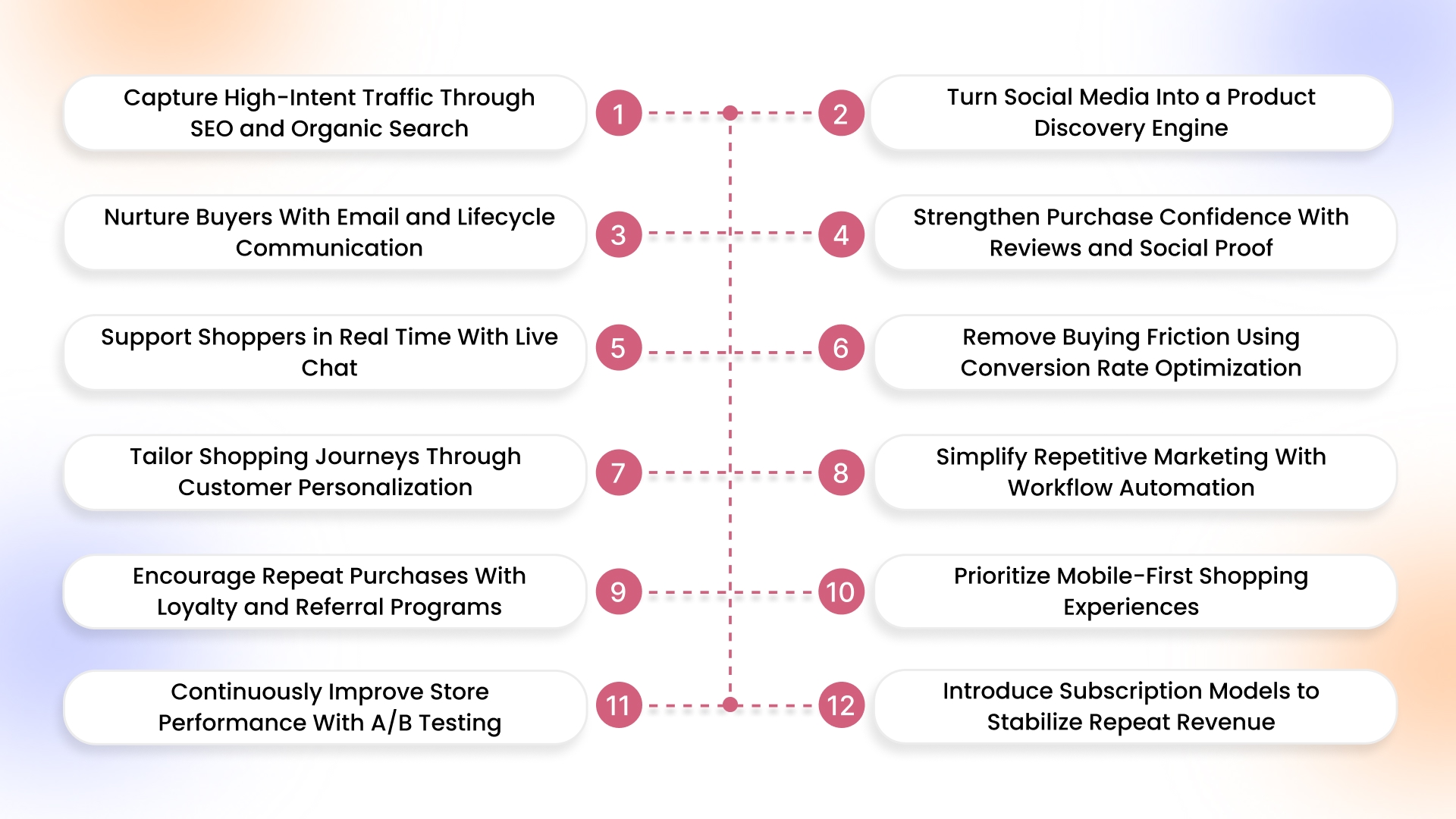
1. Capture High-Intent Traffic Through SEO and Organic Search
Organic search remains one of the few acquisition channels that compound over time. When your store appears exactly where shoppers are actively searching, you capture high-intent traffic without paying for every click, while also building long-term discoverability and brand trust.
To turn organic search into a consistent revenue channel:
- Align product titles and category structures with real search phrases customers use, especially intent-rich modifiers like comparisons, price brackets, and use-case queries.
- Expand product pages with FAQs, use cases, sizing help, and review highlights to improve relevance while reducing buyer hesitation and supporting stronger purchase confidence.
- Resolve crawl gaps, duplicate collections, and slow mobile performance so search engines can efficiently index, understand, and rank revenue-driving pages without friction.
- Publish buying guides, comparison content, and problem-solution articles that naturally route discovery traffic toward product and category pages while broadening keyword coverage.
- Implement structured data for reviews, pricing, FAQs, and availability to improve search visibility and increase click-through rates through richer, more informative search result listings.
2. Turn Social Media Into a Product Discovery Engine
Social platforms have shifted from awareness channels to discovery and conversion engines. Shoppers now evaluate brands, explore products, and validate credibility directly through social content.
To translate social activity into meaningful sales impact:
- Build platform-specific content calendars that balance product showcases, educational content, customer stories, and behind-the-scenes moments to strengthen brand familiarity and engagement.
- Use short-form video formats to demonstrate product value, highlight real use cases, and reduce purchase hesitation through visual proof and contextual storytelling. Video-rich product detail pages can deliver up to +152% lifts in conversion rate, as per the Tapcart BFCM 2025 report
- Turn comments, DMs, and tagged content into conversion opportunities by responding quickly, resharing user-generated content, and guiding interested users toward product pages.
- Collaborate with niche creators whose audiences mirror your target customers, prioritizing authenticity and relevance over follower size to improve trust and traffic quality.
- Integrate shoppable posts, product tagging, and storefront features to shorten discovery-to-purchase journeys and convert browsing intent into measurable revenue.
3. Nurture Buyers With Email and Lifecycle Communication
Email remains one of the highest-return retention channels because it enables controlled, personalized communication across the customer journey. Lifecycle campaigns help brands move beyond promotions by delivering timely nudges that influence consideration, conversion, repeat purchases, and long-term loyalty.
To make lifecycle email programs more performance-focused:
- Segment subscribers using behavioral signals such as browsing activity, purchase frequency, and engagement patterns to deliver messages that reflect actual customer intent.
- Build automated flows, including welcome, browse abandonment, cart recovery, post-purchase education, and replenishment reminders to capture revenue without manual intervention.
- Use dynamic product recommendations based on browsing and purchase history to surface relevant items and increase average order value through contextual cross-selling.
- Test subject lines, send timing, and creative formats to identify engagement patterns and continuously refine campaign performance without increasing send volume.
- Combine promotional campaigns with value-driven content like product education, usage tips, and social proof to strengthen brand recall while reducing discount dependency.
4. Strengthen Purchase Confidence With Reviews and Social Proof
Shoppers rarely rely only on brand messaging before purchasing. Reviews, ratings, and real customer experiences help reduce uncertainty, validate product quality, and speed up decision-making, especially for first-time buyers evaluating unfamiliar brands or higher-consideration purchases.
To strengthen trust through reviews and social proof:
- Actively request post-purchase reviews through email and SMS prompts, timing outreach after delivery to capture detailed feedback while the product experience is still fresh.
- Highlight photo and video reviews on product pages to provide a realistic usage context that addresses expectations around fit, quality, and functionality.
- Surface review summaries, such as pros, common concerns, and best-use scenarios, to help shoppers quickly evaluate suitability without scanning lengthy feedback sections.
- Display trust signals across key touchpoints, including product pages, checkout, and landing pages, to reinforce credibility during critical decision moments.
- Respond publicly to negative feedback with clear resolutions to demonstrate transparency, strengthen trust, and reassure potential buyers observing review interactions.
5. Support Shoppers in Real Time With Live Chat
Pre-purchase questions often determine whether a shopper converts or abandons. Immediate assistance helps resolve doubts around sizing, delivery timelines, product compatibility, and policies, ensuring hesitation does not interrupt buying momentum.
To improve outcomes through real-time support:
- Deploy live chat on high-intent pages such as product, pricing, and checkout screens where shoppers are most likely to encounter decision-blocking questions.
- Create structured response templates for common queries, including shipping timelines, returns, product comparisons, and availability, to maintain consistency and reduce response delays.
- Combine human support with AI chat automation for after-hours coverage while ensuring complex or high-value queries are routed to agents without friction.
- Use chat transcripts to identify recurring objections, then refine product page content, FAQs, and policies to proactively reduce support dependency over time.
- Trigger proactive chat prompts based on behavior signals such as extended page time or repeated product views to assist shoppers before hesitation leads to exit.
Also Read: 8 Mobile App Retention Strategies to Turn Users Into Regulars in 2026
6. Remove Buying Friction Using Conversion Rate Optimization
Traffic alone doesn’t translate into revenue if shoppers hesitate, get confused, or encounter friction during decision-making. Conversion optimization focuses on removing blockers, simplifying journeys, and improving clarity so more visitors complete purchases without requiring additional acquisition spend.
To improve conversion performance across key touchpoints:
- Audit checkout flows to eliminate unnecessary fields, simplify guest checkout, and clearly communicate shipping costs, delivery timelines, and payment options before final purchase steps.
- Strengthen product page clarity using benefit-led descriptions, comparison tables, and expectation-setting details that address decision gaps typically causing hesitation or bounce behavior.
- Optimize mobile shopping experiences by improving tap targets, page speed, sticky CTAs, and scroll behavior to support seamless browsing and reduce drop-offs on smaller screens.
- Use exit-intent overlays strategically to capture abandoning visitors with contextual offers, reminders, or incentives that align with browsing behavior rather than generic discount popups.
- Monitor session recordings and heatmaps to identify friction zones, confusion points, and abandoned interactions, then prioritize UX fixes based on observed behavioral patterns.
7. Tailor Shopping Journeys Through Customer Personalization
Shoppers expect relevance across discovery, browsing, and post-purchase interactions. Personalization helps brands surface the right products, content, and offers based on behavior, preferences, and intent signals, improving satisfaction while reducing choice overload and decision fatigue.
To implement meaningful personalization across the journey:
- Tools like Rubik’s AI from AppMaker help surface relevant products inside the app based on shopper behaviour, supporting more contextual discovery without requiring constant manual merchandising updates.
- Deliver tailored offers and reminders using AppMaker’s Push Notification, which allows brands to re-engage shoppers after repeat visits, wishlist updates, or cart activity, without relying heavily on discounts.
- Adapt on-site search results with synonym mapping, predictive suggestions, and behavioral ranking so shoppers find relevant products faster with minimal refinement effort.
- Personalize post-purchase experiences through targeted reorder reminders, complementary product suggestions, and usage-based content that encourages repeat engagement and continued exploration.
- Build audience cohorts using behavioral clustering rather than demographic assumptions to enable more accurate targeting across campaigns, merchandising decisions, and retention initiatives.
8. Simplify Repetitive Marketing With Workflow Automation
As ecommerce operations scale, manual execution creates delays, inconsistencies, and missed opportunities across campaigns, merchandising, and customer communication. Automation helps brands maintain speed and consistency while ensuring important actions trigger exactly when customer behavior signals demand.
To operationalize automation across workflows:
- Automate inventory-based merchandising updates so low-stock, restocked, or trending products dynamically adjust visibility across collections and promotional placements.
- Trigger campaign workflows based on behavioral events such as product views, category exploration, and purchase gaps to maintain relevance without constant manual campaign creation.
- Use automated price monitoring and promotional scheduling to coordinate seasonal offers, flash sales, and markdowns without risking operational errors or delayed execution.
- Simplify backend workflows, including order routing, fulfillment notifications, and status updates, to improve operational efficiency while keeping customers informed throughout delivery stages.
- Build cross-channel automation sequences that coordinate email, push notifications, and onsite messaging to create consistent touchpoints without overwhelming shoppers with redundant communication.
9. Encourage Repeat Purchases With Loyalty and Referral Programs
Acquiring new customers is costly. According to the Mobile app trends report 2025 by Adjust x AppLovin, loyalty and referral programs are among the ways to tackle rising acquisition costs. Loyalty and referral programs encourage repeat engagement while transforming satisfied customers into active brand promoters who influence new purchase decisions.
To strengthen loyalty and referral participation:
- Design tiered reward structures that recognize repeat purchases, engagement behaviors, and milestone achievements to motivate continued interaction beyond transactional incentives.
- Introduce experiential rewards such as early access, exclusive product drops, or priority support that deepen emotional connection rather than relying solely on discounts.
- Simplify referral participation with frictionless sharing links, clear reward explanations, and visible progress tracking to encourage consistent customer advocacy.
- Highlight loyalty benefits throughout the shopping journey, including account dashboards, checkout reminders, and post-purchase communication to reinforce perceived value and participation.
- Analyze loyalty behavior patterns to identify high-value advocates, then tailor targeted incentives and engagement strategies that amplify repeat purchase frequency and referral contribution.
10. Prioritize Mobile-First Shopping Experiences
A large share of ecommerce discovery and browsing now happens on mobile, but purchase intent often drops when navigation feels slow or cluttered. Optimizing for mobile ensures smoother discovery, faster decisions, and fewer drop-offs across critical buying moments.
To strengthen mobile performance and usability:
- Simplify mobile navigation with sticky search, quick filters, and thumb-friendly menus that help shoppers reach relevant products without excessive scrolling or navigation fatigue.
- Optimize page speed through compressed media, lazy loading, and minimal scripts to reduce bounce rates and maintain engagement during early browsing sessions.
- Simplify mobile checkout using autofill, express payment options, and fewer form fields to remove friction that commonly interrupts high-intent purchase journeys.
- Prioritize mobile-specific product media, including vertical imagery, short demo videos, and zoomable visuals that improve product evaluation on smaller screens.
- Use mobile behavioral insights such as scroll depth and tap patterns to continuously refine layout structure and highlight elements that drive interaction and purchase confidence.
11. Continuously Improve Store Performance With A/B Testing
Ecommerce growth often depends on small improvements across product pages, messaging, pricing, and user flows. Continuous experimentation helps brands identify what truly influences shopper decisions instead of relying on assumptions or isolated best practices.
To implement structured experimentation effectively:
- Test product page elements, including headlines, image order, and value propositions, to understand which combinations improve engagement and reduce hesitation during evaluation stages.
- Experiment with promotional formats such as discount messaging, urgency indicators, and bundle positioning to determine which approaches influence purchase timing and cart additions.
- Validate checkout design variations, including progress indicators, trust signals, and payment layouts, to identify friction points impacting completion rates.
- Run navigation and collection layout experiments to measure how sorting logic, filtering visibility, and category grouping affect discovery efficiency and product exposure.
- Establish testing frameworks with clear success metrics and sufficient traffic thresholds to ensure experiment outcomes provide reliable insights for decision-making.
12. Introduce Subscription Models to Stabilize Repeat Revenue
Subscription models create predictable revenue streams while strengthening long-term customer relationships through convenience and continuity. When implemented thoughtfully, they reduce purchase friction and encourage consistent engagement across replenishment or curated product categories.
To build effective subscription experiences:
- Identify products with natural repeat purchase cycles, such as consumables, essentials, or maintenance items, where subscription convenience directly solves recurring buying needs.
- Offer flexible subscription controls, including delivery frequency, pause options, and product swaps, to maintain customer trust and reduce cancellation risk.
- Introduce subscription-exclusive incentives like pricing advantages, bundled value, or priority fulfillment that reinforce perceived benefits beyond convenience alone.
- Highlight subscription options within product pages and cart stages to capture intent at decision moments rather than limiting visibility to dedicated subscription landing pages.
- Monitor subscriber behavior patterns, including churn triggers, engagement gaps, and upgrade opportunities, to refine retention strategies and improve lifetime value contribution.
With multiple growth initiatives in motion, tracking the right performance metrics becomes necessary to understand impact, identify bottlenecks, and prioritize future optimization efforts.
Also Read: Best Mobile App Builder for Shopify: Top Picks for 2026
KPIs and Metrics to Track for Maximum Returns
Growth strategies only work when you can see what they actually change inside your store. Tracking the right metrics helps you spot friction, understand buying behavior, and identify which improvements are driving revenue versus which efforts are simply adding noise.
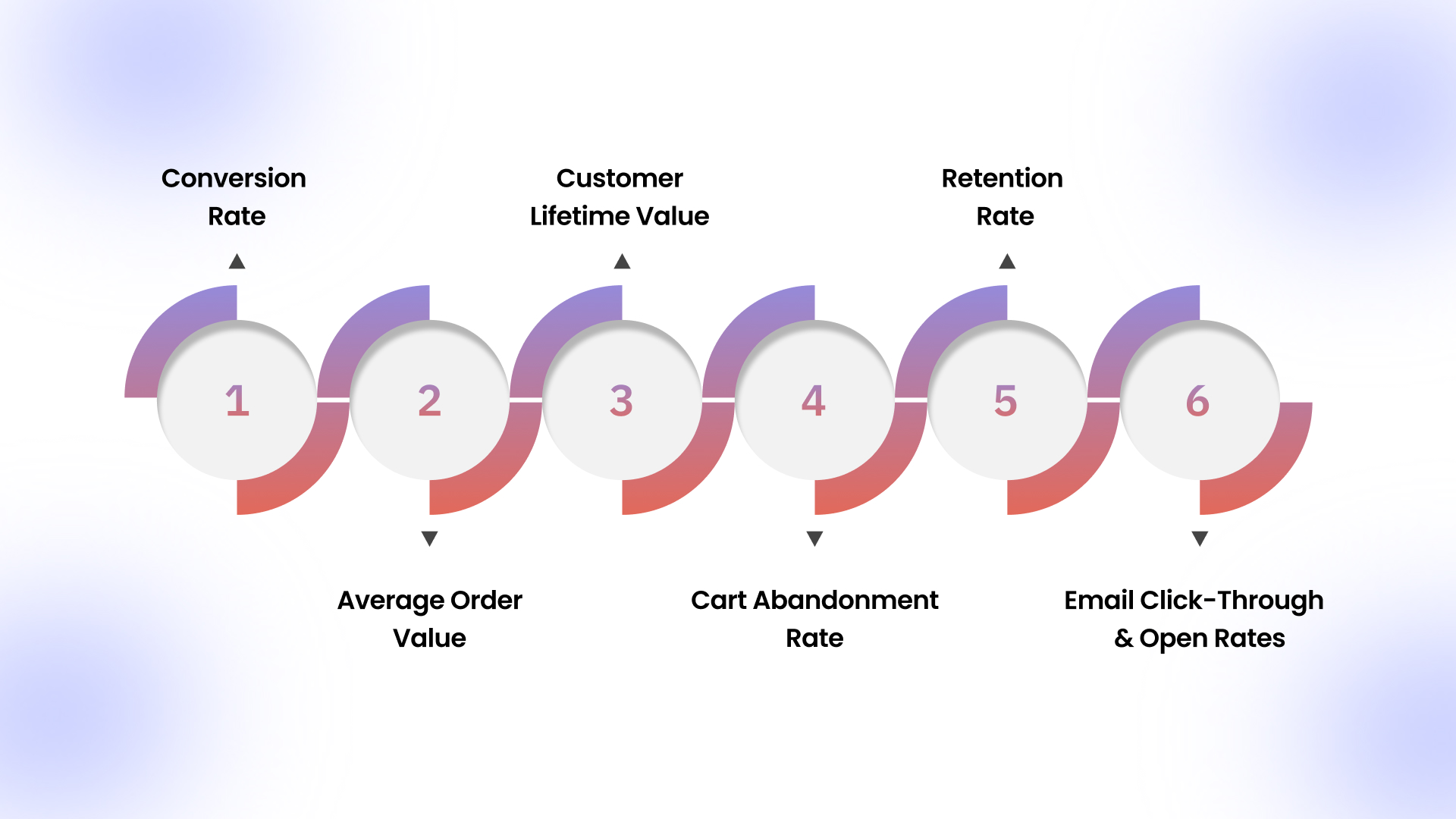
To keep your growth efforts grounded in measurable impact, pay close attention to:
- Conversion Rate: Measures how effectively your store turns visitors into buyers, revealing whether traffic quality, product messaging, and checkout experience are aligned with purchase intent.
- Average Order Value (AOV): Indicates how much customers spend per transaction, helping you evaluate bundling, cross-selling, upselling, and pricing strategies designed to increase revenue without increasing traffic.
- Customer Lifetime Value (CLV): Shows long-term customer profitability by combining repeat purchases and retention patterns, guiding decisions around loyalty investments, acquisition spend, and personalized engagement efforts.
- Cart Abandonment Rate: Highlights friction during checkout, exposing issues like unexpected costs, complicated forms, limited payment options, or a lack of trust signals that interrupt purchase completion.
- Retention Rate: Reflects how frequently customers return after their first purchase, helping you assess post-purchase experience quality, product satisfaction, and effectiveness of re-engagement initiatives.
- Email Click-Through and Open Rates: Reveal whether your messaging resonates with subscribers, helping refine subject lines, content relevance, segmentation logic, and timing across lifecycle email campaigns.
Having established measurement frameworks, translating strategy into practical mobile execution becomes the next step, particularly for brands aiming to strengthen engagement beyond traditional web experiences.
Turning Ecommerce Growth Strategy Into Mobile Execution With AppMaker
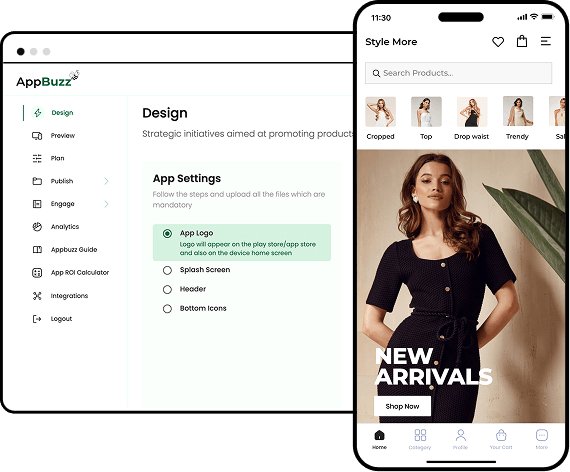
Most ecommerce growth plans break at execution, especially on mobile, where layout changes, personalization, retention campaigns, and performance improvements often require developer support. AppMaker removes that dependency by giving brands a no-code environment to design, test, and iterate native app experiences directly.
This allows teams to operationalize growth strategies through:
- Appmaker Studio: Enables marketers to adjust homepage modules, collections, and merchandising blocks visually, making campaign and CRO changes without developer delays.
- Eidolon AI: Transforms Figma files or screenshots into app-ready layouts, helping brands launch experiments and seasonal experiences faster.
- Rubik’s AI personalization: Uses behavior signals to automatically surface relevant products, improving discovery and reducing browsing friction.
- Real-time Shopify sync: Keeps catalog, inventory, and pricing aligned, preventing operational gaps that impact conversion.
- Push notifications: Supports lifecycle messaging, cart recovery, and promotional reminders from a single dashboard.
Together, AppMaker supports the mobile execution of ecommerce growth initiatives while reducing reliance on developer intervention.
Conclusion
Sustainable ecommerce growth rarely comes from a single tactic. It develops through steady improvements in discovery, experience, conversion, and post-purchase engagement. The strategies discussed in this guide focus on reducing friction, improving shopper confidence, and creating repeat purchase behaviour. This helps brands build revenue that is more predictable and less promotion-dependent over time.
For brands investing in mobile as a growth channel, a no-code builder like AppMaker enables turning an existing store into a native app without complex development. By creating a dedicated app setup for browsing, purchasing, and engagement, brands can build more consistent mobile experiences and maintain stronger customer touchpoints.
If you’re applying these growth strategies and evaluating mobile expansion, connect with us to explore how AppMaker can support your ecommerce app launch.
FAQs
1. How do ecommerce brands prioritize growth strategies without overwhelming internal teams?
Brands should audit the customer journey to locate revenue leaks, then rank initiatives using impact-versus-effort scoring. This helps teams execute high-return improvements first while maintaining operational focus and avoiding fragmented experimentation across multiple growth channels.
2. Why is mobile becoming a primary driver of sustainable ecommerce growth?
Mobile generates high browsing intent, but conversion gaps often persist due to friction and limited engagement depth. Strengthening mobile experience through faster navigation, streamlined checkout, and app-based touchpoints helps brands convert traffic into repeat revenue more effectively.
3. How can ecommerce teams validate growth strategies before scaling investments?
Teams can deploy controlled experiments such as A/B tests, segmented campaign launches, and time-bound pilots. Measuring behavioural shifts, conversion impact, and retention changes ensures strategies are validated through evidence before committing resources to full-scale implementation.
4. When does launching a mobile app make strategic sense for ecommerce brands?
A mobile app becomes relevant when brands observe strong repeat purchase patterns, high mobile traffic share, and reliance on promotional reacquisition. Apps support persistent engagement, faster access, and direct communication, strengthening retention within broader ecommerce growth initiatives.