























Mobile app users spend more per transaction compared to on mobile websites. That's a higher purchase value from the same customer base. For Shopify merchants, this gap represents millions in unrealized revenue.
Shoppers expect fast checkouts, personalized experiences, and seamless browsing on their phones. If your Shopify store doesn't have a dedicated mobile app, you're competing with one hand tied behind your back. The right mobile apps for e-commerce unlock push notifications, faster load times, and retention tools that mobile websites can't deliver.
In this article, we'll break down the top 10 mobile e-commerce apps that help US Shopify merchants increase conversions, retain customers, and scale operations without hiring developers.
Key Insights
- Mobile app users tend to place higher-value orders than mobile web shoppers, making apps an essential driver of revenue growth.
- Native mobile apps for e-commerce offer push notifications, offline browsing, and 3-5 second load times that mobile websites can't match.
- No-code platforms like Appmaker let Shopify merchants launch iOS and Android apps in 7-14 days without technical expertise.
- Customer-facing apps drive sales through faster checkout and personalization, while operational apps streamline inventory and order management.
- Multi-channel sellers need apps that sync across Shopify, Amazon, and physical locations to maintain consistent customer experiences.
- The best mobile ecommerce apps integrate with existing tools like Klaviyo, Recharge, and loyalty platforms to maximize retention.
Why Mobile Apps Matter for E-commerce Brands?
Mobile apps deliver measurably better results than mobile websites. They load in 3-5 seconds compared to 8-12 seconds for mobile sites. Checkout flows take fewer taps, and customers don't need to log in repeatedly because apps store credentials locally.
Apps also give you direct access to customers through push notifications. You can announce flash sales, abandoned cart reminders, and personalized offers without competing for inbox attention.
For DTC brands focused on lifetime value, apps create stickiness. Customers who download your app usually visit more than mobile web visitors. That frequency compounds over time, increasing repeat purchase rates and customer lifetime value.
The math is simple. For example, if your average customer spends $150 per year and your app increases visit frequency by 3x, you're looking at $200-$300 per customer without changing your product or pricing.
Top 10 Must-Have Features in Your E-Commerce App
A successful e-commerce app goes beyond basic browsing and checkout. It should remove friction at every step, support repeat purchases, and scale as your business grows. The features below form the foundation of a high-performing mobile shopping experience.
1. User-friendly navigation: Clear menus, intuitive categories, and smart search help users find products quickly without friction.
2. Fast and secure checkout: Minimal steps, multiple payment options, and strong security build trust and reduce cart abandonment.
3. Product search and filters: Filters by price, category, ratings, and availability make browsing faster and improve conversion.
4. Personalized user experience: Product recommendations, recently viewed items, and tailored content keep users engaged.
5. Push notifications: Timely alerts for order updates, price drops, back-in-stock items, and promotions drive repeat visits.
6. Order tracking and status updates: Real-time visibility into order status reduces support queries and improves the post-purchase experience.
7. Wishlist and save-for-later options: Allows users to plan purchases and return easily, increasing long-term retention.
8. Customer reviews and ratings: Social proof helps shoppers make confident buying decisions directly within the app.
9. Analytics and performance insights: Visibility into user behavior, conversions, and drop-offs supports better merchandising decisions.
10. Scalable integrations: Easy connections with payments, marketing tools, analytics, CRM, and support systems ensure the app grows with your business.
How Mobile Apps Improve Customer Retention?
Retention matters more than acquisition once you reach $5M in annual revenue. Mobile apps turn one-time buyers into repeat customers through three mechanisms: accessibility, personalization, and convenience.
Accessibility means your brand lives on the customer's home screen. Every time they unlock their phone, they see your icon. This visibility increases top-of-mind awareness and reduces the friction of returning to your store.
Personalization happens through push notifications and in-app recommendations. You can send messages based on browsing history, past purchases, or abandoned carts. Apps also remember customer preferences, saved items, and payment methods, creating a customized experience from the first tap.
Convenience comes from speed. Apps load faster than mobile websites, pre-fill checkout fields, and securely store payment information. One-tap reordering makes replenishment purchases effortless, which is critical for consumables, supplements, and subscription products.
Brands that invest in mobile apps see higher repeat purchase rates within the first year. The app becomes a retention tool that pays for itself through increased customer lifetime value.
Top 10 Mobile Apps for E-commerce Success
We've evaluated dozens of mobile e-commerce apps based on features, ease of use, integration capabilities, and ROI for US Shopify merchants. The following list includes both customer-facing apps that drive sales and operational tools that streamline store management. Whether you need a no-code builder for your branded app or a management tool to run your business on the go, these platforms deliver measurable results.
1. Appmaker
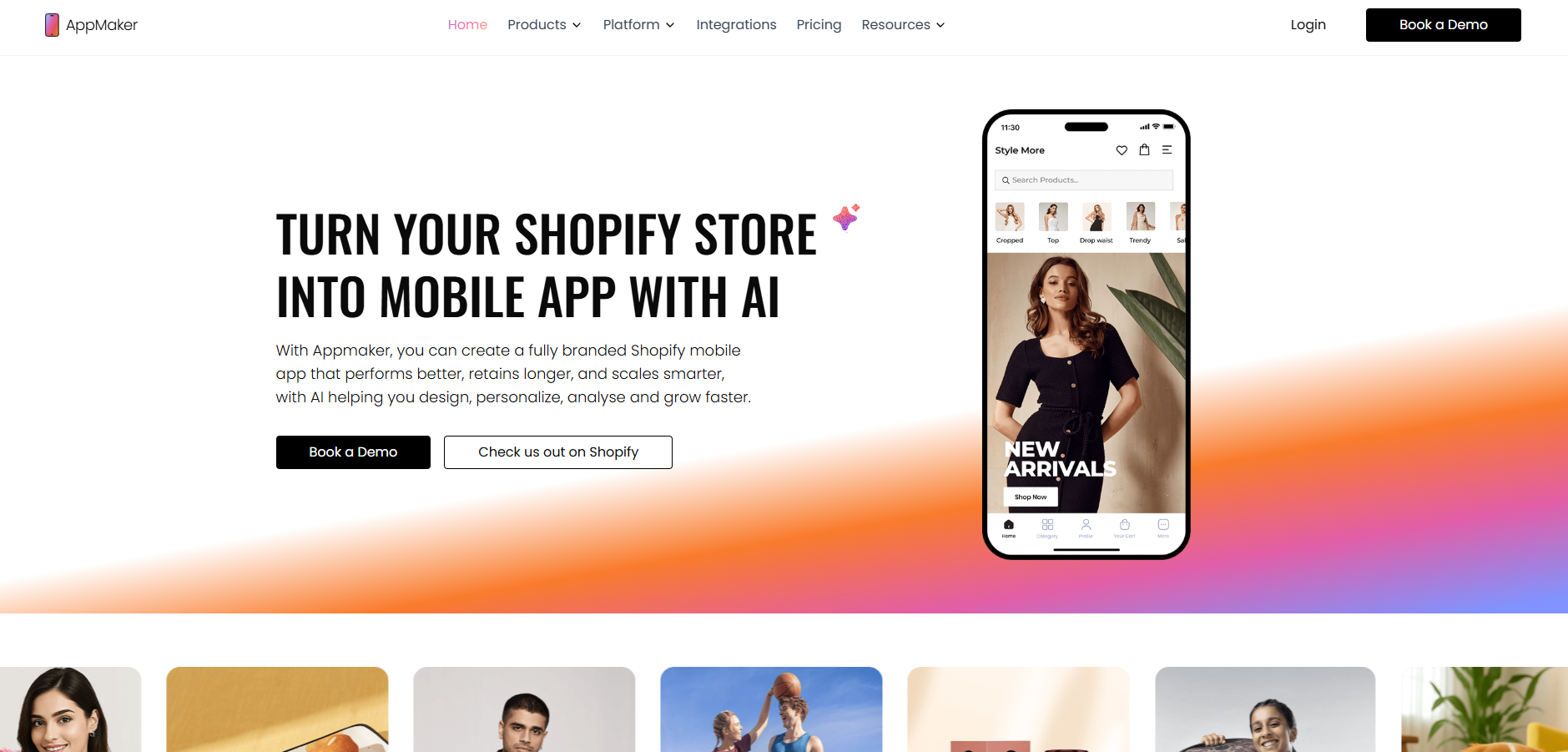
Appmaker turns your Shopify store into a fully native iOS and Android app without writing a single line of code. Built for US merchants who want speed, flexibility, and control, it syncs products, orders, and customers in real time.
Key Features
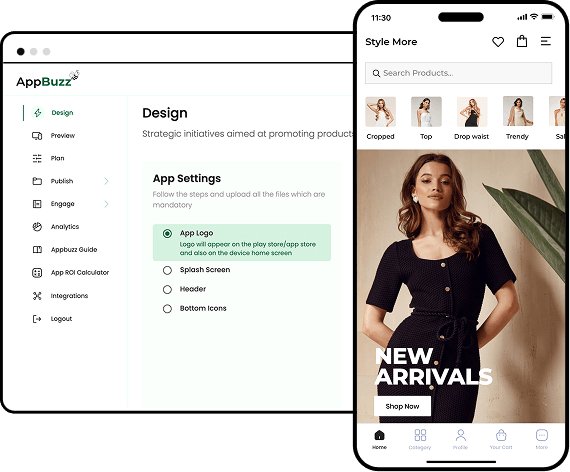
- Appmaker Studio – Drag-and-drop builder with 50+ pre-built blocks for product pages, checkout flows, and custom layouts. You can build quiz funnels, membership portals, or subscription pages without technical dependencies. The interface mirrors what you see in the final app, so there's no guesswork.
- Real-time Shopify sync – Inventory, pricing, and customer data update automatically within seconds. When a customer places an order through your app, it appears in Shopify Admin immediately, no manual exports, no CSV uploads, no delays.
- Push notifications – Segment audiences by purchase history, browsing behavior, or location. Schedule campaigns for abandoned carts, back-in-stock alerts, or flash sales. You can A/B test messaging and timing to optimize open rates.
- Eidolon AI – Upload Figma designs, screenshots, or mockups, and Eidolon converts them into working app layouts. This cuts design time from weeks to hours and ensures your app matches your brand guidelines exactly.
- John AI – Ask questions like "What's trending this week?" or "Which products have the highest return rate?" John analyzes your sales data and delivers insights in plain English. It also generates forecasts for inventory planning.
- Code Blocks – Insert custom JavaScript or CSS when you need functionality beyond the drag-and-drop builder. You can integrate third-party APIs, build custom calculators, or add unique features without starting from scratch.
- Extensive integrations – Connect with over 160 third-party tools across marketing, analytics, payments, loyalty, and support to fit seamlessly into your existing Shopify ecosystem.
Why It Stands Out
Appmaker doesn't lock you into rigid templates. You control every element, from navigation menus to product tile layouts.
Brands using Appmaker typically see conversion rate improvements within the first 60 days because apps eliminate mobile web friction points, such as slow page loads and clunky checkout forms.
Best For: Shopify merchants generating $1M–$10M annually who want a branded mobile experience without developer overhead.
2. Tapcart
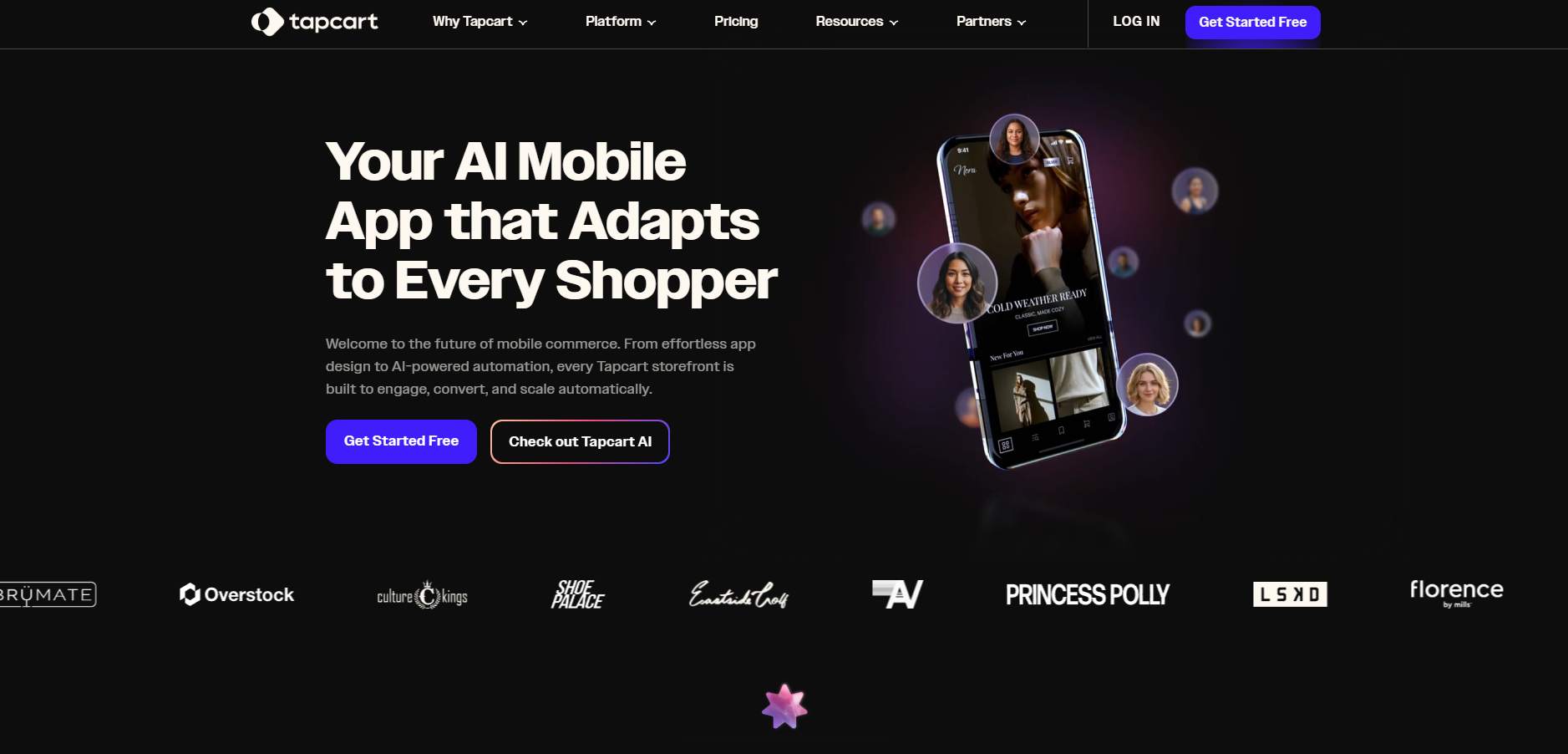
Tapcart helps DTC brands merchandise their products through mobile apps. It focuses on visual storytelling and shoppable content, making it a strong fit for fashion, beauty, and lifestyle brands.
The platform emphasizes product discovery over utility. You can create shoppable Instagram-style feeds, curated collections, and interactive product carousels. The goal is to mimic the browsing experience customers expect from social media but within a branded environment.
Key Features
- Pre-built templates optimized for product discovery with homepage layouts designed around hero images and category navigation.
- Push notification campaigns segmented by purchase history, cart value, or engagement level.
- Integration with Klaviyo, Yotpo, and Recharge to sync email campaigns, reviews, and subscription management.
- A/B testing for app layouts, messaging, and CTA placement to identify what drives conversions.
Tapcart works well for brands with strong photography and content teams. If your growth strategy relies on visual merchandising, this platform gives you the tools to execute that vision on mobile.
Best For: Brands that prioritize visual merchandising and already have a strong content strategy.
3. Plobal Apps
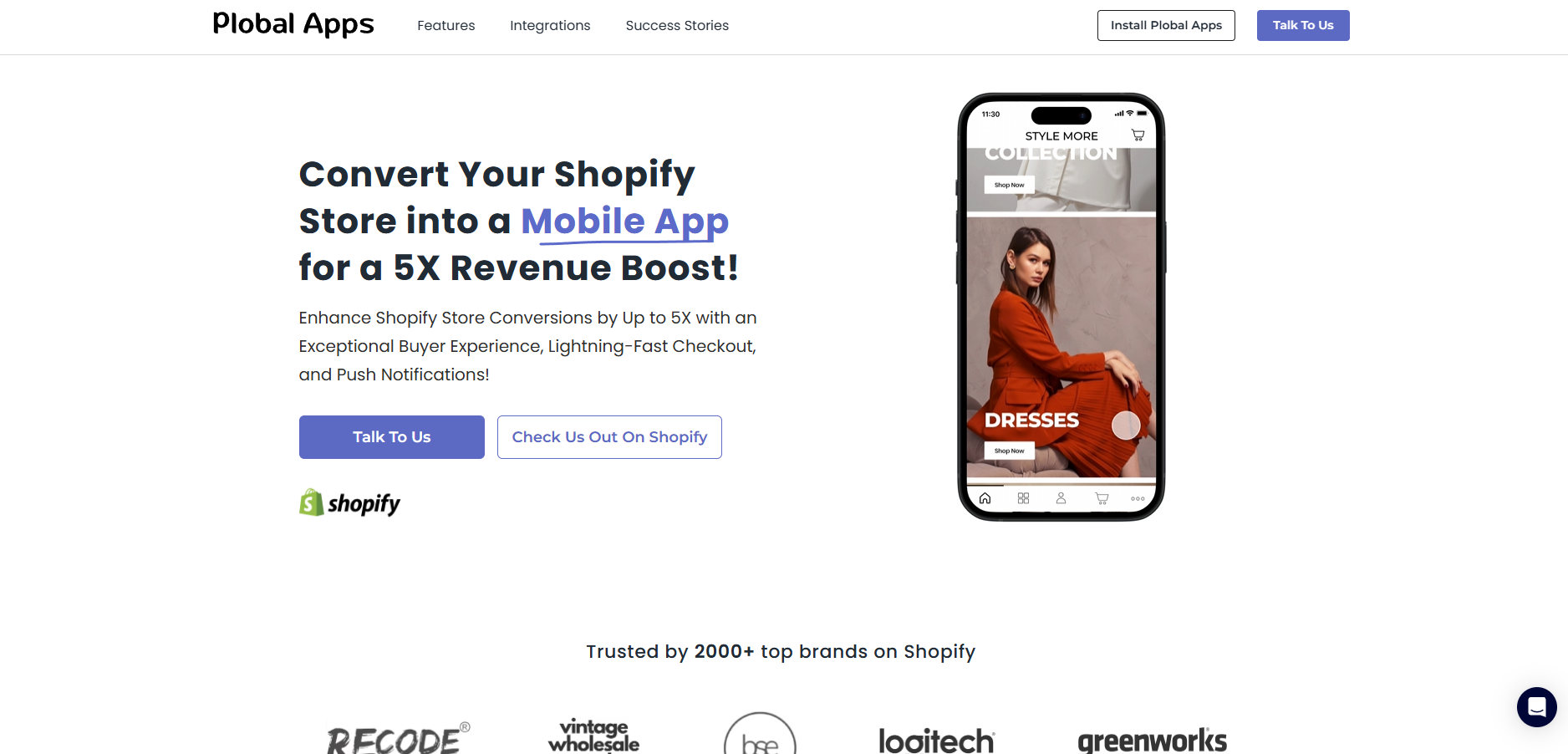
Plobal Apps combines mobile app creation with loyalty program integrations. It syncs with Shopify and works well for brands that want to reward repeat customers through app-exclusive perks.
The platform integrates with Smile.io, LoyaltyLion, and Yotpo to surface points balances, tier status, and rewards directly in the app. Customers can redeem points at checkout without leaving the app or visiting a separate loyalty portal.
Key Features
- Native iOS and Android apps with customizable home screens, product pages, and checkout flows.
- Loyalty and rewards integrations that display point balances, available rewards, and referral links prominently.
- Push notifications and automated campaigns are triggered by loyalty milestones, such as tier upgrades or expiring points.
- Real-time Shopify sync to ensure order history and rewards accuracy across all channels.
Plobal Apps makes sense if your customer retention strategy centers on loyalty programs. The app becomes the primary touchpoint for members to track and use their rewards.
Best For: Brands with existing loyalty programs are looking to extend those benefits into a mobile app.
4. Vajro
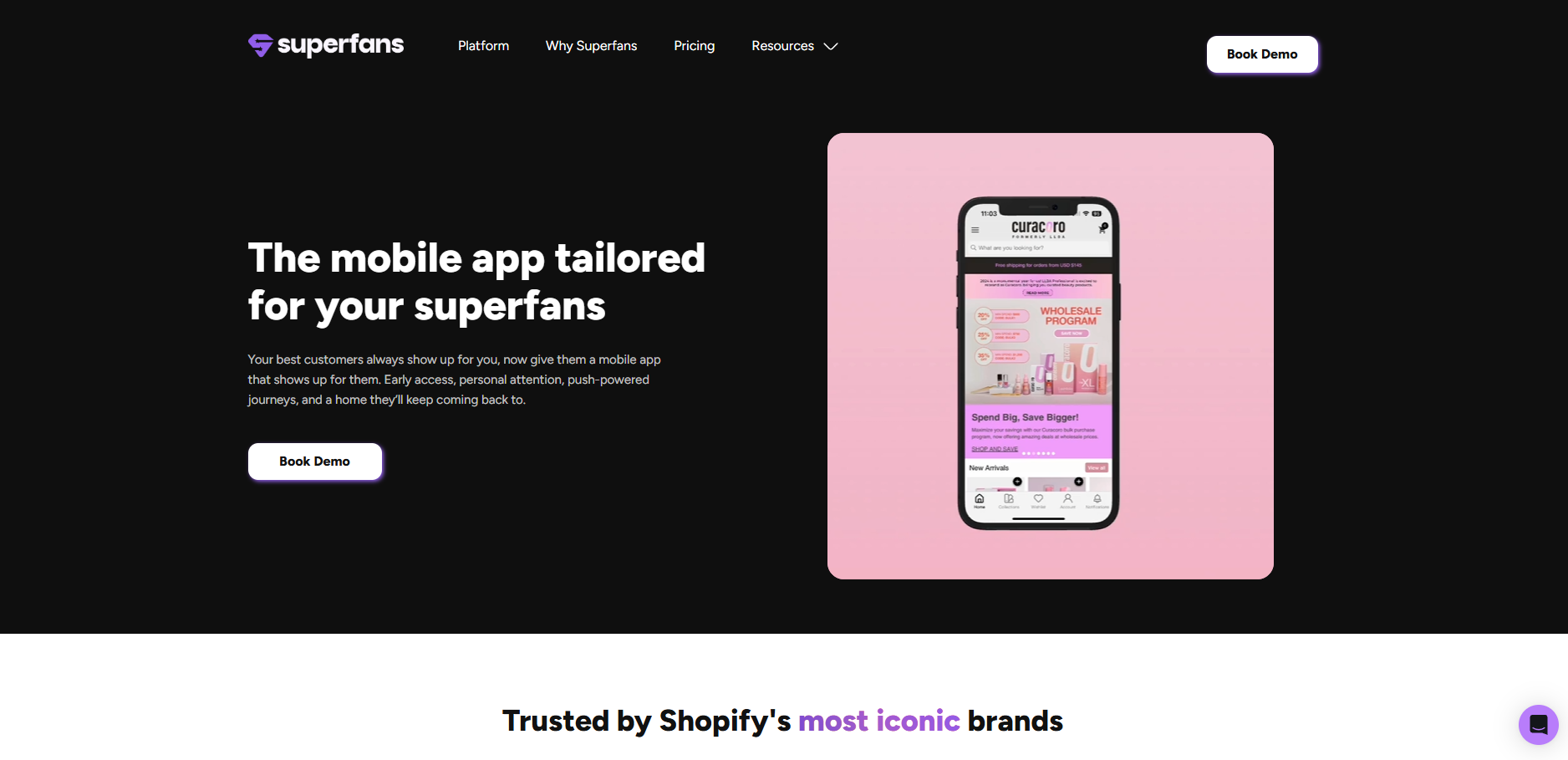
Vajro targets Shopify Plus merchants who need to launch apps quickly. It offers pre-configured templates and managed App Store submissions, reducing time to market.
The platform prioritizes speed over customization. You select a template, connect your Shopify store, and Vajro handles the rest. The trade-off is less control over layout and features, but you can have an app live in the App Store and Google Play within weeks.
Key Features
- Rapid deployment with claims of 60-minute setup for basic configurations, though full launch takes 2-3 weeks, including app store approvals.
- Push notifications and in-app chat that connect directly to your support team through Zendesk or Gorgias integrations.
- Integration with Shopify Plus tools, including Launchpad for flash sales and Script Editor for custom checkout logic.
- Managed app updates where Vajro pushes new features and security patches automatically without requiring your involvement.
Vajro works for enterprise brands that need a functional app quickly and don't have time to manage the technical details. The managed service model means you pay more per month but spend less time on maintenance.
Best For: Enterprise Shopify brands that need speed over deep customization.
5. Shopney
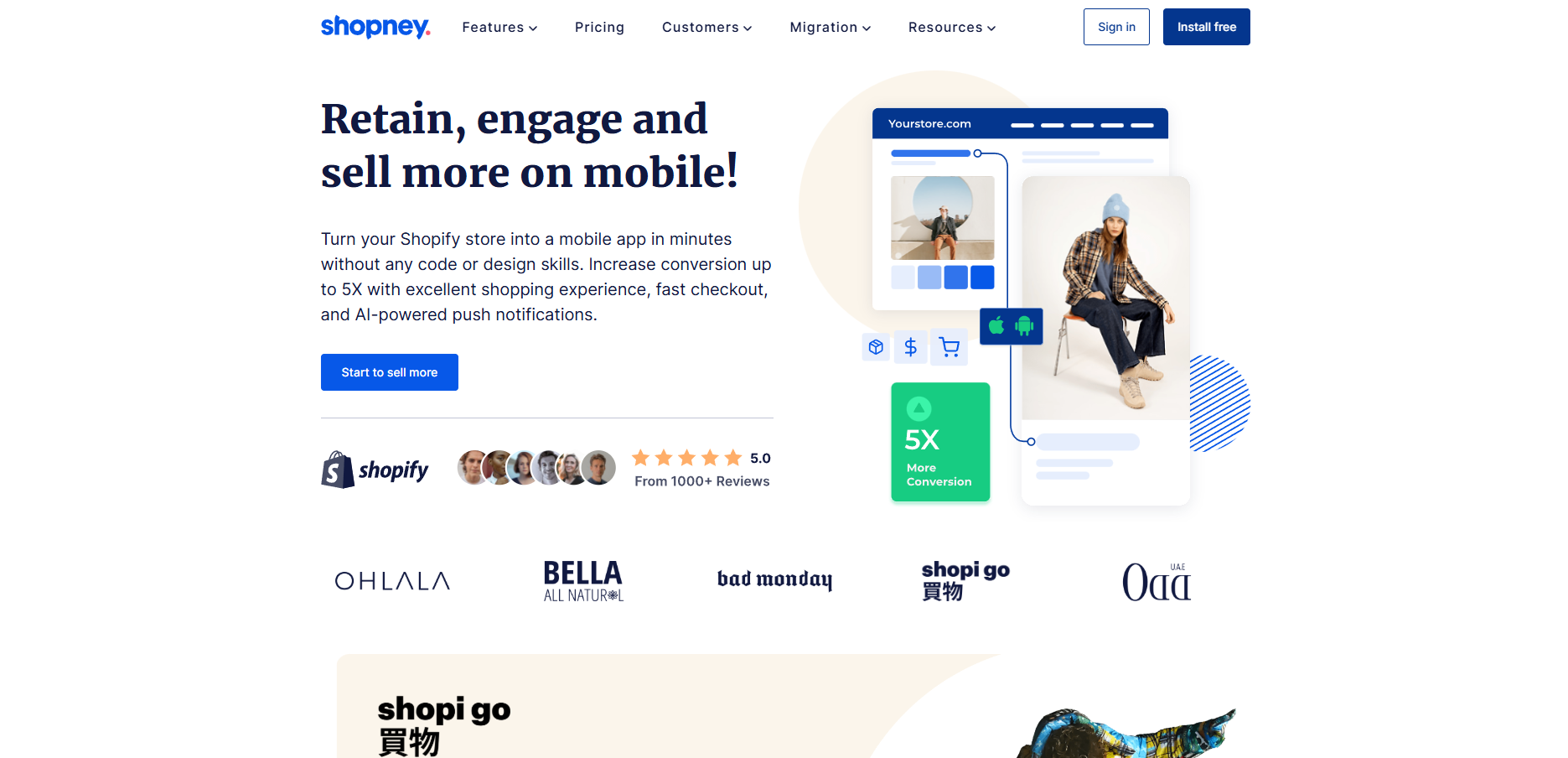
Shopney emphasizes design flexibility. It offers a visual editor with more layout options than most competitors, making it a good choice for brands with specific aesthetic requirements.
You can customize fonts, colors, button shapes, spacing, and animations. The platform gives you control over every visual element, so your app can match your brand guidelines exactly. This level of detail matters for luxury and design-forward brands where aesthetic consistency affects perceived value.
Key Features
- Drag-and-drop design editor with granular control over padding, margins, border radius, and shadow effects.
- Custom fonts, colors, and layouts that let you upload brand-specific typefaces and define exact hex color values.
- Push notifications and analytics with user-behavior and purchase-pattern segmentation.
- Integration with Shopify and WooCommerce to support multi-platform merchants running stores on different backends.
Shopney requires more hands-on design work than template-based platforms. You'll spend time adjusting layouts and testing different configurations. The payoff is an app that looks exactly the way you want it to.
Best For: Brands with strong design guidelines that want granular control over app appearance.
For brands needing design control but with faster implementation, Appmaker Studio offers granular customization through drag-and-drop blocks. At the same time, Eidolon AI converts your existing design files into working app layouts within hours.
6. MageNative
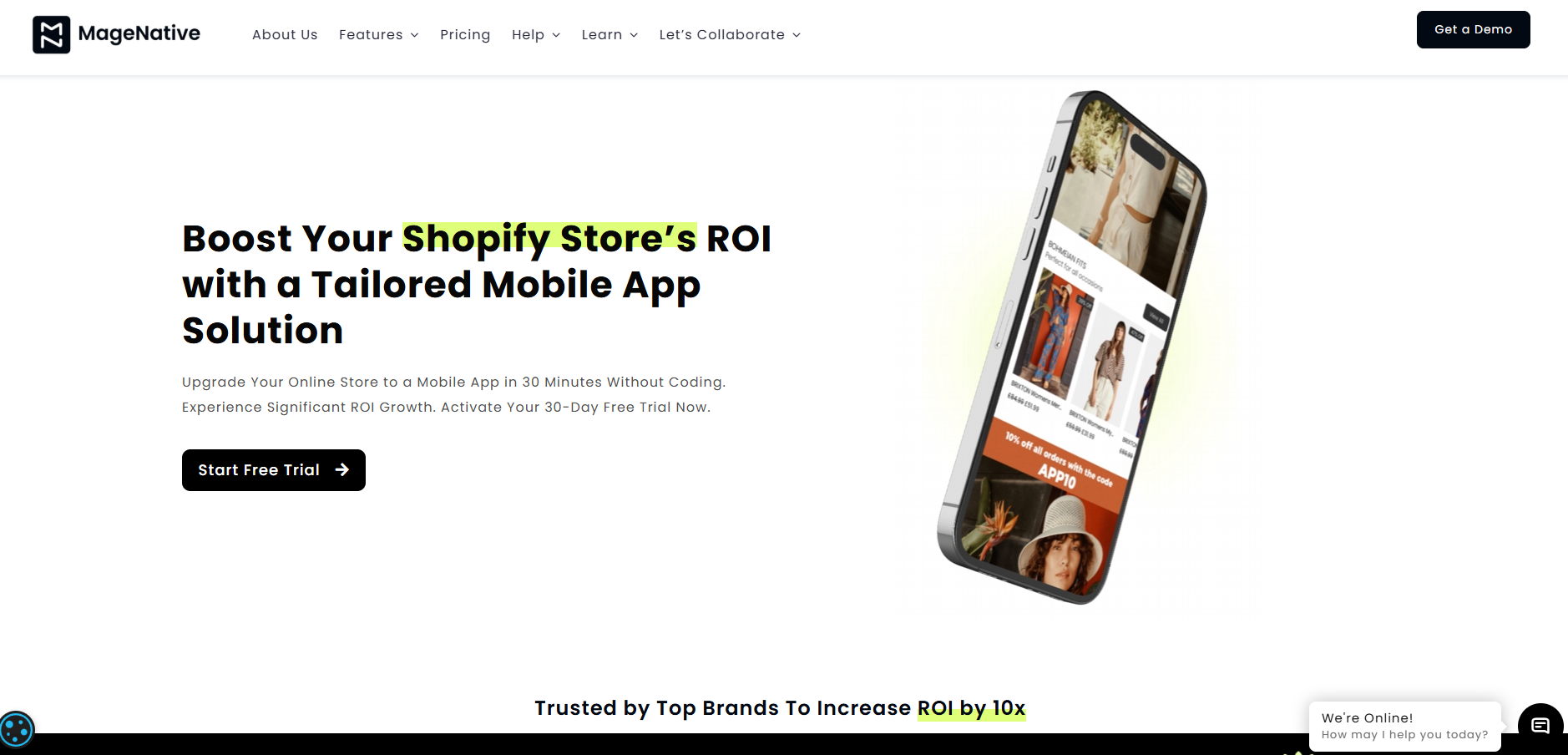
MageNative builds native apps for Shopify, Magento, and WooCommerce. It includes offline browsing, which allows customers to view products even without an internet connection.
The offline feature caches product images, descriptions, and prices locally on the device. When customers open the app in a subway, on an airplane, or in an area with poor connectivity, they can still browse your catalog. Once they reconnect, the app syncs their cart and allows them to complete checkout.
Key Features
- Offline product browsing with local storage of up to 500 products, automatically updating when the device connects to wifi.
- Push notifications and abandoned cart recovery that trigger messages when customers add items but don't complete checkout.
- Multi-currency and multi-language support for international merchants selling in multiple regions.
- Integration with major e-commerce platforms, including Shopify, Magento 2, WooCommerce, and BigCommerce.
MageNative makes sense for brands with international customers or those serving markets with inconsistent connectivity. The offline browsing feature reduces bounce rates caused by connectivity issues.
Best For: Brands serving customers in areas with inconsistent connectivity or international markets.
7. AppMySite
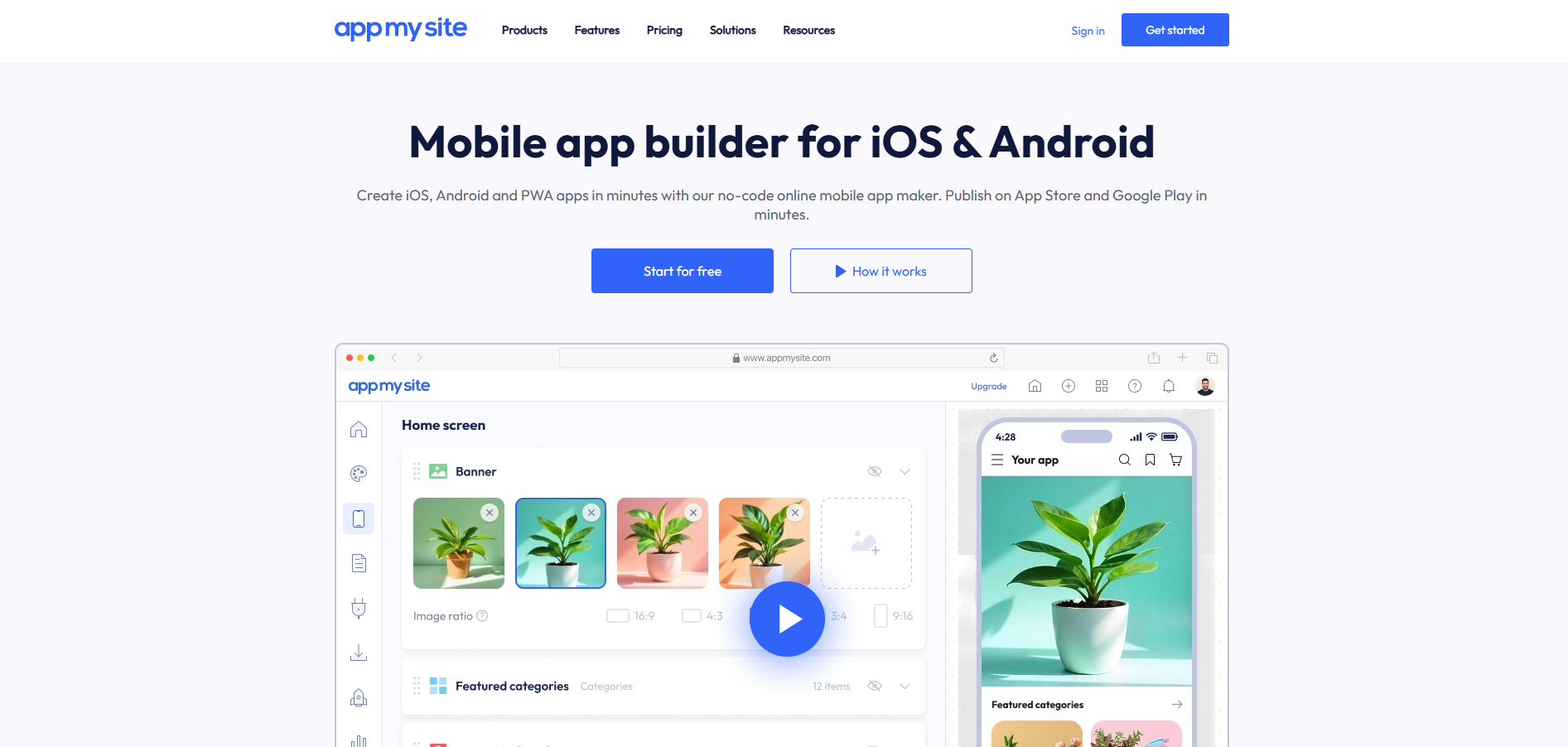
AppMySite supports both WooCommerce and Shopify. It's a no-code solution for merchants who want to build apps for iOS and Android simultaneously without platform-specific development.
The platform uses a single codebase to generate native apps for both operating systems. You design once, and AppMySite compiles versions for Apple and Google. This approach cuts development time in half compared to building separate iOS and Android apps.
Key Features
- Cross-platform compatibility that generates native apps for iOS and Android from one design, reducing maintenance overhead.
- Real-time sync with Shopify and WooCommerce to ensure product catalogs, pricing, and inventory match your web store.
- Push notifications with scheduling, segmentation, and A/B testing capabilities to optimize engagement.
- App Store and Google Play submission assistance, including compliance checks, screenshots, and listing optimization.
AppMySite works well for merchants running multiple stores or testing different platforms. You can create apps for both your Shopify and WooCommerce stores from one dashboard.
Best For: Merchants running stores on multiple platforms who want a unified mobile presence.
8. MobiLoud
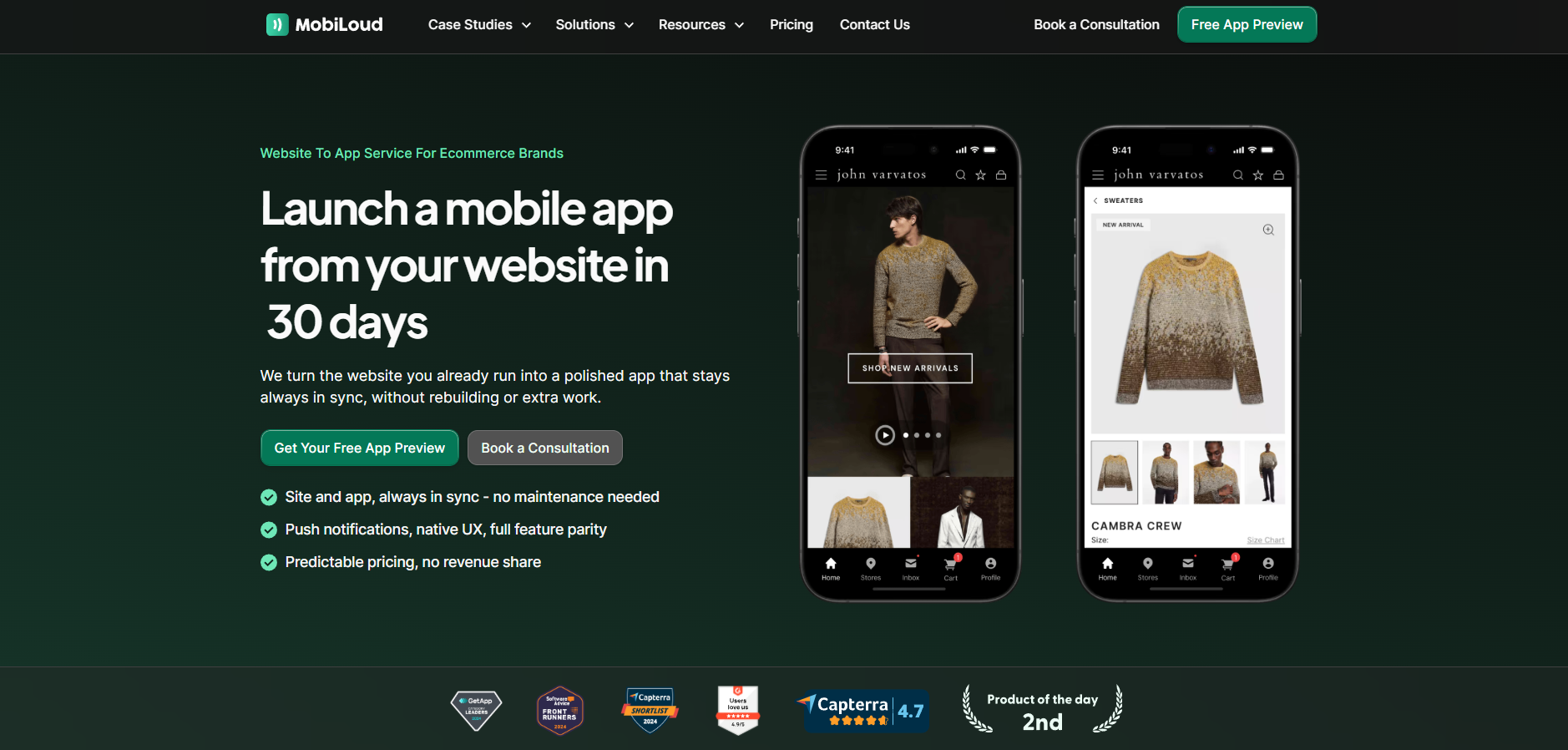
MobiLoud helps businesses turn their existing website into fully-branded native mobile apps for iOS and Android without rebuilding anything from scratch. It’s not just a DIY builder; the MobiLoud team handles the technical heavy lifting for you.
With MobiLoud, your mobile app stays perfectly in sync with your website. You update your site as usual, and changes automatically reflect in your apps, no duplicate work or separate content management needed.
Key Features
- Converts your live website into polished native mobile apps with push notifications and native navigation.
- Always-in-sync content and design, website updates instantly appear in apps.
- Team-managed onboarding, QA testing, and App Store / Google Play submission support.
- Use your existing tools (analytics, CRO, plugins) directly in the app experience.
MobiLoud doesn't generate revenue itself, but it boosts engagement and retention by giving users a native experience, improving repeat sessions, conversions, and long-term customer value.
Best For: Businesses and e-commerce sites that want a full native app experience without parallel development and maintenance.
9. GoodBarber
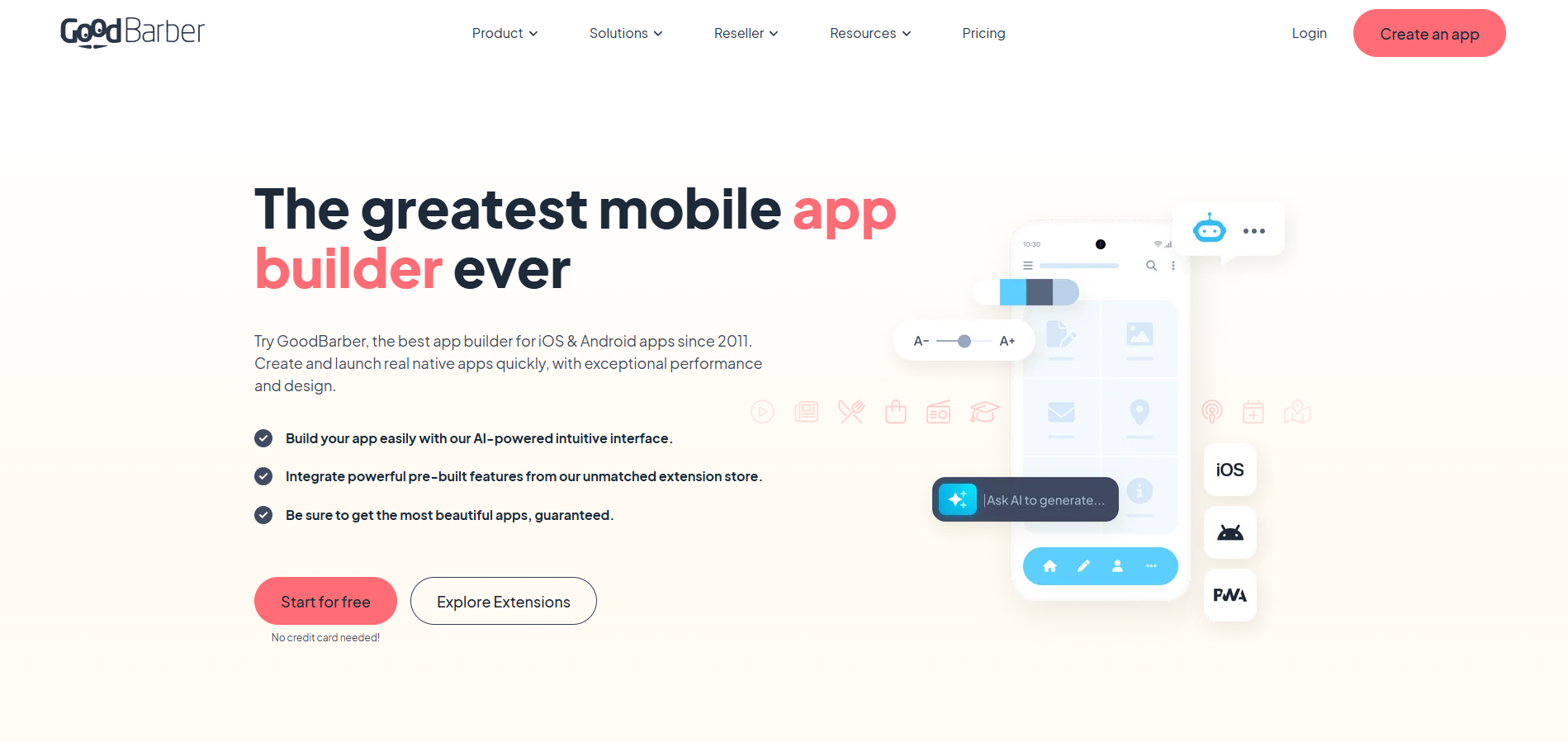
GoodBarber is a no-code app builder platform that lets you design and launch beautiful, fully functional mobile apps, including native iOS, Android, and Progressive Web Apps (PWAs), without writing any code.
It’s geared toward creators and businesses who want total visual and functional control over their app through drag-and-drop design tools, templates, and a large extensions store.
Key Features
- No-code drag-and-drop editor for building native mobile apps and PWAs.
- More than 190 extensions and templates to add features like chat, loyalty cards, maps, and payment systems.
- Supports native device features: push notifications, GPS, offline mode, and more.
- Real-time previews and a management dashboard to test your app before submission.
GoodBarber gives you full ownership; you retain all data and control over your app, with no commissions or ads from the platform. It’s suited for everything from e-commerce shops to content apps and community platforms.
Best For: Small to medium businesses and creators who want a professional-looking app with rich customisation and no coding.
10. Fuego.io
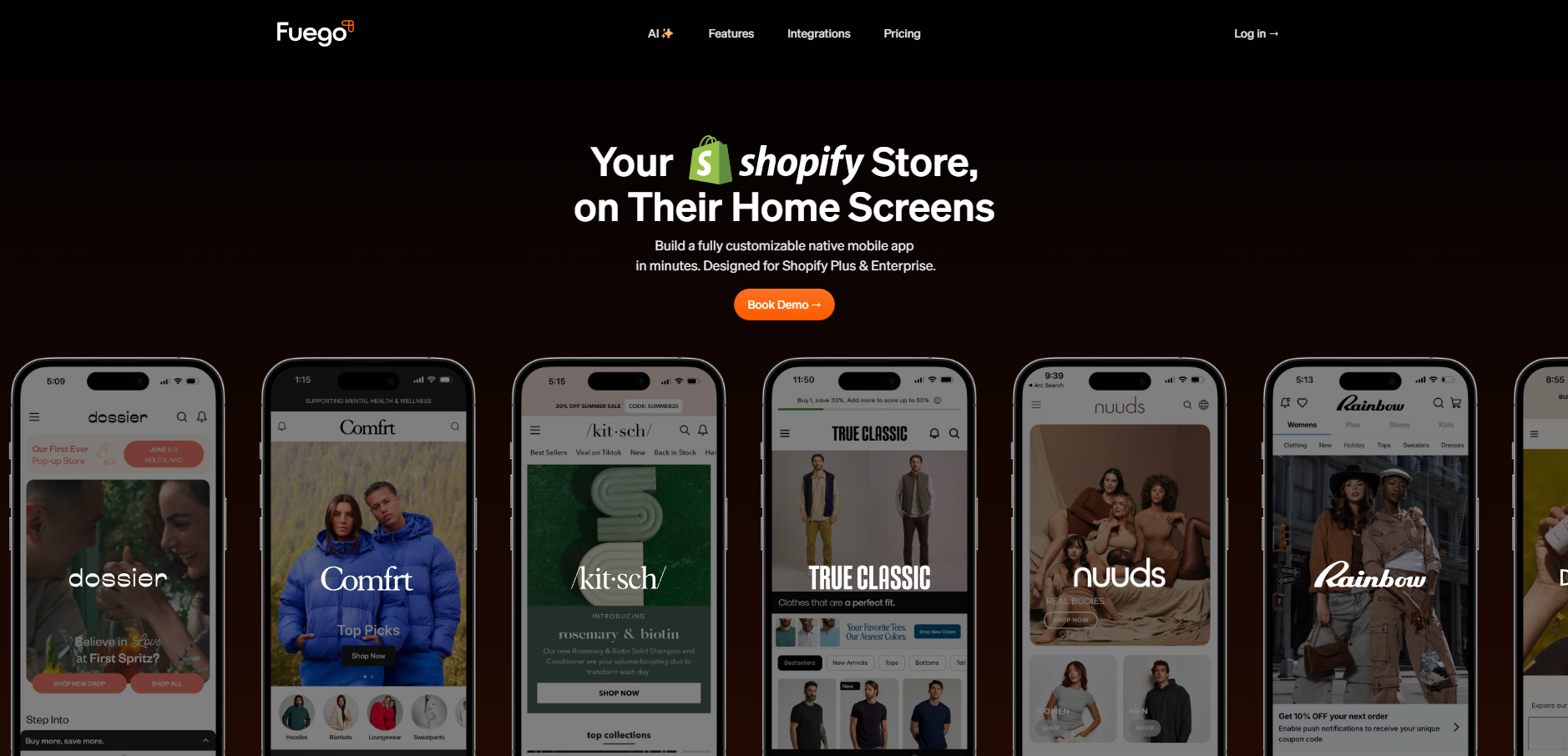
Fuego.io is a no-code app platform focused on creating fully custom mobile apps, especially for Shopify Plus & Enterprise stores. The emphasis is on performance and deep integration with your commerce tools, not just web views.
Unlike simple wrappers around websites, Fuego helps you design engaging, native native iOS and Android apps complete with real mobile commerce features and automated engagement tools.
Key Features
- No-code editing and block-based app design for custom layouts.
- Automated push notifications, including abandoned cart, back-in-stock, and user-segment targeting.
- Deep integrations with 80+ Shopify and third-party apps (reviews, subscriptions, loyalty, UGC).
- Real-time insights and analytics to track app performance and user behaviour.
Fuego’s pricing plans are tiered, from Starter plans with core commerce features to Enterprise plans offering advanced segmentation, multi-store support, custom blocks, and A/B testing.
Best For: Shopify brands and enterprise stores seeking a highly customised mobile shopping app with strong engagement and analytics.
How to Choose the Right Mobile App for Your E-commerce Store?
Selecting the best mobile app for e-commerce depends on your business model, technical resources, and growth goals.
Questions to Ask Yourself When Choosing the Right Mobile App for Your E-commerce Store:
1. Do you need a customer-facing app or an operations tool?
Customer apps drive sales through better user experience and push notifications. Operations apps help you manage inventory, fulfill orders, and track performance. Most merchants need both.
2. What's your budget for development and maintenance?
No-code platforms cost $50-$500 per month, with minimal setup fees. Custom development requires $50,000-$150,000 upfront, plus ongoing maintenance. For Shopify merchants with revenue under $10M, no-code makes more financial sense.
3. How important is design flexibility?
If your brand identity is tightly controlled and every visual element matters, choose a platform with deep customization options. If speed to market matters more than perfect aesthetics, use a template-based solution.
4. Do you want to own the customer relationship?
Third-party marketplaces like Amazon control customer data and communication. Native apps keep that data in your hands, allowing you to build direct relationships and reduce dependency on external platforms.
5. What integrations do you need?
Check compatibility with your existing tools, such as Klaviyo for email, Recharge for subscriptions, LoyaltyLion for rewards, and Gorgias for customer support. Seamless integration prevents data silos and manual workarounds.
Most US Shopify merchants prioritize speed, simplicity, and conversion optimization. No-code platforms deliver all three without requiring technical expertise or long development cycles.
Common Mistakes When Building Mobile Apps for E-commerce
Many merchants approach mobile apps as if they're building a smaller version of their website. This misses the point entirely.
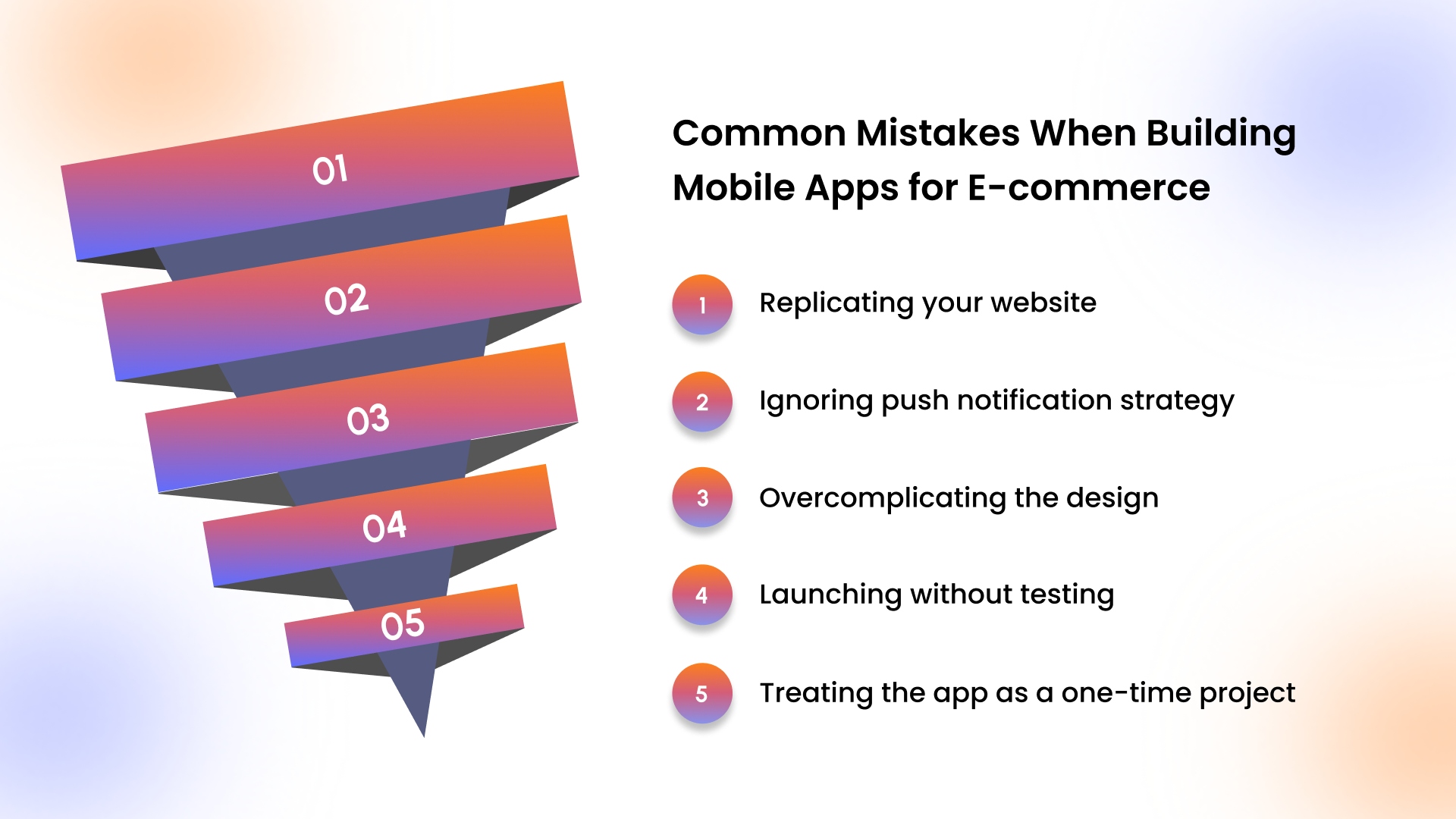
Mistake 1: Replicating your website
Mobile apps should do things websites can't. If you're just shrinking your desktop experience, customers have no reason to download it. Focus on push notifications, one-tap reordering, and personalized recommendations that leverage app-specific capabilities.
Mistake 2: Ignoring push notification strategy
Building an app without a notification strategy is like buying a billboard and leaving it blank. Segment your audience, test different messages, and track which campaigns drive revenue. Push notifications are your direct line to customers.
Mistake 3: Overcomplicating the design
Mobile screens are small. Simple navigation, large tap targets, and clear calls-to-action convert better than cluttered interfaces with too many options. Less is more on mobile.
Mistake 4: Launching without testing
Test your app on multiple devices before launch. Screen sizes, operating system versions, and network speeds affect performance. What works perfectly on your iPhone 15 Pro might crash on an Android device from 2021.
Mistake 5: Treating the app as a one-time project
Apps require ongoing maintenance. You'll need to update content, add features, and fix bugs based on user feedback. Budget for monthly maintenance, not just initial development.
Avoiding these mistakes improves your chances of launching an app that customers actually use and that generates measurable ROI.
Conclusion
Mobile apps for e-commerce deliver measurably better results than mobile websites. They convert faster, retain customers longer, and create direct communication channels through push notifications.
The best mobile e-commerce apps give you control over design, data, and customer engagement. Whether you're launching your first app or upgrading from an outdated solution, the right platform transforms how you sell on mobile.
Appmaker makes it easy to build, launch, and scale a native mobile app for your Shopify store. No coding required. No developer dependencies. Just a faster path to mobile commerce success.
With real-time Shopify sync, push notifications, AI-powered design tools, and comprehensive App Store management, Appmaker helps DTC brands boost mobile conversions and enhance customer lifetime value.
Schedule a demo today to see how Appmaker can transform your mobile commerce strategy.
FAQs
1. What makes mobile apps for e-commerce better than mobile websites?
Mobile apps load in 3-5 seconds, compared with 8-12 seconds for mobile sites. They allow push notifications, securely store payment information, and work offline for browsing products.
2. Which mobile apps let you run e-commerce without a computer?
Shopify Mobile and Square Online offer comprehensive store management capabilities from your phone, including inventory updates, order fulfillment, and customer service. You can run your entire operation from a mobile device.
3. How long does it take to build a mobile app for a Shopify store?
No-code platforms like Appmaker let you launch in 7-14 days. Custom development takes 3-6 months and costs $50,000-$150,000 upfront.
4. Do I need separate apps for iOS and Android?
Native app builders create both versions from a single design. Platforms like Appmaker handle iOS and Android simultaneously, so you don't need separate development.
5. Can I add custom features to a no-code mobile app?
Yes. Appmaker includes Code Blocks for custom JavaScript and CSS. You can integrate third-party APIs or build unique features while keeping the no-code foundation.