
























Key takeaways
- Best all-rounder: AppMaker no-code speed plus real developer access, and it reaches beyond Shopify.
- Best Shopify-native DTC pick: VennApps bespoke native design, commerce-first, zero commission.
- Fastest clean launch on a flat price: Shopney or Tapday.
- Live selling and community: Vajro (now Superfans).
- Quick commerce (grocery, food, pharmacy): Mobivogue.
- Off Shopify or headless: MobiLoud (wraps your existing site) or AppMaker.
- Cheapest way to test the channel: OneMobile, MageNative, or Tapday.
- Subscriptions / B2B: Shop2App.
- Watch the fee model, not the sticker price. A low headline with a 2–2.5% revenue share can cost more than a higher flat fee once the app works. Every builder also needs an Apple Developer account ($99/year) and Google Play account ($25 one-time).
Disclosure: this is AppMaker's blog. The ranking reflects that; the pricing and trade-offs are checked against public sources so you can verify them yourself.
If you're comparing Fuego alternatives, you've almost certainly concluded what most teams struggle to do. Fuego is a strong Shopify mobile app builder, but it's built for a specific kind of customer. It's one of the few tools where you can type a sentence and watch it assemble an app screen, and its community and social-commerce features give ambitious Shopify Plus brands a genuine growth angle. If you're a Plus or enterprise store with a team whose full-time job is running the app as a channel, Fuego belongs on your shortlist.
The catch is that "built for a well-resourced Plus brand" is a narrow doorway. Most people shopping for a Fuego alternative aren't unhappy with the product; they've simply realized they aren't the customer it was designed for. This guide is for them: ten builders ranked by how well they serve the widest range of brands, each with pricing checked against the vendor's own pages in July 2026.
What is a Shopify Mobile App Builder?
A Shopify mobile app builder is a platform that turns your existing Shopify store into native iOS and Android apps, usually with no code, and keeps the app in real-time sync with your products, pricing, inventory, and checkout. Most use a drag-and-drop editor and pre-built blocks so a marketer can design screens, run push campaigns, and launch to the App Store and Google Play without engineering help.
They mainly differ on four things: how much you can customize (templates vs. full developer access), how the app is built (a genuinely native app vs. a native shell around your mobile site), how they charge (flat fee, flat-plus-percentage, or success fees), and what they specialize in (general DTC, live selling, quick commerce, subscriptions, or off-Shopify platforms). Those four axes are what the rest of this guide compares.
Why Brands Go Looking for a Fuego Alternative
Five reasons come up again and again.
It assumes you have a team. Fuego's best value shows up when someone is actively running, testing, and optimizing the app every week. If mobile is a side project rather than a staffed channel, much of the platform sits idle while you pay for it.
It leans Shopify Plus. The sweet spot is Plus and enterprise. Smaller and mid-market stores can feel like they're renting a stadium to host a dinner party, and if you're not on Shopify at all, a Shopify-native builder is off the table by definition.
The strongest tier is demo-gated. Fuego publishes entry pricing (roughly $499/month when your app is published, $999/month standard), but its most advanced capabilities audience segmentation, A/B testing, custom React Native blocks, the community corner, multi-store "super app," 24/7 Slack support sit in a custom enterprise tier you have to scope on a call. That's fine if you're a large brand; it's friction if you want a fixed number before you commit.
Onboarding can take time. Some reviewers describe required intro calls and slower follow-up before they could get moving. When you want to launch this quarter, that matters.
You may not need the community angle. Fuego pushes hard on social and community commerce. That's a real differentiator for the brands that live on it and dead weight for the ones that just want a fast, clean, high-converting storefront app.
If two or more of those describe you, one of the ten below will fit better.
The 30-second Router
Not ready to read all ten? Start here.
- I want one platform that scales from no-code to custom code, and I might leave Shopify one day. → AppMaker
- I'm a Shopify-only DTC fashion or beauty brand, and I want a bespoke, commerce-first app. → VennApps
- I want a good-looking app live this week without a commission on my sales. → Shopney or Tapday
- My growth runs on live selling, drops, and community. → Vajro / Superfans
- I sell groceries, food, pharmacy, or anything quick-commerce. → Mobivogue
- I'm not on Shopify, or I run headless, and I don't want to rebuild my store. → MobiLoud or AppMaker
- I want the cheapest serious way to test the channel. → OneMobile, MageNative, or Tapday
- My model is subscriptions or B2B. → Shop2App
At a Glance
| Platform | Best-fit one-liner | Starting price (verified July 2026) | Fee model | Beyond Shopify? | Best for |
|---|---|---|---|---|---|
| AppMaker | No-code speed plus real developer access | $999/mo + 1% of in-app sales | Flat + 1% | Yes (BigCommerce, Woo, WordPress) | Scaling D2C and agencies |
| Shopney | Fast, affordable, well-supported launches | From ~$149/mo | Zero commission | No | Small to mid Shopify stores |
| Vajro / Superfans | Live selling and community | See note (site: from $1,000/mo flat; App Store still shows ~$149) | 0% success fee (per site) | No | Drops, live, community |
| MageNative | Lowest-cost multi-platform | ~$99/mo | No success fees | Yes (Magento, Woo, BigCommerce) | Budget, multi-backend |
| MobiLoud | Your existing site, wrapped natively | $1,499/mo + ~$5k setup | Flat + MAU overage | Any platform | Off-Shopify / headless |
| Tapday | Flat pricing, no revenue share | Flat (~$99/mo across tiers) | Zero commission | No | Value-led Shopify brands |
| Mobivogue | Quick-commerce and industry verticals | ~$199/mo (Growth); commission entry plan | Tiered + commission entry | No | Grocery, food, pharmacy |
| OneMobile | Near-free entry point | Free plan + from ~$99/mo | Varies (revenue-based fees after thresholds) | No | Testing the channel cheaply |
| Shop2App | Subscriptions and B2B | Contested; see note (listings ~$299–$1,299/mo; one 2026 source cites $3,500/mo) | Flat tiers | No | Subscription / B2B catalogs |
| VennApps | Bespoke native design, Shopify-native | From $1,999/mo | Zero commission | No | Shopify DTC fashion/beauty |
How We Verified This
Pricing and product claims here were checked against primary sources, each vendor's own pricing page and Shopify App Store listing in July 2026, then cross-referenced against independent roundups. Where sources disagreed (notably Vajro/Superfans, Shop2App, and Tapday's enterprise tier), we've said so plainly rather than pick a number and hope. This is AppMaker's blog, and AppMaker is ranked first; we've disclosed that, kept the trade-offs honest, and pointed you to each vendor's free trial so you can judge for yourself. Because prices in this category move, reconfirm any figure before you commit.
Native App vs. Web Wrapper vs. PWA (a 60-second Primer)
This distinction decides which tools even belong on your list, so it's worth 60 seconds.
- Genuinely native apps are built for iOS and Android (many builders here use React Native). They load fast, feel like apps, and generally convert better. Most tools in this guide are in this camp.
- Native-shell / webview apps wrap your existing mobile website in a native container with native navigation, push, and deep linking. MobiLoud is the deliberate example: whatever works on your web checkout works in the app, with nothing to rebuild, but you can't design app-specific screens that differ from your site.
- PWAs (progressive web apps) run in the browser and can be "installed" to a home screen, but they don't get the full native app-store presence or push behavior on every platform.
Rule of thumb: if your mobile site is already well optimized and you don't want a second platform to manage, a native shell (MobiLoud) is efficient. If you want app-specific merchandising, personalization, and layouts, choose a native builder.
10 Best Fuego Alternatives in 2026, Ranked by Fit
1. AppMaker: the strongest all-rounder
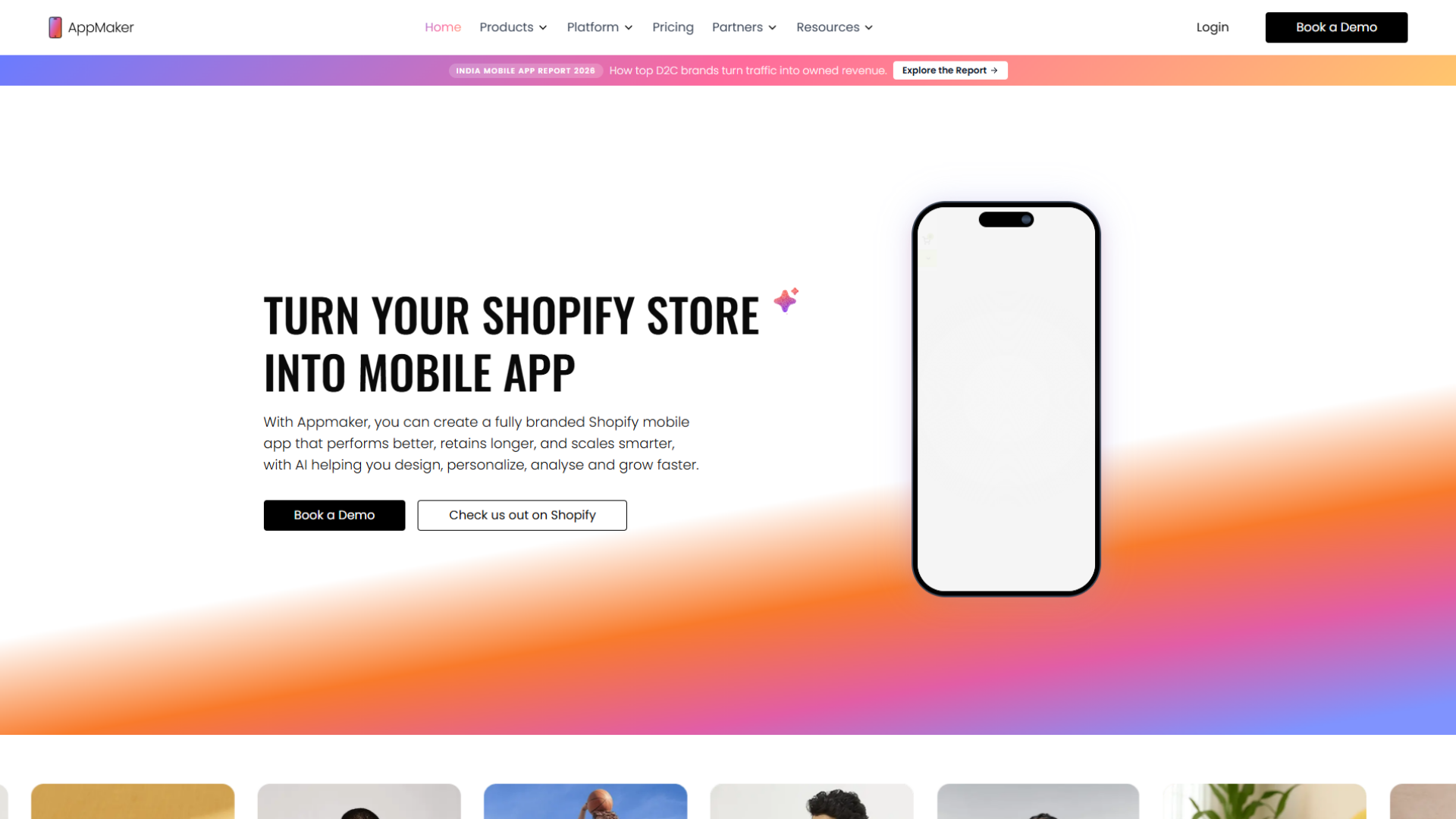
In one line: the closest thing to a builder you won't outgrow.
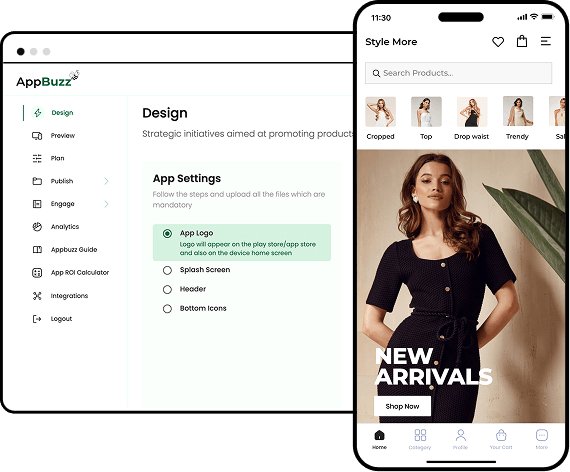
Why it wins: AppMaker is the rare platform that hands a marketer a drag-and-drop studio and an engineer a real developer surface, inside one product. The no-code Studio ships home screens and campaigns without engineering tickets; the Open Model and Code Blocks (Enterprise tier) let a team add custom logic, React components, and bespoke screens when templates run out. Its AI is layered rather than a single assistant: John AI handles operational work like analytics questions, campaign setup, and abandoned-cart flows; Rubick's AI personalizes the in-app experience in real time; and Eidolon AI (rolling out) turns a Figma file or screenshot into usable layouts. Crucially for anyone leaving a Shopify-only tool, it also reaches BigCommerce, WooCommerce, and WordPress.
The catch: It sits at the higher end of the category, and the deepest Enterprise capabilities (custom APIs, full developer access) carry solutioning and one-time build fees on top of the subscription. It's built for brands ready to treat the app as a real channel, not a weekend test. (Worth noting: AppMaker isn't certified "Built for Shopify," so confirm any Shopify-native workflow you depend on.)
Price check: Growth is $999/month + 1% of in-app sales (native iOS and Android, real-time Shopify sync, the CMS, conditional blocks, unlimited push). Enterprise starts at $2,000/month + 1%, adding custom themes, the Open Model, custom integrations, multi-language support, and a dedicated account manager. Verified against AppMaker's pricing page.
Leave Fuego for this if your worry is outgrowing a Plus-only, commerce-only tool, or you want AI that runs operations and personalization rather than only generating screens.
2. Shopney fastest clean launch, no revenue share
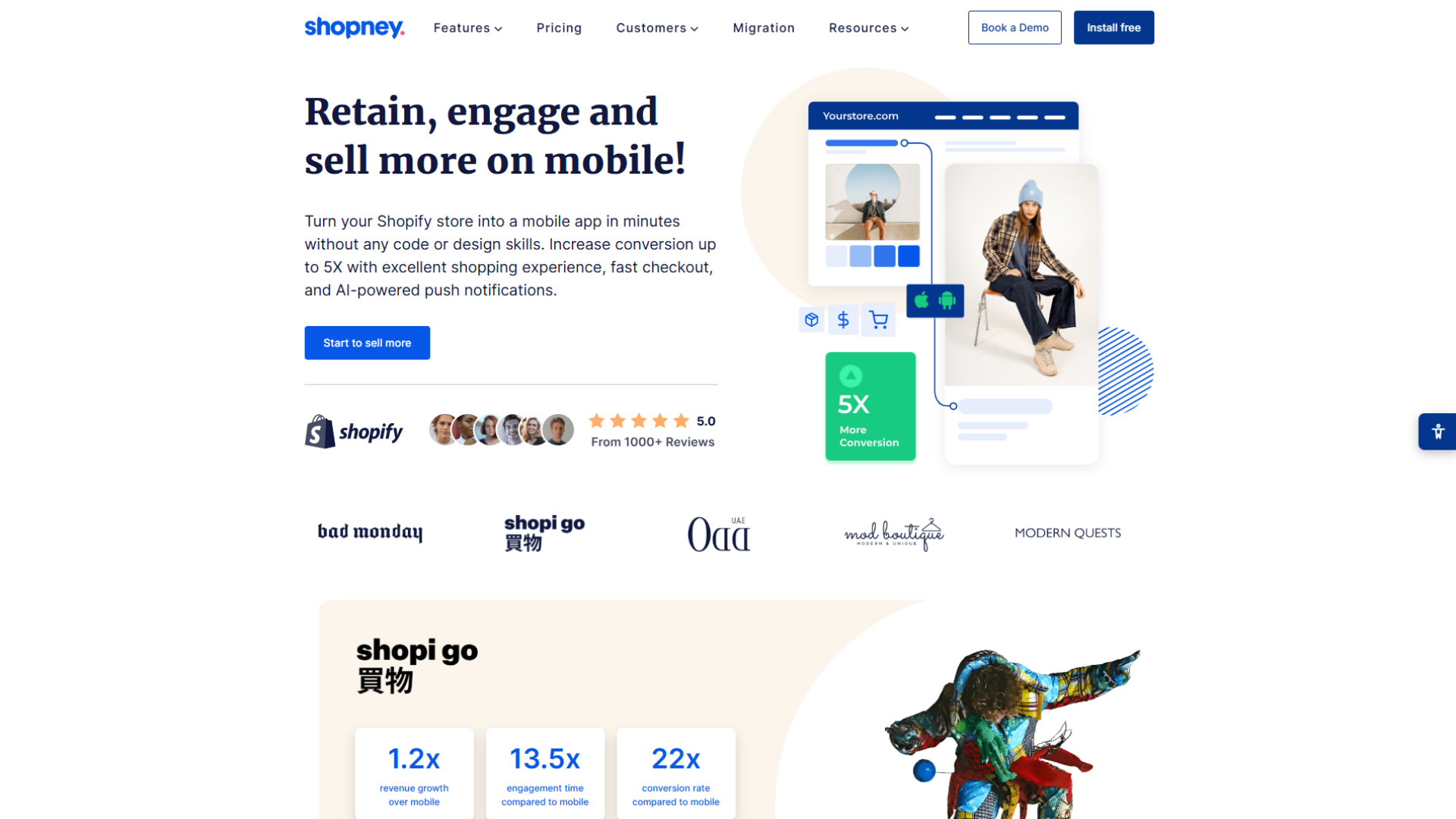
In one line: a good-looking app lives in a day or two, at a flat price.
Why it wins: Shopney is built around speed, attractive pre-built themes, and ease of use. It's repeatedly praised for getting apps live quickly, for in-app chat that supports conversational selling, and for responsive support. Unlimited push sits on every plan, multi-language reach is broad, and there's no commission on sales.
The catch: Customization has a ceiling, and there's less developer extensibility than open-architecture platforms. Brands that need bespoke logic will eventually want more room.
Price check: Plans start around $149/month and scale toward premium tiers for high-volume stores, with the difference driven by push limits, support level, and features. No commissions.
Leave Fuego for this if you value speed-to-launch and predictable flat pricing over an AI-heavy, team-intensive build.
3. Vajro (now Superfans) the live-selling specialist
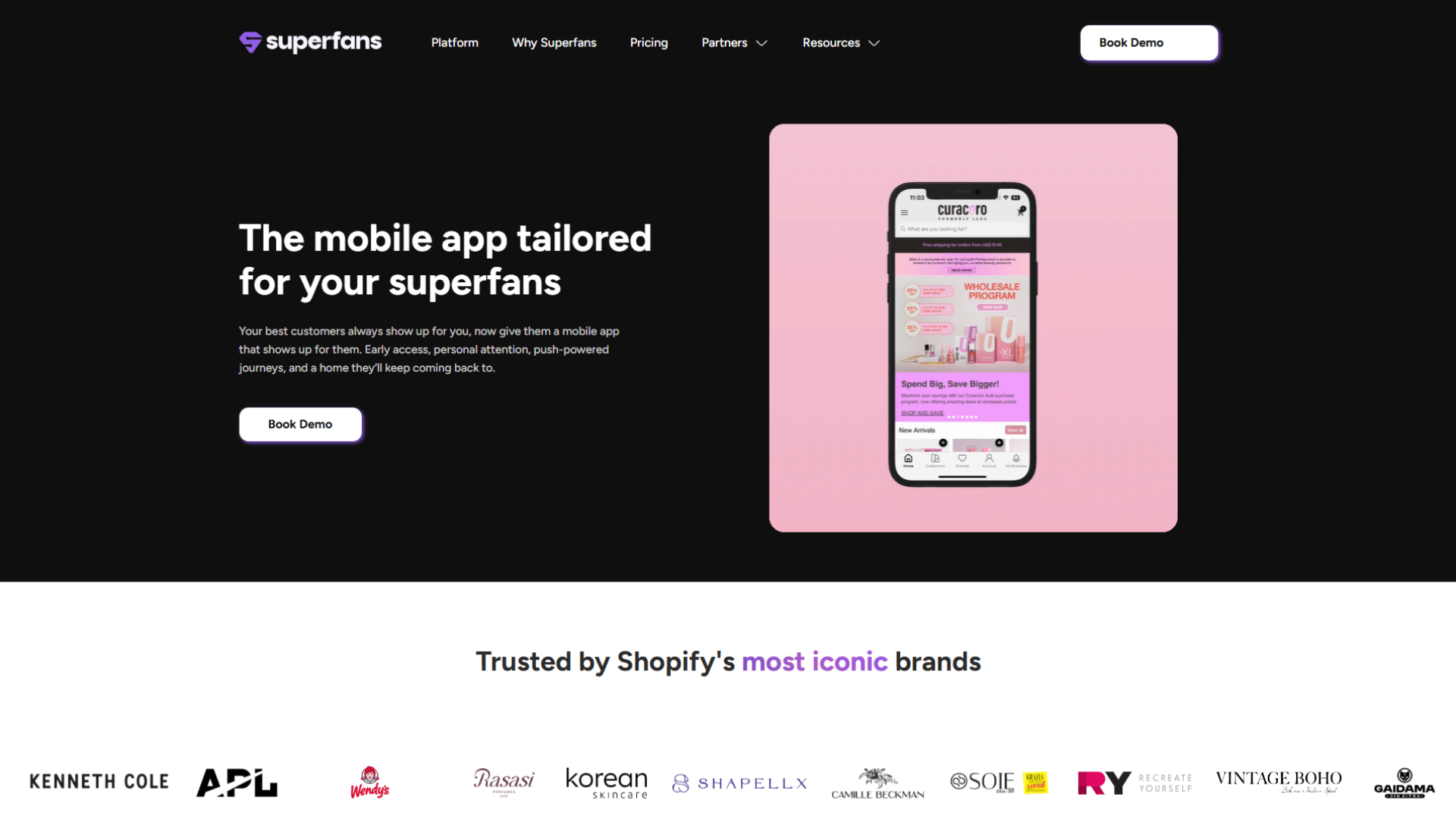
In one line: the builder for brands that sell in real time.
Why it wins: One of the longest-running platforms in the space, Vajro pioneered in-app live-stream shopping and has rebranded to Superfans. It's purpose-built for fashion drops, collectibles, and beauty: live selling on both app and Facebook, behavior-based segmented push, 70+ one-click integrations, custom blocks via an SDK, and a support team with a strong reputation.
The catch is to read this before you budget: Pricing transparency is the sore point, and the public numbers genuinely don't agree. Superfans' own site promotes a single flat plan (its pricing/blog pages reference from $1,000/month for unlimited features with no success fees), but the Shopify App Store listing still advertises entry pricing from around $149/month, and at least one real merchant review reports paying close to $600/month to run live selling roughly once a week. In short: the flat-plan headline and the store listing point to different numbers, so get a written quote in the demo and confirm exactly what your bill will be at your order volume. It's also less suited to brands that want a content-rich traditional storefront app over a live-and-community angle.
Price check: Treat "flat, from ~$1,000/month, no success fees, 30-day trial" as the headline from Superfans' site, then pin down your specific quote, because the App Store listing and older tiered pricing tell a different story.
Leave Fuego for this if live shopping and community are the core of how you sell, and you want a tool built around those moments specifically.
4. MageNative: the low-cost, multi-platform option
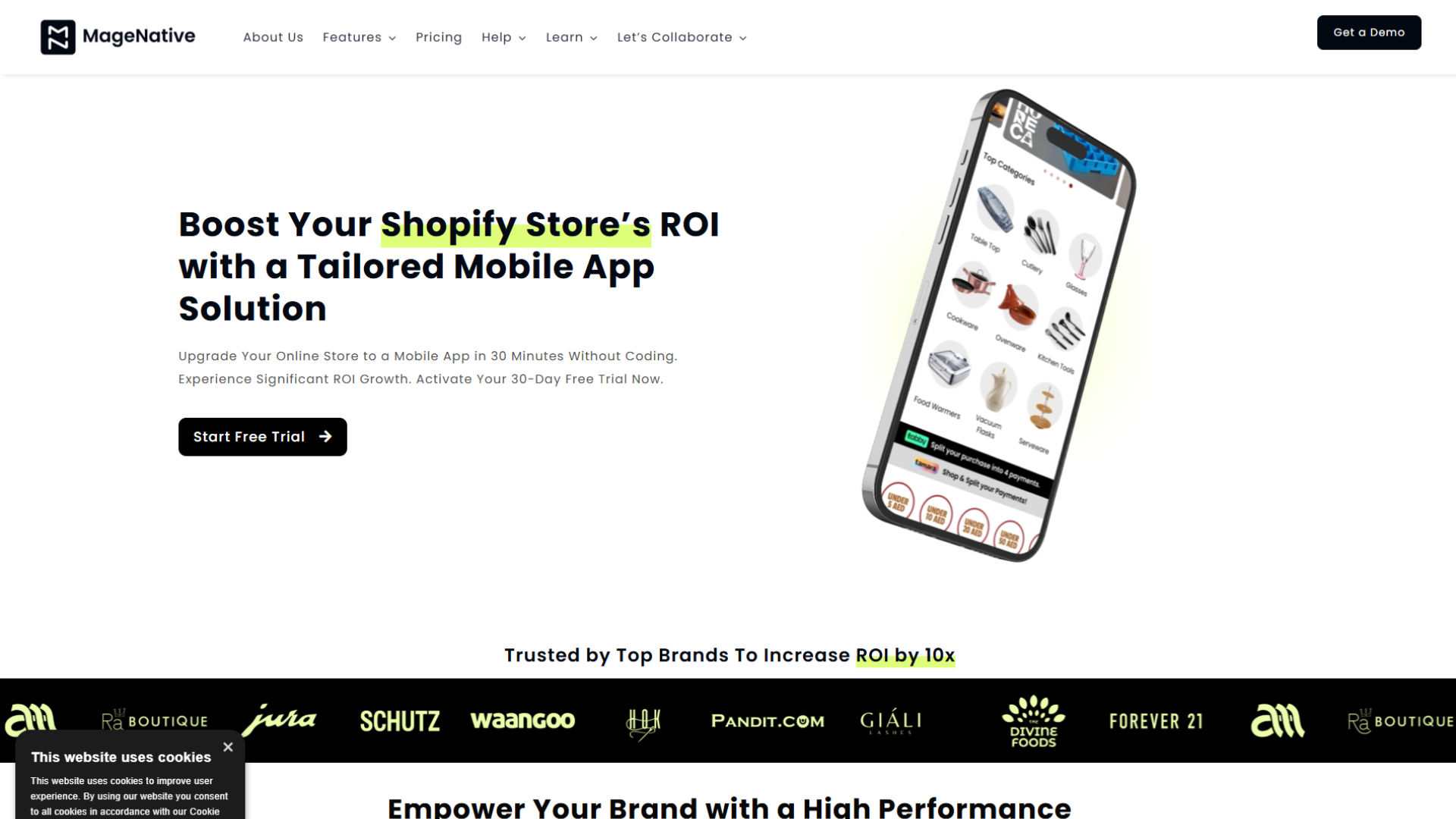
In one line: the essentials done reliably, for less.
Why it wins: MageNative turns Shopify (and other) stores into native apps without frills or success fees. It supports Magento, WooCommerce, and BigCommerce alongside Shopify, offers a gentle learning curve, and adds nice touches on premium tiers like augmented-reality product viewing, AI recommendations, and multi-language and multi-currency support.
The catch: It lacks the advanced personalization and conversion tooling of higher-end platforms, its integration library is narrower (notably no native email or SMS marketing connection), and some reviewers report bugs and slow resolution on complex issues. It's also not certified "Built for Shopify," so confirm compatibility with your stack.
Price check: Plans start at about $99/month and scale to roughly $249/month, with custom pricing above that. No success fees at any tier.
Leave Fuego for this if your needs are straightforward, budget is the main constraint, or you run more than one commerce backend.
5. MobiLoud: turn your existing site into an app
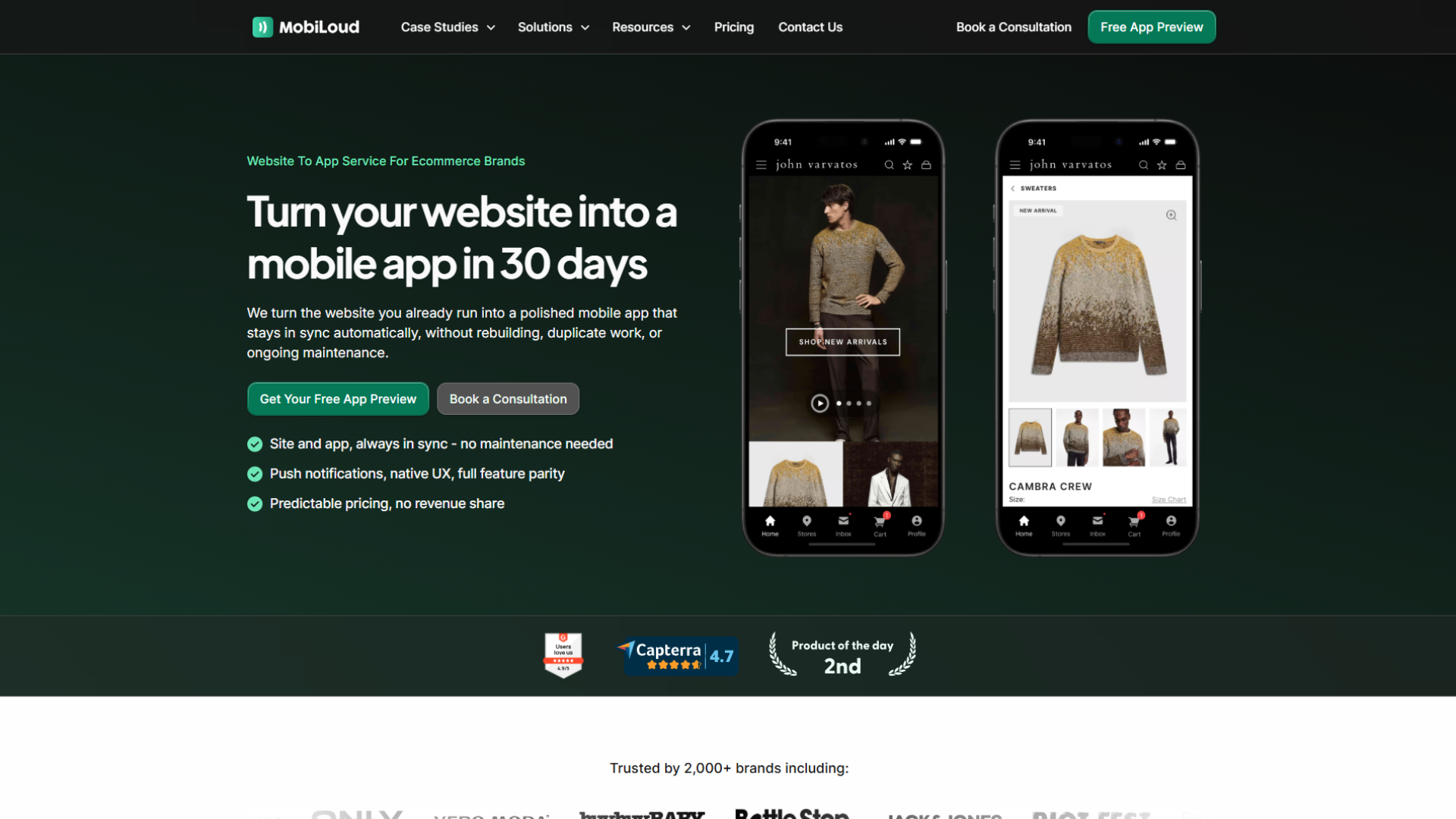
In one line: the fully managed route for anyone not rebuilding in a block editor.
Why it wins: MobiLoud takes a different path entirely: instead of recreating your store, it wraps your existing mobile website in a native shell (native navigation, push, deep linking) and manages the whole build, submission, and maintenance for you. It works with any platform: WooCommerce, BigCommerce, Adobe Commerce, Salesforce Commerce Cloud, WordPress, headless, and custom builds. Whatever works on your web checkout works in the app, with no second platform to maintain.
The catch: There's no drag-and-drop builder, so you can't design app-specific layouts that differ from your site. All-in cost is higher, the agreement runs 12 months, and launch takes longer than a DIY tool. Because it mirrors your web experience, it's a webview-and-native-shell model rather than a from-scratch native build.
Price check: The Business plan is a flat $1,499/month + a one-time setup fee of about $5,000, including up to 10,000 monthly active users ($50 per additional 1,000). Enterprise is custom. Both run as 12-month agreements, and a typical launch takes around six to eight weeks. Verified against MobiLoud's pricing page.
Leave Fuego for this if you're off Shopify or running headless, and you'd rather the team ship and maintain the app than build it yourself.
6. Tapday flat pricing, zero commission, fast setup
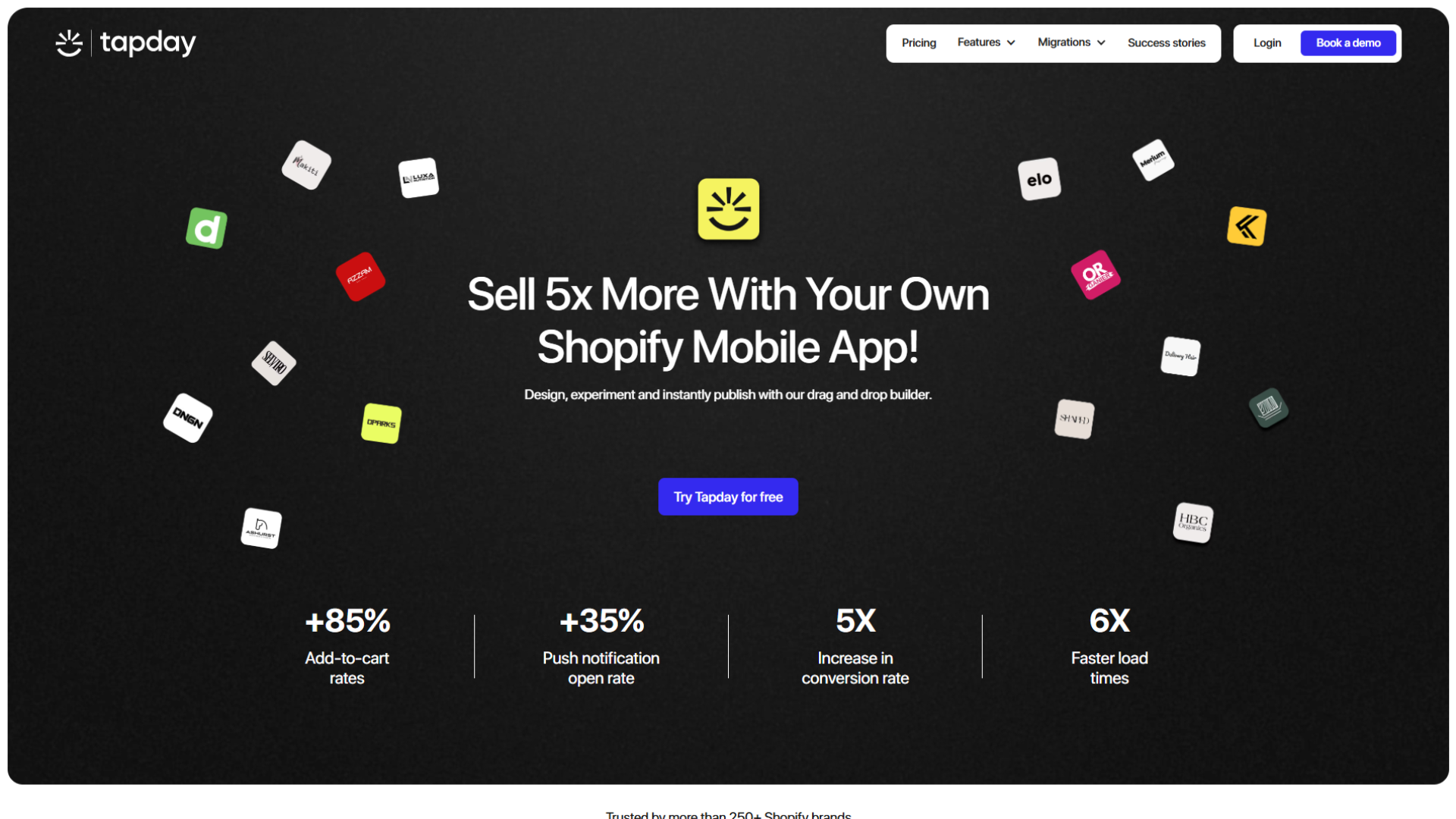
In one line: the value-led builder that keeps 100% of your app sales yours.
Why it wins: Tapday is a drag-and-drop, no-code builder with a striking Shopify App Store record (a 5.0 rating across a growing review base) and a pitch aimed squarely at merchants tired of revenue share. Its structural advantage is a fixed subscription with no commissions, no usage penalties, and no forced upgrades to what your app earns; you keep. It ships in a few days, integrates with 70+ Shopify apps (with a promise to add missing ones on request), and includes unlimited push, free migration, and hands-on support with an assigned manager and designer.
The catch: It's Shopify-only, and its brand footprint is smaller than the decade-old incumbents, so you're betting on a fast-rising newer player rather than an established default. Advanced features (abandoned-cart push, back-in-stock, welcome series) sit behind premium integration on higher tiers.
Price check: Fixed monthly subscription with no commission and a 30-day free trial. Publicly listed pricing spans roughly $99–$999/month across its new, small, growth, and enterprise tiers; exact tier and annual figures aren't always cleanly published, so confirm the current table directly before you sign. Apple Developer ($99/year) and Google Play ($25 one-time) accounts are required, as with every builder here.
Leave Fuego for this if you want predictable flat costs and no revenue share, and you'd rather launch fast than staff a full optimization team.
7. Mobivogue the quick-commerce and vertical specialist
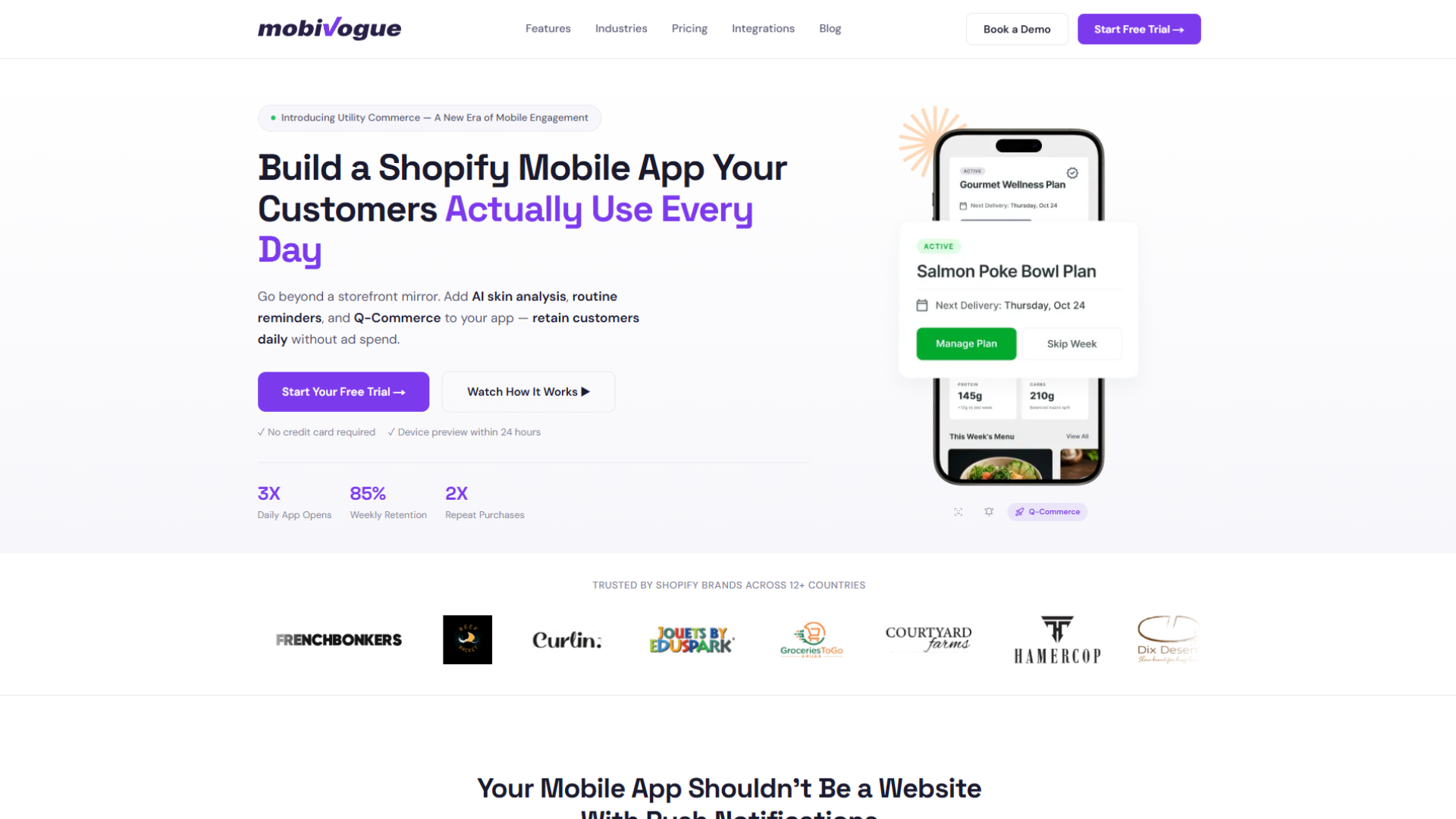
In one line: the only builder here with quick commerce baked in.
Why it wins: Mobivogue (by ShopiVogue) is built for verticals other tools treat as afterthoughts: grocery, food, pharmacy, restaurants, beauty, supplements, and electronics. It's the rare Shopify app builder with native quick commerce geolocation, delivery zones, delivery-slot booking, real-time tracking, and dark-store support. Add 18 functional widgets, industry-specific themes, vertical extras like AI skin analysis and dosage-reminder tooling, multi-language and multi-currency reach, and Firebase integration where you own your own data.
The catch: It's Shopify-only, its ecosystem and review base are smaller than the leaders, and the strongest vertical features are gated to higher tiers. It's a specialist: if you don't sell in one of its target verticals, a generalist may serve you better.
Price check: The Growth plan is about $199/month and unlocks the quick-commerce module and vertical features (AI skin analysis, size finder, routine reminders, zip-code product visibility). A lower commission-based entry plan ("LaunchPad") exists for getting started, and the core builder with themes works on all plans. Confirm the current tier structure before signing.
Leave Fuego for this if you run grocery, pharmacy, food, or any quick-commerce model, and you want delivery logic and vertical features out of the box rather than bolted on.
8. OneMobile: the near-free starting line
In one line: the cheapest way to find out if an app moves the needle.
Why it wins: OneMobile is among the most budget-friendly serious options, with a click-based no-code builder, pre-built themes, and unlimited push notifications even on entry plans. It carries the "Built for Shopify" badge, is well rated on the App Store, and includes promotion tools like Facebook and Google ad integrations and QR templates.
The catch: Advanced customization and personalization are limited, the ecosystem is smaller, and enterprise readiness is thin. Note that paid tiers can layer revenue-based fees after certain thresholds, so read the plan details. It's a validation tool, not a forever home.
Price check: A free plan plus inexpensive paid tiers (from around $99/month) that unlock more features and higher limits is one of the lowest barriers to entry of any credible builder.
Leave Fuego for this if budget is the whole constraint and you want to prove the channel cheaply before investing more.
9. Shop2App subscriptions and B2B, handled natively
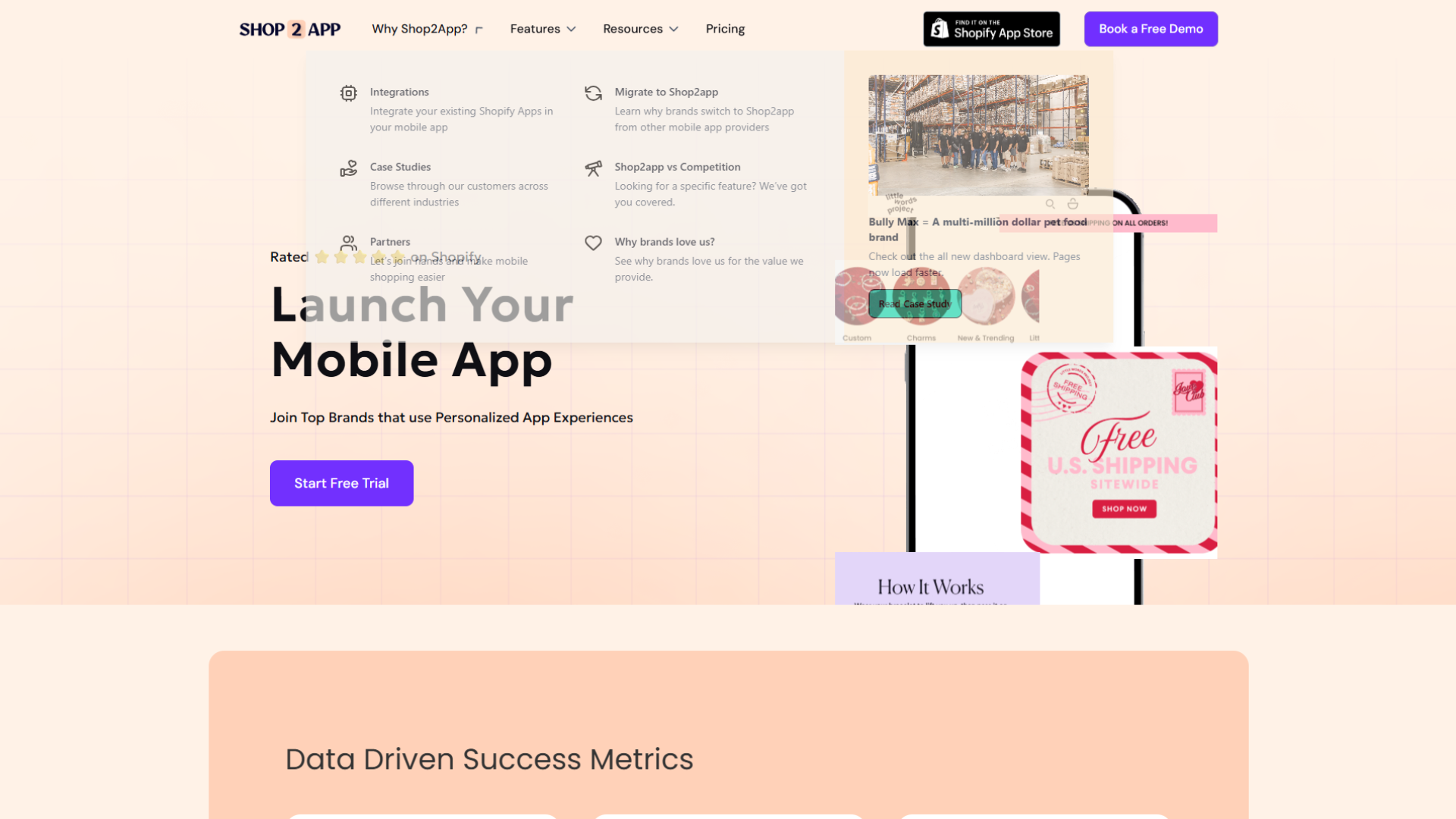
In one line: the focused pick when subscriptions or B2B are the model.
Why it wins. Shop2App positions itself against the incumbents with genuine strength in native subscription management and B2B workflows, areas most builders treat as add-ons. Its in-app subscription portal lets customers skip, pause, swap products, update addresses, and change delivery frequency without a support ticket. It emphasizes fast launches, personalized customer journeys, custom landing pages, scheduled app-wide updates, and a migration path designed to retain existing users. Real brands including LEGO, Public Goods, and Bully Max use it.
The catch. Its brand footprint and review base are smaller than the market leaders, and the advanced tiers climb into premium territory quickly.
Price check. Pricing is not cleanly consistent across sources; most third-party listings put Shop2App around $299–$1,299/month (Basic → Enterprise), while at least one 2026 roundup cites $3,500/month for the top tier. Because the public numbers disagree, confirm the current tiers directly with Shop2App before budgeting.
Leave Fuego for this if subscriptions or B2B are central to how you sell, and you want those workflows native rather than duct-taped on.
10 VennApps: the Shopify-native design specialist
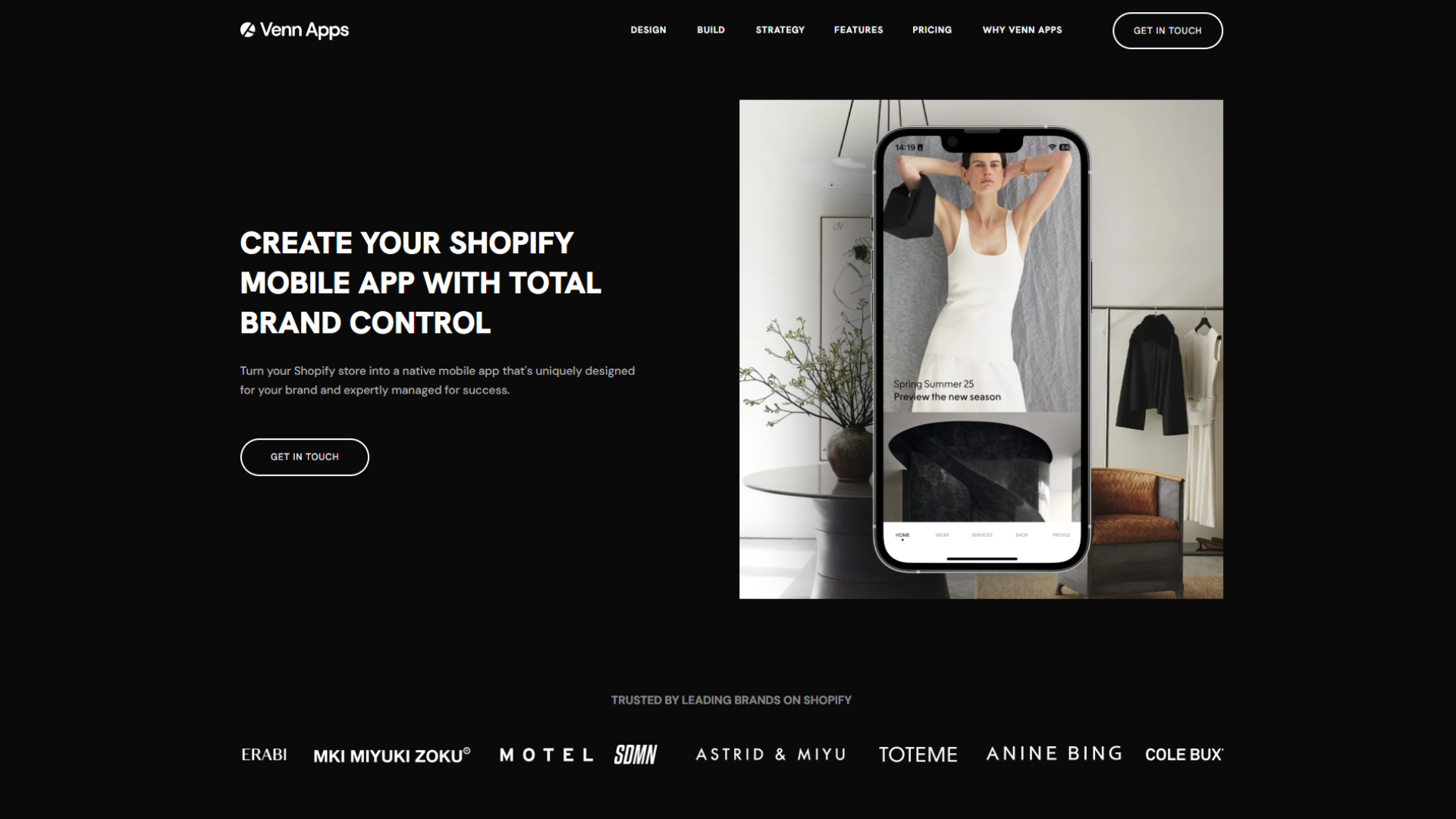
In one line: the bespoke, brand-first choice for Shopify DTC.
Why it wins: VennApps ships genuinely native apps built in Swift and Kotlin (no web wrappers), pairing a drag-and-drop builder with a dedicated designer and a fully managed build. Rather than handing you a template, its team translates your Shopify setup, including metafields and custom objects, into a smooth, bespoke native experience, and its customer-success reputation is among the best in the category, with reviewers describing the team as working "like an extension of our team." Fashion and beauty brands living entirely inside Shopify (Motel Rocks among them) tend to love it, and it charges no commission on app sales.
The catch: It's Shopify-only by design, and the managed model means less pure self-serve control than a DIY builder. The entry price is premium, with a four-figure floor that only makes sense for established brands, and integrations run through its proprietary middleware rather than a self-install marketplace, so confirm your specific tools during onboarding.
Price check: Pro starts at $1,999/month and Enterprise at $2,999/month, both with a 30-day free trial and no commission on app sales.
Leave Fuego for this if you're a Shopify DTC brand that wants a bespoke, fully managed native app with hands-on design support, and Fuego's community-first, Plus-first framing is more than you need.
Do the Math Before you Sign
The sticker price is the least reliable number in this category. Three fee models are in play, and the cheapest headline can be the most expensive in practice.
Flat monthly. Shopney, MageNative, OneMobile (base), VennApps, and Tapday charge a flat fee with no cut of sales. Costs stay predictable as revenue climbs, which is exactly when revenue-share models start to hurt.
Flat plus a small percentage. AppMaker adds 1% of in-app sales on top of its subscription.
Success or performance fees. Some platforms scale a percentage with app revenue. Run the arithmetic at your real numbers, not the base price. A 2.5% fee on $50,000/month in app sales adds $1,250 every month on top of the subscription, enough to turn a "cheap" plan into the priciest one on your shortlist.
Managed, per-user. MobiLoud charges a flat monthly fee plus overage on monthly active users (MAU) rather than a percentage of sales, which suits high-revenue, moderate-traffic stores.
Every builder also requires an Apple Developer account ($99/year) and a Google Play Console account ($25 one-time). Fold those in.
Match Yourself to the Right Builder.
One clean decision, instead of guessing. Answer three questions before you book a single demo, and most of this list eliminates itself.
- What platform are you on? If you're not on Shopify, or you run headless, your shortlist is only AppMaker (Shopify + BigCommerce, WooCommerce, WordPress), MageNative (Shopify, Magento, WooCommerce, BigCommerce), or MobiLoud (any platform, including headless and custom). Everything else here is Shopify-only.
- What's your realistic monthly app revenue?
- Low or unproven → start cheap and validate with OneMobile, MageNative, or Tapday. Established and growing → a flat-plus-1% platform like AppMaker or a premium Shopify-native one like VennApps pays off, and you avoid revenue-share fees that scale against you.
- Will you have developer time? No dev time → a template-led builder (Shopney, Tapday, OneMobile) gets you live fast. Real dev time or big customization needs → AppMaker (Open Model) or MobiLoud (managed, mirrors your site).
Then layer your model on top:
- Live selling, drops, community → Vajro / Superfans
- Grocery, pharmacy, food, quick commerce → Mobivogue
- Subscriptions or B2B → Shop2App
- Agencies building for many clients → AppMaker (multi-backend + developer access)
- Enterprise → AppMaker for flexibility and reach; VennApps for bespoke Shopify-native design
Signals it's actually time to switch from Fuego: your app is a side project, not a staffed channel, and you're paying for capacity you don't use; the Plus-oriented, demo-gated pricing doesn't fit your stage; you need to launch faster than onboarding allows; you don't need the community and social angle the product is built around; or you're moving off Shopify entirely, which rules a Shopify-native builder out.
Migrating Off Fuego Without Losing Your Users
Most builders offer free migration and promise no loss of existing app users, but "promise" isn't "confirmed in writing." Before you switch, get answers to these:
- Do existing users, reviews, and ratings carry over, or does the app relist from zero?
- Do push-notification subscribers transfer, or do customers have to re-opt-in?
- Does customer data (accounts, order history, store credit, gift cards) migrate intact?
- What's the timeline, and are there one-time migration or setup fees?
- Will there be app-store downtime during the switch?
Ask for these in writing during the demo. A vendor confident in its migration will put it on paper.
The Bottom Line
Fuego is a strong product aimed at a specific customer: a Plus or enterprise brand with a team to run the app and a strategy built on AI-generated design and community commerce. If that's not you, the right Fuego alternative is simply the one whose constraints match yours.
Write down three things before you book a single demo: your platform (Shopify or not), your realistic monthly app revenue, and whether you'll have developer time. Those three answers eliminate most of this list and point clearly at the two or three worth a proper trial. If you want the broadest, most future-proof platform native quality, real customization, reach beyond Shopify, and an AI toolkit that does more than build screens, AppMaker is the strongest all-round choice, which is why it leads. If your strategy hinges on live selling, quick commerce, subscriptions, or the lowest possible entry cost, a specialist will serve you better than a generalist.
Every serious option offers a free trial. Use them before you sign a year-long anything.
Frequently Asked Questions
What is the best alternative to Fuego?
For most scaling brands, AppMaker delivers native quality and a genuinely useful AI stack, but adds developer-level customization and reach beyond Shopify, so you're less likely to outgrow it. If you specifically need live selling, quick commerce, or the lowest possible entry price, a specialist (Vajro/Superfans, Mobivogue, OneMobile) will beat a generalist for your case.
Which Fuego alternative is cheapest?
OneMobile has a free plan, and MageNative starts around $99/month with no success fees. Tapday's flat, commission-free model becomes very attractive once your app generates real revenue. Always factor in any success fees plus the Apple ($99/year) and Google ($25 one-time) developer costs.
Which Fuego alternatives charge no commission on sales?
Shopney, MageNative, and Tapday use flat pricing with no cut of app sales. AppMaker charges a flat fee plus 1%. MobiLoud charges a flat fee plus active-user overage rather than a percentage. Vajro/Superfans advertises 0% success fees on its flat plan to confirm the specifics in a quote.
Which is best for enterprises?
AppMaker (Enterprise tier with full developer access and multi-backend reach) and Shopney (deep Shopify-native optimization) are the strongest, with Shop2App a fit for subscription-heavy or B2B enterprises.
Which is easiest for non-technical teams?
Shopney and Tapday get a polished app live in a day or two with drag-and-drop editors, and OneMobile's builder is about as simple as it gets. All three sidestep the steeper learning curve heavier platforms carry.
Do any of these work beyond Shopify?
Most are Shopify-only. The exceptions are AppMaker (Shopify plus BigCommerce, WooCommerce, WordPress), MageNative (Shopify, Magento, WooCommerce, BigCommerce), and MobiLoud (any platform, including headless and custom). If you're not on Shopify, your shortlist narrows to these three.
How much does it cost to build a Shopify app overall?
Using a no-code builder, realistically $50–$1,500+/month depending on the tool and tier (some add a revenue share on top), plus the Apple and Google developer fees. A managed conversion like MobiLoud runs $1,499/month plus a one-time setup fee. Custom native development is a different universe, typically tens to hundreds of thousands of dollars upfront plus ongoing maintenance, which is why most scaling brands use a builder.
Do I still need Apple and Google developer accounts?
Yes. Every builder here publishes under your own developer accounts: an Apple Developer Program membership ($99/year) and a Google Play Console account ($25 one-time). Budget for both.
How long does the launch take?
Most no-code builders get you live in days to a couple of weeks, including app-store submission; the fastest (Shopney, Tapday, Mobivogue) advertise a day or two. A managed conversion like MobiLoud runs roughly six to eight weeks.
Are these truly native apps or web wrappers?
Most build genuinely native iOS and Android apps (many on React Native), which load faster and convert better than wrappers. MobiLoud is the deliberate exception: it wraps your existing site in a native shell, which works well when your mobile site is already well optimized.
Can I migrate from Fuego without losing my app users?
Most builders offer migration support and state that existing users carry over. Confirm the specifics: user data, reviews, and push subscribers in writing before switching, and ask about timeline and one-time fees. (See the migration checklist above.)
Is Vajro the same as Superfans?
Yes. Vajro rebranded to Superfans; the Shopify App Store listing still sits on the legacy path, which is part of why its pricing looks inconsistent across sources. Get a written quote for your order volume.