
























Key Takeaways
- Superfans (formerly Vajro) is a well-reviewed Shopify app builder for live selling and loyalty. Its Shopify listing now starts at roughly $150 per month, but its full-featured Unlimited plan sits at about $1,000 per month, which is the tier most established brands actually buy, and the main reason cost-conscious teams compare alternatives.
- The best alternative depends on your priority. For customisation and developer control, Appmaker leads. For the lowest entry price, AppMySite, MageNative or Hulk. For a self-serve marketing-led build, Tapcart or Apptile. For full website-to-app parity, MobiLoud.
- Native apps generally convert better than mobile web. Independent reviews commonly put native app conversion at around 3 to 5 per cent versus roughly 1 to 2 per cent on mobile web, though several headline figures in this category are vendor-reported.
- Entry pricing spans a wide range, from under $50 per month (AppMySite) to around $799 per month plus setup (MobiLoud). Watch for hidden costs: revenue-share success fees, in-app performance charges, and features gated behind higher tiers.
- Budget two extras regardless of platform: an Apple Developer account ($99 per year) and a Google Play Developer account ($25 one-time).
- The shift that matters most in 2026 is that the strongest builders now pair no-code speed with code-level access, so pick one your app will not outgrow and avoid a costly rebuild later.
If you run your Shopify store's app on Superfans, the platform formerly known as Vajro, and the fit no longer feels right, you are not alone. Maybe the full-featured plan feels expensive, the live-selling tools are more than you need, or you simply want more control over how the app looks and behaves. Whatever the reason, the Shopify mobile app builder category has become genuinely competitive, and several platforms now offer better value, deeper customisation, or a lower entry price for your stage of growth.
This guide compares the 10 best Superfans alternatives in 2026. Every price below was checked against the vendor's own Shopify App Store listing or pricing page in July 2026; ratings come from the Shopify App Store, and vendor marketing claims are labelled as self-reported so you can decide on evidence rather than hype.
Why a Mobile App is a Growth Channel in 2026, Not a Nice-To-Have
Mobile is no longer where a small share of shopping happens. It is where most of it does. Multiple 2026 industry roundups place mobile commerce at roughly 59 to 60 per cent of global e-commerce sales, a figure those write-ups attribute to eMarketer and Statista. Traffic, though, is not the same as revenue, and that gap is exactly where a mobile web experience starts to leak money.
The conversion gap is the headline. Independent reviews put mobile web conversion at about 1 to 2 per cent for most direct-to-consumer brands, while native apps commonly land in the 3 to 5 per cent range. Apps load faster, remember payment details, remove browser clutter and give you a push channel you own outright. Several widely quoted multipliers in this space, such as claims that apps convert well over 100 per cent higher than mobile web, trace back to a single vendor study, so treat them as directional rather than guaranteed.
There is also an acquisition-cost story. As paid social has become more expensive year on year, a home-screen icon behaves like recurring ad space you do not have to bid for. That is the real case for an app: not a one-off conversion bump, but a durable, owned channel for repeat purchases.
A note on the big numbers. Conversion, average order value and open-rate figures in this category are often vendor-reported or drawn from a single study. Treat them as evidence that apps tend to outperform mobile web, not as a promise of a specific result. Your real lift depends on your traffic, catalogue and how hard you promote the app.
What is Superfans (Formerly Vajro)?
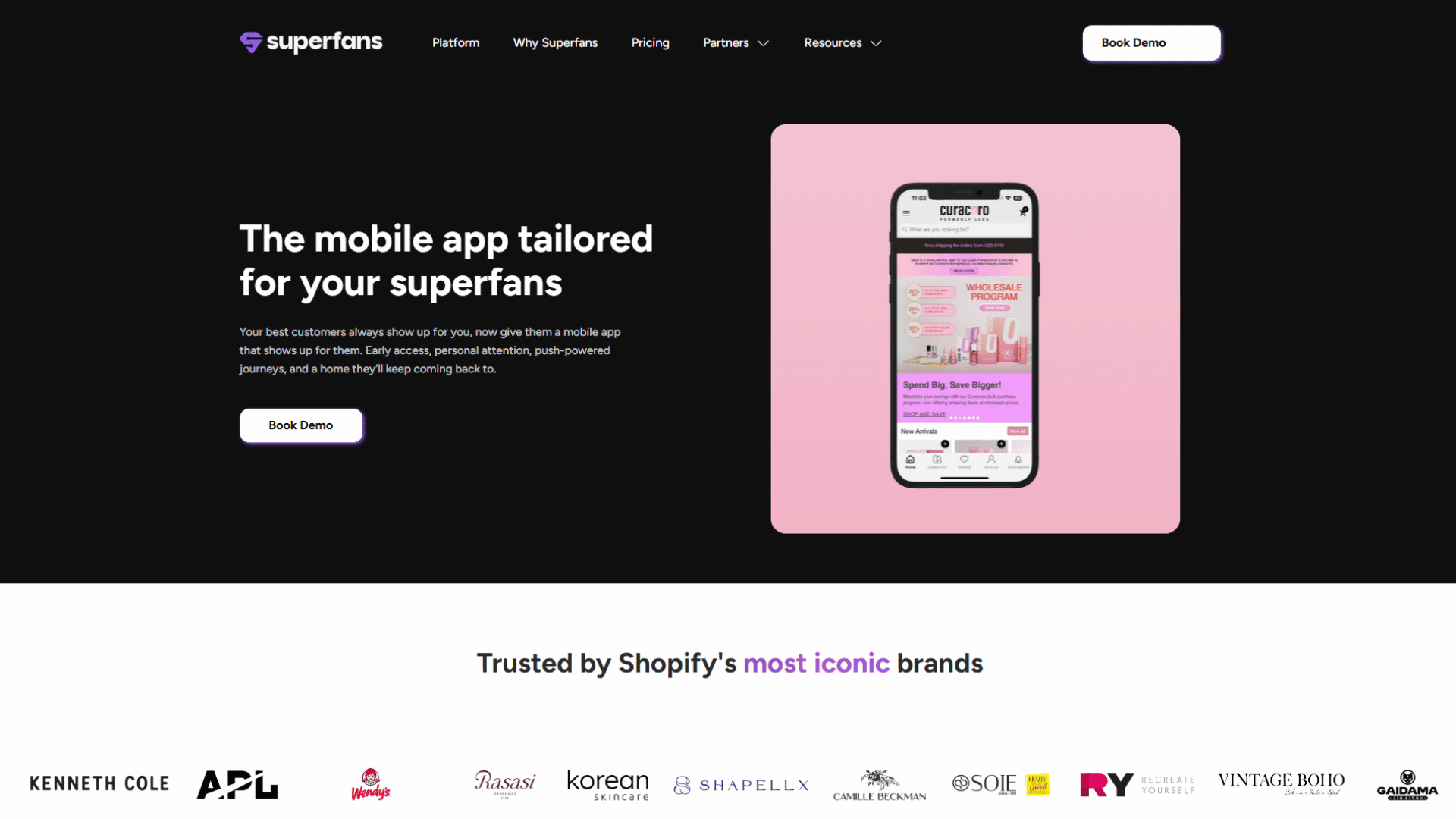
Superfans is the rebrand of Vajro, a long-running Shopify mobile app builder that repositioned itself around loyalty and retention. The pitch is that mobile web is built for traffic while a mobile app is built for your most loyal customers, your "superfans". It turns a Shopify store into a native iOS and Android app with a no-code builder, segmented push notifications, app-exclusive drops, in-app live chat, and its signature feature: interactive live selling, including streams to the app and Facebook.
On the Shopify App Store, the Superfans listing carries a 4.9-star rating across more than 870 reviews and holds Shopify's "Built for Shopify" badge. Its installed base skews towards apparel and lifestyle brands in the United States, and reviews frequently praise the onboarding and support teams by name. Pricing is now tiered rather than a single flat plan: entry tiers begin at roughly $99 to $150 per month, and the all-inclusive Unlimited plan sits at about $1,000 per month.
Superfans is a capable, well-reviewed tool, especially for apparel and lifestyle brands that want live selling and a VIP, community-led experience. It simply is not the right fit for every store, which is why so many merchants compare alternatives.
Why Shopify Brands Look for a Superfans Alternative
The full-featured plan is premium-priced: While Superfans now advertises lower entry tiers, live selling, multi-currency, automated push, and advanced analytics sit on higher plans, and the feature-complete Unlimited plan is around $1,000 per month. For a brand that wants the flagship live-selling and VIP-drop features, that is the real cost of the platform, and it prices out stores that would rather validate the app channel at $50 to $200 per month first.
Live-selling reliability draws complaints: Because live selling is the flagship, its stability is business-critical for the brands that rely on it. Some public reviews on the Shopify App Store describe live-sale sessions disrupted by bugs, with at least one long-term merchant citing unreliable streaming despite a $500-plus monthly spend. For a store whose calendar revolves around live events, that risk is a fair reason to evaluate a builder with a different core strength.
You want more design and developer control: Like many quick-launch builders, Superfans is optimised for speed and templated setup. Brands that want a truly distinctive app, with custom logic, deep personalisation or code-level access, often outgrow that model. This is exactly the gap that customisation-first platforms are built to fill.
Comparison Table
| Platform | Starting price | Rating | Best for | Standout |
|---|---|---|---|---|
| Appmaker | From ~$1,000/mo (tiered + % of in-app sales) | 4.8–4.9★ | Customisation and developer control | Studio, Conditional Blocks, code access, AI layer |
| Tapcart | $250/mo (+ in-app fees) | 4.6–4.8★ | Established self-serve builder | App Studio, For You feed, AI push |
| Apptile | ~$224/mo | Highly rated | Design plus built-in live selling | 100+ tiles, Tile AI, code access |
| Plobal Apps | ~$199/mo | Built for Shopify | Analytics and automation | Deep analytics plus Code Blocks |
| Shopney | $149/mo | 4.8–4.9★ | Fast setup plus in-app chat | In-app live chat, strong RTL support |
| MageNative | Free / $99/mo | 4.7–4.8★ | Budget, feature-rich | AR, visual search, live selling |
| Hulk | $79/mo | 4.9★ | Budget with native B2B | Native B2B pricing, 40+ integrations |
| Fuego | Free to build / from ~$999/mo to publish | Plus-focused | Generative AI, social commerce | Free to build, AI screen generation |
| MobiLoud | From ~$799/mo + setup | Managed | Website-to-app parity | Mirrors your live site, fully managed |
| AppMySite | Free / $49/mo | ~4.4★ | Cheapest, multi-platform | Shopify, WordPress, Woo, white-label |
| Superfans (Vajro) | From ~$150/mo (Unlimited ~$1,000/mo) | 4.9★ | Live selling and loyalty | Interactive live selling, VIP drops |
Pricing verified against each vendor's Shopify App Store listing or pricing page in July 2026. Mobile app pricing changes frequently by tier, in-app volume and add-ons, so confirm the current figure before committing.
How to Evaluate a Shopify App Builder (Quick Checklist)
Set up your developer accounts on day one so approval, which usually takes one to three business days, never blocks your launch. Nearly every builder requires an Apple Developer account ($99 per year) and a Google Play Developer account ($25 one-time) to publish. Then weigh each platform on the following.
- Real-time Shopify sync. Products, inventory, pricing, orders and customers should mirror your store with no manual work.
- Total cost, not sticker price. Watch for revenue-share success fees, in-app performance charges and features gated behind higher tiers.
- Design and customisation ceiling. A templated builder launches fast but caps how unique your app can look. An open one gives more control but needs more work.
- Developer access. If you may want custom blocks, application programming interfaces (APIs) or code-level control later, confirm it exists before you build.
- Integrations. Verify that Klaviyo, Yotpo, Recharge, LoyaltyLion, Gorgias and similar tools you rely on are supported.
- Who runs the app. A self-serve builder you operate, or a managed service where a team builds and maintains it for you.
Best Superfans Alternatives in 2026
Tool Overview
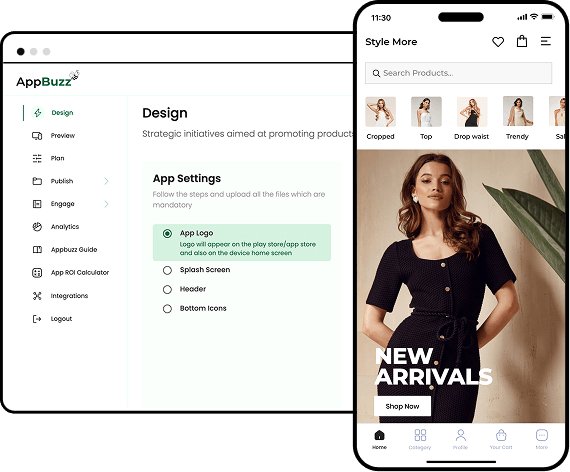
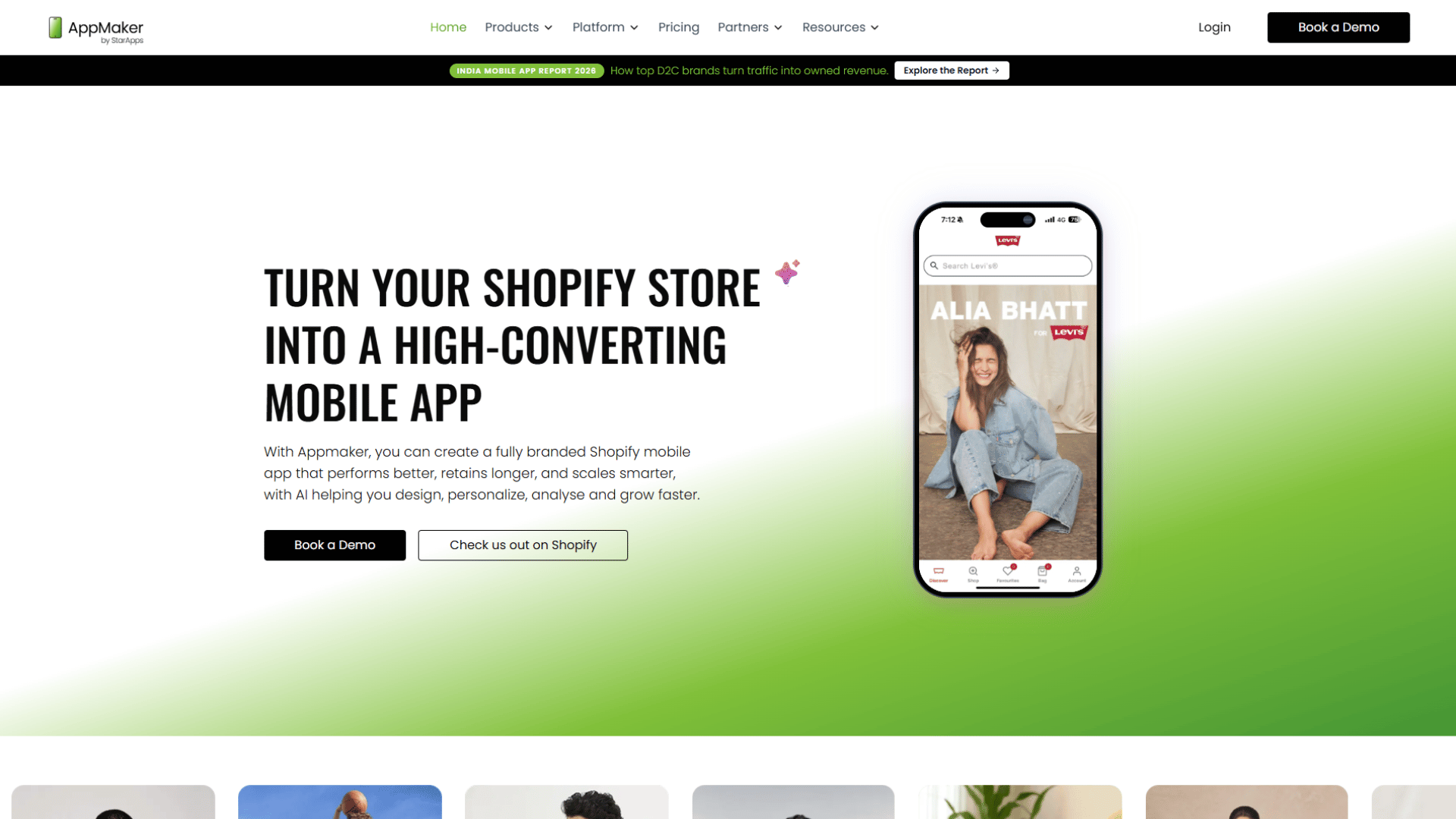
Appmaker is a customisation-first Shopify mobile app platform built for teams that have outgrown template-based builders. Its guiding idea, "build the extraordinary, not another templatised mobile app", speaks directly to the most common reason brands leave Superfans. You design in Appmaker Studio, a drag-and-drop editor with live preview, and the app syncs products, orders, and customers from Shopify in real time. What sets it apart is depth: the platform is built on an open architecture with a real-time content management system (CMS) and, on higher tiers, code-level access.
Key Features
- Appmaker Studio drag-and-drop editor with live preview and real-time Shopify sync.
- Conditional Blocks that personalise the app using Shopify tags and metafields for behaviour-based experiences.
- A built-in artificial intelligence (AI) layer, including John AI for analytics and campaign support, Rubick's AI for in-app personalisation, and the Eidolon design engine.
- Full developer access on the Enterprise tier, including custom APIs and extensions for a genuinely bespoke app.
- Native iOS and Android output with app store submission support.
Pros
- Among the deepest customisation available in a no-code builder, with a clear path to code-level control.
- Personalisation via Shopify tags and metafields is more advanced than most template builders offer.
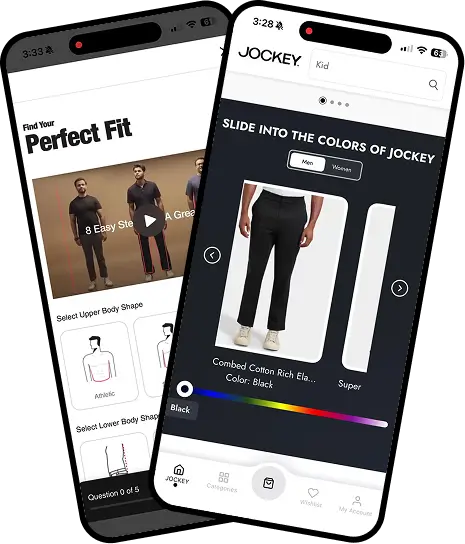
- Established brand roster, including boAt, Supertails, Bombay Shirt Company, The House of Rare, mCaffeine and Jockey.
Cons
- Priced for scaling and established brands rather than first-time testers.
- The revenue-share component means your cost rises with in-app sales, so model it at your expected volume.
- Deeper customisation takes more setup time than a fixed-template app.
Pricing
Appmaker's Shopify App Store listing shows pricing from roughly $1,000 per month, with a free trial. Published tiers pair a monthly base with a percentage of in-app sales, and an Enterprise tier adds full developer access and higher-scale support. Because Appmaker lists slightly different tier structures across its own pages, confirm the current plan and revenue-share percentage on the Appmaker pricing page before committing.
Best For
Shopify and Shopify Plus brands that want a fully custom mobile experience, deeper personalisation and the option of code-level control, rather than a templated app they will outgrow.
Why Choose It Over Superfans
Superfans is optimised for live selling and templated speed. Appmaker is optimised for brand-owned customisation and longevity. If the reason you are leaving Superfans is that you want the app to express your brand, personalise by customer segment and keep evolving without a rebuild, Appmaker is built for exactly that use case.
Overall Verdict
For a $1M to $10M brand that treats the app as a long-term channel, Appmaker's combination of no-code speed, deep personalisation and code-level access on Enterprise makes it the strongest all-round pick on this list.
"Appmaker is perfect for converting our Shopify store into a smooth iOS and Android app." Merchant review, Shopify App Store
2. Tapcart: Best-known Self-Serve Builder
Tool Overview
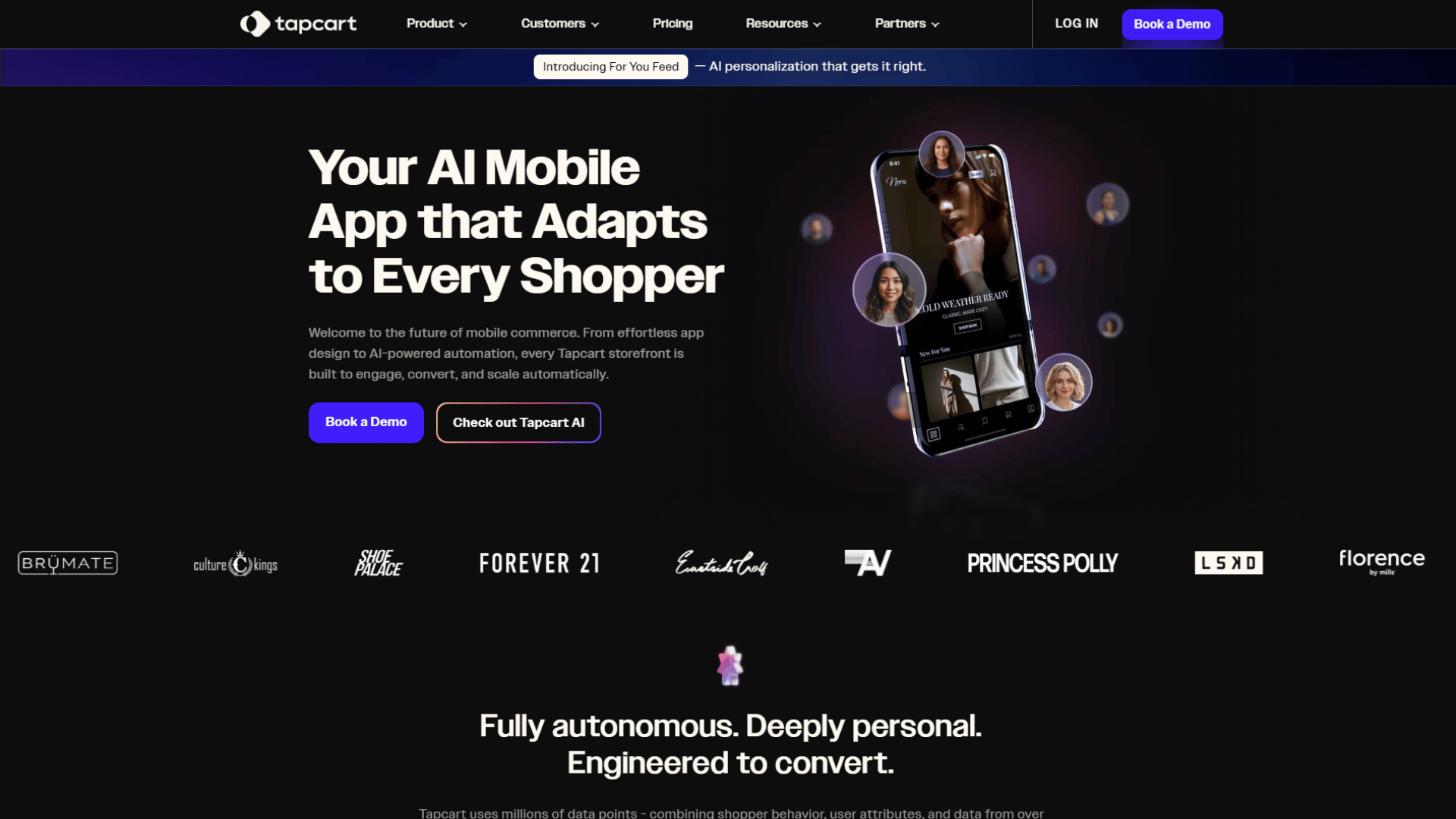
Tapcart is the most established name in the category. Founded in 2017 and based in Santa Monica, it runs on a self-serve model: you rebuild your store inside its block-based App Studio, and Tapcart produces native iOS and Android apps that sync with Shopify in real time. It has leaned into AI, adding a "For You" feed, AI-generated push copy and an Insights Pro analytics add-on.
Key Features
- App Studio drag-and-drop editor supporting multi-page and segment-specific designs.
- Real-time sync of products, collections, inventory, pricing and customer data.
- Unlimited push notifications with scheduled campaigns and behavioural triggers such as abandoned cart and welcome series.
- AI-powered push copy and a "For You" personalised feed.
- Integrations including Klaviyo, Yotpo, Nosto, Gorgias, Rebuy and Recharge.
Pros
- The most mature self-serve builder, with a large review base and a wide integration library.
- Strong push and campaign tooling, which is the primary revenue driver for most Tapcart merchants.
- Marketing teams can run the app independently without engineering involvement.
Cons
- Plans add in-app performance charges on top of the monthly base, so the effective price climbs with volume.
- Multiple reviewers report a 12-month contract and difficulty cancelling.
- Some users note a steeper learning curve than lighter builders.
Pricing
The Core plan starts at $250 per month, billed with additional charges based on in-app performance. Enterprise pricing is custom. A free plan and a 30-day trial are available. Tapcart holds a 4.6 to 4.8-star rating across 300-plus reviews on the Shopify App Store. Confirm current tier pricing on the Tapcart pricing page.
Best For
Design-forward mid-market and Shopify Plus brands with the resources to run the app as its own channel and manage push-led marketing in-house.
Why Choose It Over Superfans
If you want to run the app yourself through a mature, well-documented CMS rather than lean on a managed live-selling workflow, Tapcart is the category's default self-serve choice, with a deeper integration library than Superfans.
Overall Verdict
A safe, capable pick for brands that want a proven self-serve builder and strong push marketing, provided you model the in-app performance fees and are comfortable with an annual contract.
3. Apptile: Design-Forward with AI-Assisted Build
Tool Overview
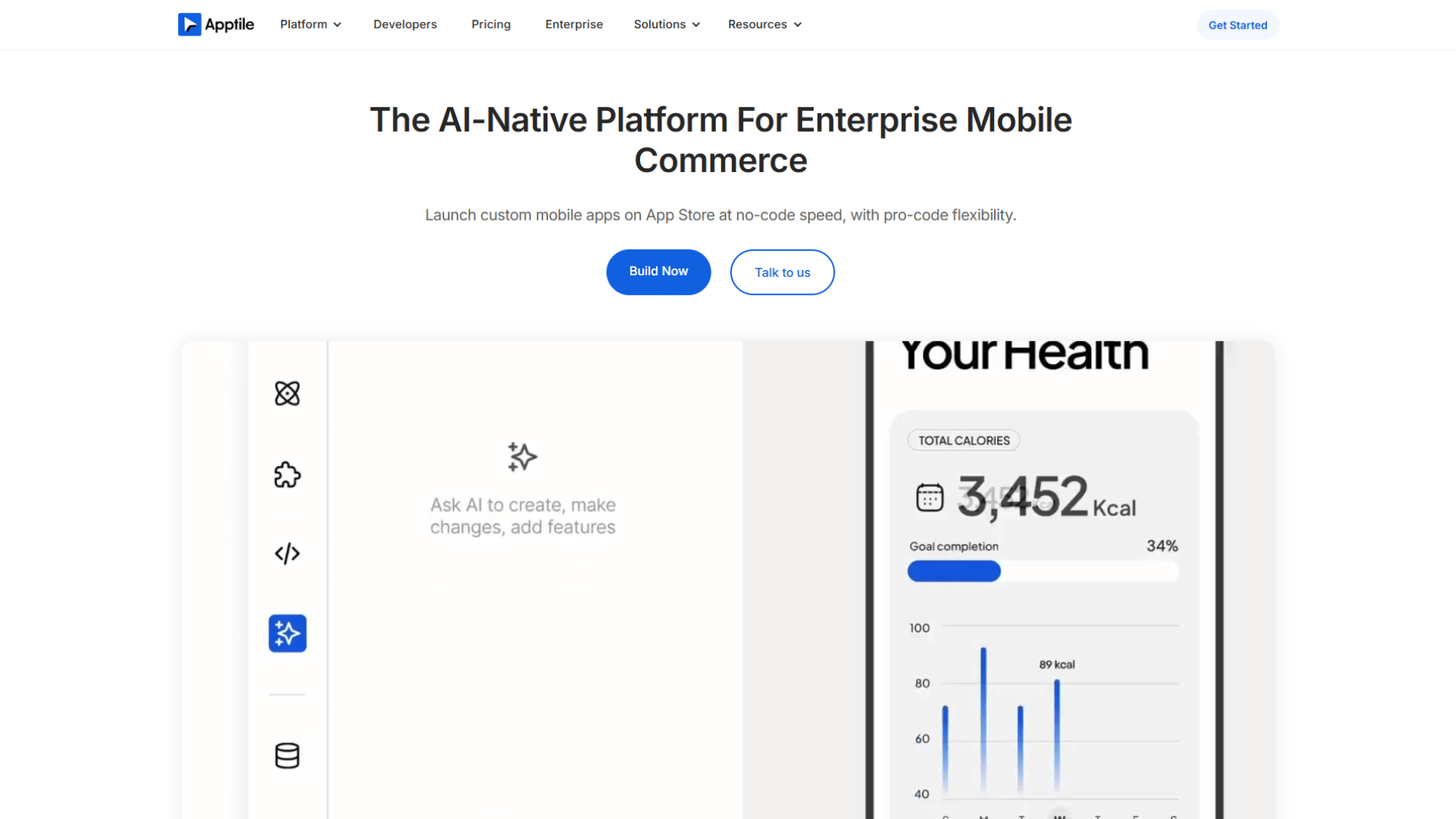
Apptile leans on generative AI as part of the build. You assemble the app from a library of more than 100 modular "tiles", and Tile AI can generate a section from a text prompt. Apps are native with over-the-air updates, and higher tiers offer code-level and even source-code access. It also includes live selling with in-stream checkout, so it can double as a lower-cost live-selling alternative to Superfans.
Key Features
- Tile-based builder with 100-plus components and AI section generation from prompts.
- Native iOS and Android apps with over-the-air updates.
- Live selling with in-stream checkout, automated push and app-only discounts.
- Code-level and source-code access on higher tiers.
- Real-time Shopify sync.
Pros
- Distinctive, storytelling-led design without jumping to enterprise pricing.
- Built-in live selling makes it a genuine Superfans alternative for that use case.
- Room to add code later, so the app can evolve.
Cons
- Smaller brand footprint and review base than Tapcart or Appmaker.
- The tile model has a learning curve if you want highly custom layouts.
- Advanced features concentrate on higher tiers.
Pricing
Apptile starts at roughly $224 per month, with higher tiers unlocking deeper code access. Confirm current pricing and tier inclusions on the Apptile site, as plans in this category change often. Used by brands including Harney & Sons and Monos.
Best For
Mid-market brands that want distinctive design and built-in live selling, with the option to add code as they grow.
Why Choose It Over Superfans
Apptile offers live selling and in-stream checkout, the same core use case Superfans is known for, while adding AI-assisted design and code access at a lower entry price for the equivalent capability.
Overall Verdict
A strong middle-ground option: more design freedom than a fixed-template builder, native live selling, and a lower floor than the premium enterprise tools.
4. Plobal Apps: Analytics and Automation Depth
Tool Overview
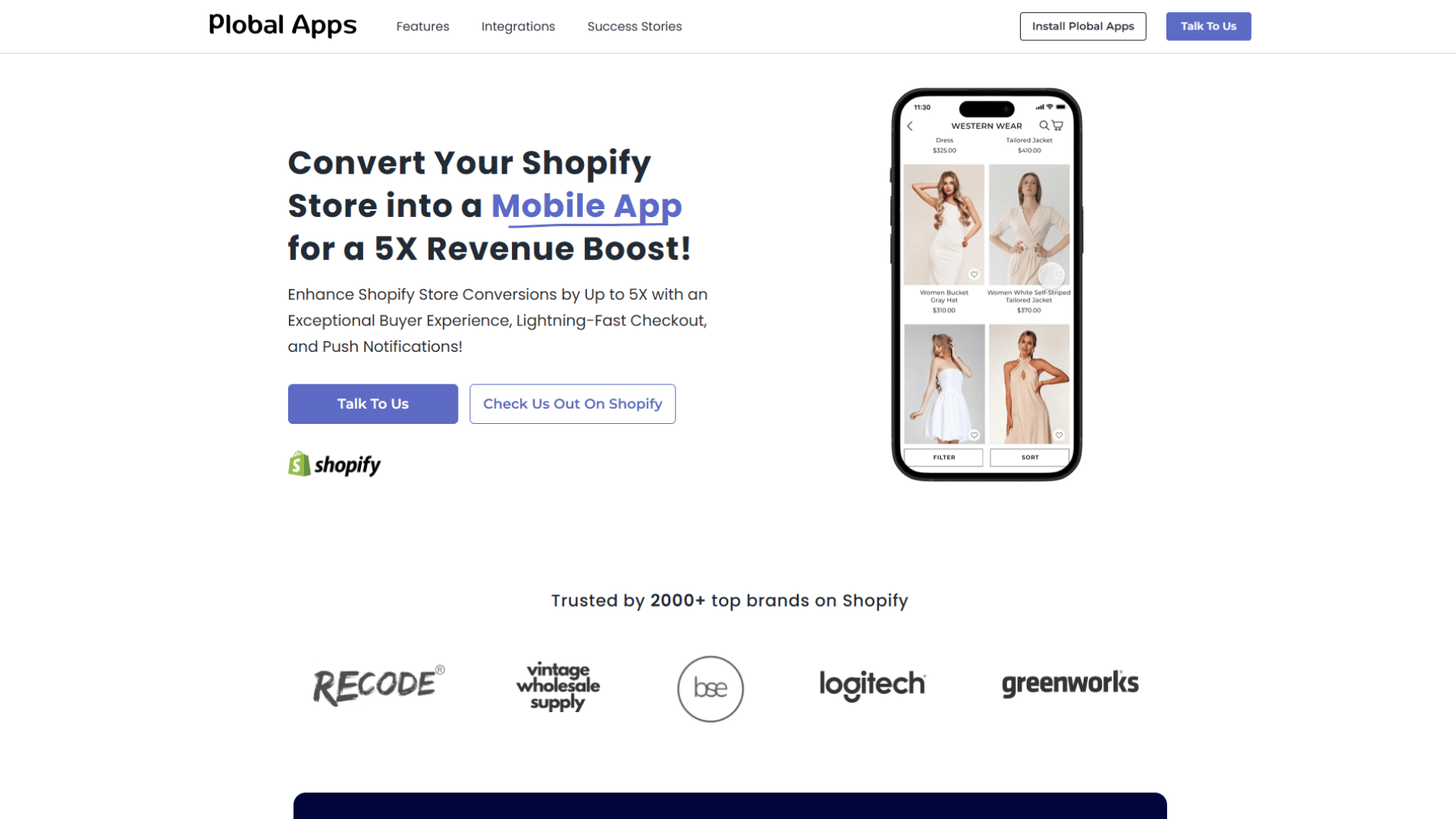
Plobal Apps positions itself as an AI-powered mobile commerce platform focused on growth, automation and analytics. It combines a drag-and-drop editor with Code Blocks for custom logic, and carries the "Built for Shopify" badge. The trade-off is complexity; it needs more setup than a simple builder.
Key Features
- Editor supporting both drag-and-drop layouts and custom code via Code Blocks.
- Automated push campaigns and personalised product recommendations.
- Deep behavioural analytics for cohort and lifecycle insight.
- Real-time Shopify sync.
- Segment-based notifications and layout personalisation on higher tiers.
Pros
- Among the stronger analytics and automation offerings in the category.
- Code Blocks give a genuine path beyond templates.
- Built for Shopify badge signals performance and design standards.
Cons
- More involved to set up and operate than lighter builders.
- Advanced personalisation and integrations sit on higher tiers.
- Some plans include a revenue-share component at scale.
Pricing
Plobal Apps tiers start at about $199 per month for core growth features, move to roughly $499 per month on more advanced plans, and reach approximately $1,199 per month for enterprise functionality, with optional revenue-share depending on in-app sales. Confirm current pricing on the Plobal Apps site.
Best For
Brands that want strong analytics and automation and have the team to manage a more involved platform.
Why Choose It Over Superfans
If your priority is data and automation rather than live selling, Plobal's analytics depth and Code Blocks give you more room to optimise and customise than Superfans does.
Overall Verdict
A solid analytics-led choice for operationally mature teams, with the caveat that you will invest more setup time to get the most from it.
5. Shopney: Fast Setup with in-app Live Chat
Tool Overview
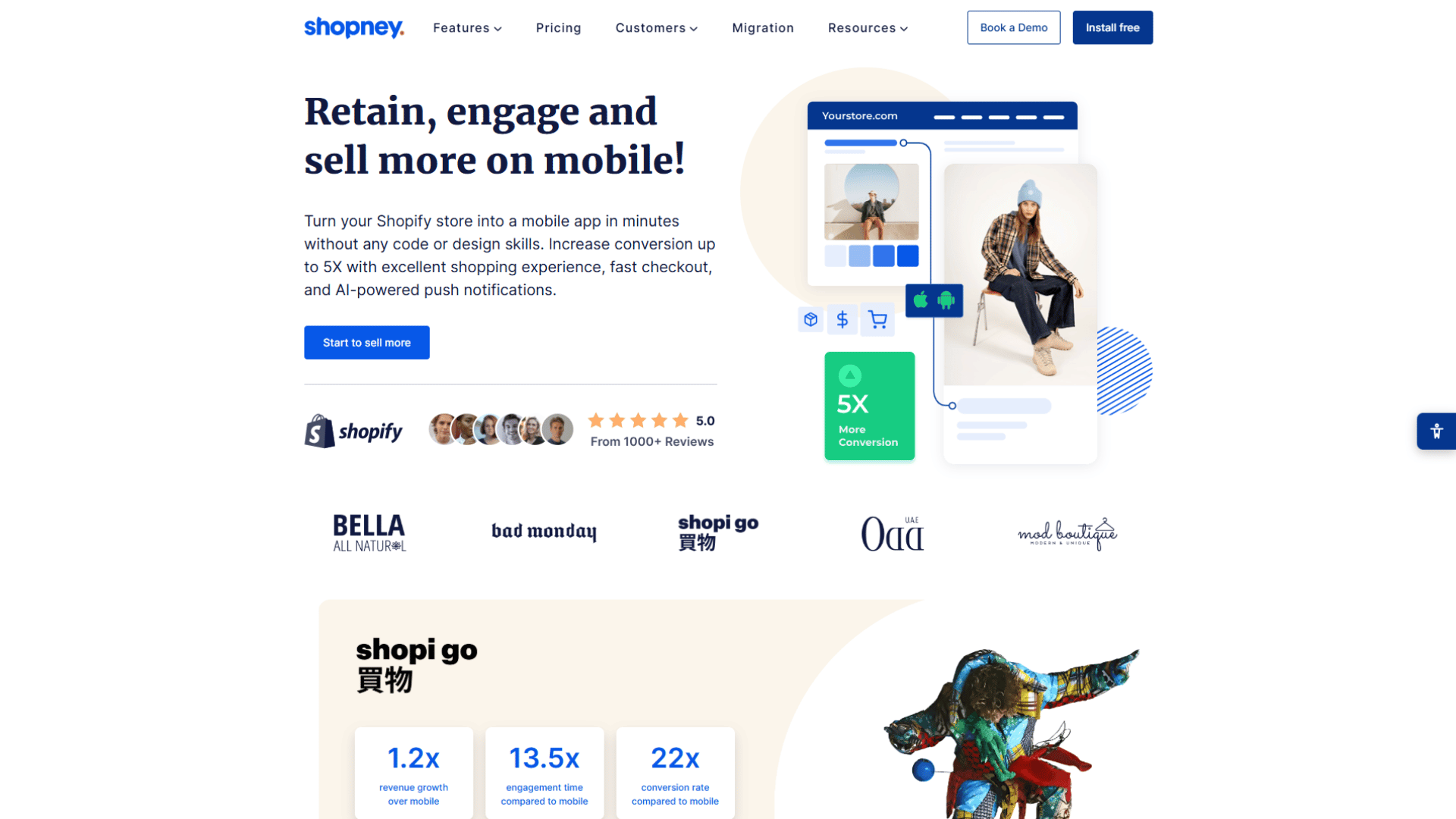
Shopney is built for speed, with polished pre-built themes that get an app live quickly, often within an hour of finalising the design. Its standout feature is a built-in in-app live chat module. The catch is that everything is built on fixed templates, and full customisation plus some push features sit on higher tiers.
Key Features
- Attractive pre-built themes with a clean, drag-and-drop editor.
- In-app live chat that connects to Gorgias, Tidio and Zendesk without a separate software development kit (SDK).
- Strong multilingual and right-to-left (RTL) language support.
- Push notifications, including scheduled campaigns and abandoned-cart reminders.
- Real-time Shopify sync and native checkout.
Pros
- Very fast to launch with a professional-looking result.
- In-app chat is a natural fit for high-consideration or subscription categories.
- Among the best multilingual and RTL support in the category.
Cons
- Fixed templates cap how distinctive the app can look.
- Full customisation and some push features require higher tiers.
- Lighter personalisation than native-first builders.
Pricing
Shopney's Silver plan starts at $149 per month, with higher tiers scaling up to around $1,299 per month. It holds a strong Shopify App Store rating, commonly cited between 4.8 and 4.9 stars. Confirm current tier pricing on Shopify's site.
Best For
Small-to-mid brands that want an attractive app quickly, with live chat as a core feature.
Why Choose It Over Superfans
If you want speed and built-in customer chat rather than live selling, Shopney gets you live faster and bundles support tooling that Superfans leaves to separate integrations.
Overall Verdict
A dependable speed-to-launch option with a genuinely useful chat feature, best suited to brands comfortable working within templates.
6. MageNative: Budget-Friendly and Feature-Rich
Tool Overview
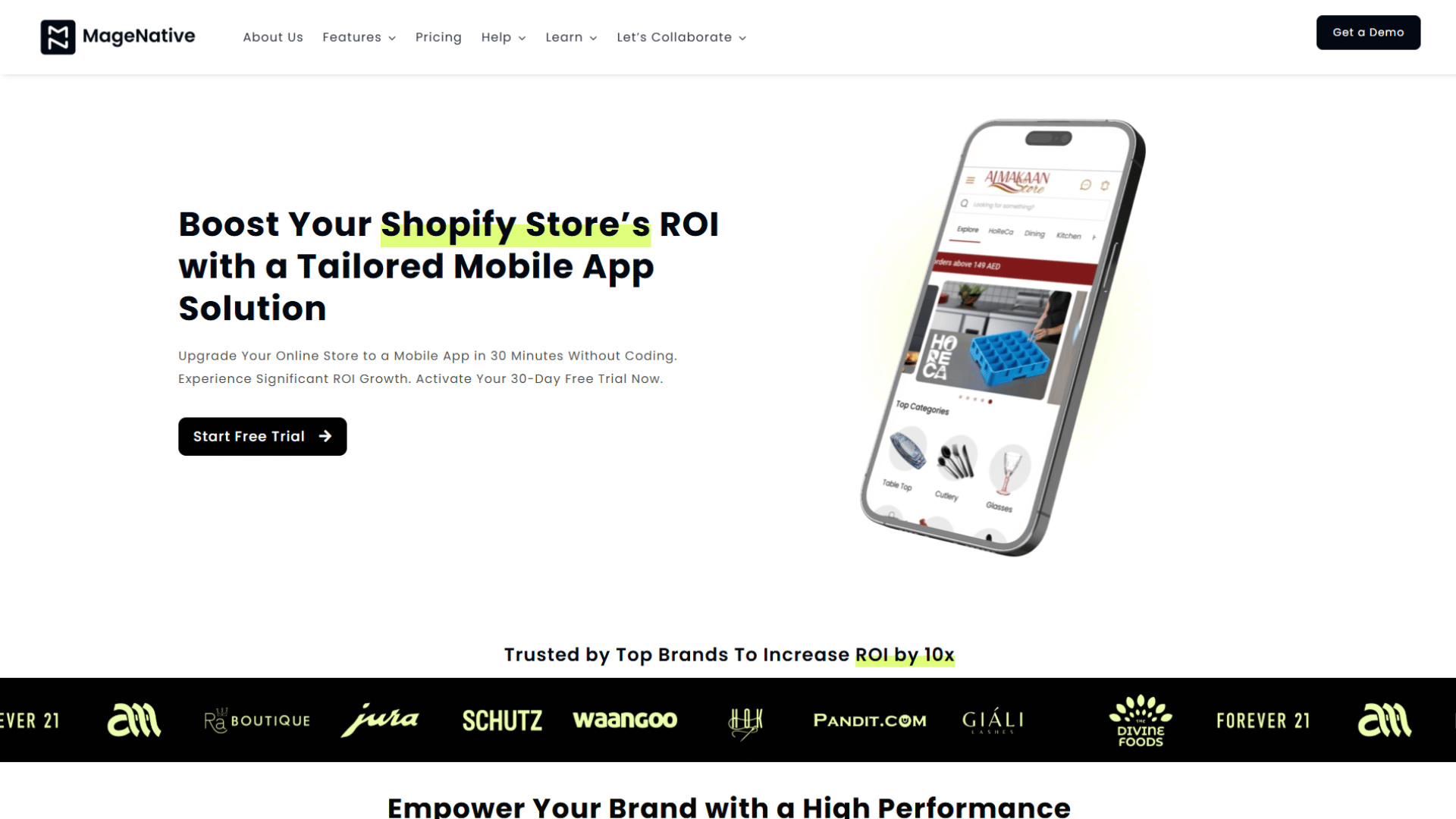
MageNative packs a broad feature set into a low price, one of the more accessible ways for a smaller store to test the app channel. It builds native apps from a single backend with real-time auto-sync and no-code Design Blocks, and notably includes features that usually appear higher up the market.
Key Features
- No-code Design Blocks with real-time Shopify auto-sync.
- Augmented reality (AR) product previews and image or visual search at accessible tiers.
- Live video selling on higher plans.
- AI-powered product recommendations and personalised push notifications.
- Multi-language and multi-currency storefront support.
Pros
- Strong feature-to-price ratio, including AR and visual search that are uncommon at this tier.
- Multi-language and multi-currency support across tiers.
- Established maker with a large review base.
Cons
- Reviews flag inconsistent support at times.
- No native Klaviyo email or short message service (SMS) integration, which matters if Klaviyo is central to your stack.
- Personalisation is lighter than native-first platforms.
Pricing
A free plan is available, with paid tiers commonly cited from $99 per month (Starter), $149 (Standard) and $249 (Premium), and no revenue fee. MageNative holds a 4.7 to 4.8-star rating across 300-plus reviews on the Shopify App Store. Confirm current pricing on the MageNative site.
Best For
Early-stage or sub-$500K gross merchandise value (GMV) stores validating a mobile app before committing to a bigger platform.
Why Choose It Over Superfans
If cost is the reason you are leaving Superfans, MageNative delivers a broad feature set, including live video selling, at a fraction of the price of a premium plan.
Overall Verdict
The value pick for smaller stores, provided you can live without native Klaviyo integration and are comfortable with occasionally variable support.
7. Hulk Mobile App Builder: Broad Features at a Low Price
Tool Overview
Hulk Mobile App Builder is the mobile app product from HulkApps, one of the larger Shopify app developers, with a wide catalogue of other store apps. It is a no-code drag-and-drop builder: you start from a niche design template, customise it in the editor, and Hulk produces native iOS and Android apps, with the company citing launches in around 30 minutes. It carries the "Built for Shopify" badge.
Key Features
- No-code drag-and-drop builder with niche design templates.
- Native iOS and Android apps with app-exclusive offers and automations.
- Abandoned-cart and product-review automations, plus upsell, cross-sell and referral programmes.
- Native business-to-business (B2B) mobile commerce with localised pricing, which is uncommon at this price.
- More than 40 integrations, including Recharge, Judge.me and Yotpo, plus deep-link tracking for Google Analytics and Meta.
Pros
- A broad feature set for the price, with a Built for Shopify badge.
- Native B2B support is rare at this tier.
- Useful if you already use other HulkApps tools, keeping vendors consolidated.
Cons
- Integrations lean towards the HulkApps and common Shopify ecosystem rather than a very large third-party library.
- Smaller review base than category leaders, though ratings are high.
- Lighter brand-level design freedom than customisation-first platforms.
Pricing
Pricing starts at $79 per month on Basic (up to 30 push notifications), with Pro at $149 (unlimited push) and Pro+ at $249 adding automation and upsell features, all billed with no revenue share. Hulk Mobile App Builder holds a 4.9-star rating across 70-plus reviews on the Shopify App Store. Confirm current pricing on the HulkApps listing.
Best For
Cost-conscious Shopify stores that want an affordable native app from an established developer, especially brands that need native B2B pricing or already use other HulkApps products.
Why Choose It Over Superfans
For brands that do not need live selling, Hulk offers a Built-for-Shopify app with B2B commerce and broad automation at well under a fifth of the cost of a premium Superfans plan.
Overall Verdict
A strong budget contender, particularly for B2B or mixed B2B and B2C stores, and a natural fit for merchants already inside the HulkApps ecosystem.
8. Fuego: Generative AI and Social Commerce, Plus Focus
Tool Overview
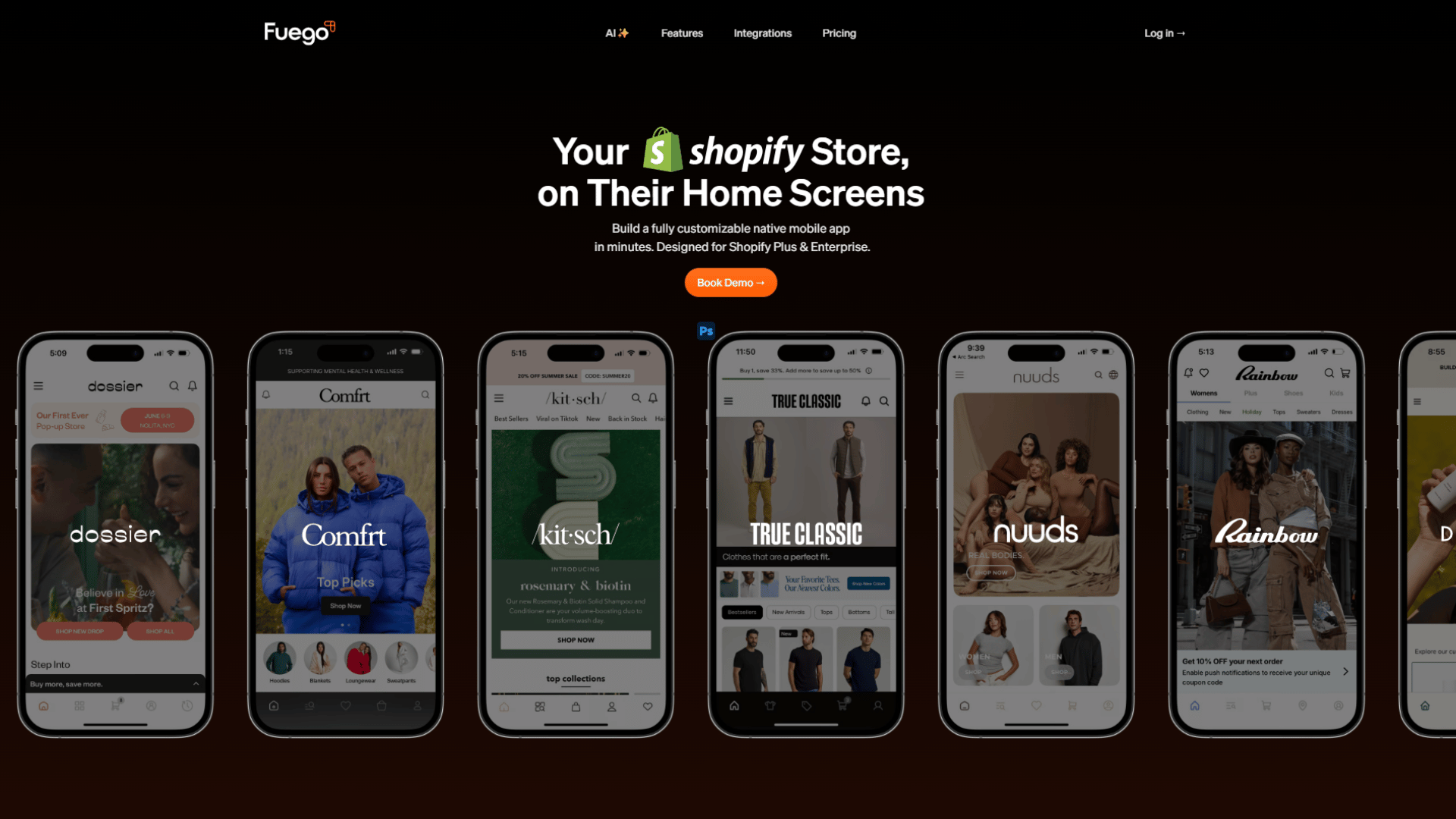
Fuego is an AI-powered, no-code builder aimed largely at Shopify Plus brands that want rapid deployment and social-commerce features. Its generative AI Creative Assistant builds screens from prompts. A helpful detail: you build for free and only pay once you are ready to publish.
Key Features
- Generative AI Creative Assistant that builds screens from text prompts.
- Native checkout and more than 80 integrations, including Rivo and Rebuy.
- A "Community Corner" for social and community-led commerce.
- Free to build, with payment triggered only at publish.
- Real-time Shopify sync.
Pros
- AI-assisted design speeds up the initial build.
- Free-to-build model lets you evaluate before paying.
- Strong integration count for social-first stores.
Cons
- Its Plus orientation and publish-tier price make it less accessible for smaller stores.
- Smaller independent review base than the category leaders.
- Best value concentrates on higher-volume Plus brands.
Pricing
Free to build, with publishing from roughly $999 per month. Confirm current pricing on the Fuego site.
Best For
Shopify Plus and social-first brands that want AI-assisted design and social-commerce features.
Why Choose It Over Superfans
If your growth is social-led and you want AI to accelerate the build, Fuego's Creative Assistant and Community Corner target that model more directly than Superfans' live-selling focus.
Overall Verdict
A capable choice for Plus and social-commerce brands, though the publish-tier price makes it a poor fit for early-stage stores testing the channel.
9. MobiLoud: Managed, Full Website-To-App Parity
Tool Overview
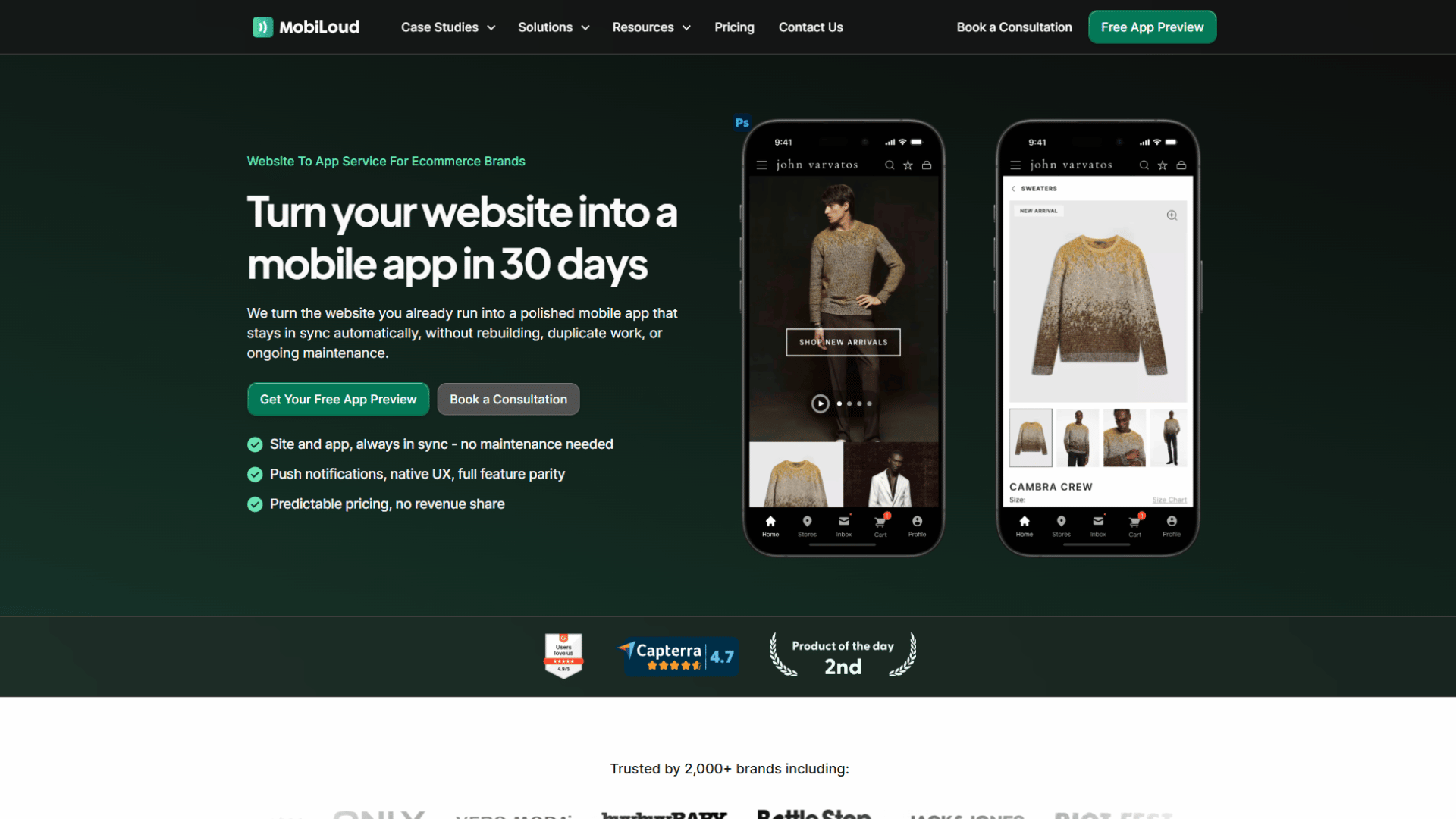
MobiLoud takes a different approach. Instead of rebuilding your store in a block editor, it converts your existing storefront into a native app that mirrors your site, so you get full feature parity between web and app with no second storefront to maintain. It is a fully managed service that works beyond standard Shopify, including Plus, headless and other platforms.
Key Features
- Converts your live storefront (Liquid or headless) into native apps with full parity.
- Fully managed build, app store submission and ongoing maintenance.
- Native push notifications, deep links and social login built in.
- Direct integrations with Klaviyo and OneSignal.
- Support beyond Shopify, including BigCommerce, Adobe Commerce, Salesforce Commerce Cloud and custom or headless sites.
Pros
- No second storefront to maintain, since the app runs your existing site.
- Hands-off, managed service suited to teams without app engineering capacity.
- Predictable subscription with no revenue share on in-app sales.
Cons
- Among the higher entry prices here, plus a one-time setup fee.
- Less suited to brands that want a distinct, app-only merchandising experience.
- MobiLoud is candid that if your goal is a low-cost app, it is not the right fit.
Pricing
Plans start from around $799 per month plus a one-time setup fee, with tiers commonly cited from roughly $299 to $949 per month depending on scope, billed annually, and with no revenue share. Confirm current pricing on the MobiLoud pricing page.
Best For
Mid-market and enterprise brands, typically $1M or more in annual revenue, that want a hands-off, managed app with total parity to their site.
Why Choose It Over Superfans
If maintaining a separate app storefront is the friction, MobiLoud removes it entirely by running your live site inside the app, which Superfans, as a rebuild-in-editor tool, does not.
Overall Verdict
The best fit for brands with complex or headless stacks that want parity and a managed service, and are comfortable paying a premium for it.
10. AppMySite: Cheapest and Most Platform-Agnostic
Tool Overview
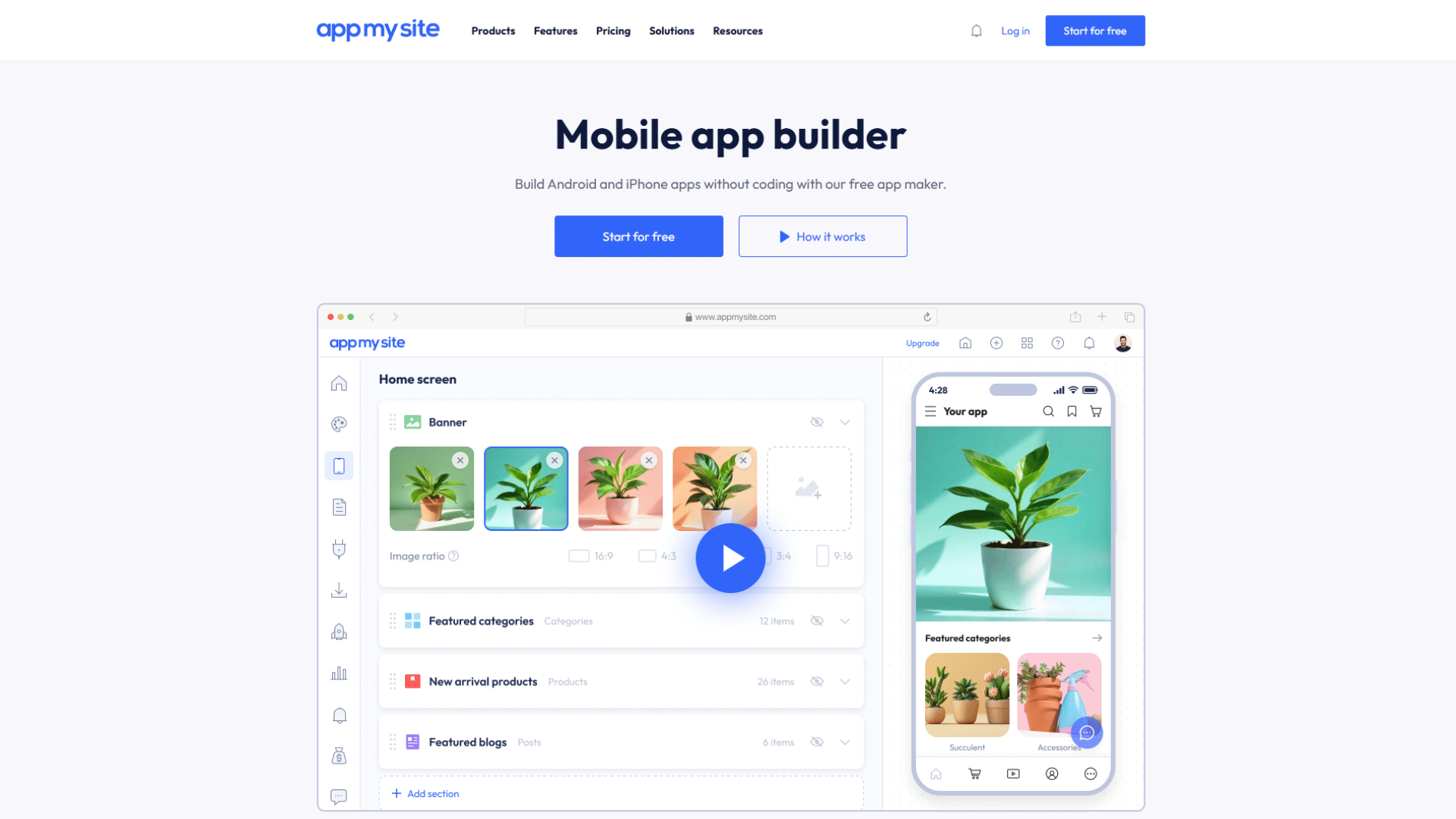
AppMySite is the lowest-cost, most platform-agnostic option. It converts websites, including Shopify, WordPress, WooCommerce or any URL, into native apps, and offers a white-label plan for agencies. It is a simpler, web-view-style app rather than a deeply native commerce experience.
Key Features
- Converts Shopify, WordPress, WooCommerce, or any website into iOS and Android apps.
- Unlimited push notifications with segmentation and deep links on paid plans.
- Real-time preview and fast publishing to the app stores.
- White-label and agency plan.
- A 60-day money-back guarantee on paid plans.
Pros
- The most affordable entry point in this comparison.
- Platform-agnostic, useful if you sell across more than one system.
- White-label option suits agencies reselling apps.
Cons
- A web-view-style app rather than a deeply native experience.
- Its dedicated Shopify-to-app path is lighter than purpose-built Shopify tools.
- Fewer advanced commerce and personalisation features than native-first builders.
Pricing
A free plan covers build and preview, with paid plans from roughly $49 per month. Confirm current tiers on the AppMySite pricing page.
Best For
Very budget-conscious or multi-platform sellers who want a simple, quick app presence.
Why Choose It Over Superfans
If you need the lowest possible cost or sell on more than one platform, AppMySite gives you a live app for a fraction of any premium Shopify-specific plan.
Overall Verdict
The right pick only if price or multi-platform coverage is your top priority, and you can accept a simpler, web-view app in exchange.
Three Trends in 2026 That Should Shape Your Decision
AI moved from a marketing gimmick to a core workflow: About a year ago, "AI" usually meant an auto-generated push headline. In 2026 it runs deeper: Apptile's Tile AI and Fuego's Creative Assistant generate screens from a prompt, Tapcart added a For You feed and AI imagery, and Appmaker ships a multi-part stack across analytics, personalisation and design. The gap between a templated app and a personalised one is narrowing. Ask what the AI actually does day to day, not just whether the box is ticked.
Retention economics now justify the app on their own: With acquisition more expensive each year, the maths increasingly rests on retention rather than reach. A home-screen icon plus an owned push channel gives repeat engagement no ad platform can throttle, which is why builders repositioned around loyalty, VIP access and lifecycle journeys. Weight lifecycle and personalisation features, such as segmented push, cohort journeys, loyalty visibility and app-only drops, at least as heavily as raw design tools.
No-code and developer access stopped being opposites: The old trade-off was stark: a no-code builder with a template ceiling, or a custom build costing tens or hundreds of thousands of pounds over months. In 2026, the strongest platforms, including Appmaker, Apptile, Plobal and Tapcart, pair a no-code editor for speed with code-level access for the moments you need to break out of the template. This hybrid model is the single most important thing to check if you expect your app to evolve.
How to Choose the Right One for Your Store
The honest answer is that the best builder depends on your stage, budget, and how much control you want. A rule of thumb: under roughly $500K GMV, start affordable and validate the channel; if you are scaling and want the app to last for years without a rebuild, invest in customisation depth up front.
- Validating the channel on a budget: AppMySite, MageNative or Hulk let you test with minimal risk.
- Self-serve marketing team: Tapcart or Apptile give you a mature CMS to run the app in-house.
- Live selling and VIP drops: Superfans itself may still be right, or Apptile as a lower-cost live-selling alternative.
- Analytics and automation depth: Plobal Apps.
- Complex or headless stack, managed service: MobiLoud.
- Brand-owned customisation built to last: Appmaker.
Consider total cost, not the headline. Two builders can advertise similar monthly plans but behave very differently once your app starts generating installs and orders. Success fees, in-app performance charges and gated features are the most common ways the real price climbs. Model your cost at your expected volume, not at launch.
Switching From Superfans: A Quick-Start Checklist
Migrating between builders is more straightforward than it sounds, because your catalogue, customers and orders live in Shopify, not in the app builder. Most platforms advertise easy migration from Superfans (Vajro), Tapcart, Shopney and others. A clean switch looks like this.
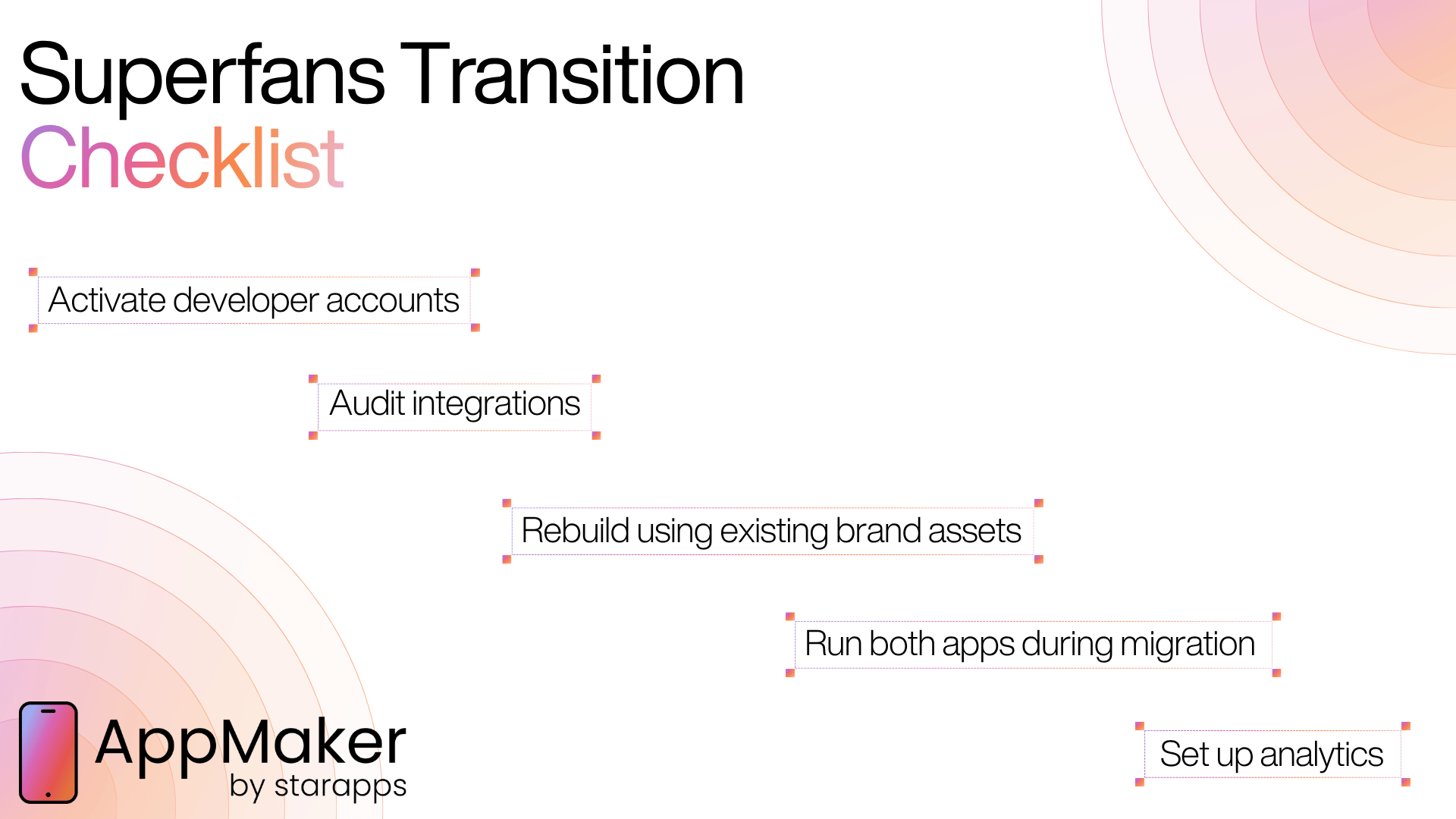
- Confirm your developer accounts are active (Apple $99 per year, Google Play $25 one-time) so publishing is never the bottleneck.
- Audit your integrations. List every tool your current app depends on, such as Klaviyo, Yotpo, Recharge, LoyaltyLion and Gorgias, and verify support before rebuilding.
- Rebuild in the new editor using your existing brand assets. A real-time-sync platform pulls products, pricing and inventory automatically.
- Keep both apps live briefly during the transition so existing users are not stranded, then migrate push subscribers and announce the new experience.
- Instrument analytics from day one so you can measure conversion, retention and average order value against your Superfans baseline.
If deeper customisation or developer access is the reason you are moving, Appmaker's onboarding and app-success services are designed for teams making this jump, and the Enterprise tier includes solutioning hours and design support to rebuild a distinctive app rather than re-skinning a template.
Ready to build the extraordinary, not another templated app?
Appmaker turns your Shopify store into a fully custom, high-performance native app with real-time sync, deep personalisation, a built-in AI layer and full developer access when you need it. Explore the Appmaker pricing page to compare current plans and see which tier fits your stage.