





















Key Takeaways
- The best mobile app builder for fashion Shopify brands depends on your budget, design control, and growth goals, with AppMaker, Tapcart, Shopney, and Apptile leading.
- Product discovery decides fashion apps, so prioritize builders with deep size, color, and fit filtering, custom product pages, and clean size charts.
- Tapcart is the most established self-serve builder and suits fast, marketing-led launches, from $500 per month billed annually, with no commission.
- AppMaker leads on brand-custom design and developer access, backed by verified apparel case studies, at $999 per month plus 1% of in-app sales.
- Shopney and Superfans both start near $150 per month with no commission, fitting boutiques and community-led brands launching their first app.
- Budget the hidden costs: Apple at $99 per year, Google at $25 one-time, plus any commission or usage fees that grow with app sales.
- No major builder carries Shopify's "Built for Shopify" badge, so judge them on fit, merchant reviews, and verified results, not that label.
Picture one of your best customers on her phone, zooming in on a dress, hunting for a size chart that never quite loads, and abandoning her cart at checkout. That drop-off is the quiet tax of mobile web, and for fashion brands it is expensive. Nearly 70% of online shopping carts are abandoned before purchase, according to Baymard Institute, and a clumsy mobile experience only pushes that number higher.
A native app changes the story. Fashion brands that move shoppers into an app consistently see higher conversion, bigger orders, and more repeat buyers. The result, though, depends entirely on which app builder you choose. Pick well, and the app outperforms your site. Pick a generic template that cannot show a size chart or filter by fit, and it converts worse than the page it replaced.
Short on time? Watch this quick video on why fashion brands are moving to apps: https://www.youtube.com/watch?v=UNQYcYamlsI
This guide compares the best mobile app builder for fashion Shopify brands across five strong options, with verified pricing, real apparel results, and a clear read on which type of brand each one suits. No single tool wins for everyone, because a luxury label scaling across borders and a boutique running weekly drops need very different things from an app.
How We Chose These Best Mobile App Builders
We focused on builders that fashion and apparel brands on Shopify actually use, then checked each one ourselves instead of trusting marketing copy. Here is the method behind the list.
- Verified sources only: Every price, plan, feature, and rating comes from each vendor's own pricing page and its Shopify App Store listing, checked on October 7, 2026. Performance figures come from published case studies and are labeled vendor-reported.
- Fashion relevance: We weighted the capabilities that matter for apparel: size and fit, product discovery and filtering, merchandising, personalization, loyalty, and checkout, rather than raw feature counts.
- Real traction: We used Shopify App Store ratings and review volume as a rough signal of install base and merchant sentiment, while noting that review count reflects time in market, not quality.
- Order, not ranking: The five are listed from the most design control and developer flexibility to the most specialized, because design control is the main axis fashion brands differ on. Position is not a verdict. The right builder is the one that fits your brand.
The Comparison at a Glance
Verified pricing, commission model, and current Shopify App Store sentiment for the five builders. Ratings and review counts were checked on October 7, 2026, and shift over time. All five need their own Apple and Google developer accounts to publish, which sit outside these fees.
| Builder | Entry price (verified) | Commission | Shopify App Store | Best fit for fashion |
|---|---|---|---|---|
| AppMaker | $999/mo (Growth) + 1% | 1% | 4.9 (33 reviews) | Custom, non-templated apps with developer access |
| Tapcart | $500/mo (Growth, annual) | None | 4.7 (341 reviews) | High-growth brands wanting a proven, fast launch |
| Apptile | $599/mo (Pro) | None | 4.9 (131 reviews) | AI-first brands wanting flat, no-commission pricing |
| Shopney | $149/mo (Silver) | None | 5.0 (770 reviews) | Smaller boutiques and first-time launchers |
| Superfans (Vajro) | $1000/mo | None | 4.9 (909 reviews) | Loyalty, live selling, and community-led brands |
One caveat on that table: review volume is a rough proxy for install base and time in market, not quality, so Tapcart's larger count mainly reflects its longer head start.
Why the "Built for Shopify" badge is not a useful filter here
Shopify awards a Built for Shopify badge to apps that meet its performance and quality bar, and shoppers often read it as a trust signal. In this category, it does not help you choose. None of the five builders above currently carry the badge, while some much smaller mobile-app-builder apps do. Filtering by it would rule out every established option, so weigh verified results and merchant reviews instead.
Top Mobile App Builder for Fashion Shopify Brands
1. AppMaker
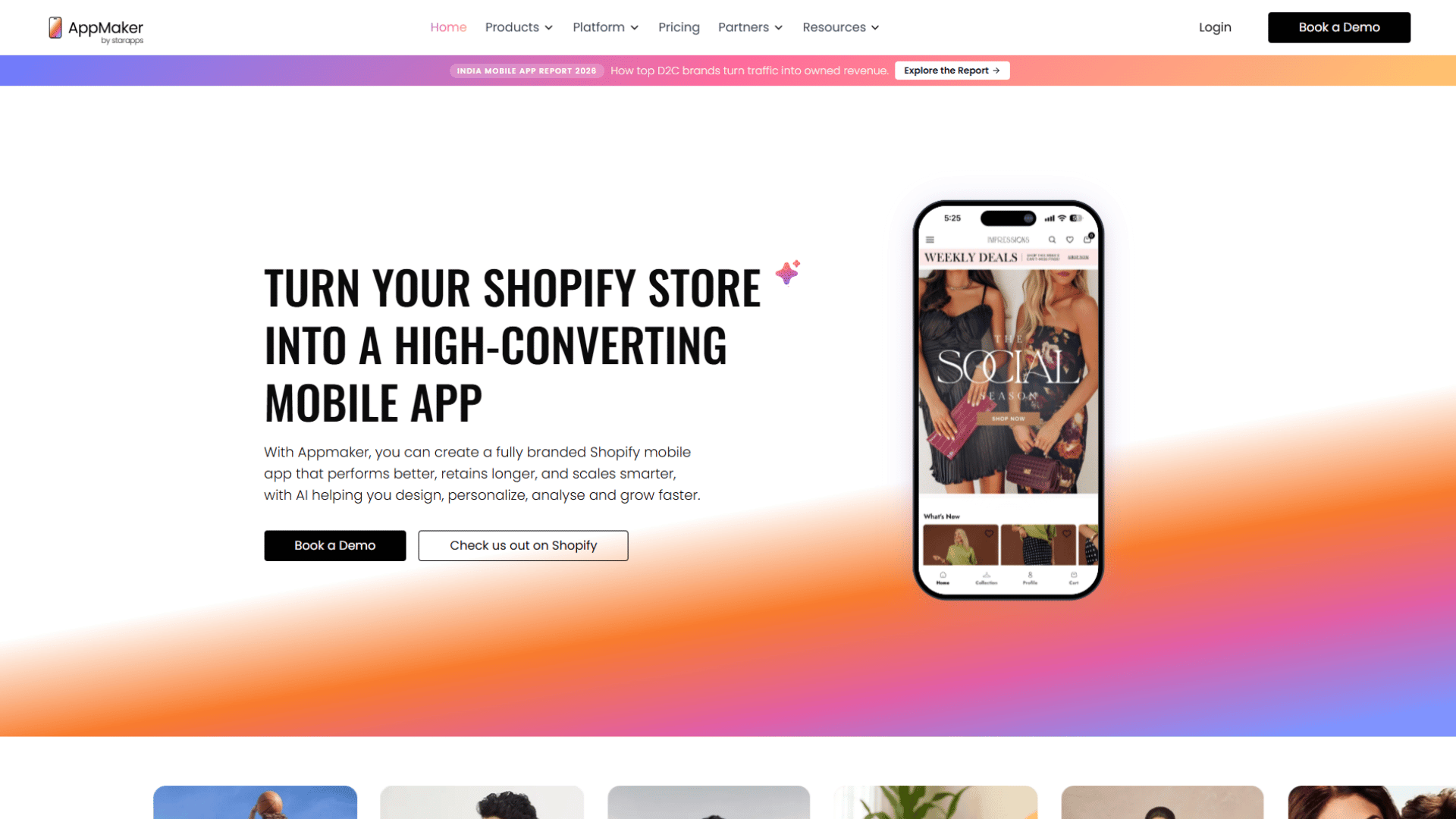
AppMaker, now operating as AppMaker by StarApps Studio, is built on one idea: a fashion brand should ship an app that looks like the brand, not like a template.
Pricing
Growth is $999 per month plus 1% of in-app sales. Enterprise starts at $2,000 per month plus 1% of in-app sales, with one-time solutioning and development fees on top. Its Shopify App Store listing shows the same two plans as Pro, at roughly $1,000 and $2,000.
Strengths for fashion
- Design and developer control: Enterprise unlocks custom themes, full developer access through the Appmaker Open Model, and code blocks for custom flows such as loyalty checkouts, subscription modules, or gamified product pages. This is the deepest control in this comparison, and most of the cheaper builders do not offer it.
- Merchandising: Native size charts and product metafields, custom product page templates, dynamic homepage sections, and conditional blocks that tailor content by tag, for example, an offer shown only to returning shoppers.
- Personalization and AI: Three modules do the work: John AI for analytics, campaigns, abandoned-cart flows, and push scheduling; Rubick's AI for real-time in-app personalization such as behavior-based banners; and Eidolon AI, a design engine for faster customization.
- Verified apparel results: House of Rare, the group behind Rare Rabbit and Rareism, reports 45% of orders through the app, 2.5x higher conversion than mobile web, and 1.3x higher average order value (AOV). XYXX reports 5.3x higher conversion, 7x average revenue per user (ARPU), and 31% higher app AOV. Both figures are vendor-reported as relative uplifts with no revenue disclosed, and both apps are built around size and fit discovery and loyalty.
Limitations to weigh
At $999 per month plus 1%, AppMaker is the priciest entry point here, so a low-volume brand will struggle to justify it until app revenue scales. Its 33 reviews are the fewest in this set, reflecting a shorter self-serve track record than Tapcart or Shopney. Enterprise customization also carries one-time build fees, so the real first-year cost sits above the subscription.
Best suited for
Mid-size to large fashion brands that have outgrown templates and want full creative and technical control, especially those planning custom loyalty, subscription, or gamified experiences. You can check the evidence directly in AppMaker's case studies and feature list.
2. Tapcart
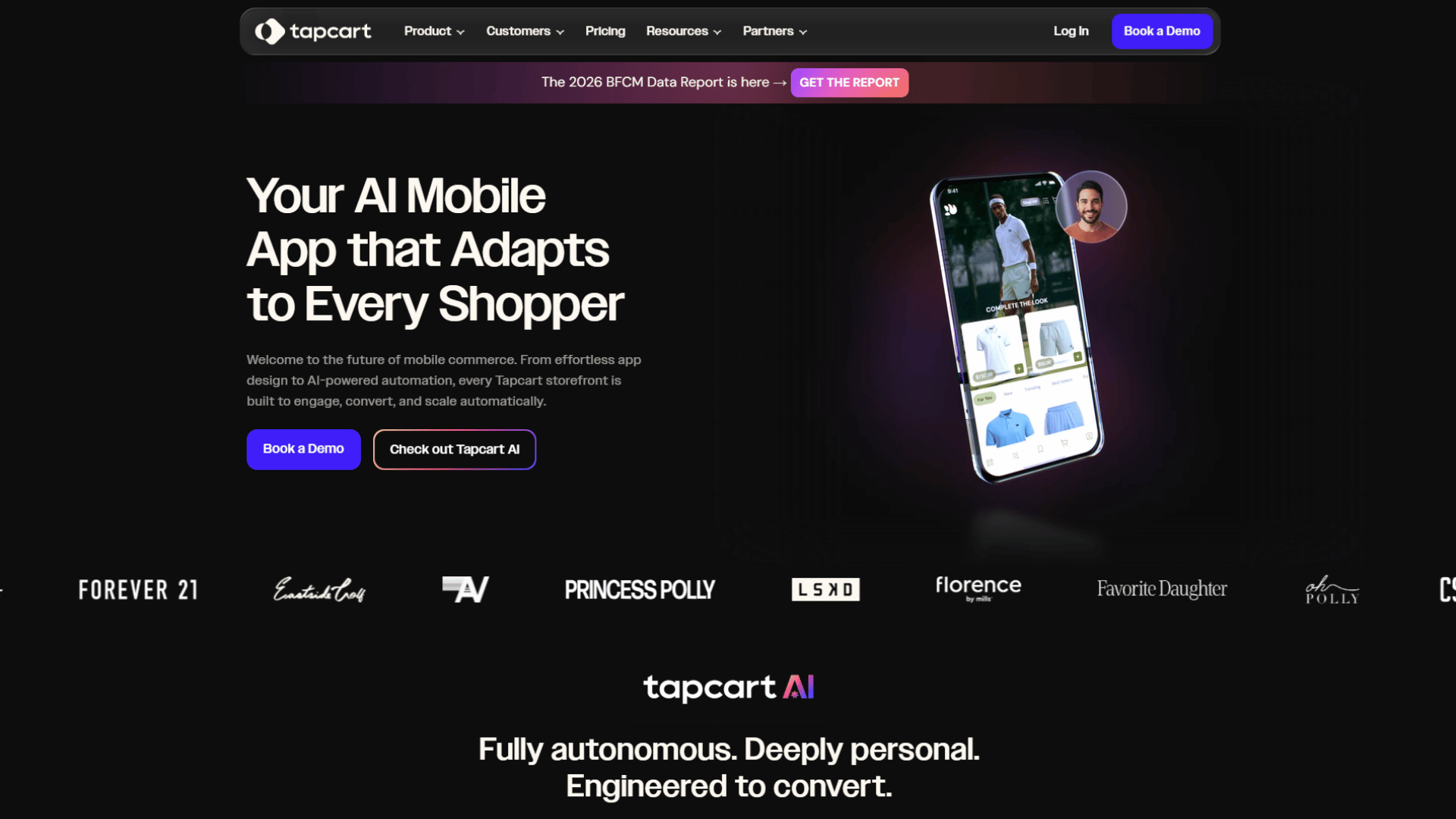
Founded in 2017, Tapcart is the most established self-serve builder for Shopify and usually the first name a merchant meets.
Pricing
Growth is $500 per month, Scale $1,250 per month, and Enterprise+ $2,850 per month, all billed annually. AI push and related tooling are a $250 per month add-on on any plan. There is no commission on in-app sales. (Source: Tapcart pricing page.)
Strengths for fashion
- A long track record. A 4.7 rating across 341 reviews, the longest public history in this group.
- Design and build. Unlimited blocks, integrations, and custom screens on every plan. A Product Page Builder and Dynamic Layouts let you design a block once and apply it across a product group by tag, which saves real time on a large catalog.
- Merchandising. Product badging and gift-with-purchase on the base plan; Shopify metafields and conditional visibility of content arrive on the Scale plan.
- AI and marketing. A For You Feed for personalization, plus AI push, content autopilot, and AI lifestyle imagery, all aimed at faster campaign execution.
- Checkout and ecosystem. One-step native checkout (Apple Pay, PayPal, Google Pay, Amazon Pay), real-time Shopify sync, a large partner catalog, white-label branding, and migration that keeps your users and push subscribers.
- Fashion credibility. A dedicated Fashion and Apparel vertical, with apparel case studies including Princess Polly, BÉIS (67% higher in-app conversion, vendor-reported), and LSKD.
Limitations to weigh
Tapcart is Shopify-only, and its design model is block-based rather than code-level, so brands wanting bespoke control will meet a ceiling that AppMaker does not have. The features fashion needs most, metafields and conditional visibility, sit on Scale at $1,250 per month, not the $500 entry plan.
Best suited for
High-growth and enterprise fashion brands that want a proven, reliable platform with deep marketing tooling and are comfortable with a self-serve, block-based design model.
3. Apptile
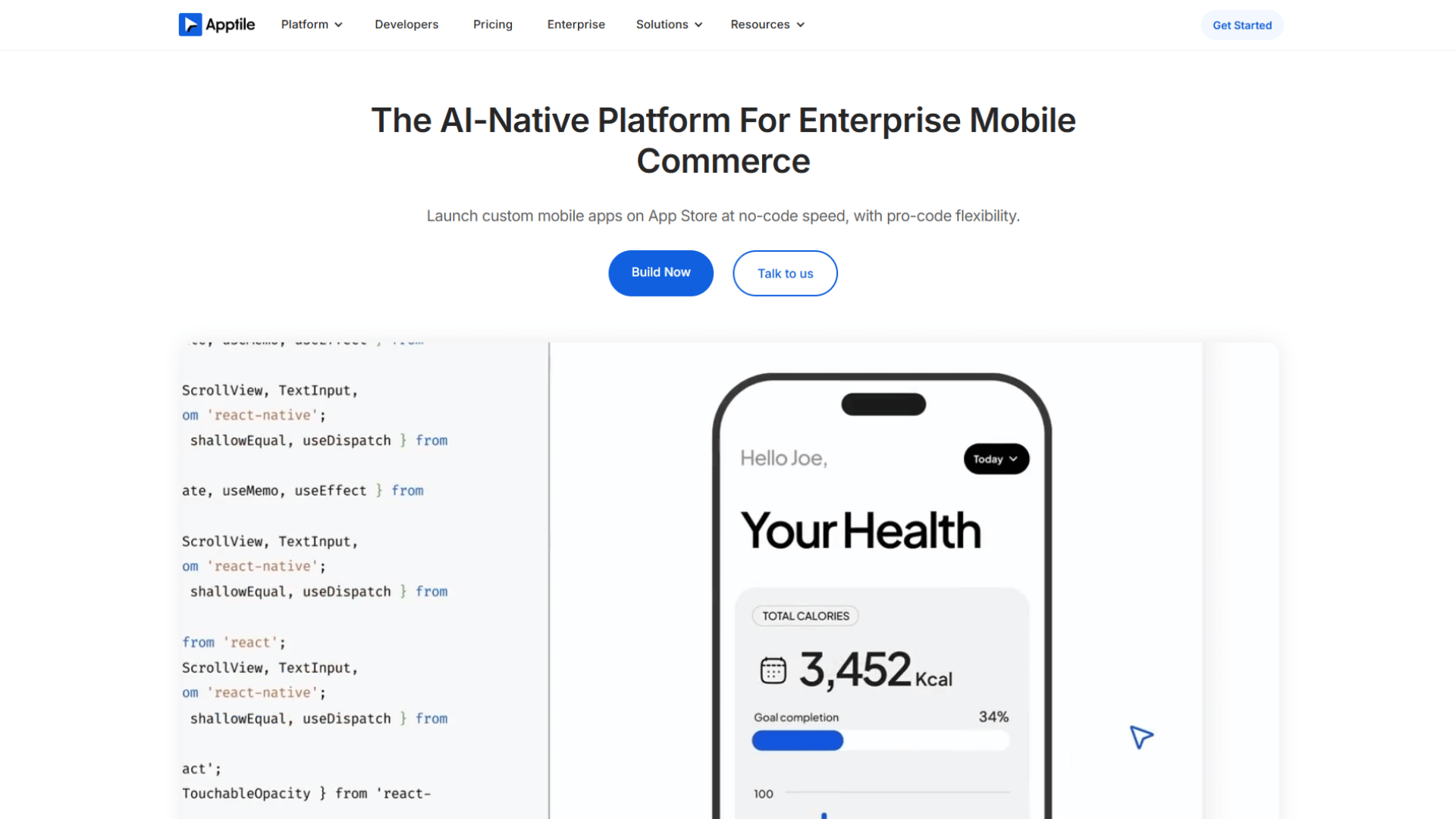
Apptile is an AI-driven builder for Shopify brands that want to assemble and change an app quickly, using natural-language prompts rather than developers.
Pricing
Plus is $599 per month, and Enterprise is $1,199 per month, each around 10% cheaper when billed annually. There is no commission on in-app sales; the app is free to install, and payment begins when you go live. A 15-day free trial is offered. (Source: Apptile Shopify App Store listing.)
Strengths for fashion
- AI-assisted build. You can generate app sections and features with plain-language prompts, which shortens setup for a small team. A 4.9 rating across 131 reviews.
- Design and merchandising. A drag-and-drop editor with templates, custom homepage, product page, and cart layouts, and multi-language and multi-currency support for cross-border selling.
- Content and discovery. Shoppable video and live selling, plus barcode scanning, which suit visual, drop-driven fashion merchandising.
- Engagement. Unlimited push, including abandoned-cart and back-in-stock alerts, segmentation, and one-time password (OTP) or social login. It integrates with Klaviyo, Recharge, Judge.me, and Gorgias.
Limitations to weigh
The model is template-and-AI-assisted rather than code-level, so a brand wanting fully bespoke logic will prefer AppMaker. Advanced analytics sit on the Plus plan ($499) and above, and the listing does not call out a native size-chart feature, so confirm size and fit handling during the trial. It is Shopify-only.
Best suited for
Fashion brands that want to stand up and iterate on a branded app quickly with AI assistance and flat, no-commission pricing, especially those leaning on shoppable video and frequent drops.
4. Shopney
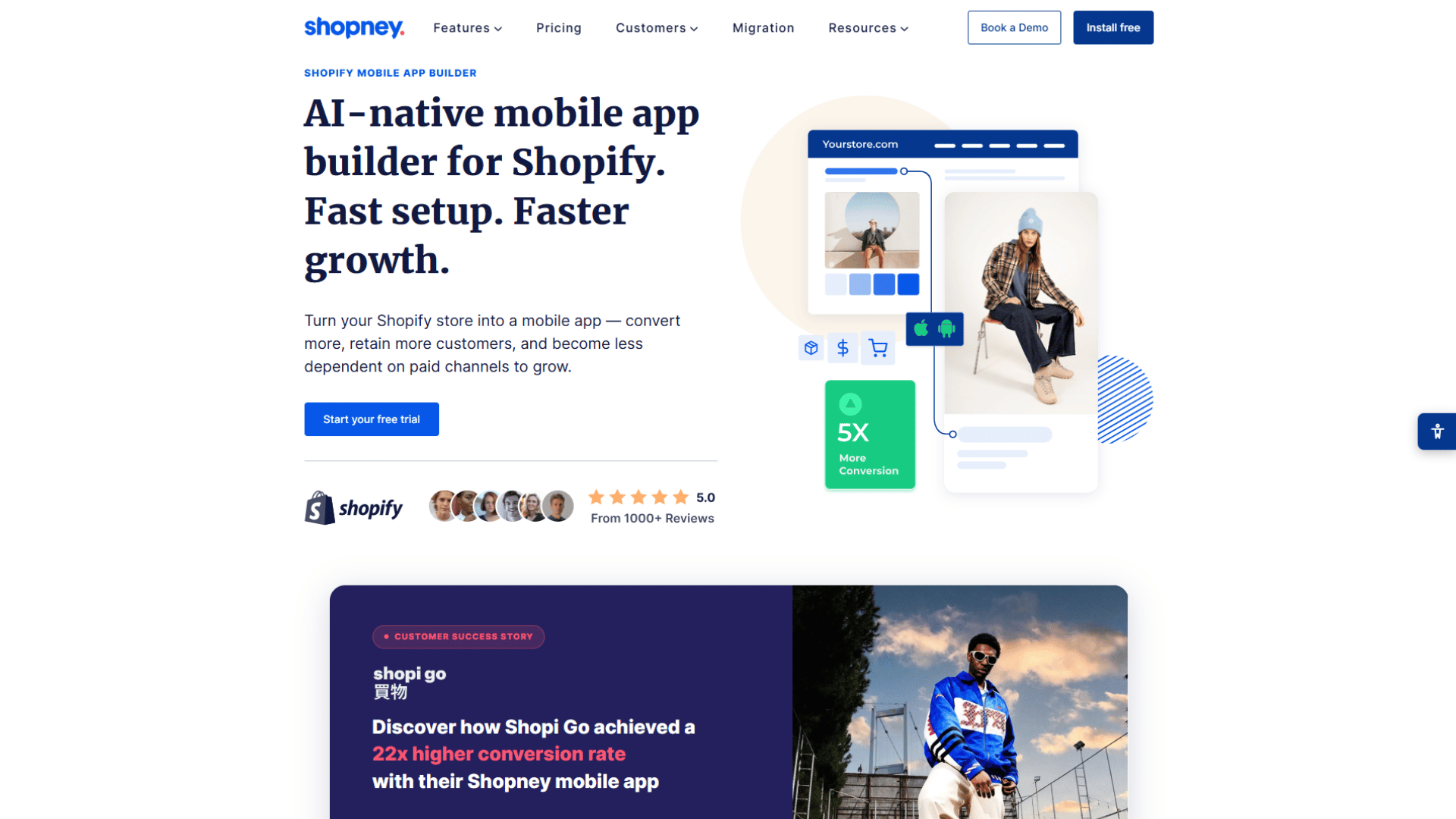
Shopney is the most accessible serious builder in this group, and it is beginner-friendly and quick to launch.
Pricing
Silver is $149 per month, Gold $299, Platinum $599, and Enterprise from $1,299 per month. Yearly billing lowers these, with Silver dropping to around $119 per month. There are no success fees or commissions. (Sources: Shopney pricing page; Shopify App Store.)
Strengths for fashion
- Strong sentiment for the price. A 5.0 rating across 770 reviews, the best sentiment-to-price ratio here.
- Design. A drag-and-drop editor, white-label apps, four to eight themes depending on tier, 15 design element types, deep-linking, and bottom-bar navigation.
- Fashion merchandising. Product search and sort, wishlist, recently viewed, product labels and badges, sub-collections, and a Kiwi Size Chart integration. Higher tiers add search-and-filter integrations (Boost, Searchanise, Searchspring) and reviews (Yotpo, Stamped, Judge.me, Growave).
- Engagement and support. Unlimited push on every plan, in-app chat with Shopify Inbox, and 24/7 live chat and video support with onboarding on every tier. Its Touché case study cites 12x higher mobile conversion (vendor-reported).
- International. Localization across 21 languages with multi-currency support and Shopify Markets.
Limitations to weigh
The model is theme-based rather than code-level, so a brand wanting bespoke or developer-led builds will outgrow it. Several features fashion leans on, including AI push and live selling, start on Platinum at $599 per month rather than the entry plan.
Best suited for
Smaller fashion boutiques, emerging labels, and first-time app launchers who want strong merchandising and support without a four-figure commitment or a revenue share.
5. Superfans (formerly Vajro)
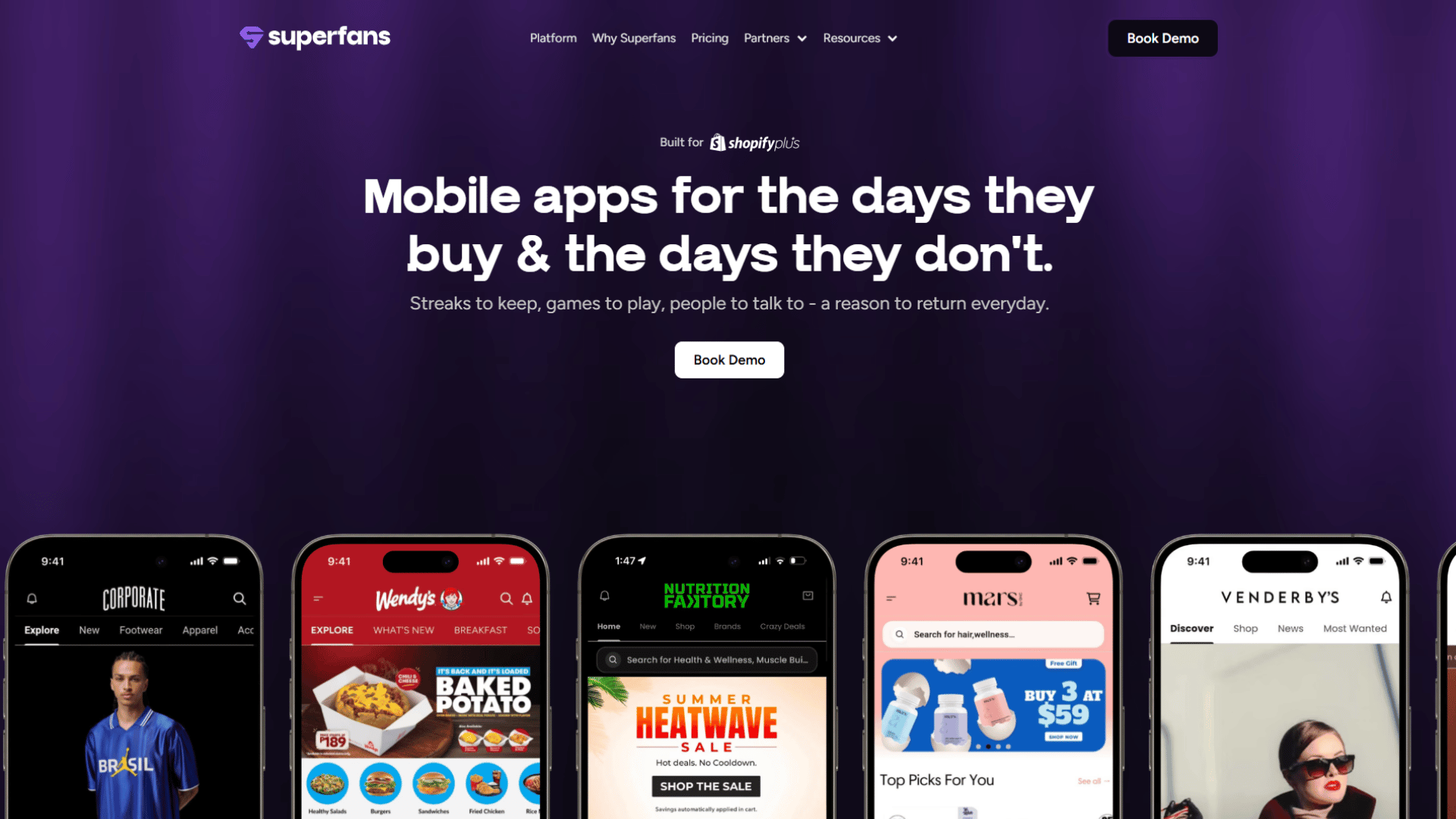
Vajro has rebranded to Superfans.io and repositioned around loyalty, retention, and VIP experiences rather than being a generalist builder.
Pricing
The Unlimited plan is around $1,000 per month, priced on the website by annual revenue band and listed at $1,000 on the App Store. There is no commission, and a 30-day free trial is offered. (Sources: Superfans.io pricing page; Shopify App Store.)
Strengths for fashion
- Loyalty and retention. App-exclusive drops, discounts and shipping, promo widgets, gift-with-purchase, back-in-stock alerts, and loyalty. A 4.9 rating across more than 900 reviews, the largest base in this group and weighted toward boutiques.
- Live selling. Scheduled live streams, which have strong traction among boutique and social-first sellers.
- Breadth. The platform claims the highest integration count here (70-plus) and broad localization (18 languages, 82 currencies).
- Support and migration. The Unlimited plan adds a dedicated design manager, priority support, an account manager, a Slack channel, and a price-lock guarantee. It migrates existing apps and brings current users across.
Limitations to weigh
Superfans is retention-first, not design-first, so a brand chasing a bespoke editorial or luxury interface will find AppMaker more flexible. The full-feature Unlimited plan also sits near $1,000 per month, so the complete toolset is not a budget option even though the Starter tier is.
Best suited for
Community-led and social-first fashion brands, boutiques, and live sellers who want retention mechanics and VIP experiences out of the box.
The Hidden Costs Nobody Puts on the Pricing Page
The subscription is rarely the full bill. Factor in these before you choose:
- Developer accounts: Every builder needs your own Apple Developer account at $99 per year and a Google Play account at a $25 one-time fee, separate from the subscription.
- Commission on app sales: AppMaker and Plobal charge a percentage of in-app sales (1% for AppMaker, 1% to 3% for Plobal by tier). On a high-volume app, this can exceed the base subscription.
- Tier jumps for core features: With Tapcart and Shopney, several features fashion needs (metafields, conditional visibility, live selling, AI push) sit a tier or two above the entry plan.
- One-time build fees: AppMaker's Enterprise plan adds solutioning and development fees for custom work, so the first-year cost runs above twelve months of subscription.
The fair comparison is total cost against expected app revenue, not the number on the pricing hero.
Which App Builder Fits Which Fashion Brand
Match your situation to the builder, then read its section below to confirm.
| Your situation | Strongest fit | Why |
|---|---|---|
| A fully branded, non-templated app with room to add custom logic | AppMaker | Custom themes, developer access, size charts, and conditional merchandising |
| The proven, marketing-rich default and a fast launch | Tapcart | Largest install base in this set, mature AI and campaign tooling |
| An AI-first app with flat, no-commission pricing | Apptile | AI app generation, shoppable video, cross-border support |
| A smaller boutique launching a first app on a budget | Shopney | Lowest serious entry price, in-app chat, strong onboarding |
| An edge built on community, loyalty, and live selling | Superfans (formerly Vajro) | Retention mechanics, live streams, app-exclusive drops |
One constraint applies to the whole category: every option here is Shopify-native, so none will help if you also sell on WooCommerce or another platform.
What to Look For When Choosing a Fashion App Builder
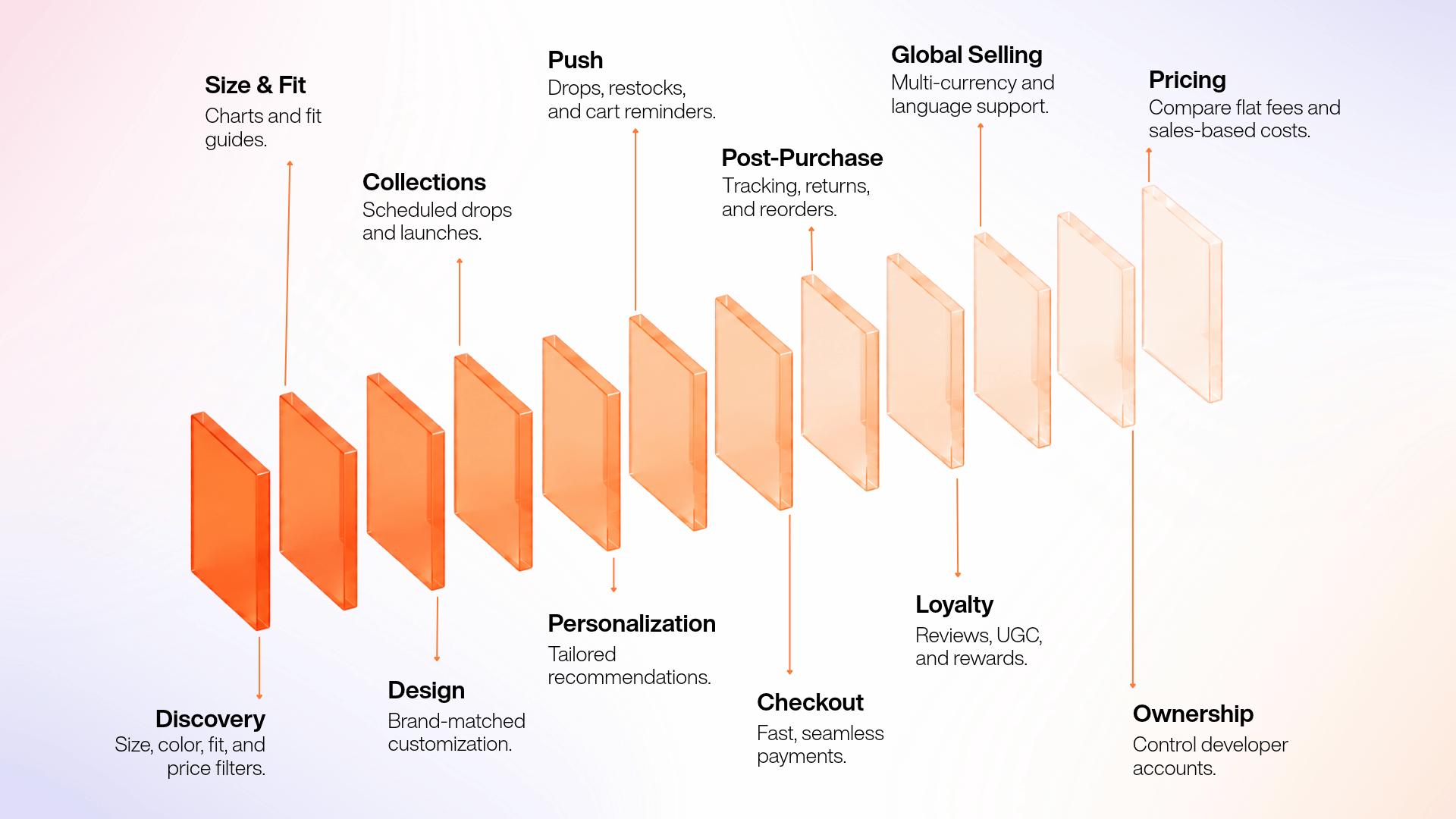
Fashion rewards a narrower set of capabilities, because apparel shoppers behave differently from, say, electronics buyers. They browse wide catalogs, study fit, read reviews, and return often. Here is what to weigh.
- Product discovery and filtering: Apparel catalogs are large and attribute-heavy. Shoppers need to sort and filter by size, color, fit, price, pattern, and offer without friction. XYXX, a premium innerwear and loungewear brand, built its AppMaker app around this, making 191 products under one category navigable through filters across price, type, size, color, pattern, and fit. Clumsy discovery undermines everything after it.
- Size, fit, and merchandising: Size charts, fit guides, and clear variant selection cut returns and lift conversion. House of Rare places a size sheet with a fit chart directly on the product page. Support varies widely, from native size charts to a dedicated integration to nothing at all.
- Design flexibility: Fashion is brand-led, and a luxury label should not look like a template a streetwear brand also used. The range runs from fixed themes with limited styling, through theme-plus-customization, to full code-level control.
- Collections, drops, and scheduling: Seasonal collections and limited drops drive urgency. Look for scheduled publishing, app-only products, and countdown mechanics so a launch goes live at the minute you plan.
- Personalization: Returning shoppers expect relevance. Conditional content, behavior-based recommendations, and segmentation turn a static catalog into a storefront that adapts.
- Push notifications: Push is the retention engine of app commerce, and fashion leans on it for drops, restocks, and abandoned-cart recovery. XYXX runs more than 60 push campaigns a month as a core growth channel (vendor-reported).
- Checkout: The documented average online cart abandonment rate is 70.22%, averaged by Baymard Institute across 50 studies. Checkout friction is one of the most fixable causes, so a fast native checkout with the payment methods your customers already use matters more than most cosmetic features.
- Returns and post-purchase: Apparel carries structurally high return rates because of fit, so order tracking, easy reorder, and a clean returns path count for more here than in most categories. House of Rare offers order history with per-item support, and XYXX allows order tracking without a login.
- Reviews, loyalty, and user-generated content (UGC): Social proof on the product page and a reason to return are disproportionately important in fashion. Check for review-app integrations (Yotpo, Stamped, Judge.me) and loyalty integrations (Smile, LoyaltyLion, Yotpo), since these are how most apps surface ratings, photos, and points.
- International selling: If you ship across borders, multi-currency and multi-language support tied to Shopify Markets is not optional. Builders range from a handful of languages to 80-plus currencies.
- Ownership and lock-in: With any no-code builder, you license the app rather than own its code. What protects you is owning the Apple and Google developer accounts the app and its push subscribers live under. Confirm they are registered in your company's name, not the vendor's, before you launch.
- Pricing model, not just price: A low sticker price is not automatically cheaper. A builder charging a percentage of in-app sales can cost more than a flat-fee rival once volume grows, and less at low volume. Model the total against realistic app revenue.
The Bottom Line
For fashion Shopify brands, the right mobile app builder is the one that matches your budget, your need for design control, and your main growth lever, not the one with the longest feature list. Shopney and Superfans win on accessibility and merchant sentiment for smaller brands. Tapcart is the proven, marketing-rich default for high-growth brands. Apptile suits AI-first teams wanting flat, no-commission pricing. AppMaker leads on brand control, developer extensibility, and fashion-grade merchandising, backed by two verified apparel case studies.
Shortlist two, run a demo with your real catalog, and test size charts, filtering, and push before you decide.
Frequently Asked Questions
What is the best mobile app builder for fashion Shopify brands?
No single tool wins for every brand. AppMaker suits brands wanting fully custom apps with developer access and size-chart merchandising. Tapcart is the most established and best for fast, proven launches. Shopney and Superfans are the most affordable serious options. Apptile suits AI-first brands wanting flat, no-commission pricing. Match the builder to your budget, design needs, and growth lever.
How much does a Shopify fashion app cost in total?
Subscriptions run from about $149 per month (Shopney Silver or Superfans Starter) to $2,850 per month (Tapcart Enterprise+). On top, every builder needs an Apple Developer account at $99 per year and a Google Play account at a $25 one-time fee. Some add commission on in-app sales, such as AppMaker at 1% and Plobal at 1% to 3%, so budget the total against expected app revenue.
Do mobile apps really convert better than mobile web for fashion?
Vendor-reported apparel case studies consistently show apps outperforming mobile web. House of Rare reports 2.5x higher conversion in its AppMaker app, and XYXX reports 5.3x. Apps cut friction, enable push-led retention, and remove the re-login and re-discovery steps that cost mobile-web conversions. Treat specific multiples as directional, since results vary by brand and execution.
Can I handle size charts and fit guides in a Shopify app?
Yes, though support varies. AppMaker natively supports size charts, product metafields, and custom product page templates. Shopney integrates the Kiwi Size Chart app. Tapcart supports Shopify metafields on its Scale plan, which you can use to surface fit information. Confirm the exact size-chart workflow during a trial, since it is a common weak spot.
Who owns my app and my users if I switch builders later?
With every no-code builder, you license the app rather than own its code. What protects you is owning the Apple and Google developer accounts, so register them in your company's name. If you do, you keep your published app listing and push subscribers when you move. Tapcart and Superfans both migrate existing apps and keep your users across the move.
Which builder is best for a small fashion boutique starting out?
Shopney is usually the most sensible starting point, from $149 per month with no commission, including unlimited push, product search and filtering, wishlists, and in-app chat even on the entry plan.
Do these app builders work with WooCommerce or only Shopify?
All five covered here are Shopify-focused, and Tapcart and Apptile are Shopify-only. If you need support beyond Shopify, you will have to look outside this set.
Is a "Built for Shopify" badge important when choosing?
Not in this category. None of the five major builders carry the badge, while some much smaller mobile-app-builder apps do, so using it as a filter would rule out every established option. Judge these tools on verified results, merchant reviews, and fit instead.