























Key Takeaways
- Apptile holds a 4.9 App Store rating across 131 reviews, priced at $249/month (Pro), $499 (Plus), and $999 (Enterprise).
- Merchants leave Apptile mainly for three reasons: AI layouts needing rework, a $249/month floor, and inconsistent support in recent reviews.
- Native apps convert roughly 3x higher than mobile web, and app users view 286% more products per session, per Criteo's commerce data.
- Alternatives run from $99/month (MageNative, OneMobile) to around $1,999/month (VennApps), so switching need not raise your costs.
- AppMaker fits brands that have outgrown a fixed tile system and want open, code-extendable architecture with real-time Shopify sync.
- Tapcart is the most established name, but performance fees on app sales stack on top of its base subscription.
- Cart abandonment averages 70.22% across 50 studies (Baymard), and in-app push is the one recovery channel a mobile website cannot use.
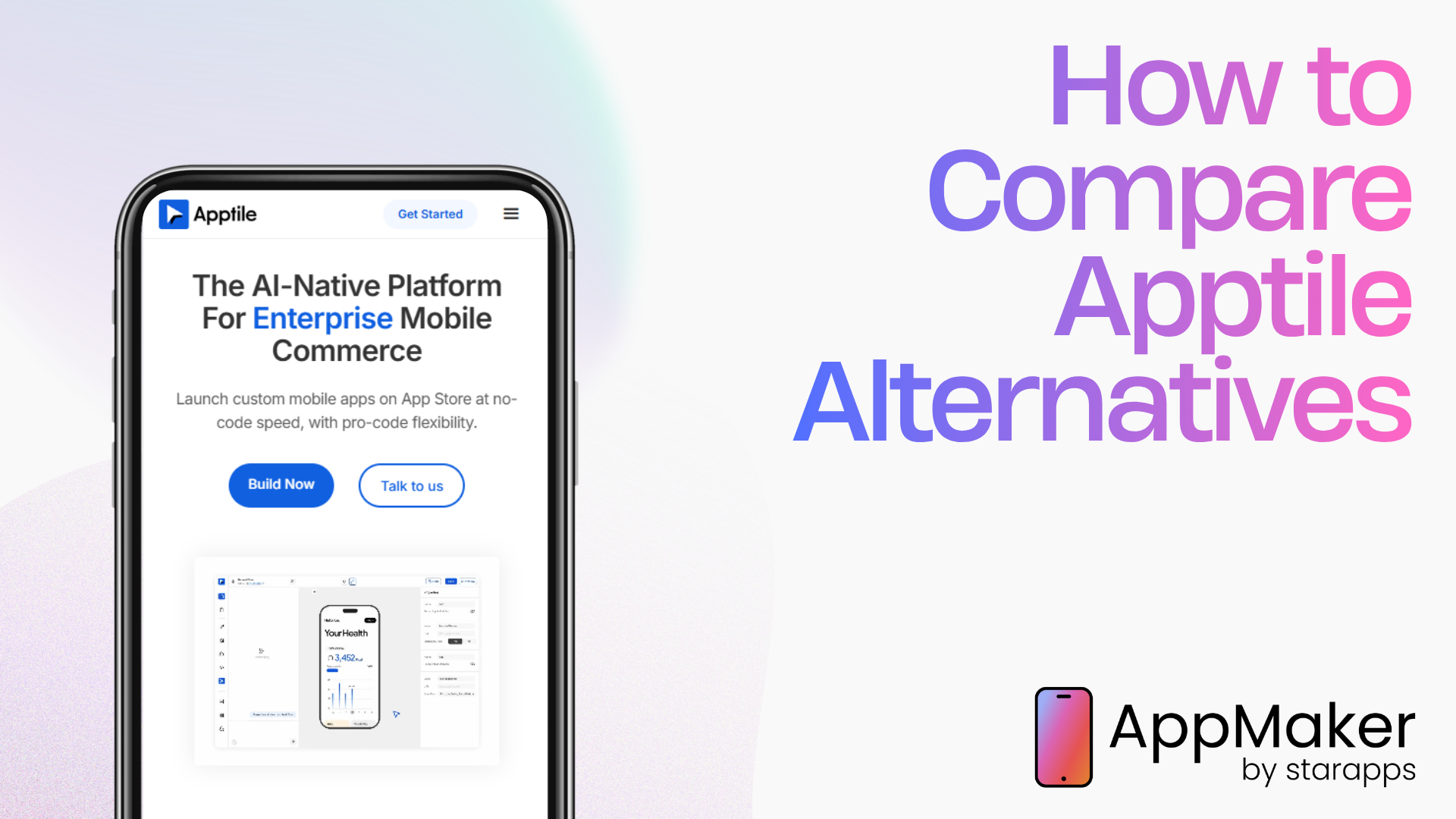
The best Apptile alternative depends on why you're leaving. If the tile editor's AI keeps producing layouts you have to rebuild by hand, you want an open, code-extendable platform. If support went quiet during your last sale, you want a builder with a named account manager. If $249 a month is steep for a channel you're still testing, several tools start at $99 or a free plan. This guide sorts ten of them by exactly that logic.
First, some credit where it's due. Apptile carved out a real niche by betting on AI early: its Tile AI generates app sections from a plain-language prompt instead of making you assemble every screen by hand, and it pairs that with live selling, rich push, and one-click Shopify integrations. For a store that wants to launch fast without a designer, that's a genuine head start, and the market has noticed. Apptile holds a 4.9 rating across 131 reviews on the Shopify App Store at the time of writing.
None of that makes it the right long-term fit for every store. Merchants tend to start looking elsewhere for three reasons: AI layouts that need manual cleanup once the brief gets specific, a $249-per-month entry price that sits well above budget tools, and a handful of recent reviews describing slow or unanswered support. The ten platforms below each answer at least one of those, and every price and rating here was checked against live Shopify App Store listings and official pricing pages in August 2026. Where pricing is custom or usage-based, it says so rather than guessing.
Why Shopify Merchants Look For An Apptile Alternative
Apptile's AI-first approach is a real advantage for a fast launch. The friction shows up later, as a store adds SKUs, layers on merchandising rules, and wants an app that looks unmistakably like its brand.
AI layouts aren't always precise enough: Tile AI drafts app sections from a prompt, which is quick, but merchants report rebuilding those sections by hand once they need something the tile library doesn't generate cleanly. Think of the AI as a fast first draft on top of a drag-and-drop builder, not a finished design engine.
Customization hits a ceiling: A tile system starts faster than a platform built on open application programming interfaces (APIs) and custom code, but it's less flexible once you want a truly bespoke experience or developer access to extend the app. Brands with variant-heavy catalogs or unusual UX requirements tend to find the edges of a component-library approach.
Support has been uneven lately: Most of Apptile's reviews praise responsive help, but its listing also carries recent one-star reviews about tickets left open for weeks, including a merchant who waited two weeks on a basic price-formatting fix. When a bug surfaces mid-sale, response time stops being a footnote.
The entry price isn't "budget."Apptile's paid plans begin at $249 a month, which places it in the middle of the category rather than at the entry level, where rivals start at $99 or offer a free plan.
Integration costs can stack: Some third-party connections are billed as paid add-ons rather than bundled in, so the real monthly cost can climb once you wire in the marketing and support tools you actually run.
What To Evaluate When Comparing Apptile Alternatives
Work through these before you book a single demo.
- Customization depth: Can it go past templated tiles when your brand needs something specific, and is there a route to custom code if you grow into it?
- Support model: Ticket-only, or a named account manager and hands-on onboarding? Given how often support drives merchants off Apptile, weigh this heavily.
- Real-time, two-way Shopify sync: Inventory, pricing, orders, and customer data should update instantly as your catalog changes, ideally without rebuilding the same layout twice.
- AI beyond layout generation: Decide whether you want AI mainly to draft push copy and screens, or for ongoing work like analytics, campaign setup, and real-time personalization. The second bar narrows the field fast.
- True cost, not the sticker: Compare flat fees against revenue-share and success-fee models at your realistic app revenue. A flat plan can undercut a lower headline price once a performance fee kicks in.
- Ecosystem fit: List your stack: email (Klaviyo, Omnisend), reviews (Yotpo, Judge.me), loyalty (Smile.io, Rivo), subscriptions (Recharge). Confirm your must-haves are supported before you commit.
Quick Comparison: Apptile Alternatives At A Glance
| Platform | Best for | Starting price | App Store rating | Multi-platform |
|---|---|---|---|---|
| AppMaker | Custom, code-extendable apps with developer access | $999/mo + 1% of in-app sales | 4.9 | Shopify, BigCommerce, WooCommerce, WordPress |
| Tapcart | Established brands wanting a proven, integration-rich platform | From ~$500/mo + performance fees | 4.6 | Shopify only |
| Vajro (Superfans) | Live selling and community-driven brands | ~$1000/mo | 4.9 | Shopify only |
| Shopney | Fast, affordable launches with strong support | From ~$149/mo (no commission) | 5.0 | Shopify only |
| Plobal Apps | Analytics-led mid-market stores | Custom (quote-based) | 4.8 | Shopify (Built for Shopify) |
| VennApps | Premium, fully managed native builds | ~$1,999/mo | 4.5 | Shopify only |
| MobiLoud | Turning an existing site into an app | From ~$1,499/mo + setup | 5.0 | Any platform, including headless |
| MageNative | Lowest-cost multi-platform conversions | From ~$99/mo (no commission) | 4.7 | Shopify, Magento, WooCommerce, BigCommerce |
| OneMobile | A near-free starting point | Free plan + paid tiers | 4.8 | Shopify (Built for Shopify) |
| Fuego | AI-assisted builds for Shopify Plus brands | $999/mo (no transaction fees) | 4.8 | Shopify only |
Ratings and prices reflect live App Store listings and official pricing pages in August 2026 and shift over time; confirm current numbers before you sign. Every serious builder also needs an Apple Developer account (99/year)andaGooglePlayaccount(25 one-time) on top of the subscription.
The 10 Best Apptile Alternatives For Shopify Stores In 2026
These are ordered by how well they serve the widest range of brands, starting with the most complete all-rounder.
1. AppMaker: best overall Apptile alternative
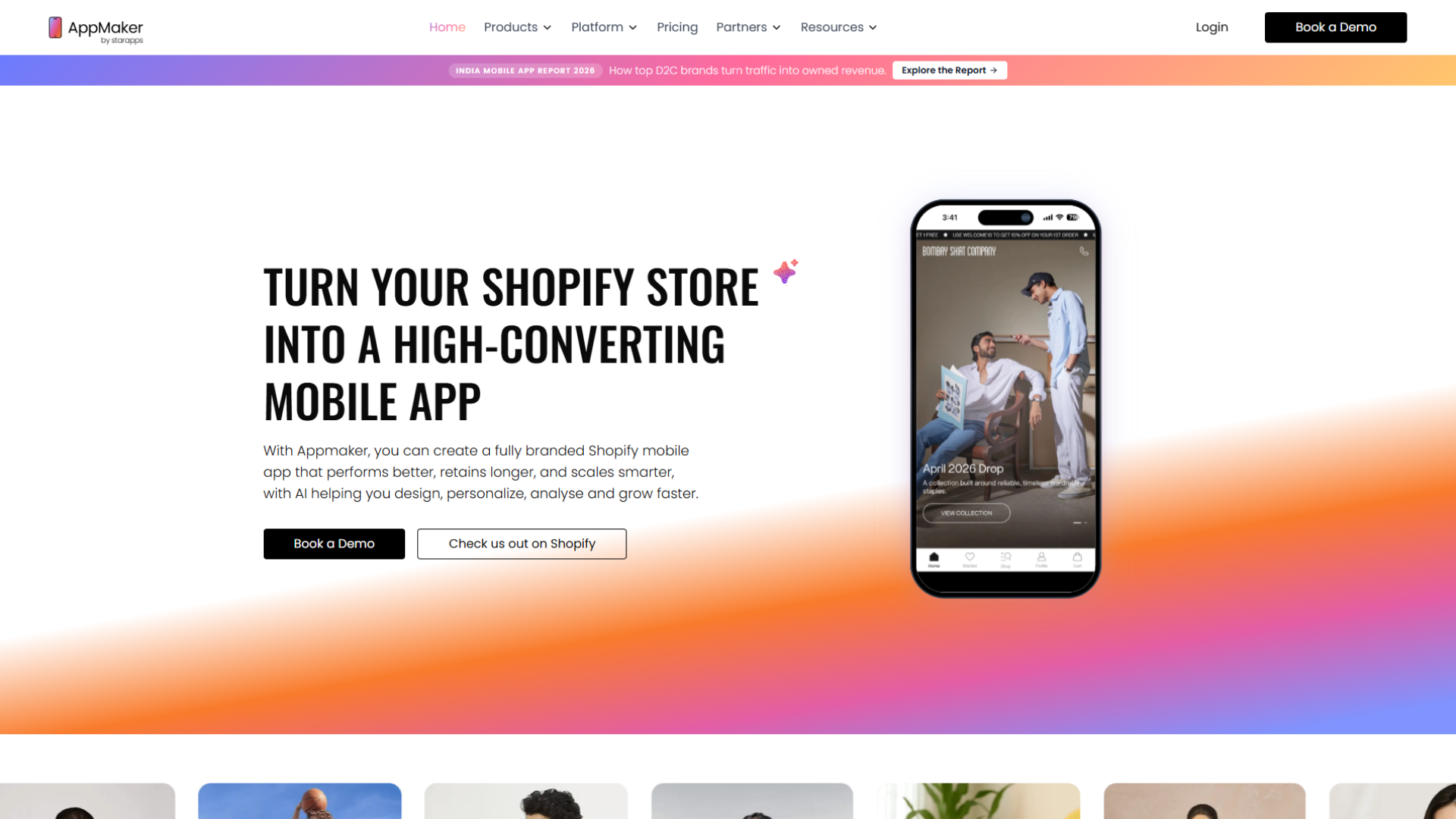
Overview: AppMaker works the opposite way to Apptile's closed tile system. Instead of assembling an app from a fixed component library, it pairs a no-code, drag-and-drop studio with a developer-accessible open architecture, so a marketing team ships daily while engineers extend the app when the work calls for it. Where Apptile's AI mostly generates layouts, AppMaker runs a layered AI stack that reaches into analytics, personalization, and design. It answers the two things merchants most often leave Apptile for: a customization ceiling and support that goes quiet.
Key features:
- Appmaker Studio: a drag-and-drop builder with real-time preview, so non-technical teams lay out home screens, banners, and pages without filing engineering tickets.
- Code Blocks and the Appmaker Open Model: full developer access on the Enterprise tier for custom logic, React-based components, and bespoke screens. You get a real no-code-to-pro-code path in one platform instead of a hard wall.
- Conditional Blocks: personalize the app using Shopify tags, metafields, and customer data, so different segments see different content in the same build. That's a step past what a tile library alone can express.
- A layered AI stack, not one assistant: John AI, an in-app assistant for analytics questions, campaign setup, abandoned-cart flows, and push scheduling; Rubick's AI, which personalizes the in-app experience in real time based on behavior; and Eidolon AI (rolling out), a design engine that turns a screenshot or Figma file into ready-to-use layouts.
- Real-time, two-way Shopify sync for products, orders, and customers, plus unlimited push, scheduled campaigns, and segmentation.
- An extensions library: sticky carts, countdown timers, reorder scrollers, loyalty modules, buy-now-pay-later on the product page, and size charts.
Pros:
- A rare pairing of no-code speed and genuine developer extensibility in one product.
- A practical AI layer that spans design, personalization, and operations, not just push copy.
- A 4.9 App Store rating, with reviewers repeatedly citing hands-on onboarding and responsive support as the exact gap merchants leave Apptile over.
- Reaches beyond Shopify to BigCommerce, WooCommerce, and WordPress.
Cons:
- Pricing sits at the higher end; it's built for brands ready to treat the app as a real channel, not a quick test.
- It isn't currently certified "Built for Shopify," so a few native workflows may need extra configuration depending on plan and setup.
- The Enterprise tier's deepest capabilities, custom APIs and full developer access, involve solutioning and one-time development fees on top of the subscription.
Pricing: Growth is $999/month plus 1% of in-app sales, and covers native iOS and Android apps, real-time Shopify sync, the drag-and-drop studio, Conditional Blocks, default themes, unlimited push, key integrations, and app-success services. Enterprise starts at $2,000/month plus 1% of in-app sales, adding custom themes, full developer access through the Open Model, custom APIs, multi-language and regional support, and a dedicated account manager. Solutioning and one-time development fees are billed separately. View detailed pricing
Best for: Mid-market and scaling direct-to-consumer (DTC) brands, roughly $1M to $10M or more in revenue, that want a brand-specific app rather than a templated one, value deep personalization, and want the option to extend with custom code as they grow. It also suits multi-backend merchants and agencies building for several clients.
Why choose it over Apptile? If your worry about Apptile is "the tile system is fast, but I'll outgrow it," AppMaker removes that ceiling. You keep no-code speed for daily work, gain a real route to custom logic through the Open Model, and get AI that does more than generate a launch screen. For teams that left over slow support specifically, AppMaker's onboarding and account management are among the most consistently praised in the category.
2. Tapcart: best for established brands wanting a proven platform
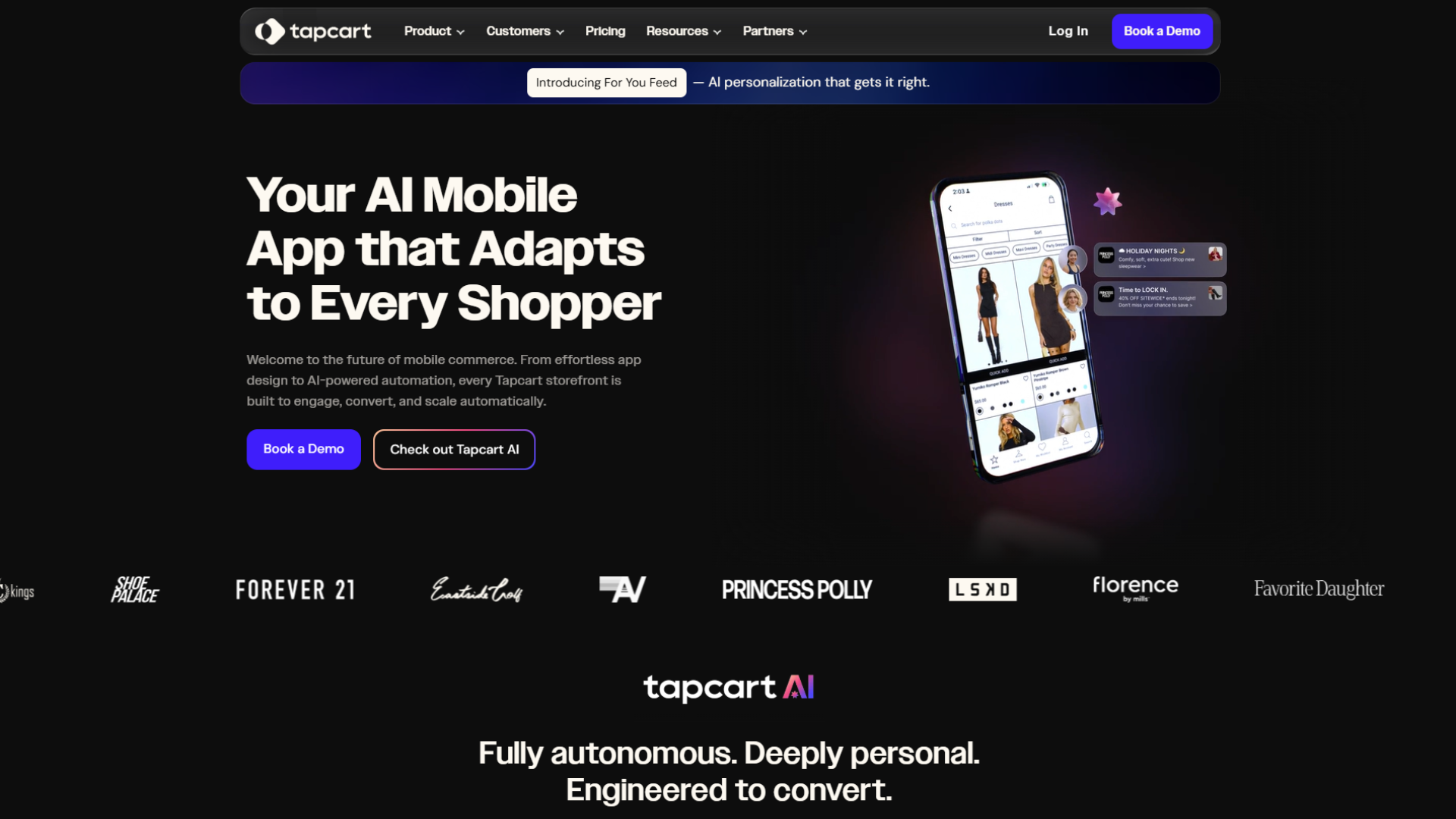
Overview: Founded in 2017, Tapcart is the most widely adopted Shopify mobile app builder and the default safe choice for larger DTC brands. Its block-based App Studio and the deepest integration ecosystem in the category make it dependable, though customization past its blocks needs code.
Key features: A drag-and-drop App Studio with multi-page designs and segment-specific experiences; real-time Shopify sync for products, inventory, pricing, and themes; unlimited push with scheduled campaigns, behavioral triggers, and AI-generated copy through Tapcart AI; more than 100 integrations, the widest library in the space; Server Functions and Custom Blocks for developers; and Capture Kit, a set of QR and marketing tools for driving app installs.
Pros: Stable and battle-tested, with thoroughly QA'd blocks; the largest integration ecosystem, which matters with a deep marketing stack; and strong account management. Where Apptile's recent support reviews are mixed, Tapcart's enterprise support is a consistent strength.
Cons: Premium base pricing plus performance fees that scale with app revenue. No themes or templates, just a block layout, so advanced designs require code, which cuts against the no-code promise. Reviewers report 12-month contracts and friction when canceling. Shopify only.
Pricing: Base plans start around $500/month (Core), with higher Ultimate and Enterprise tiers, plus performance fees tied to app sales and a separate charge for Tapcart AI. Reported figures vary across sources in 2026, so confirm the current structure on Tapcart's own pricing page before committing.
Best for: Established Shopify brands doing $1M or more with an existing stack (Klaviyo, Recharge, and similar) that want a stable, premium app and can absorb success fees that grow with revenue.
Why choose it over Apptile? Tapcart trades Apptile's AI-generated workflow for a mature, manually driven editor and the widest plug-in library around. Merchants who found Apptile's AI output hard to fine-tune often prefer direct block control, and Tapcart's track record and support reliability are its clearest edge.
3. Vajro (now Superfans): best for live selling and community-driven brands
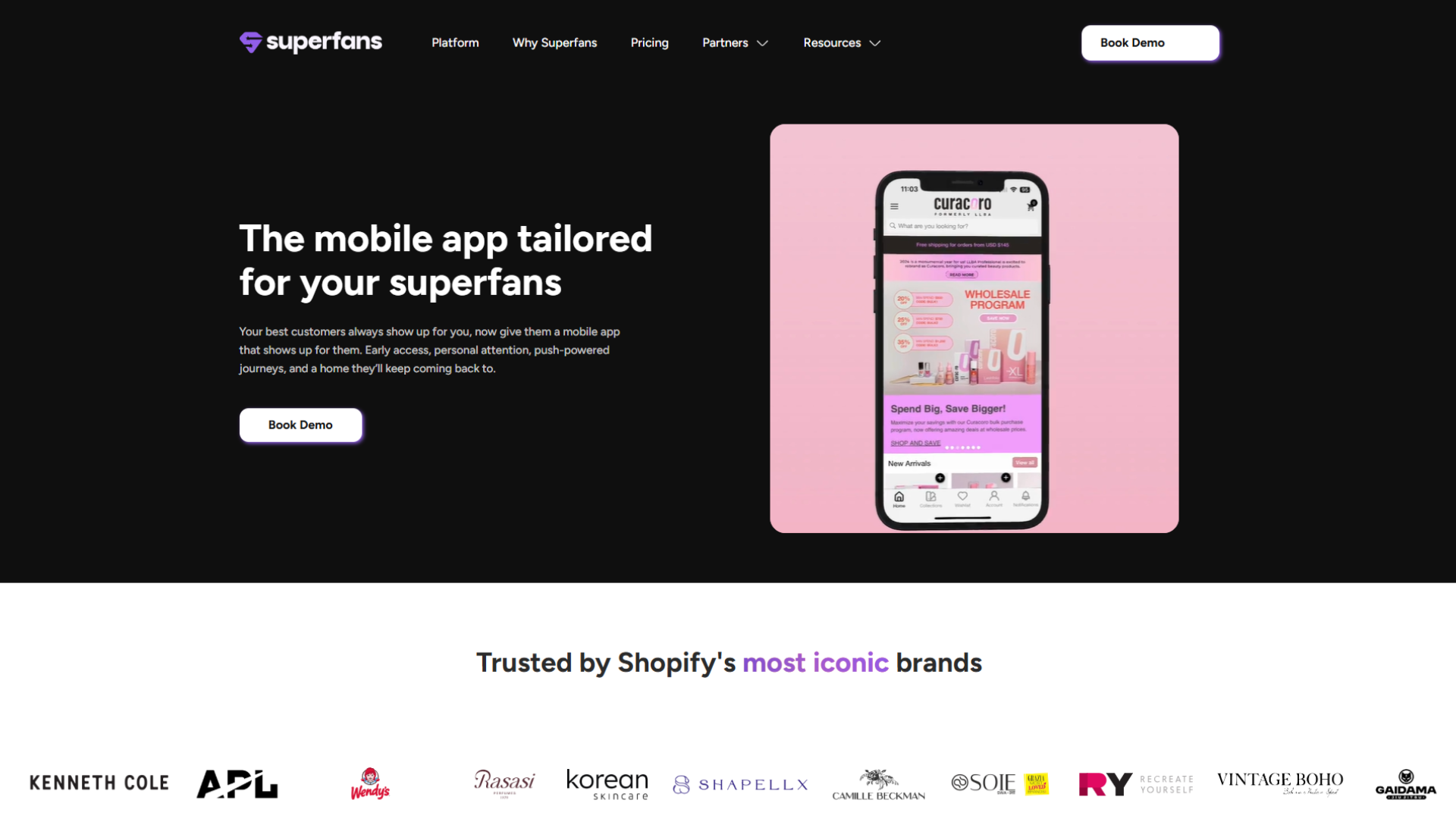
Overview: One of the longest-running builders in the space, recently rebranded to Superfans, Vajro pioneered in-app live-stream shopping. It's the closest functional match for merchants who chose Apptile specifically for live selling but ran into other limits, and it targets brands built on community, drops, and direct interaction: fashion, collectibles, and beauty in particular. It carries a 4.9 App Store rating across more than 870 reviews, one of the largest review bases in the category.
Key features: Built-in live-stream selling on the app and Facebook; a drag-and-drop builder with real-time Shopify sync and a live-preview editor that assembles a launch-ready layout quickly; behavior-based, segmented, unlimited push; more than 70 one-click integrations plus custom blocks through a software development kit (SDK); and 24/7 support with a strong reputation for hands-on onboarding.
Pros: A best-in-class live-commerce feature set, a retention and VIP focus suited to loyal repeat buyers, and a consistently praised support team.
Cons: Anchored to Shopify. Less suited to brands that want a content-rich storefront app over a community and live angle. Some reviewers report integrations behaving unexpectedly, so confirm your specific tools before launch.
Pricing: Plans start around $1000/month, with custom pricing for high-volume Shopify Plus brands. A 30-day free trial is available. Pricing has simplified under the Superfans brand, so confirm current tiers directly.
Best for: Brands whose growth runs on live selling, drops, and community, and who want a builder designed around those moments.
Why choose it over Apptile: If live shopping is the reason you looked at Apptile at all, Superfans centers its whole product on it, and swaps the AI-generation workflow for a faster, more manual live-preview setup.
4. Shopney: best for fast, affordable launches with strong support
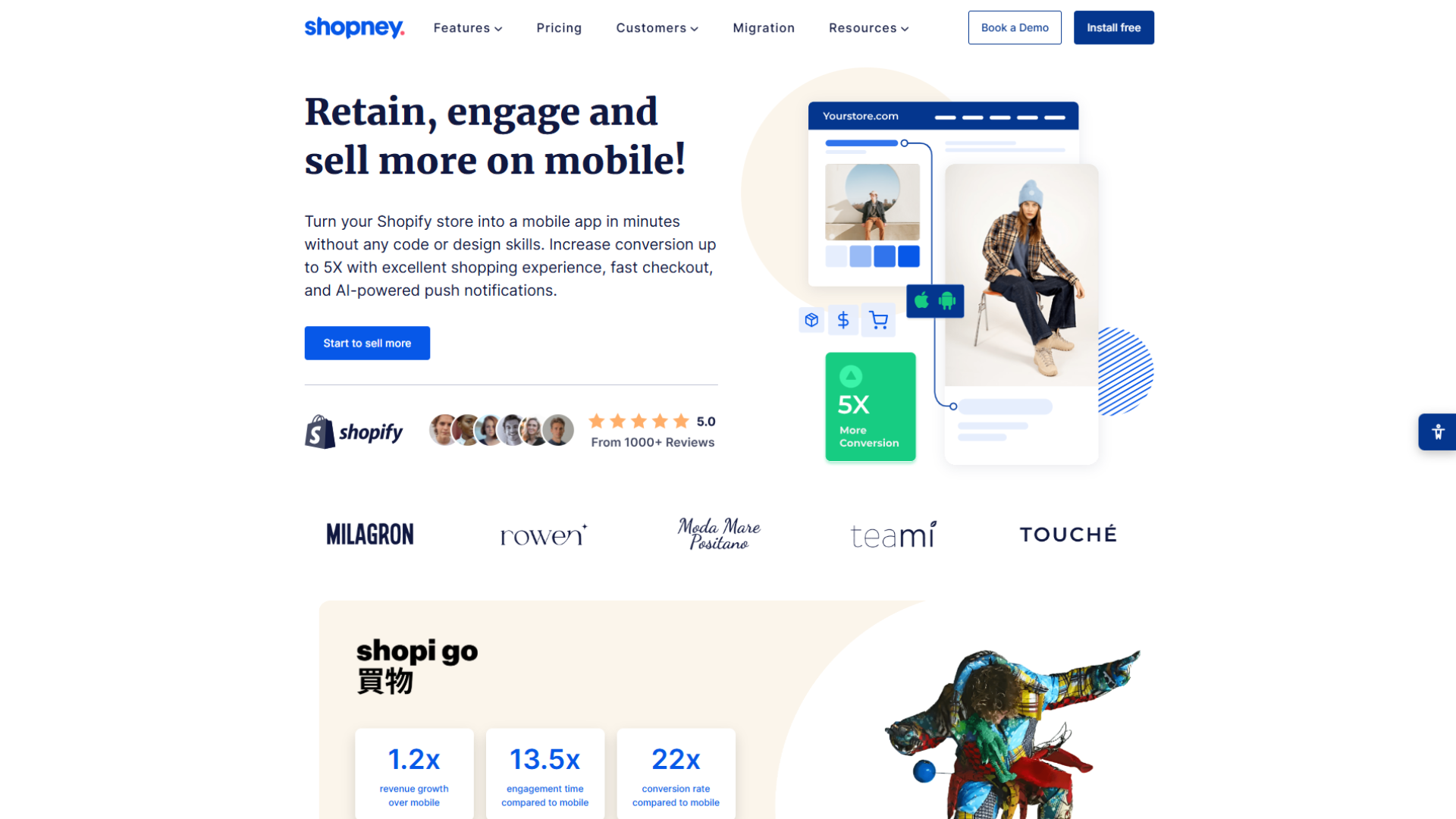
Overview: Shopney focuses on speed, attractive pre-built themes, and ease of use for Shopify and Shopify Plus brands. Since uneven support is a common Apptile complaint, Shopney's emphasis on guided onboarding is worth calling out: it includes in-app chat even on its entry plan, which many rivals reserve for higher tiers.
Key features: A drag-and-drop editor with several polished theme layouts; in-app chat for conversational selling and faster responses; unlimited push on all plans; multi-language support; and Shopney AI to speed up design and setup, with live selling on higher tiers.
Pros: Among the fastest paths to a live, good-looking app, often within a day or two; no sales commissions, just flat pricing; and strong, well-reviewed support with broad multi-language reach. It carries a 5.0 App Store rating.
Cons: Customization can be limited where brands need deeper flexibility, and there's less developer extensibility than open-architecture platforms.
Pricing: Plans start around $149/month and scale up through mid and higher tiers (toward roughly $1,299/month for Plus and high-volume stores), with differences driven by push limits, support level, and features. No commissions.
Best for: Small to mid-sized Shopify brands that want a polished app live quickly, with predictable flat pricing and dependable support.
Why choose it over Apptile? Shopney is faster and cheaper to start with, charges no performance fees, and puts responsive support front and center, hitting the two frictions merchants most often name when leaving Apptile.
5. Plobal Apps: best for analytics-led mid-market stores
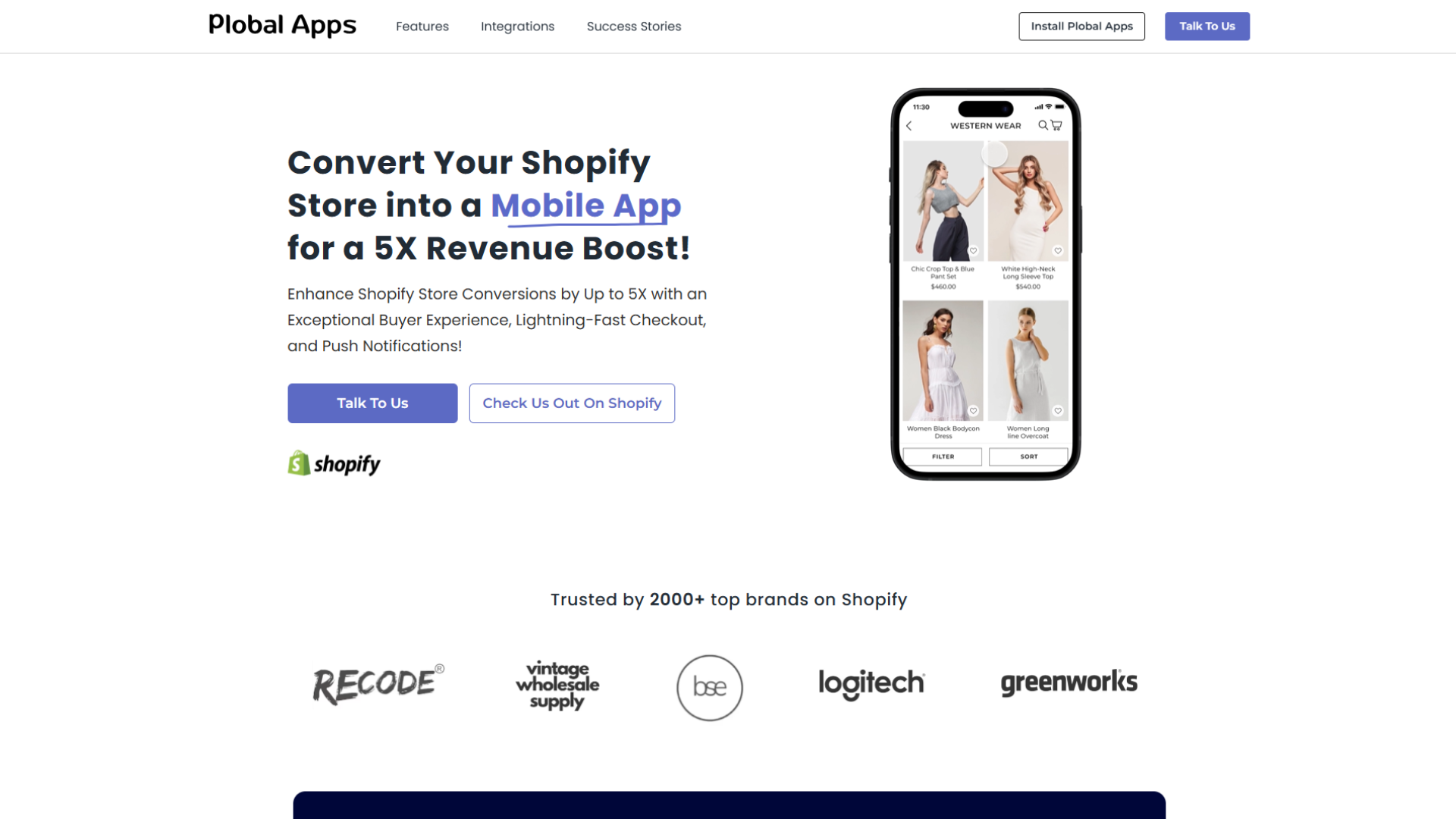
Overview: Plobal Apps converts Shopify stores into branded apps with AI-driven product recommendations and a strong analytics layer. It's one of the more mature players and carries the "Built for Shopify" badge. For merchants who found Apptile stronger on launch design than on ongoing performance visibility, Plobal's analytics depth is the clearer differentiator.
Key features: AI-driven product recommendations based on behavior; segmented, unlimited push; a drag-and-drop builder with brand-alignment options; in-platform analytics covering user behavior, revenue trends, and engagement; and integrations with Klaviyo, Yotpo, Recharge, Gorgias, and other common Shopify tools.
Pros: Strong, decision-useful analytics for data-driven teams; "Built for Shopify" certification and a long, stable track record; and reviewers note direct, tailored support. It carries a 4.8 App Store rating.
Cons: More setup and ongoing management than plug-and-play builders; advanced features and segmentation reserved for upper tiers; and documentation that can be harder to navigate than some rivals'.
Pricing: Custom, quote-based pricing oriented to mid-market and Shopify Plus brands, configured per account through a demo. Some configurations have historically included success-based fees, so confirm the current model directly.
Best for: Data-driven mid-market Shopify stores that want strong analytics and personalization and have the team to run a more involved platform.
Why choose it over Apptile: If detailed in-app analytics and segmented push are your priority, Plobal leans into exactly that, and its "Built for Shopify" status smooths native workflows in a way Apptile's listing doesn't currently claim.
6. VennApps: best for premium, fully managed native builds
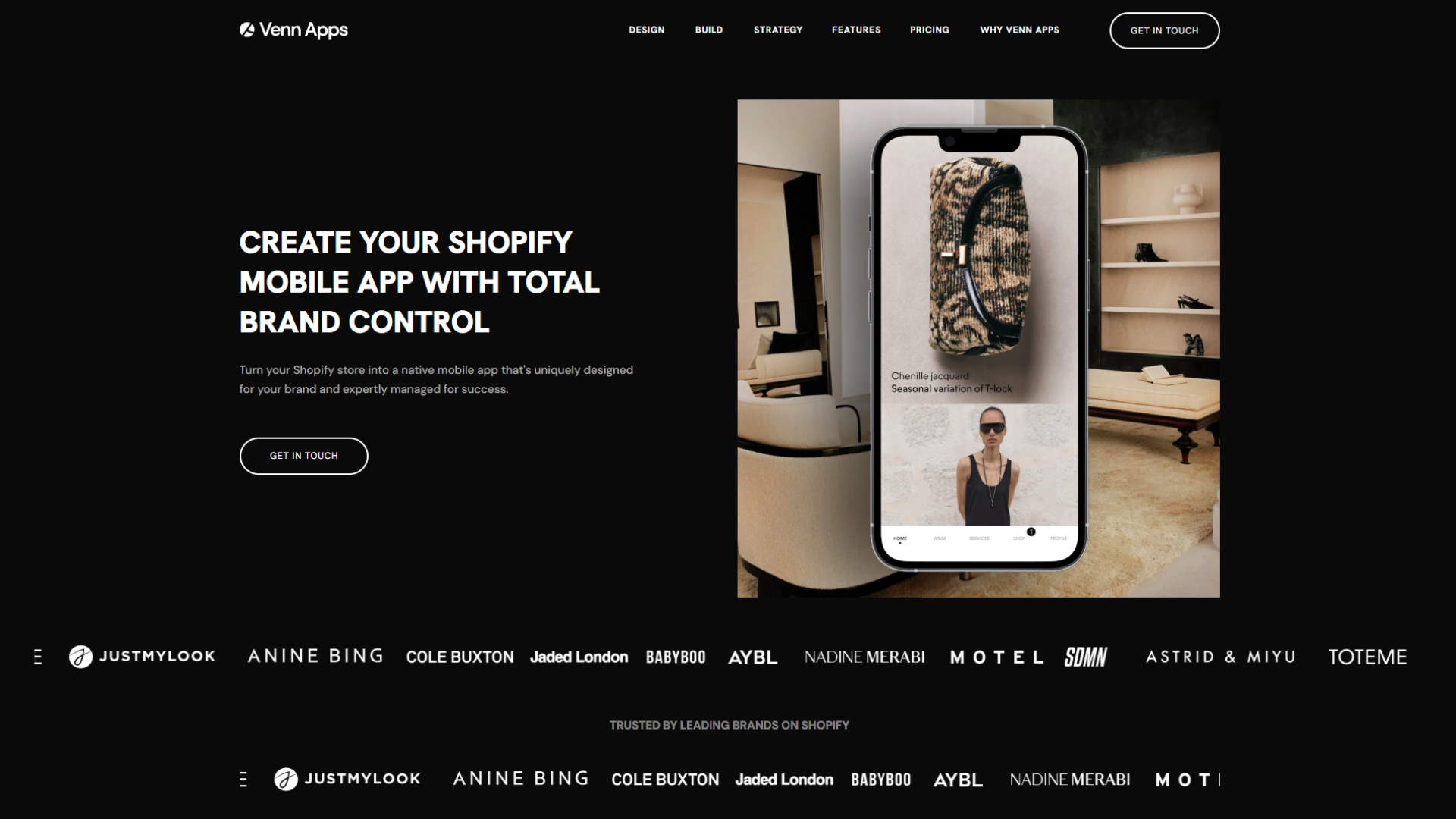
Overview: VennApps sits at the high end here, offering a fully managed, fully native build rather than a self-serve AI or template tool. Higher tiers pair with a dedicated account manager for ongoing strategic guidance, a different support model from Apptile's ticket-based one.
Key features: Fully native iOS and Android builds; extensive third-party integrations including Klaviyo, Yotpo, LoyaltyLion, and Shopify point-of-sale (POS); flat, custom-quoted pricing; and dedicated account management on higher tiers.
Pros: A genuinely managed, native build with strong integration coverage and hands-on account support. Reviews describe it as dependable for the fundamentals.
Cons: A four-figure monthly floor puts it out of reach for smaller stores, and reviewers note it lacks a single standout differentiator the way live-selling or AI-personalization specialists have. It carries a 4.5 App Store rating.
Pricing: Roughly $1,999/month, quoted per account, with a managed build and onboarding.
Best for: Established, well-funded brands that want a fully managed native app and value dedicated account support over self-serve AI tools.
Why choose it over Apptile: If your reason for leaving is support and you'd rather hand the whole build to a team than run a self-serve editor, VennApps offers a managed, native alternative with a dedicated account manager.
7. MobiLoud: best for turning an existing website into an app
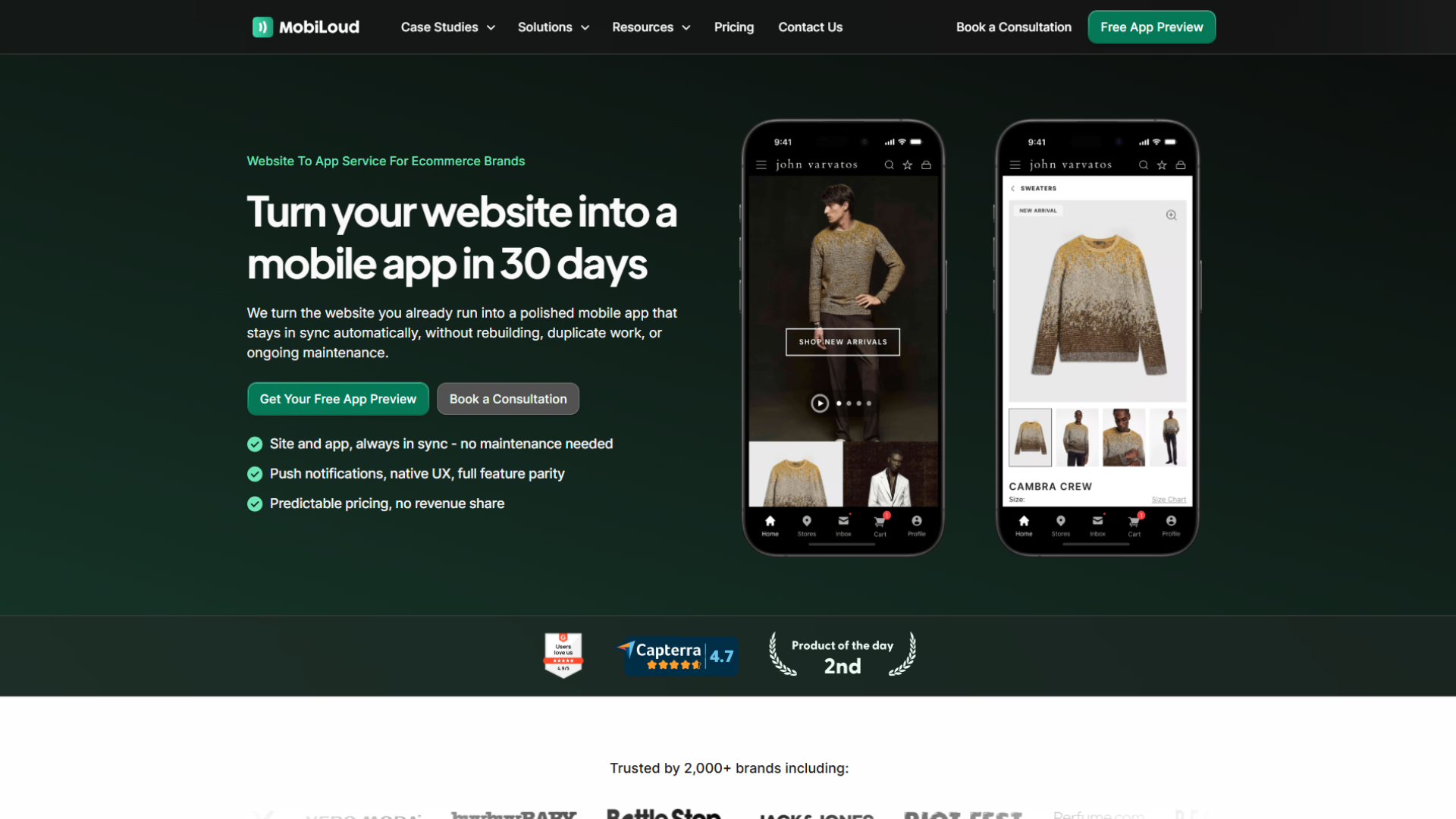
Overview: MobiLoud takes a different route entirely. Rather than rebuilding your store in a block editor, it converts your existing mobile website into iOS and Android apps and manages the whole process. It works with any platform, including headless and non-standard setups, which no tile-based builder can claim.
Key features: Website-to-app conversion that preserves your full checkout, integrations, and experience inside a native shell with native navigation, push, and deep linking; a fully managed build, app-store publishing, and ongoing maintenance; compatibility with non-Shopify and headless stacks (WooCommerce, BigCommerce, Adobe Commerce, Salesforce Commerce Cloud, WordPress, and custom builds); and push via OneSignal or Klaviyo.
Pros: Near-perfect parity with your existing site, minimal internal effort, and platform-agnostic reach including complex custom configurations. It carries a 5.0 App Store rating.
Cons: No drag-and-drop builder, so you can't design app-specific layouts that differ from your site; a higher all-in cost (a substantial setup fee plus a 12-month agreement); and a webview-and-native-shell model rather than a from-scratch native build.
Pricing: The Business plan is a flat $1,499/month plus a one-time setup fee of about $5,000, and includes up to 10,000 monthly active users (overage is $50 per additional 1,000). Enterprise is custom-scoped. Both run as 12-month agreements, and a typical launch takes six to eight weeks.
Best for: Established brands with a well-optimized mobile site that want a high-quality native app without managing it themselves, especially those off Shopify or running headless.
Why choose it over Apptile? If you don't want to rebuild your storefront in any builder and you value a managed, platform-agnostic route, MobiLoud is the cleanest path, and the natural fit when Apptile's Shopify-only, self-serve model doesn't match your stack.
8. MageNative: best for low-cost multi-platform conversions
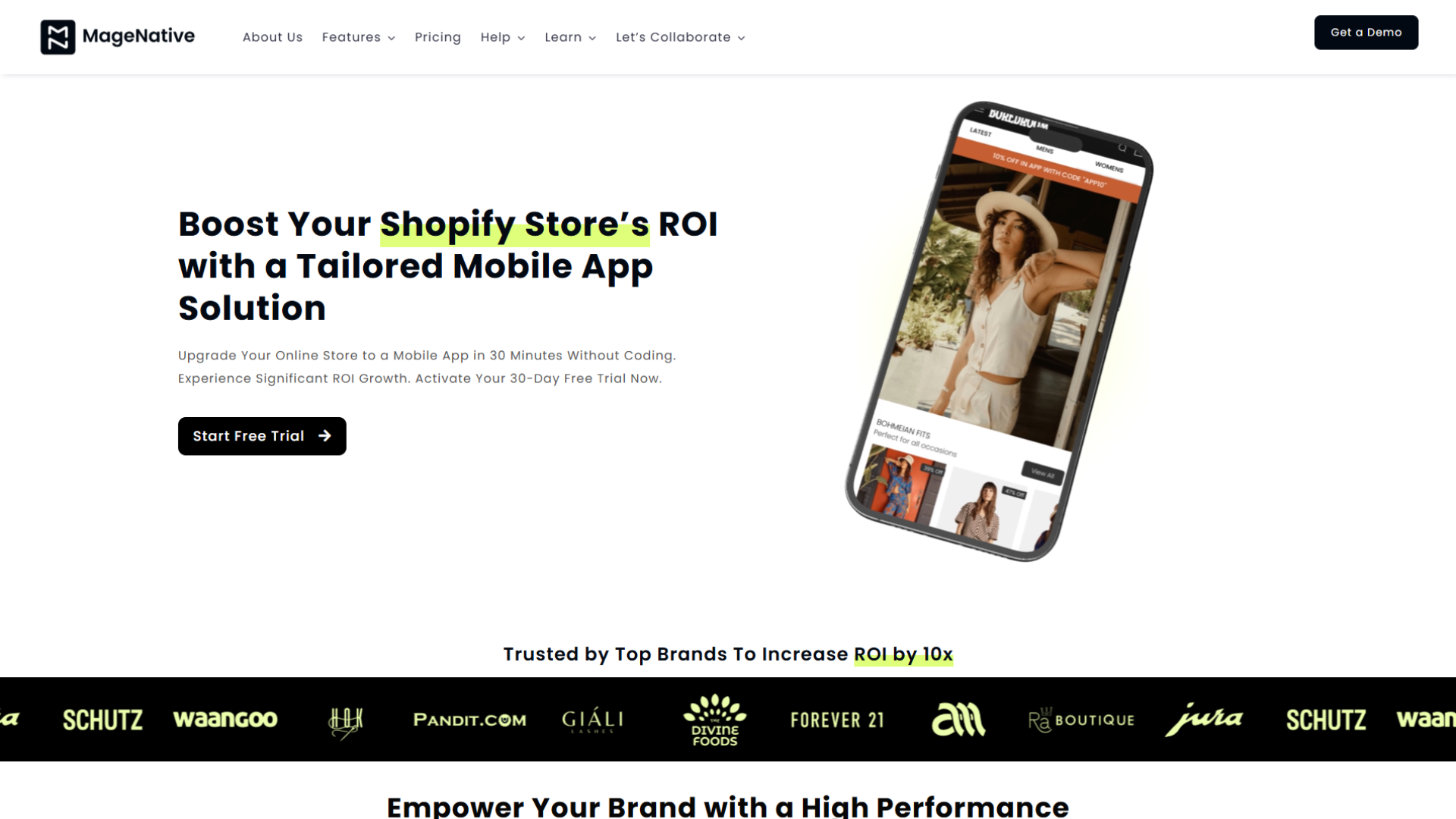
Overview: MageNative offers a no-frills way to turn Shopify (and other platform) stores into native iOS and Android apps. It's a practical pick for budget-conscious brands that want the essentials done reliably, and one of the cheapest serious options here, well below Apptile's entry price.
Key features: A drag-and-drop interface with template libraries; real-time sync and standard Shopify integrations, plus support for Magento, WooCommerce, and BigCommerce; push and core marketing tools; and augmented-reality product viewing, AI product recommendations, and multi-language and multi-currency support on premium plans. It also integrates with the Shopify review ecosystem, including Okendo and Judge.me.
Pros: Very low entry pricing and a gentle learning curve, no success fees at any tier, and multi-platform support with broadly positive reviews for core functionality. It carries a 4.7 App Store rating.
Cons: Lacks the advanced personalization and conversion tooling of higher-end platforms, a narrower integration library with no native Klaviyo or email/SMS connection, and some reviewers report bugs and slow resolution on complex issues.
Pricing: Plans start at about $99/month and scale to roughly $249/month, with custom pricing based on features and support. No success fees.
Best for: Smaller and early-stage brands that want an affordable, multi-platform app and can do without advanced personalization, or lean catalogs testing whether an app-driven channel is worth deeper investment.
Why choose it over Apptile: A far lower-cost, multi-backend alternative for brands whose needs are straightforward and who don't need Apptile's live-selling or AI depth.
9. OneMobile: best for a near-free start in mobile commerce
Overview: OneMobile is among the most budget-friendly Shopify mobile app builders, aimed at stores that want a basic native app and unlimited push without a big monthly outlay. It carries the "Built for Shopify" badge and is well rated on the App Store. It pairs its low cost with its own AI-assisted builder, a genuine option for merchants who liked the idea of AI-generated app creation in Apptile but want it far cheaper.
Key features: A click-based, no-code builder with pre-built themes and blocks; unlimited push even on entry plans; app-promotion tools including Facebook and Google ad integrations and QR templates; and standard Shopify integrations.
Pros: A free plan plus inexpensive paid tiers, one of the lowest barriers to entry of any serious option; unlimited push from the start; and "Built for Shopify" certification with a 4.8 App Store rating.
Cons: Limited advanced customization and personalization, a smaller ecosystem, and less enterprise readiness. Some integrations are billed as paid add-ons, so confirm your stack's total cost.
Pricing: A free plan, with low-cost paid tiers unlocking more features and higher limits, making it one of the cheapest ways to test whether an app moves the needle before investing more.
Best for: Early-stage and price-sensitive Shopify stores validating the channel before committing budget.
Why choose it over Apptile: When budget is the main constraint and you still want AI-assisted building, OneMobile drops the barrier far below Apptile's $249/month floor.
10. Fuego: best for AI-assisted builds for Shopify Plus brands
.png)
Overview: Fuego is the closest like-for-like on Apptile's core idea: generating app screens from a plain-language prompt. It then pushes AI further into day-to-day work, with an editor that applies design changes from text instructions and an assistant that drafts push notification copy. It is built for Shopify Plus and enterprise brands, and its site showcases names such as True Classic, Kitsch, and Gorjana. For merchants who liked Apptile's AI-first approach but want it on a platform geared to larger brands, Fuego is the most direct step up.
Key features: Prompt-to-screen generation (describe a sale screen with tabs and collections, and Fuego builds it); an AI editor that applies changes such as button shapes and spacing across the app from a single text instruction; AI-drafted push copy; native iOS and Android apps with a drag-and-drop builder, 100+ template blocks, one-click checkout, deep linking, and currency and language localization.
Pros: AI that reaches past the first draft, so layouts can be refined in plain language instead of rebuilt by hand; no transaction fees and no annual contracts on either plan, a clear contrast with builders that take a share of app sales or lock you into 12 months
Cons: A small review base (19 reviews on the Shopify App Store), so there's less public evidence to go on than for established rivals. Onboarding is demo-led rather than self-serve, and one one-star review describes a cancelled onboarding call and unanswered follow-up emails.
Pricing: Free to install from the Shopify App Store, with billing starting when you publish to the App Store and Google Play. Starter is $999/month; Enterprise is custom-priced for high-volume Shopify Plus brands. No transaction fees and no annual contracts on either plan.
Best for: Shopify Plus and enterprise DTC brands that want prompt-driven, AI-assisted building on a contract-free platform and have the budget for a four-figure monthly plan.
Why choose it over Apptile? If Apptile's AI generation is what drew you in, but you want AI that also edits and a platform built for larger brands, Fuego is the most direct upgrade. Budget accordingly: its entry price is four times Apptile's $249/month Pro plan.
How To Choose The Right Apptile Alternative For Your Store
Match the platform to your constraints, not to the longest feature list.
- Leftover support quality: Shopney or VennApps. Shopney puts in-app chat and hands-on onboarding on every plan; VennApps assigns a dedicated account manager on higher tiers.
- Leftover customization limits: AppMaker, an open, code-extendable platform with a no-code-to-pro-code path through the Open Model.
- Still want AI-generated design, just cheaper: OneMobile, a similar AI-assisted concept starting well below Apptile's entry price.
- Want Apptile's prompt-to-screen AI on a Shopify Plus-grade platform: Fuego, the closest like-for-like, with no transaction fees or annual contracts.
- Live selling is non-negotiable: Vajro (Superfans), the closest functional match with a faster manual setup.
- You need analytics depth: Plobal Apps, built around in-app performance measurement.
- You're off Shopify or running headless: MobiLoud (any platform) or MageNative (Magento, WooCommerce, BigCommerce). Apptile can't serve these stacks.
- You want the lowest possible entry cost: MageNative or OneMobile, both around $99/month or a free plan.
A quick way to shortlist: before you book a demo, write down three things. Your platform (Shopify or not), your realistic monthly app revenue, and whether you'll have developer time. Those three answers rule out most of this list and point to the two or three worth testing. Every serious option offers a free trial, so pilot before you commit.vb
Which Builder Should You Pick?
Apptile's AI-first, tile-based approach is a fast way to launch, and its 4.9 rating reflects real merchant satisfaction. But for stores that need tighter customization, steadier support, or AI that keeps paying off past launch, the category has stronger fits. The ten here cover nearly every reason to move: deeper customization and developer access (AppMaker), a proven integration-rich incumbent (Tapcart), live selling (Vajro/Superfans), AI-assisted building for Shopify Plus brands (Fuego), responsive support (Shopney), analytics depth (Plobal), multi-platform reach (MobiLoud, MageNative), or a lower entry price (OneMobile, MageNative).
If your store has hit Apptile's customization ceiling, AppMaker is built for brands that want open, extendable architecture rather than a fixed tile system, with real-time Shopify sync, an AI stack that goes well past layout generation, and a no-code-to-pro-code path that grows with the app. Book a demo to see what your store's app could look like before you commit.
Frequently Asked Questions
What is the main difference between Apptile and AppMaker?
Apptile uses an AI-generated, tile-based layout system on a fixed component library, which launches fast but can need manual rework for specific designs. AppMaker is an open, code-extendable platform with real-time Shopify sync, Conditional Blocks for personalization, and a layered AI stack (John AI for operations, Rubick's AI for personalization, Eidolon AI for design) that supports ongoing analytics and personalization, not just the initial layout. AppMaker also works beyond Shopify, on BigCommerce, WooCommerce, and WordPress.
Why do merchants switch away from Apptile?
The common reasons are AI layouts that fall short of specific design needs and require rework, reports of inconsistent support in recent App Store reviews, a $249/month entry price that's higher than budget alternatives, and integration add-on costs that can push the real monthly spend above the headline subscription.
Which Apptile alternative is closest in features?
Fuego is the closest match. Like Apptile, it generates app screens from a plain-language prompt, and it extends AI into a design editor that applies changes from text instructions and into drafting push notification copy. The differences are market and price: Fuego is built for Shopify Plus and enterprise brands, starting at $999/month with no transaction fees, against Apptile's $249/month entry plan.
Which Apptile alternative is best for small Shopify stores?
MageNative and OneMobile are the most budget-friendly, both starting around $99/month (OneMobile also has a free plan). Both suit stores testing whether an app-driven channel is worth deeper investment before moving to a pricier platform.
Does Apptile still offer live selling, and which alternatives match it?
Yes, Apptile includes live selling on its app and Facebook. Vajro (now Superfans) is the closest alternative, built specifically around real-time streamed sales rather than treating them as an add-on.
How much does Apptile cost in 2026?
Apptile's paid plans start at $249/month (Pro), rising to $499/month (Plus) and $999/month (Enterprise), billed in US dollars. It's free to install, and you pay when you're ready to go live. Some third-party integrations are billed as paid add-ons on top of the subscription.
Is Tapcart a good Apptile alternative for design control?
Yes. Tapcart's drag-and-drop App Studio gives teams direct, manual control over layout, which many merchants find more predictable than AI-generated design. The trade-offs are premium pricing (from about $500/month), performance fees on app sales, and the fact that advanced designs beyond its blocks require code.
Which Apptile alternative offers the most reliable customer support?
Shopney and VennApps are both frequently highlighted: Shopney through in-app chat on every plan and hands-on onboarding, VennApps through dedicated account managers on higher tiers. AppMaker is also consistently praised for onboarding and account management.
Can Shopify stores keep their existing app design when switching from Apptile?
Migration varies by platform. Most builders here, including AppMaker, Vajro/Superfans, and Shopney, offer migration support or guided onboarding to help you rebuild the layout rather than starting from scratch. Confirm the specifics, including user data, reviews, and push subscribers, in writing before switching.
Is AI-generated app design actually better than manual customization?
It depends on your needs. AI layouts speed up the initial launch, which is Apptile's core strength. But stores with specific brand or merchandising requirements often find that manually controlled or code-extendable platforms give more precise, lasting results as the app matures. The strongest platforms, like AppMaker, combine both: AI for speed plus a no-code-to-pro-code path for control.
Do these app builders work with platforms other than Shopify?
Most are Shopify-only. The exceptions here are AppMaker (Shopify plus BigCommerce, WooCommerce, and WordPress), MageNative (Shopify, Magento, WooCommerce, and BigCommerce), and MobiLoud (any platform, including headless and custom builds). Apptile itself is Shopify-only, so if you're not on Shopify, your shortlist narrows to these three.