

























Key Takeaways
- AppMaker leads the alternatives: no-code plus developer access, a three-part AI stack, flat pricing at ~$999/mo plus 1%, and reach beyond Shopify.
- Cheapest options: Tapday (around $99/mo), then MageNative (~$99) and Shopney (~$149), several with no sales commission.
- Off Shopify, options narrow fast: only web-to-app conversion (MobiLoud, AppBuzz) or a multi-platform builder (MageNative) works. The rest are Shopify-exclusive.
- Match specialists to your model: Vajro/Superfans for live selling, Fuego for AI social commerce, Plobal for analytics, VennApps for bespoke, commission-free Shopify apps.
- Model real cost, not sticker: at $50,000/mo in app sales, a 2.5% success fee adds $1,250 monthly on top of the base.
- Three questions settle it: your platform, your realistic monthly app revenue, and whether you have developer time. Then test the free trials.
Disclosure: this is AppMaker's blog. The ranking reflects that; the pricing and trade-offs are checked against public sources so you can verify them yourself.
Tapcart is the most widely adopted mobile app builder in the Shopify ecosystem, and it earns that position. Founded in 2017, it pairs a heavily tested block editor with the largest integration catalogue in its class, and reviewers routinely single out its account management. If you run an established DTC brand, you want a proven, low-crash app, and you can absorb premium pricing; Tapcart does what it promises.
Leading the category does not automatically make it the right fit for your store. Teams usually start looking for a Tapcart alternative for a handful of recurring reasons, and it is worth being precise about them because each one points to a different replacement.
- Costs that climb on two fronts: Paid plans open at roughly $500 per month (Core), but Tapcart adds a success fee on top, around 2.5% of in-app sales on Core and Ultimate and about 1.75% on Enterprise. Your bill grows in step with your app's success. At $50,000 per month in app sales, that 2.5% cut adds $1,250 on top of the base subscription every month.
- Long commitments and awkward exits: Multiple merchants report 12-month contracts and difficulty leaving mid-term, a sizable bet to place before an app has proven it can pay for itself.
- A blocks-only approach to design: There are no themes or templates, only Tapcart's block layout. Going further means writing code, which cuts against the no-code promise, and apps on lower tiers can end up looking alike. Independent reviewers estimate you can recreate roughly 85% of your mobile look and feel inside the builder, not 100%.
- Gated integrations and features: Lower plans cap how many integrations you get, and some connections carry prerequisites (ReCharge, for example, needs ReCharge Pro), so what you can build depends heavily on your tier.
- Shopify and nothing else: Run BigCommerce, Adobe Commerce (Magento), WooCommerce, or a headless setup, and Tapcart is a non-starter.
This guide compares the strongest alternatives on the things that actually drive a decision: features, pricing, scalability, integrations, ease of use, and ideal use case. Every price and rating below was checked against official pricing pages, Shopify App Store listings, and current third-party reviews as of mid-2026. Where pricing is custom, usage-based, or reported inconsistently, that is stated plainly rather than guessed. One pattern worth knowing before you read: nearly every serious Tapcart rival is also Shopify-native, so "works beyond Shopify" is a genuine differentiator wherever it appears. The platforms are ordered by how complete and flexible they are across the widest range of brands, starting with the most capable all-rounder.
Quick Comparison: Tapcart Alternatives at a Glance
| Platform | Best for | Starting price | AI depth | Beyond Shopify? | Enterprise ready | Shopify rating |
|---|---|---|---|---|---|---|
| AppMaker | Custom, scalable apps with developer access | ~$999/mo + 1% | Strong (John, Rubick's, Eidolon) | Via AppBuzz (BigCommerce, Woo, Wix, custom) | Yes | 4.9 |
| VennApps | Bespoke native design for premium DTC | $1,999/mo (no commission) | Moderate | No | Yes | 4.9 |
| Fuego | Shopify Plus, AI-native social commerce | ~$999/mo + custom | Strong (generative) | No (Shopify Plus) | Yes | Not published |
| Vajro / Superfans | Live selling and community | ~$1000/mo | Moderate | No | Mid | 4.9 |
| Shopney | Fast, affordable launches with strong support | ~$149/mo (no commission) | Moderate (Shopney AI) | No | Mid | 5.0 |
| MobiLoud | Turning an existing site into an app | $1,499/mo + setup | Minimal | Yes (any platform) | Yes | 5.0 |
| Plobal Apps | Analytics-led mid-market stores | Quote-based (historically ~$199/mo) | Moderate | No | Mid | 4.8 |
| Apptile | AI-built, budget-flexible customization | ~$224/mo (usage-based) | Strong (Tile AI) | No | Mid | High |
| Tapday | Affordable, support-heavy launches | ~$99/mo (no commission) | Moderate (AI-assisted) | No | Mid | 5.0 |
| MageNative | Low-cost multi-platform conversions | ~$99/mo (no commission) | Basic | Yes (Magento, Woo, BigCommerce) | Mid | Not published |
Ratings reflect Shopify App Store and review-site sentiment in mid-2026 and can shift over time. Pricing is verified where a public figure exists; several vendors gate or vary pricing, which is flagged in each entry.
The 10 Best Tapcart Alternatives for Shopify Mobile Apps
1. AppMaker: Best overall Tapcart alternative
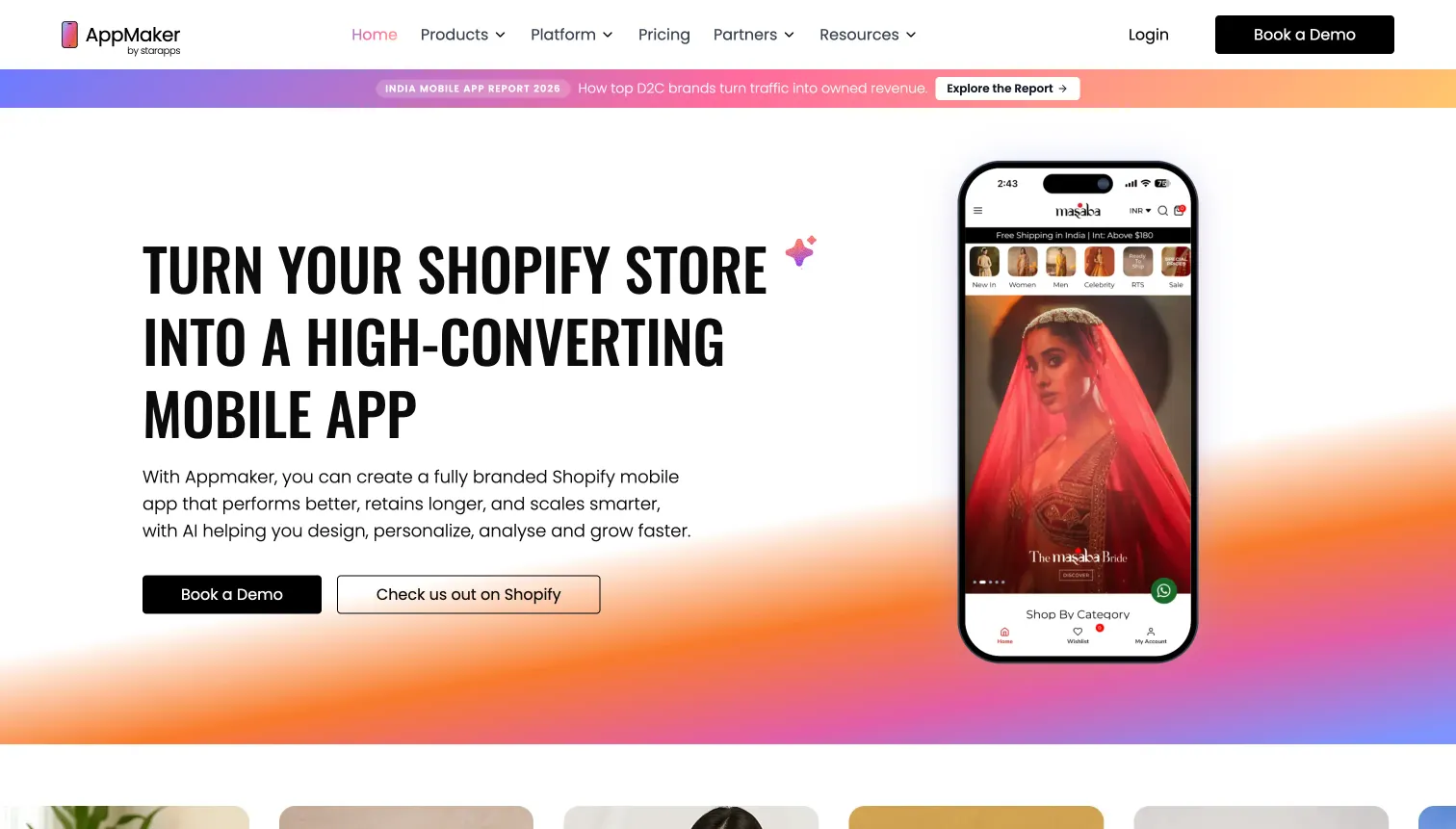
Overview. AppMaker is a mobile app platform built for Shopify brands that have outgrown templated builders and want real control over design, logic, and personalisation, without commissioning a six-figure custom build. It pairs a no-code drag-and-drop studio with a developer-accessible open architecture, so a marketing team can ship daily while engineers extend the app when the work calls for it. Of every option here, it addresses the reasons brands leave Tapcart most directly: comparable native quality, more design freedom, flatter pricing, and reach beyond a single commerce backend.
Key features
- Appmaker Studio: a drag-and-drop CMS with real-time preview for home screens, banners, scrollers, and timed content, so non-technical teams launch campaigns without engineering tickets.
- Code Blocks and the Appmaker Open Model: full developer access on the Enterprise tier for custom logic, React-based components, custom APIs, and bespoke screens, giving you a genuine no-code-to-pro-code path inside one platform.
- Conditional Blocks: personalise the experience using Shopify tags, metafields, and customer data, so different segments see different content in the same app.
- A layered AI stack rather than a single assistant: John AI, an in-app executive assistant for analytics questions, campaign setup, abandoned-cart flows, and push scheduling; Rubick's AI, which personalises the in-app experience in real time based on shopper behaviour; and Eidolon AI (rolling out), a design engine that turns a screenshot or Figma file into ready-to-use layouts.
- Native commerce plumbing: real-time two-way Shopify sync for products, orders, and customers, unlimited push notifications, scheduled campaigns, segmentation, and 160+ integrations.
- An extensions library: sticky carts, countdown timers, reorder scrollers, loyalty modules, buy-now-pay-later on the product page, and size charts.
Pros
- A rare combination of no-code speed and true developer extensibility in one product.
- A practical, multi-purpose AI layer that spans design, personalisation, and operations rather than only writing push copy.
- A 4.9 rating on the Shopify App Store, with reviewers repeatedly citing hands-on onboarding and responsive support.
- Used by recognisable scaling brands, including boAt, Jockey India, Levi's India, mCaffeine, SuperTails, XYXX, Bombay Shirt Company, and House of Rare, which reports more than 2 million app downloads and a 2.5x conversion rate.
Cons
- Pricing sits at the higher end of the category; it is built for brands ready to treat the app as a real channel, not a quick experiment.
- It is not currently certified Built for Shopify, so a few Shopify-native workflows may need extra configuration depending on plan and setup.
- The Enterprise tier's deepest capabilities, such as custom APIs and full developer access, involve solutioning and one-time development fees on top of the subscription.
Pricing. Verified against AppMaker's pricing page: Growth runs $999 per month plus 1% of in-app sales and includes native iOS and Android apps, real-time Shopify sync, the drag-and-drop CMS, Conditional Blocks, default themes, unlimited push, key integrations, and app-success services. Enterprise starts at $2,000 per month plus 1% of in-app sales and adds custom themes, full developer access through the Open Model, custom APIs and deep integrations, multi-language and regional support, and a dedicated account manager, with solutioning and one-time development billed separately.
Best for. Mid-market and scaling D2C brands (roughly $1M to $10M+ in revenue) that want a brand-specific app rather than a templated one, value deep personalisation, and want the option to extend the app with custom code as they grow. It also suits multi-backend merchants and agencies building for several clients.
Why choose it over Tapcart? Three things. First, pricing philosophy: a flat fee plus a small 1% share, instead of a 2.5% success fee that grows as your app succeeds. Second, real developer freedom through the Open Model, versus Tapcart's block-only model where anything advanced needs code. Third, reach beyond Shopify: while the flagship platform is Shopify-first, AppMaker's sister product, AppBuzz, converts stores on BigCommerce, WooCommerce, Wix, and custom stacks into apps, so the family is not locked to one backend the way Tapcart is.
In one line: the most complete Tapcart alternative for brands that want native performance plus genuine room to customize and scale.
2. VennApps: Best for bespoke native design for premium DTC
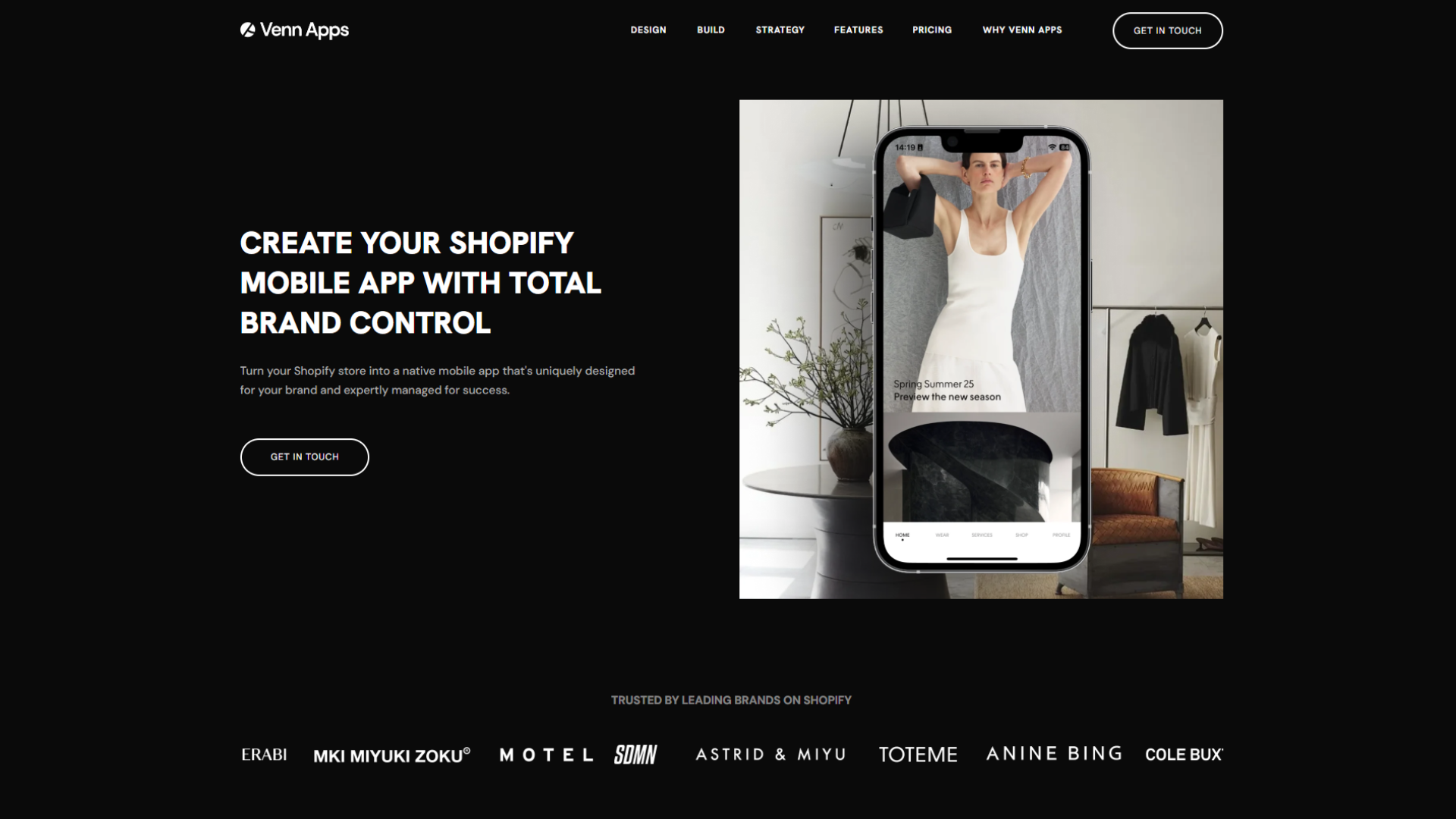
Overview. VennApps is a managed design-and-development platform built exclusively for Shopify, with a strong following among fashion, beauty, and lifestyle DTC brands. Rather than a purely self-serve template system, it pairs a drag-and-drop builder with a dedicated designer and a fully managed build, turning your Shopify store, including metafields and custom objects, into genuinely native iOS and Android apps. It ships truly native apps built in Swift and Kotlin (no web wrappers), and beyond the build it offers ongoing strategic support and growth guidance.
Key features
- Fully native iOS and Android apps built in Swift and Kotlin, tailored to brand identity rather than assembled from a shared template.
- A dedicated designer and managed build, so your app mirrors your brand precisely with no cookie-cutter layouts and minimal internal effort.
- Real-time Shopify sync with conditional tagging and metafields, so the app carries the same dynamic functionality as your website.
- Proprietary middleware that brings your existing third-party integrations (Klaviyo, Yotpo, ReCharge, LoyaltyLion, Shopify POS) into the app.
- Unlimited push notifications with analytics, plus app-exclusive drops and products.
- Full localisation: multi-currency, multi-language, and clone/expansion-store support for international brands.
Pros
- Excellent native performance and UX, particularly for content-driven fashion and beauty brands, with a bespoke design rather than a templated one.
- A zero-commission pricing model, so you keep all app revenue.
- Consistently praised, hands-on support that reviewers describe as working "like an extension of our team."
Cons
- Shopify only, so it is off the table for multi-platform or headless stacks.
- The managed model means less pure self-serve control, and the four-figure floor only makes sense for established brands.
- Integrations run through its middleware rather than a self-install marketplace, so confirm your specific tools during onboarding.
Pricing. Verified against VennApps' Shopify App Store listing: Pro is $1,999 per month (dedicated designer, unlimited standard integrations, homepage/shop-menu/custom-page editor, unlimited push with analytics, app-exclusive drops), and Enterprise is $2,999 per month (custom design modules, unlimited premium integrations
Best for. Fashion, beauty, and lifestyle DTC brands living entirely on Shopify that want a bespoke, agency-grade native app delivered for them, and value dedicated design and managed execution over building it in-house.
Why choose it over Tapcart? Zero commission instead of a scaling success fee, plus fully native Swift/Kotlin builds and a dedicated designer rather than a block-only editor. The trade-off is a higher, four-figure entry point and a managed rather than fully self-serve workflow.
In one line: a bespoke, design-led, commission-free pick for premium Shopify brands that want native quality delivered for them.
3. Fuego: Best for Shopify Plus brands wanting AI-native social commerce
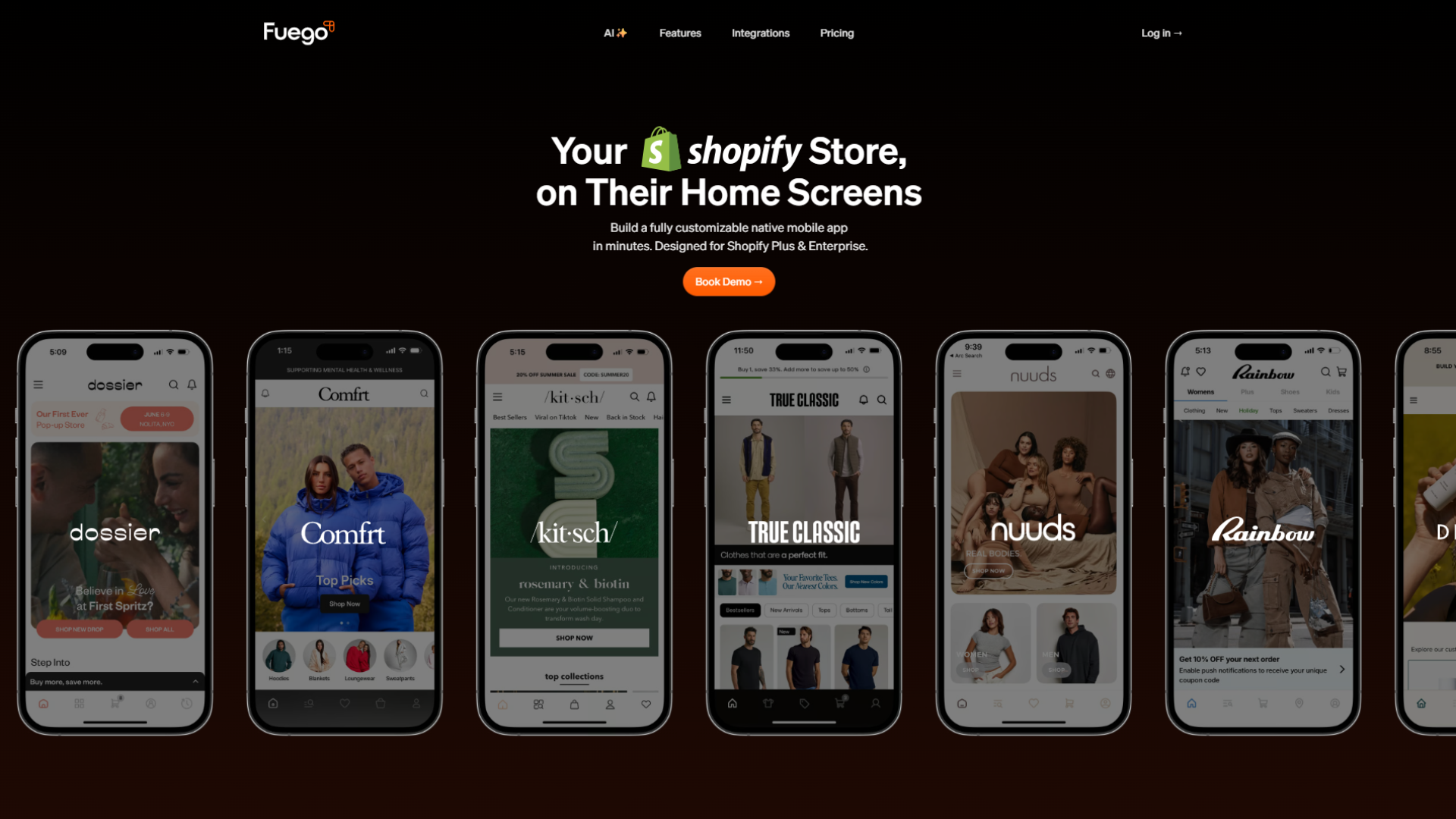
Overview. Fuego is an AI-native, no-code builder aimed at Shopify Plus and enterprise stores. Its signature is generative AI that builds entire app screens from natural-language prompts, paired with in-app community and social-commerce features that most builders do not centre their product around.
Key features
- A generative AI Creative Assistant that builds and varies app screens from text prompts, plus an in-app AI agent (Apa) on higher tiers.
- More than 100 template blocks, with custom React Native blocks for advanced builds.
- Community Corner for in-app, shoppable brand content and engagement.
- A/B testing, audience segmentation, Apple App Clips, and multi-store super-app support on higher tiers.
- Integrations with roughly 50 to 80+ Shopify and third-party tools.
Pros
- Among the strongest AI screen-generation tools in the category.
- Genuine differentiation through community and social-commerce features.
- Highly customisable for teams willing to treat the app as an active project.
Cons
- Pricing is custom and gated, with the strongest features on upper tiers.
- Some reviewers report onboarding friction, including required intro calls and slow follow-up.
- Best value assumes you have a team to actively run and optimize the app.
Pricing. Fuego markets pricing starting at approximately $999 per month, with most plans configured per account through a demo. Older public tiers varied widely across sources, so treat any single number with caution and confirm the current structure directly.
Best for. Shopify Plus and enterprise brands that want the app as a continuously optimised growth channel with social and community features built in.
Why choose it over Tapcart? Generative AI design and community-led commerce, angles Tapcart does not emphasise, for teams operating at Plus or enterprise scale.
In one line: a powerful, AI-forward choice for ambitious Plus brands with the team to run it.
4. Vajro (now Superfans): Best for live selling and community-driven brands
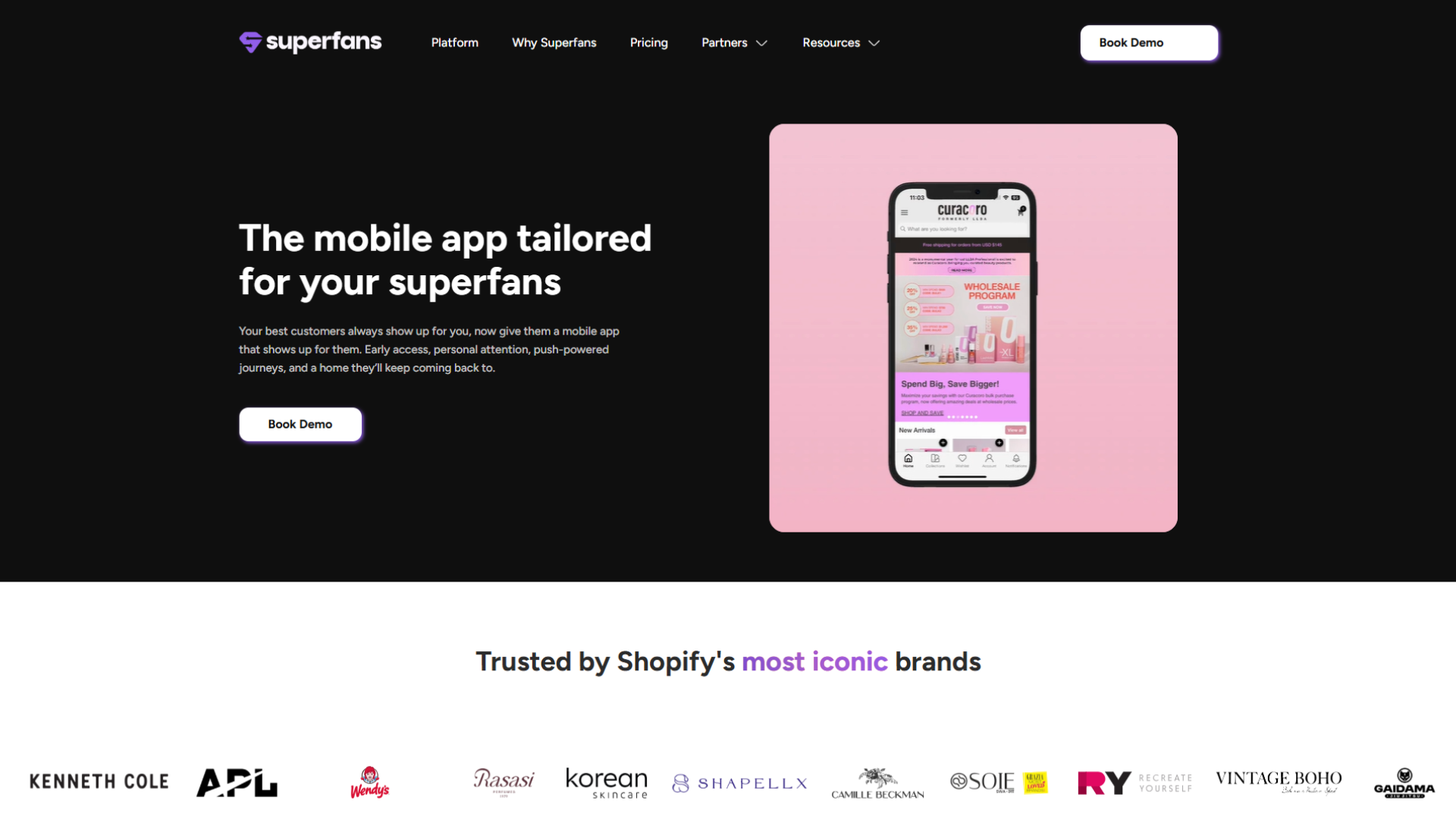
Overview. One of the longest-running builders in the space, recently rebranded to Superfans, Vajro pioneered in-app live-stream shopping. It targets brands built on community, drops, and direct customer interaction, particularly fashion, collectables, and beauty.
Key features
- Built-in live-stream selling on both the app and Facebook.
- A drag-and-drop builder with real-time Shopify sync.
- Behaviour-based, segmented, unlimited push notifications.
- More than 70 one-click integrations, plus custom blocks through an SDK.
- 24/7 support with a strong reputation for hands-on onboarding.
Pros
- A best-in-class live-commerce feature set.
- A retention and VIP focus that suits loyal, repeat-purchase audiences.
- Consistently praised, responsive support, and accessible entry pricing.
Cons
- Shopify only.
- Better suited to community and live selling than to a content-rich, traditional storefront app.
- Some reviewers report integrations that did not behave as expected, so confirm your specific tools before launch.
Price check. Under the Superfans brand, Vajro has moved to a single flat plan. The official pricing page now lists one "Unlimited" plan at $1,000/month with every feature included (fully branded app, unlimited push, unlimited integrations, app-exclusive drops), no success fees, and a price-lock guarantee, plus a custom tier for larger teams and extended builds. A 30-day free trial is available.
Best for. Brands whose growth runs on live selling, drops, and community engagement, and who want a builder purpose-built for those moments.
Why choose it over Tapcart? Dedicated live-commerce and community tooling that Tapcart does not prioritise, plus a lower entry price and no success fee.
In one line: the specialist's pick for live and community commerce.
5. Shopney: Best for fast, affordable launches with strong support
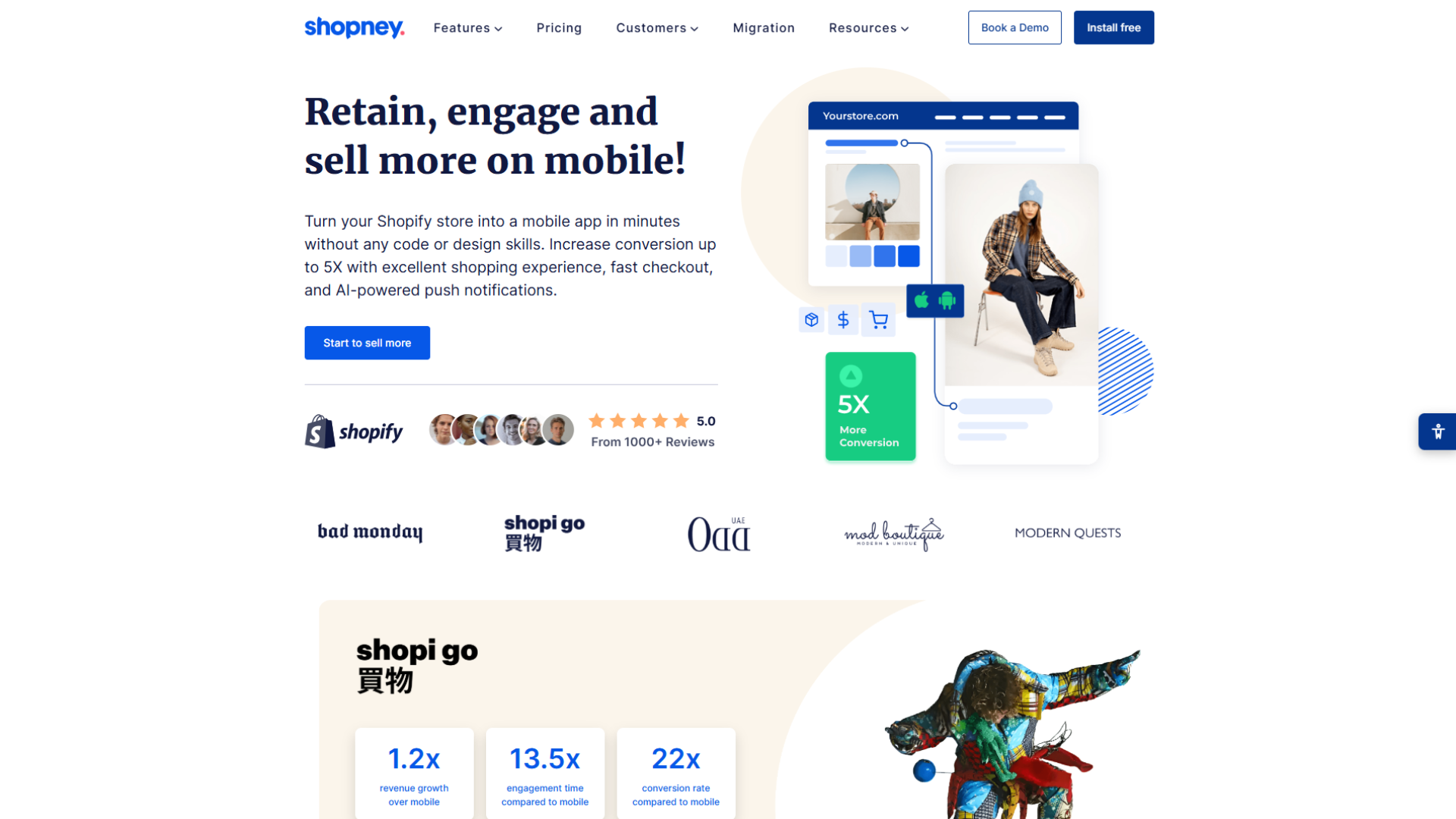
Overview. Shopney focuses on speed, polished pre-built themes, and ease of use for Shopify and Shopify Plus brands. It is frequently cited for getting apps live quickly and for its in-app chat, and it charges no commission on sales.
Key features
- A drag-and-drop editor with several polished theme layouts.
- In-app chat for conversational selling and faster customer responses.
- Unlimited push notifications on all plans.
- Multi-language support for international stores.
- Shopney AI to speed up design and setup, with live selling on higher tiers.
Pros
- Among the fastest paths to a live, good-looking app, often within a day or two.
- No sales commission, so costs stay predictable as revenue grows.
- Strong, well-reviewed support and broad multi-language reach.
Cons
- Customisation is limited on lower tiers, with full design control reserved for the top plan.
- Less developer extensibility than open-architecture platforms.
- Several advanced marketing features sit on higher tiers, and it is not currently Built for Shopify.
Pricing. Plans start around $149 per month and scale through mid and higher tiers toward roughly $1,299 per month for Plus and high-volume stores, with differences driven by push limits, support level, and features. No commission.
Best for. Small to mid-sized Shopify brands that want a polished app live quickly, with flat pricing and dependable support.
Why choose it over Tapcart? Faster and cheaper to start, with flat pricing and no performance fee.
In one line: a strong, affordable starter platform with excellent support that heavier-customisation brands may eventually outgrow.
6. MobiLoud: Best for turning an existing website into an app
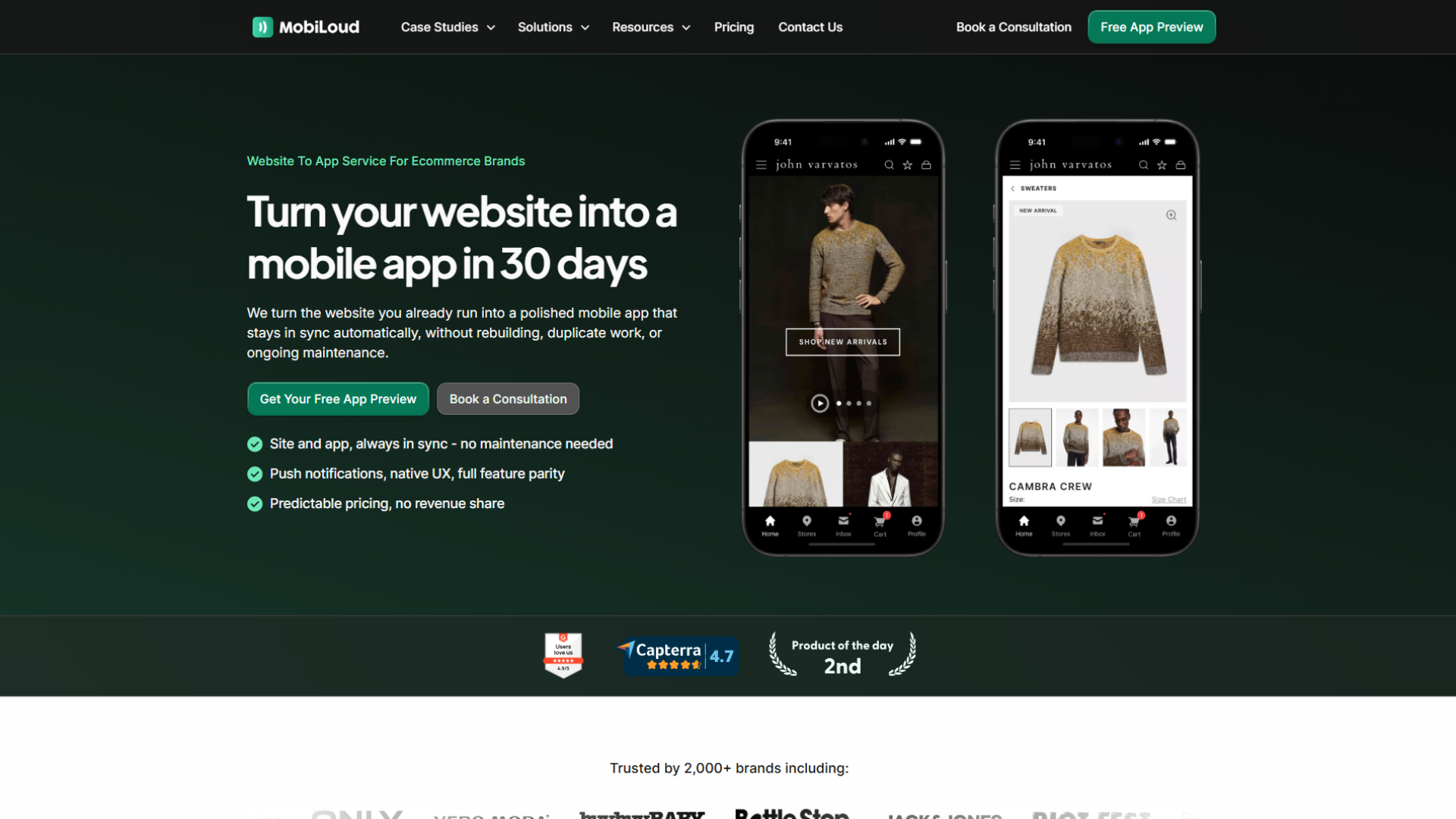
Overview. MobiLoud takes a fundamentally different route. Instead of rebuilding your store in a block editor, it converts your existing mobile website into iOS and Android apps and manages the whole process for you. It works with any platform, including headless and non-standard setups.
Key features
- Website-to-app conversion that preserves your full checkout, integrations, and experience inside a native shell (native navigation, push, and deep linking).
- A fully managed build, app-store publishing, and ongoing maintenance.
- Compatibility with your existing Shopify apps and non-Shopify and headless stacks (WooCommerce, BigCommerce, Adobe Commerce, Salesforce Commerce Cloud, WordPress, and custom builds).
- Push via OneSignal or Klaviyo, configured to your account.
Pros
- Near-perfect parity with your site: whatever works on the web works in the app.
- Minimal internal effort, since the MobiLoud team handles setup and submissions.
- Platform-agnostic, including headless and complex custom configurations.
Cons
- No drag-and-drop builder, so you cannot design app-specific layouts that differ from your site.
- A higher all-in cost (a substantial setup fee plus a 12-month agreement) and a longer launch timeline than DIY builders.
- A webview-and-native-shell model rather than a from-scratch native build.
Pricing. Entry conversions have started flat $1,499 per month plus a one-time setup fee of about $5,000 and includes up to 10,000 monthly active users (average around $50 per additional 1,000). Both are typically 12-month agreements, with a launch of roughly six to eight weeks. Enterprise is custom-scoped.
Best for. Established brands with a well-optimised mobile website that want a high-quality native app without managing it themselves, especially those off Shopify or running headless.
Why choose it over Tapcart? It converts any-stack site into an app without a rebuild, the natural fit when Tapcart's Shopify-only, build-it-yourself model does not match your stack. If you like the web-to-app approach but want a lower entry point across Shopify, WooCommerce, BigCommerce, Wix, or custom sites, AppBuzz is worth comparing alongside it.
In one line: the efficiency play for teams that want an app mirroring their site with minimal effort.
7. Plobal Apps: Best for analytics-led mid-market stores
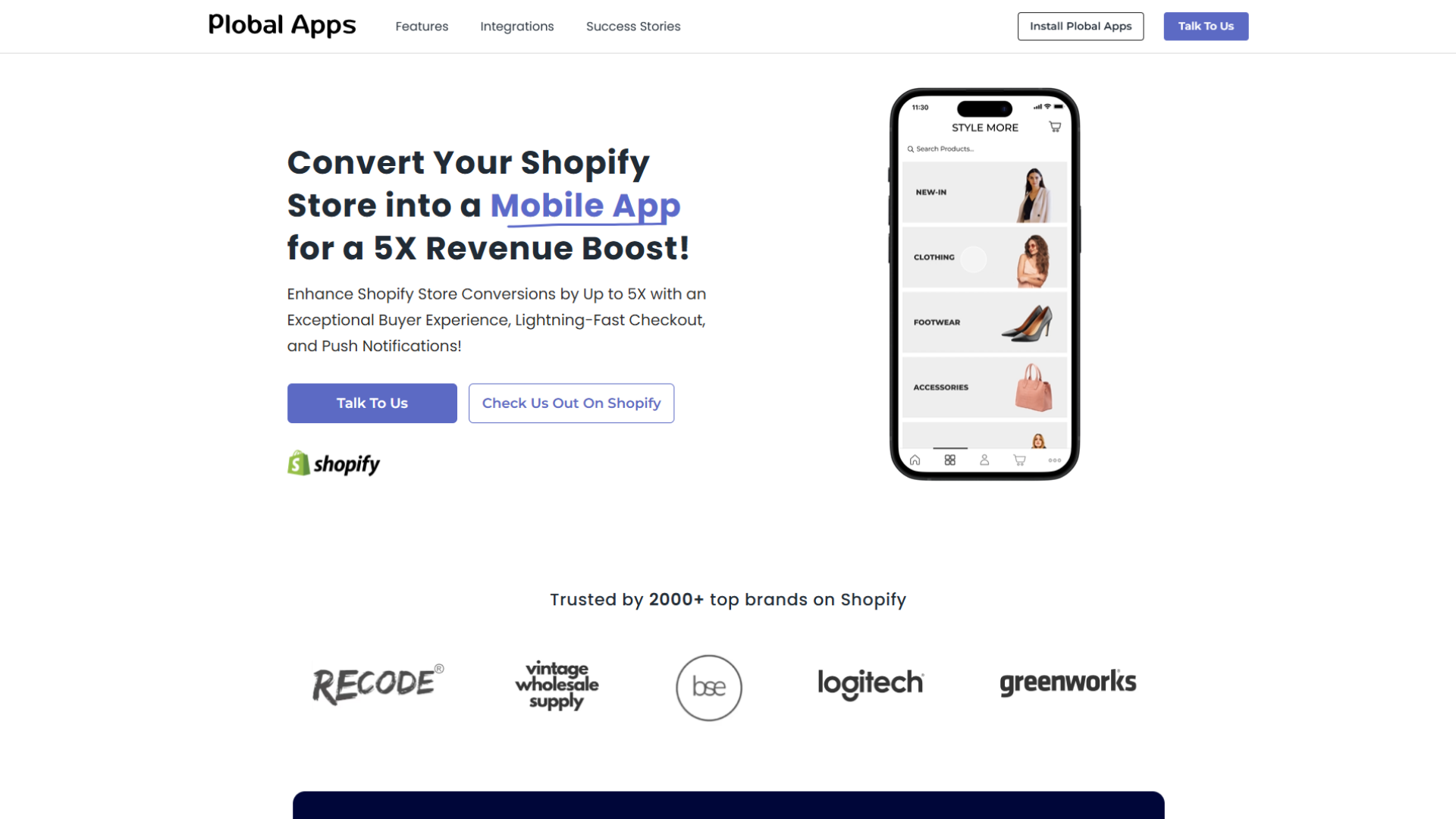
Overview. Plobal Apps converts Shopify stores into branded apps with AI-driven product recommendations and a strong analytics layer. It is one of the more mature players in the category and carries the Built for Shopify badge.
Key features
- AI-driven product recommendations based on customer behaviour.
- Segmented, unlimited push notifications for marketing and re-engagement.
- A drag-and-drop builder with brand-alignment options.
- In-platform analytics covering user behaviour, revenue trends, and engagement.
- Integrations with Klaviyo, Yotpo, Recharge, Gorgias, and other common Shopify tools.
Pros
- Strong, decision-useful analytics for data-driven teams.
- Built for Shopify certification and a long, stable track record.
- Reviewers note direct, tailored support.
Cons
- More setup and ongoing management than plug-and-play builders.
- Advanced features and segmentation types are reserved for upper tiers.
- Documentation can be harder to navigate than some competitors'.
Pricing. Plobal has historically published tiers starting around $199 per month (Growth), rising toward roughly $1,199 per month at the enterprise end, and now leans toward quote-based pricing configured through a demo. Some plans have historically included success-based fees, so confirm the current model directly.
Best for. Data-driven mid-market Shopify stores that want strong analytics and personalisation and have the team to optimise a more involved platform.
Why choose it over Tapcart. Deeper in-app analytics and segmented push, with Built for Shopify status smoothing native workflows.
In one line: a capable, analytics-forward builder for teams willing to invest setup time.
8. Apptile: Best for AI-built, budget-flexible customisation
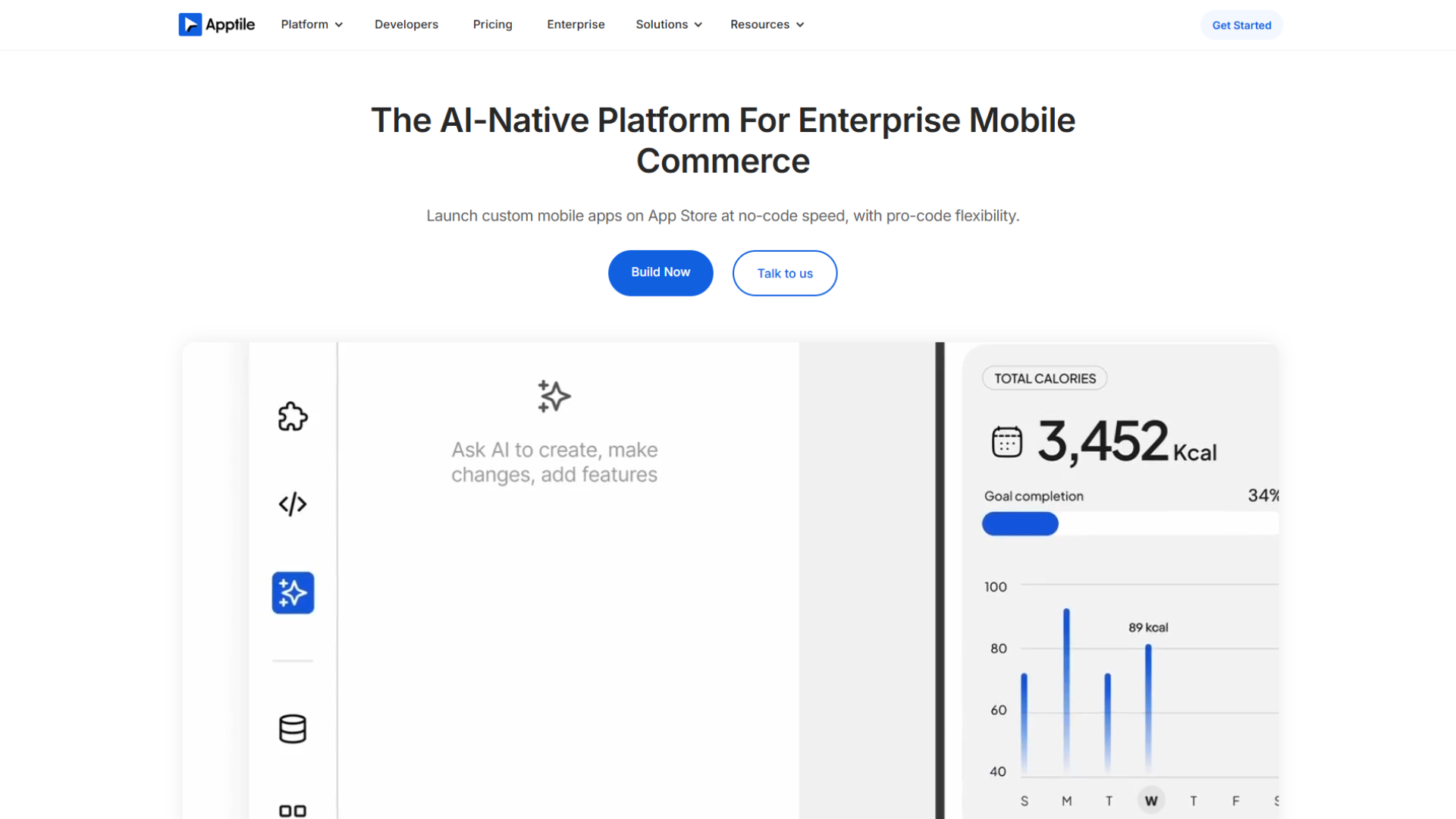
Overview. Apptile is a no-code builder organised around a flexible tile design system and heavy use of AI. Its Tile AI generates app features and screens from plain-language prompts, and unlike most entry-level tools, it lets you customize visually or drop into code, which makes it more capable than its price suggests.
Key features
- Tile AI that builds app features and layouts from natural-language prompts, then lets you refine visually or in code.
- A tile-based editor for custom home, PDP, and cart pages, fonts, and icons.
- One-click integrations with popular Shopify apps such as Klaviyo and Recharge.
- Live selling (app, Facebook, and Instagram), barcode scanning, advanced analytics, and social login on higher plans.
- Migration support from Tapcart, Vajro, Shopney, OneMobile, Swipecart, and Plobal.
Pros
- A genuinely strong AI build experience, well rated on the Shopify App Store.
- Visual-plus-code customisation that most budget builders do not offer.
- Built-in live selling without needing a separate specialist tool.
Cons
- The best features, and several integrations, sit behind higher tiers or paid add-ons (for example, some connectors are billed separately).
- Usage-based components (such as live-stream viewer minutes) mean cost can vary month to month.
- Its Built for Shopify status is reported inconsistently across sources, so confirm on the current listing.
Pricing. Free to install, and you pay when you go live. Paid plans start around $224 per month (Core) and scale to roughly $999 per month (Enterprise), with a 30-day free trial and usage-based charges for certain features. Confirm current tiers and any add-on integration fees before committing.
Best for. Brands that want an AI-first build and real design flexibility without jumping to enterprise pricing.
Why choose it over Tapcart? AI-assisted building and visual-or-code customisation at a fraction of Tapcart's entry cost, and it actively markets one-click migration off Tapcart.
In one line: capable enough to rank higher than its price suggests, if AI-assisted design matters more to you than a huge integration catalogue.
9. Tapday: Best for affordable, support-heavy launches
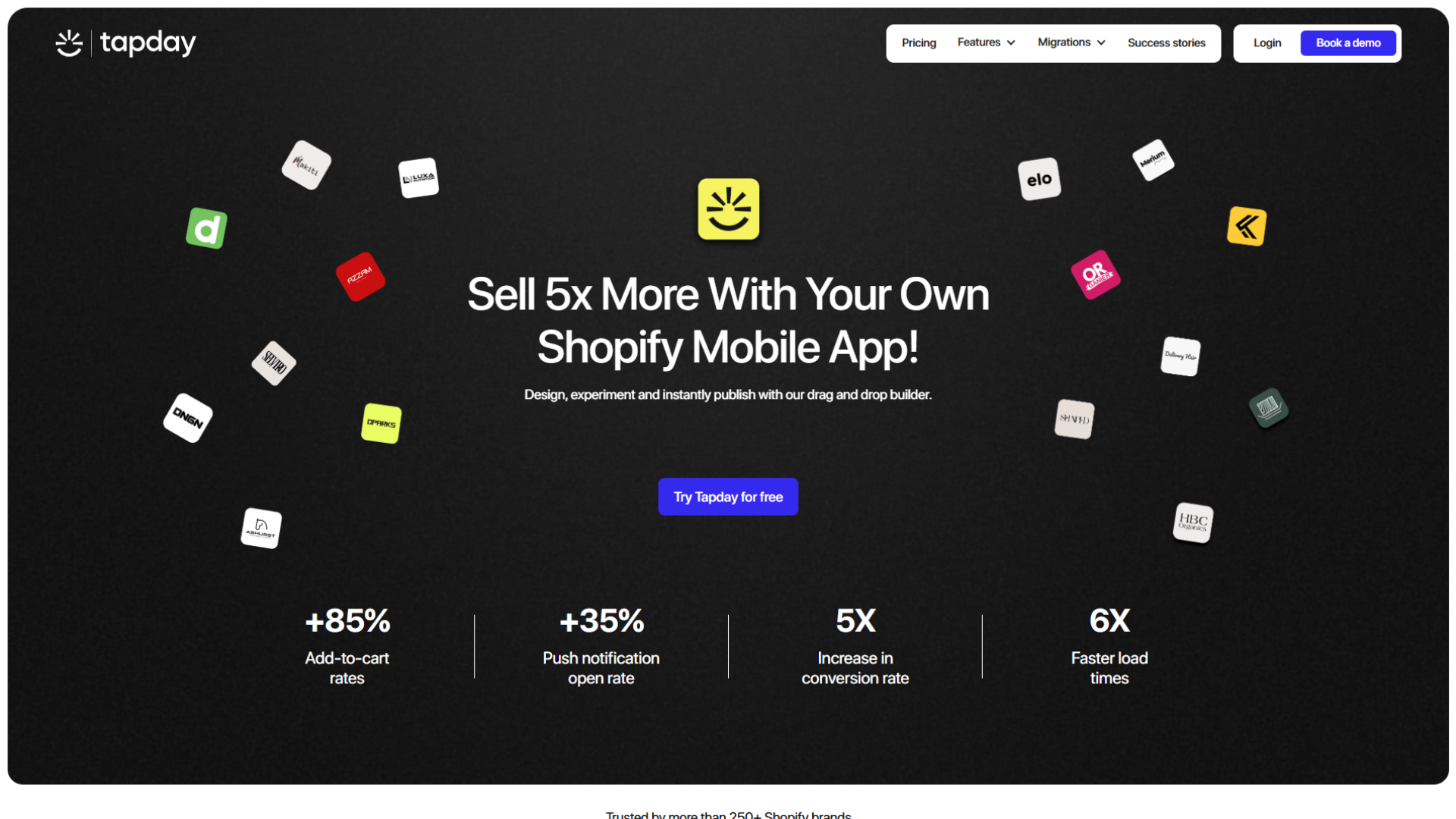
Overview. Tapday is a budget-friendly, AI-assisted no-code builder that leans hard on hands-on service. It carries the Built for Shopify badge and undercuts almost every premium option on price.
Key features
- A drag-and-drop native iOS and Android builder with real-time, two-way Shopify sync.
- Unlimited push notifications with no commissions or usage caps.
- A broad integration set (the vendor reports 72+ and builds custom integrations at no extra charge when a tool is not supported).
- Tapday Drops for scheduling app-wide updates, plus wishlist, loyalty, and analytics.
- Done-for-you migration.
Pros
- A very low entry price with no commissions and no forced upgrades tied to revenue.
- A consistently strong reputation for support and a 5.0 rating on the Shopify App Store.
- A free trial, extended for merchants migrating from another builder.
Cons
- A smaller brand footprint than the category leaders.
- Fewer enterprise-grade capabilities than the top tier.
- Some flagship results come from vendor-supplied case studies, so weigh them accordingly.
Pricing. Tiered subscriptions start at a low monthly price (its entry tier is around $99 on the listing), with no commissions or revenue-based upgrades. Confirm current tiers on the Shopify App Store.
Best for. Small and mid-sized Shopify stores that want an affordable, well-supported app and value flat, predictable pricing.
Why choose it over Tapcart? It is the anti-Tapcart on cost, opening far below Tapcart's Core plan with no success fees, while still offering migration and hands-on setup.
In one line: the value-plus-service pick for a clean, cheap launch without a market leader's ecosystem.
10. MageNative: Best for low-cost multi-platform conversions
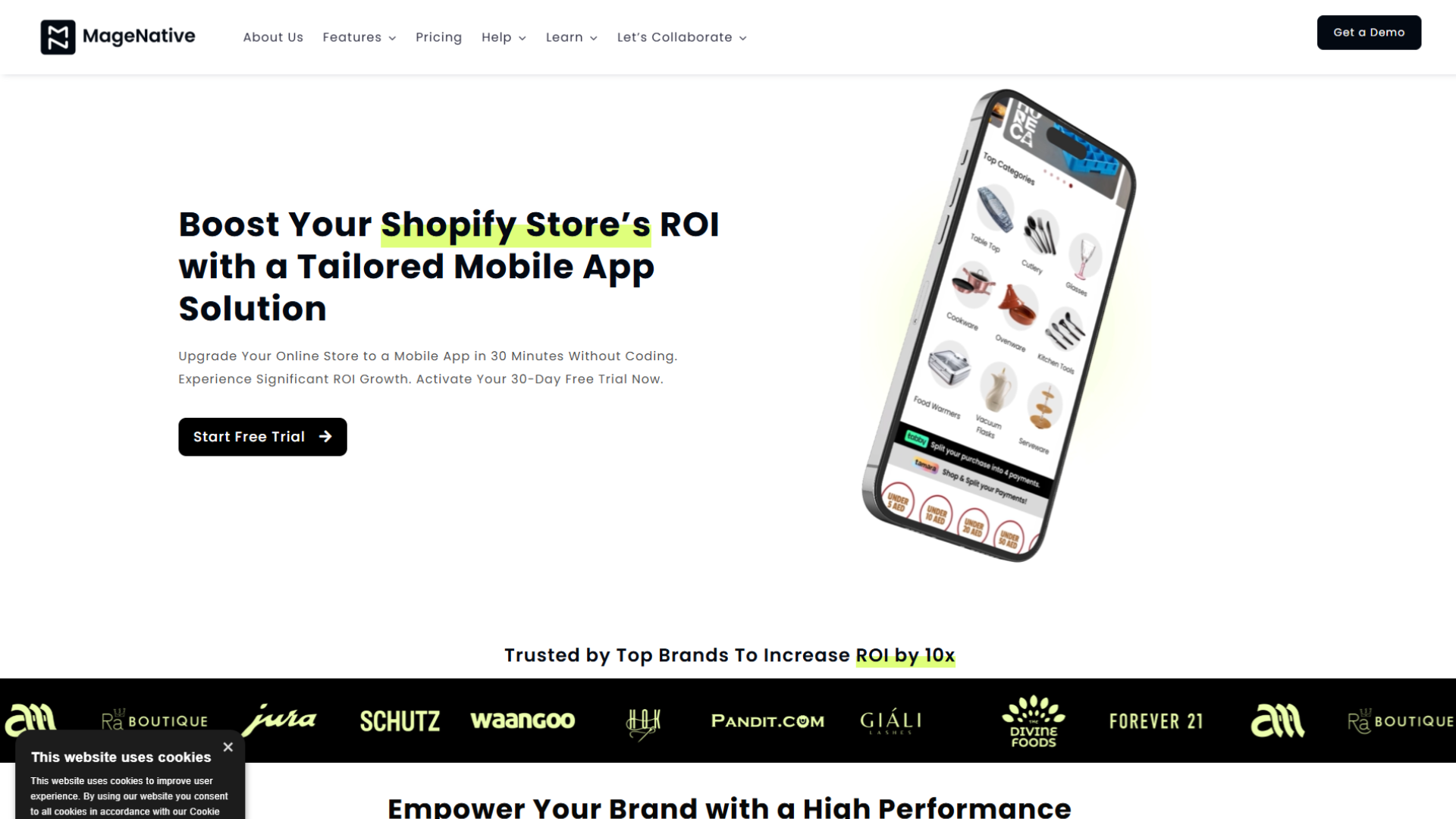
Overview. MageNative offers a no-frills way to turn Shopify and other-platform stores into native iOS and Android apps. It is a practical pick for budget-conscious brands that want the essentials done reliably, and it is one of the cheapest serious options here.
Key features
- A drag-and-drop interface with template libraries.
- Real-time sync and support for Shopify, Magento, WooCommerce, and BigCommerce.
- Push notifications and core marketing tools.
- Augmented-reality product viewing on premium plans, AI product recommendations, and multi-language and multi-currency support.
Pros
- Very low entry pricing and a gentle learning curve.
- No success fees at any tier.
- Multi-platform support and broadly positive reviews for core functionality.
Cons
- Lacks the advanced personalisation and conversion tooling of higher-end platforms.
- A narrower integration library, with no native Klaviyo or email/SMS marketing connection.
- Some reviewers report bugs and slow resolution of complex issues, and it is not certified as Built for Shopify.
Pricing. Plans start at about $99 per month and scale to roughly $249 per month, with custom pricing based on features and support. No success fees.
Best for. Smaller and early-stage brands that want an affordable, multi-platform app and can live without advanced personalisation.
Why choose it over Tapcart? A far lower-cost, multi-backend alternative for brands whose needs are straightforward and who are not tied to Shopify.
In one line: solid and economical for the basics, and a sensible way to test the channel across more than one platform.
How to Choose the Right Tapcart Alternative
Picking a mobile app builder is less about the longest feature list and more about matching the platform to your constraints. Work through these in order.
Budget, and the full cost, not the sticker. Compare flat monthly fees against revenue-share and success-fee models. This is the single most common reason brands leave Tapcart: a flat plan can be far cheaper than a base-plus-performance-fee plan once your app generates real revenue. At $50,000 per month in app sales, a 2.5% fee adds $1,250 on top of the base every month.
Business size and stage. Early-stage stores testing the channel are better served by low-cost tiers such as Apptile, Tapday, MageNative, and Shopney. Scaling and enterprise brands should weigh AppMaker, VennApps, or Fuego.
Technical resources. If you have engineers and want a distinct app experience, prioritise platforms with real developer access: AppMaker's Open Model or Fuego's React Native blocks. If you have none but want a bespoke result, a managed platform like VennApps builds it for you. If you want to self-serve without code, prioritise the smoothest no-code editors.
Integrations. Inventory your stack: email (Klaviyo, Omnisend), reviews (Yotpo, Judge.me), loyalty (Smile.io, Rivo), subscriptions (Recharge). AppMaker and Fuego support custom integrations; VennApps brings your existing tools in via its middleware; lighter builders cover the essentials; and a few skip email and SMS connections or charge for them as add-ons. If Tapcart's integration gating is your complaint, check whether the alternative bundles what you need at your tier.
Automation and AI. Decide whether you want AI mainly for push copy, or for operational work (analytics, campaign setup) and real-time personalisation. The latter narrows the field to platforms like AppMaker and Fuego.
Customisation. If a templated app is fine, almost anything works. If Tapcart's block-only model is what pushed you to look, prioritise design freedom and conditional content, which is where AppMaker, VennApps, and Fuego stand out.
Compliance. Regulated or international sellers should confirm data handling, multi-region support, and any GDPR or PCI considerations before signing.
Support. Hands-on onboarding and a dedicated success manager materially affect launch speed. Shopney, Vajro/Superfans, VennApps, Tapday, and AppMaker are all well reviewed here.
Scalability and contracts. Ask the uncomfortable question early: what happens when you want something the platform was not designed for, and how long are you locked in? Open architectures age better than closed ones, and month-to-month or short commitments beat a 12-month contract while you are still proving the channel.
When Should You Switch from Tapcart?
Real migration triggers worth acting on:
- The success fee is outpacing the value. As app revenue grows, a percentage-of-sales fee can dwarf a flat plan. If you would prefer predictable costs, look at flat-fee or low-share options such as AppMaker, Shopney, Tapday, or VennApps.
- You are locked into a 12-month contract you regret, or you want the freedom of shorter terms next time.
- The block-only design model is limiting you, and you want either true design freedom (AppMaker, VennApps, Fuego) or, conversely, the simplest possible editor (Tapday, Shopney).
- You are moving off Shopify or going headless, which Tapcart does not support. Consider MobiLoud, AppBuzz, or MageNative.
- A core capability is missing, such as live selling (Vajro/Superfans, Apptile), in-app community (Fuego), or deeper analytics (Plobal, AppMaker).
Most builders offer free migration and promise no loss of existing app users. Confirm this in writing, including user data, reviews, and push subscribers, and export what you can from Tapcart before switching.
Which Alternative is Best for…
- Small businesses: Shopney or Tapday, for affordable, fast, flat pricing.
- Startups: Apptile or MageNative to validate the channel cheaply, then graduate up.
- Agencies: AppMaker, whose multi-backend reach and developer access suit building across multiple clients.
- Developers: AppMaker (Open Model), Fuego (React Native blocks).
- Large enterprises:AppMaker, VennApps, or Fuego, depending on whether you prioritise flexibility, bespoke native design, or AI-native social commerce.
- Non-technical builders: Shopney or AppMaker's no-code studio.
- IT teams: MobiLoud (fully managed, minimal internal load) or AppMaker (controllable and extensible).
- Operations teams: AppMaker, whose operational AI assistant and analytics reduce manual campaign and reporting work.
- Live selling and community: Vajro/Superfans, with Apptile as a budget option.
- Non-Shopify or headless stacks: MobiLoud, AppBuzz, or MageNative.
The Bottom Line
The best Tapcart alternative is not the one with the longest feature list. It is the one that removes the specific limitation pushing you to look. Tapcart has earned its reputation for reliability and a mature ecosystem, but if your real concerns are a success fee that scales with revenue, a 12-month commitment, block-based design limits, or its Shopify-only focus, the right move is a platform that removes those constraints.
For most brands, AppMaker is the strongest all-round alternative, which is why it leads this list. It combines native app performance, real customisation through its Open Model, an AI toolkit that goes well beyond push copy, flatter pricing, and reach beyond Shopify through AppBuzz. If you want premium native design delivered for you and a commission-free experience inside Shopify, VennApps is another excellent choice. And if your strategy hinges on live selling, community, or the lowest possible entry cost, one of the specialists will serve you better than a generalist.
Before you book a single demo, write down three things: which ecommerce platform you use, your realistic monthly app revenue, and whether you will have developer time. Those three answers eliminate most of this list and point clearly at the two or three platforms worth testing. Then use the free trials, which every serious option offers, to validate the fit before committing. The right app pays for itself in retention and repeat purchases; the wrong one is an expensive lesson in lock-in.
Frequently asked questions
What is the best Tapcart alternative?
For most scaling brands, AppMaker is the best all-round Tapcart alternative. It delivers comparable native quality and stronger AI, adds developer-level customisation through its Open Model, uses flatter pricing (a flat fee plus 1%), and reaches beyond Shopify through its AppBuzz product.
Why do brands leave Tapcart?
The usual triggers are the success fee (about 2.5% of app sales on Core and Ultimate) eating into margin as revenue climbs, 12-month contracts that are hard to exit, a block-only design model that limits customisation without code, and the fact that Tapcart works only with Shopify.
Which Tapcart alternative is cheapest?
MageNative and Tapday both open around $99 per month, and Apptile is free to install (you pay when you go live).
How much does Tapcart cost in 2026?
Tapcart's base plans run roughly $500 per month (Core), with Ultimate and Enterprise tiers above that, and it adds a success fee of about 2.5% of app sales on Core and Ultimate and about 1.75% on Enterprise. So your real cost rises with your app revenue, which is why merchants model total cost rather than the sticker price.
We are not on Shopify. Does that shrink my options?
Considerably, because nearly every builder in this space is Shopify-exclusive. Your practical options are the web-to-app route through MobiLoud (any stack, including headless) or AppBuzz (Shopify, BigCommerce, WooCommerce, Wix, and custom sites), or a multi-platform builder like MageNative (Shopify, Magento, WooCommerce, BigCommerce).
Which alternative has the best AI features?
AppMaker and Fuego lead on AI. AppMaker runs a layered stack: John AI for operations and analytics, Rubick's AI for real-time personalisation, and Eidolon AI for design-to-layout. Fuego specialises in generative AI that builds full app screens from prompts, and Apptile's Tile AI assembles features from written prompts. Tapcart's AI focuses mainly on marketing copy and merchandising.
Which Tapcart alternative is best for live selling?
Vajro (now Superfans) is the specialist, with live-stream selling built into both the app and Facebook and a feature set tuned for drops and VIP communities. Apptile also includes live selling at a lower entry price, and Shopney offers it on higher tiers.
Will I lose my app, reviews, or subscribers if I switch from Tapcart?
You should not, if you move deliberately. AppMaker, Shopney, Vajro/Superfans, Tapday, and Apptile all run migrations designed to carry users across intact. Before you cancel anything, get the specifics in writing, especially customer data, ratings, and your push-subscriber list, and export what you can from Tapcart first.
Which Tapcart alternative is easiest for a first-time app builder?
Shopney and Tapday are the gentlest on-ramps. Shopney hands you polished themes and a drag-and-drop canvas that can go live within a day or two, and Tapday leans on its team to do much of the setup for you. Neither expects you to understand the technical side to ship a solid app.
What does "no commission" pricing actually mean?
Usually the fee structure sits elsewhere. Flat-fee builders like Shopney, Tapday, and MageNative charge a predictable monthly rate with no cut of sales. Apptile swaps commission for usage-based billing on some features. AppMaker adds a small 1% share on top of its flat fee. Tapcart uses performance fees. Model your real cost at your expected app revenue, because "no commission" and "cheapest overall" are not always the same thing.
How long does it take to launch a mobile app with these tools?
Most no-code builders get you live in days to a few weeks, including app-store submission, and the fastest (such as Shopney) advertise launches in a day or two. Managed conversions like MobiLoud take roughly six to eight weeks given the hands-on build.
Are these apps truly native or web wrappers?
Most platforms here build genuinely native iOS and Android apps, many on React Native, which load faster and convert better than web wrappers. MobiLoud and AppBuzz are the nuance: they wrap your existing site in a native shell with native navigation and push, which works well when your mobile site is already optimised.
Do these builders work on platforms other than Shopify?
Most are Shopify only. The exceptions are AppBuzz (Shopify, BigCommerce, WooCommerce, Wix, and custom sites), MobiLoud (any platform, including headless), and MageNative (Shopify, Magento, WooCommerce, BigCommerce). If you are not on Shopify, your shortlist narrows to these.