

























Key Takeaways
- Best all-rounder (and the only pick here that reaches beyond Shopify with deep customisation): AppMaker no-code speed plus real developer access, also building for BigCommerce, WooCommerce, and WordPress.
- Most established DIY app: Tapcart, the category veteran, but usage-based fees and a 12-month contract.
- Conversion-first Shopify-native pick: Apptile AI-built, native, no commission on paid plans.
- Live selling and drops: Superfans (formerly Vajro).
- Push automation and AI segmentation: Plobal Apps.
- Cheapest ways to test the channel: MageNative (multi-platform) or OneMobile (free plan).
- Off Shopify or headless: MobiLoud, a fully managed native shell around your existing site.
- Subscriptions and B2B: Shop2App.
- Fully managed enterprise builds: Venn Apps.
- Watch the fee model, not the sticker price. A low headline with a revenue share can cost more than a higher flat fee once your app actually works.
Shopney is a genuinely good Shopify app builder. Most brands who go looking for an alternative aren't leaving because it's bad; they're leaving because they've hit a specific ceiling: template-only screens, thin personalisation, no developer access, a move off Shopify, or a budget that needs a cheaper way to test the channel. This guide maps ten credible alternatives to those exact ceilings, with pricing checked against every vendor's own pricing page and Shopify App Store listing in July 2026.
One disclosure up front, because it matters for how you read this: this is AppMaker's blog, and AppMaker leads the list. We've said so plainly, flagged every vendor's self-reported numbers as self-reported, and linked you to free trials so you can judge for yourself. Where the public pricing genuinely disagrees, which happens more than you'd expect, we say so instead of picking a number and hoping.
What Is The Best Shopney Alternative?
For most scaling brands, AppMaker is the strongest all-round choice: it gives a marketing team a drag-and-drop studio and gives engineers real developer access in the same product, adds deeper personalisation than Shopney offers, and is one of only three builders here that works beyond Shopify. If your strategy hinges on one specific thing: live selling, subscriptions, push automation, or the lowest possible entry price, a specialist will beat a generalist, and the sections below name the right one for each case.
Why Brands Leave Shopney (Even Though It's Good)
Shopney earned its reputation honestly. It's one of the fastest ways to get a credible Shopify app live; many stores finish design in under an hour, and its support team is the single feature reviewers praise most consistently. It charges no commission on sales, includes unlimited push notifications on every plan, and starts at $149/month. On its Shopify App Store listing, it holds one of the highest ratings in the category, across 700+ reviews. If you want a good-looking, theme-based app delivered with a lot of hand-holding, Shopney is a legitimately strong tool.
Merchants start shopping for an alternative when they hit one of five edges:
- You've outgrown templates: In Shopney, the home screen is fully editable, but the product, cart, and checkout screens follow set layouts with lighter customisation. That's exactly what keeps launches fast and exactly what frustrates brands that want a distinctive, brand-first experience.
- You need deeper personalisation and segmentation: Shopney's behavioural-targeting tooling is thinner than what conversion-focused platforms offer. If you want A/B testing, cohort-based push, and metafield-driven content, you'll feel the ceiling.
- You want developer access: Shopney has no open architecture or custom-code layer. Brands with subscriptions, loyalty logic, or region-specific flows eventually want to extend the app, and a template builder can't.
- You're leaving Shopify or already running headless: Shopney is Shopify-only by design. Move to BigCommerce, WooCommerce, or a custom stack and a Shopify-native builder is off the table.
- Budget or feature gating: Some teams want something cheaper than $149/month just to validate the channel; others discover that live selling only unlocks on Shopney's Platinum tier and above.
If two or more of those describe you, one of the ten builders below will fit better.
Why Getting The Mobile App Right Actually Matters In 2026
Mobile is no longer a channel; it's the channel. Mobile commerce now accounts for roughly 59% of global retail e-commerce sales, with the mobile-commerce market reaching about $2.64 trillion in 2025 and on track for $4.16 trillion by 2031, a figure corroborated by Statista's mobile e-commerce revenue estimate of roughly $2.51 trillion for 2025. In plain terms, most customers now discover, compare, and pay on a phone screen.
The shift is just as stark inside the app economy. 2025 was the year non-gaming app revenue ($85.6 billion) overtook mobile gaming revenue ($81.8 billion) for the first time, with non-gaming apps growing 21% year-over-year while games effectively flatlined at around +1%. Generative AI was the single largest growth driver, adding roughly $3.5 billion in in-app purchase revenue, and three apps (ChatGPT, CapCut, and WeTV) each crossed $1 billion in IAP revenue — the first time that's happened with no games on the list since 2022. It's a clear signal that apps are now the primary channel for consumer transactions across every category.
But there's a gap that costs merchants money every day. Mobile drives roughly 75–78% of e-commerce traffic yet only ~57% of sales, because mobile web converts poorly. Native apps are what close that gap. Independent benchmarks put shopping-app conversion at roughly 2-3× higher than mobile web (commonly cited as about 3.5% versus ~2%, though the multiple varies by source and category), and shoppers spend far longer inside apps, on the order of 15-18× more engagement time than on mobile shopping sites.
Treat any single multiplier as directional, not a guarantee. Conversion lift swings enormously by vertical: MobiLoud's own brand studies, for example, report anywhere from 1.9× (cosmetics) to 11× (fashion) self-reported and not independently audited. The practical takeaway is simpler than the numbers: the right app builder is the one that turns your mobile traffic into repeat revenue at your stage, not the one with the flashiest demo.
Native App vs. Web Wrapper vs. PWA (A 60-Second Primer)
This one distinction decides which tools even belong on your shortlist.
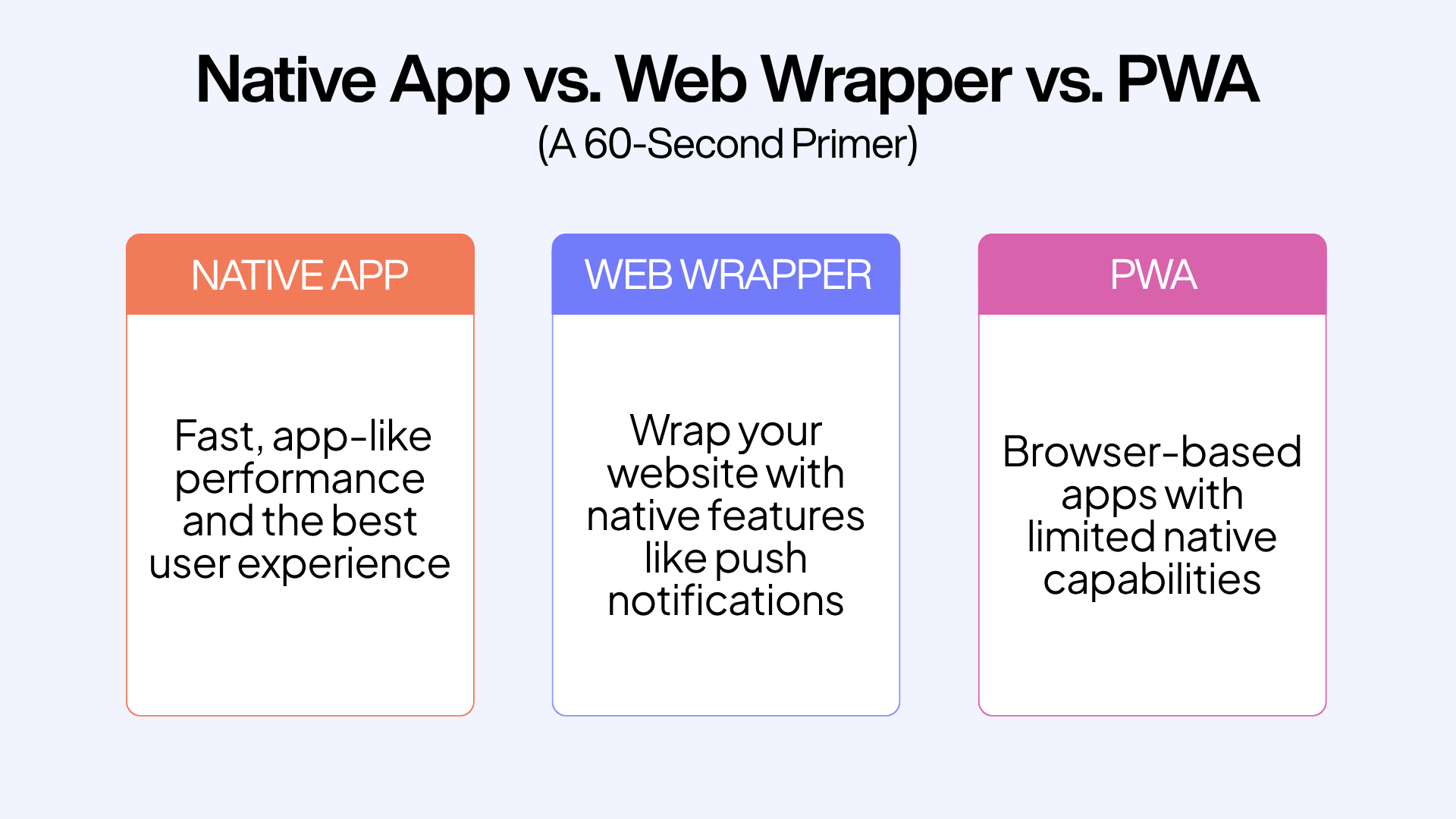
- Genuinely native apps are built for iOS and Android (many builders here use React Native). They load fast, feel like apps, and generally convert best. Shopney is native, and so are most tools below.
- Native-shell / webview apps wrap your existing mobile website in a native container with native navigation, push, and deep linking. MobiLoud is the deliberate example: whatever works on your web checkout works in the app, with nothing to rebuild, but you can't design app-specific screens that differ from your site.
- PWAs (progressive web apps) run in the browser and can be "installed" to a home screen, but they don't get full native app-store presence or consistent push behaviour on every platform.
Rule of thumb: if your mobile site is already well optimised and you don't want a second platform to manage, a native shell is efficient. If you want app-specific merchandising, personalisation, and layouts the whole reason most people leave a template builder choose a native builder.
The 10 Best Shopney Alternatives At A Glance
| Platform | Best for | Starting price (verified July 2026) | Fee model | Beyond Shopify? |
|---|---|---|---|---|
| AppMaker | No-code speed + real developer access | $999/mo + 1% of in-app sales | Flat + 1% | Yes (BigCommerce, WooCommerce, WordPress) |
| Tapcart | Mature, marketing-led DIY app | From ~$250/mo + usage fees | Flat + performance | No |
| Apptile | Conversion-first Shopify DTC | From $99/mo (Core) | No commission (paid plans) | No |
| Superfans (formerly Vajro) | Live selling, drops, loyalty | Disputed see section | 0% success fee | No |
| Plobal Apps | Push automation + AI segmentation | $199–$1,199/mo | Flat tiers | No |
| MageNative | Lowest-cost, multi-backend | ~$49–$249/mo | No success fees | Yes (Magento, WooCommerce, BigCommerce) |
| MobiLoud | Off-Shopify / headless, managed | $1,499/mo + $5,000 setup | Flat + MAU overage | Any platform |
| OneMobile | Near-free channel validation | Free plan; paid from $29/mo | Revenue-based above thresholds | No |
| Shop2App | Subscriptions and B2B | From ~$500/mo | Flat tiers | No |
| Venn Apps | Fully managed premium/enterprise | $1,999–$2,999/mo | Managed flat | No |
Apple ($99/year) and Google ($25 one-time) developer fees apply to most options with one notable exception covered in the fee section below.
The 10 Best Shopney Alternatives, Ranked by Fit
1. AppMaker the strongest all-rounder
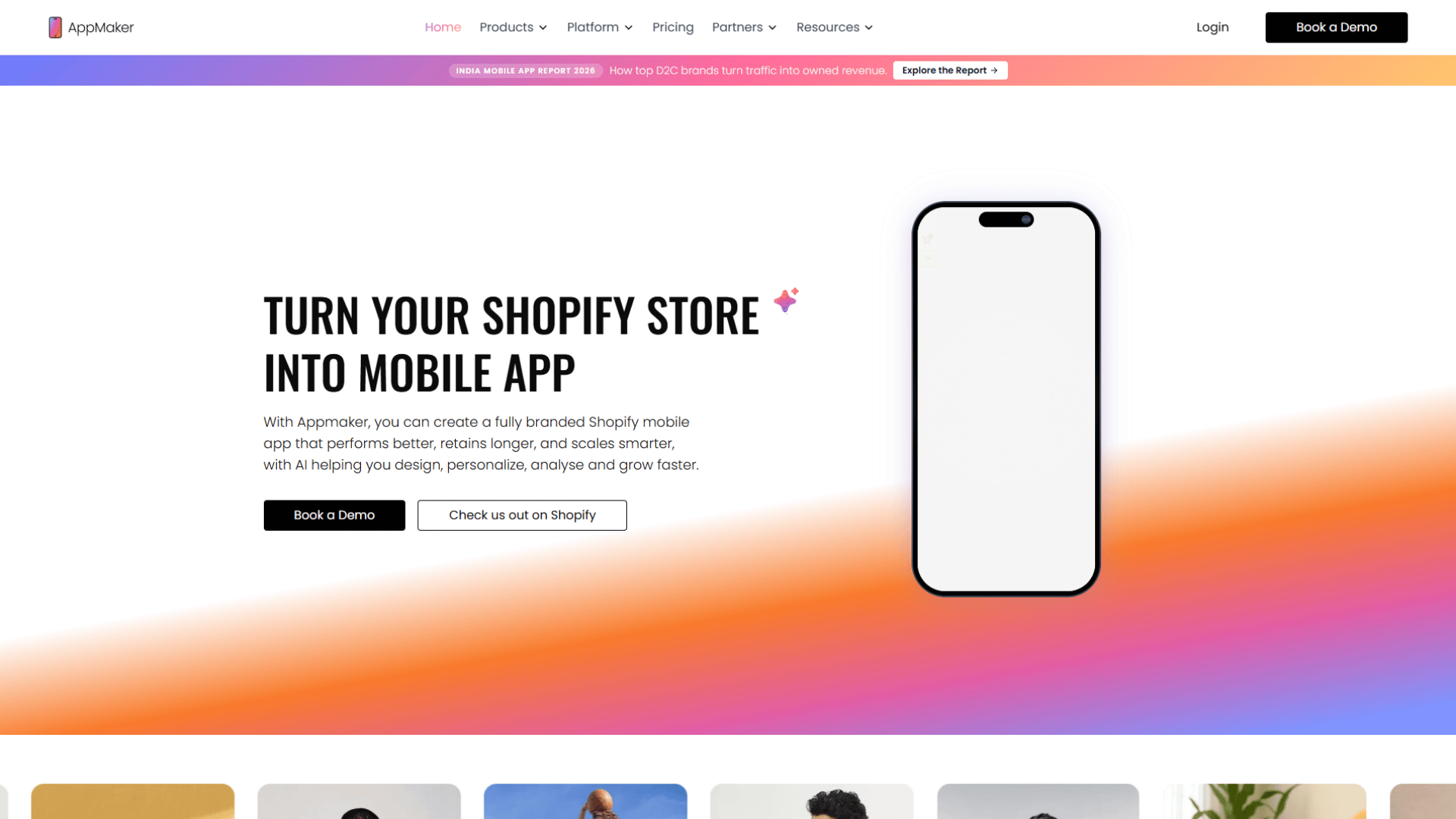
In one line: The closest thing to a builder you won't outgrow and the only pick here that pairs deep customisation with reach beyond Shopify.
Why it wins: AppMaker hands a marketer a drag-and-drop studio and an engineer a real developer surface inside one product. AppMaker Studio ships home screens and campaigns without engineering tickets, while the Open Model and Code Blocks (Enterprise) let a team add custom logic, React components, and bespoke screens when templates run out precisely the ceiling that pushes brands off Shopney. Its AI is layered rather than a single assistant:
- John AI handles operational work (analytics questions, campaign setup, abandoned-cart flows)
- Rubick's AI personalises the in-app experience in real time
- Eidolon AI (rolling out) turns a Figma file or screenshot into usable layouts. Personalisation runs on Conditional Blocks driven by Shopify tags and metafields, the segmentation depth Shopney users often ask for. And for anyone weighing a move off a Shopify-only tool
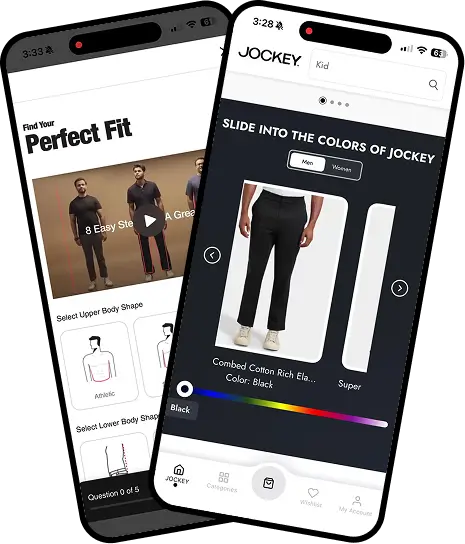
AppMaker also builds for BigCommerce, WooCommerce, and WordPress. It names boAt, Supertails, and Bombay Shirt Company among its customers (its roster skews toward Indian D2C, including Levi's India, Jockey, and mCaffeine) and holds a 4.9/5 rating across 34 reviews on the Shopify App Store.
The catch: It sits at the higher end of the category, and the deepest Enterprise capabilities (custom APIs, full developer access) carry solutioning and one-time build fees on top of the subscription. It's built for brands ready to treat the app as a real channel, not a weekend test. Its integration library, strong on payments (CreditsYard, Cashfree BNPL Plus) and marketing (Klaviyo, Judge.me), is narrower than the very largest ecosystems, and the review base, while excellent, is still modest in size, so confirm the specific Shopify-native workflows you depend on.
Price check: Growth is $999/month + 1% of in-app sales (native iOS and Android, real-time Shopify sync, the CMS, conditional blocks, unlimited push). Enterprise starts at $2,000/month + 1%, adding custom themes, the Open Model, custom integrations, multi-language support, and a dedicated account manager, with solutioning and one-time development fees quoted separately.
Leave Shopney for this if you've outgrown template-only screens and want deeper personalisation, developer access, or a path off Shopify without giving up no-code speed for your marketing team.
2. Tapcart: the mature, marketing-led market leader
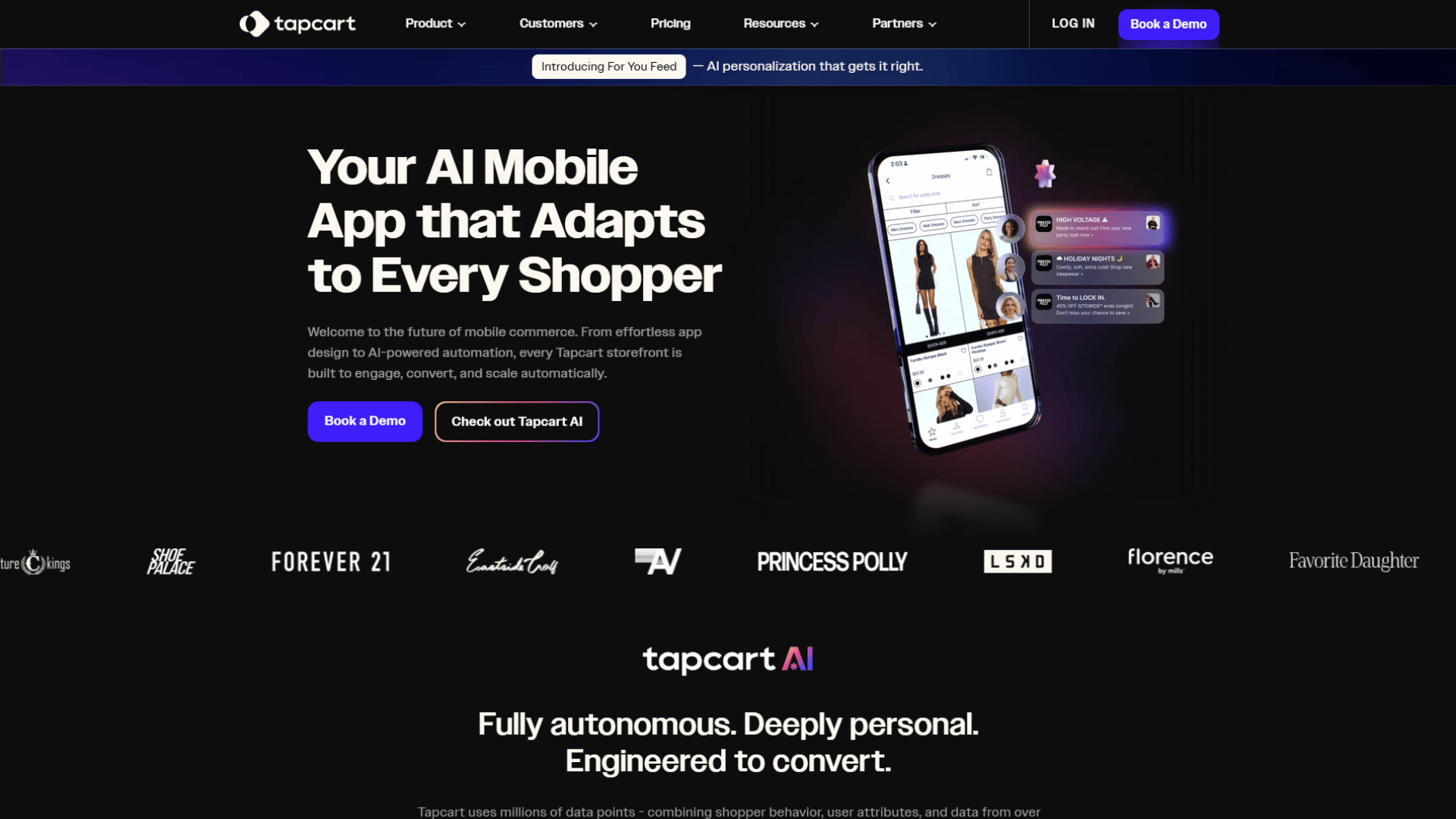
In one line: The most established DIY builder, best for brands that already have real mobile volume.
Why it wins: Founded in 2017 and backed by Shopify, Tapcart is the category's most recognised name, with a rating in the high-4s across 300+ Shopify App Store reviews and, by its own account, billions in sales processed through customer apps. Its App Studio is a polished block editor built for marketing teams, real-time Shopify sync is excellent, and its integration library (100+, including Klaviyo and Recharge) is among the widest. If Shopney felt too template-bound but you still want a no-code tool, Tapcart offers more control and unusual platform stability.
The catch:Two things trip merchants up. First, the model is usage-based on top of the base fee; plans carry additional charges tied to in-app performance, plus an add-on for Tapcart's AI features, so your real bill scales with success. Second, multiple reviewers report a 12-month lock-in contract; one Capterra reviewer describes being stuck after an employee signed up unknowingly. It's Shopify-only, "custom blocks" require HTML/CSS/JS (which cuts against the no-code promise for advanced designs), and most reviewers agree it only pays back above meaningful volume.
Price check: Current public tiers run roughly Core ~$250/month and Ultimate ~$500/month, with Enterprise custom-quoted, each with performance-based fees added on top. Tapcart's marketed figures (a "2.4× LTV" uplift among app users, for instance) are self-reported.
Leave Shopney for this if you have significant mobile traffic, want the most battle-tested DIY platform, and can live with a revenue-linked bill and an annual contract.
3. Apptile: the AI-built, conversion-first Shopify-native specialist
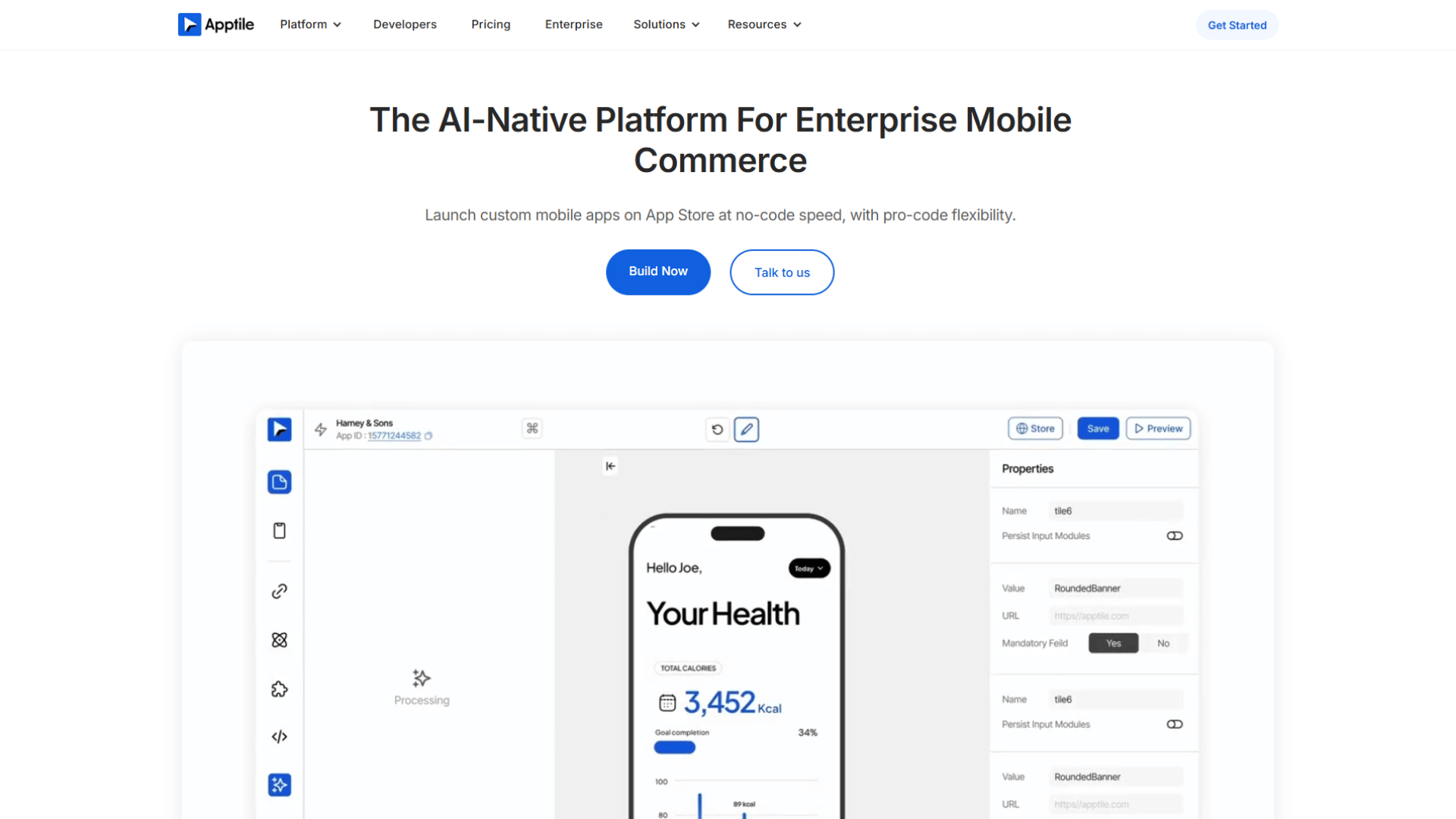
In one line:The AI-assisted, design-flexible choice for Shopify DTC brands focused on conversion.
Why it wins:Apptile builds genuinely native iOS and Android apps and leans hard into AI: its app maker generates a working first draft from a plain-language prompt, which you then refine visually or in code. Where template builders lock you into set layouts, Apptile's flexible tile-based design system gives real creative freedom over home, PDP, and cart screens, directly answering the personalisation gap Shopney users hit. On top of that sit AI-driven personalization tiles, native live selling, shoppable video and live events, an app-only discounts engine, real-time Shopify sync, and hands-on 24/7 live-chat support.
The catch: It's Shopify-only, and it isn't certified "Built for Shopify," so confirm the native workflows you depend on. Several integrations (for example Smile.io and Google Ads) are paid add-ons at roughly $49/month each, and some features carry usage-based charges (such as live-video minutes), so the real bill can climb above the base subscription. Confirm which connectors you need, and their cost, before committing.
Price check: Free to install; you pay when the app goes live. Paid tiers run Core $99, Pro $249, Plus $499, and Enterprise $999/month (Enterprise adds custom development, custom themes and tiles, and a dedicated designer and developer). Paid plans charge no commission, while the free install tier carries a 5% fee on app sales.
Leave Shopney for this if you're a Shopify DTC brand that wants AI-assisted setup, flexible tile-based design, and built-in video commerce Shopney doesn't offer, and you don't need to reach beyond Shopify.
4. Superfans (formerly Vajro) the live-selling specialist
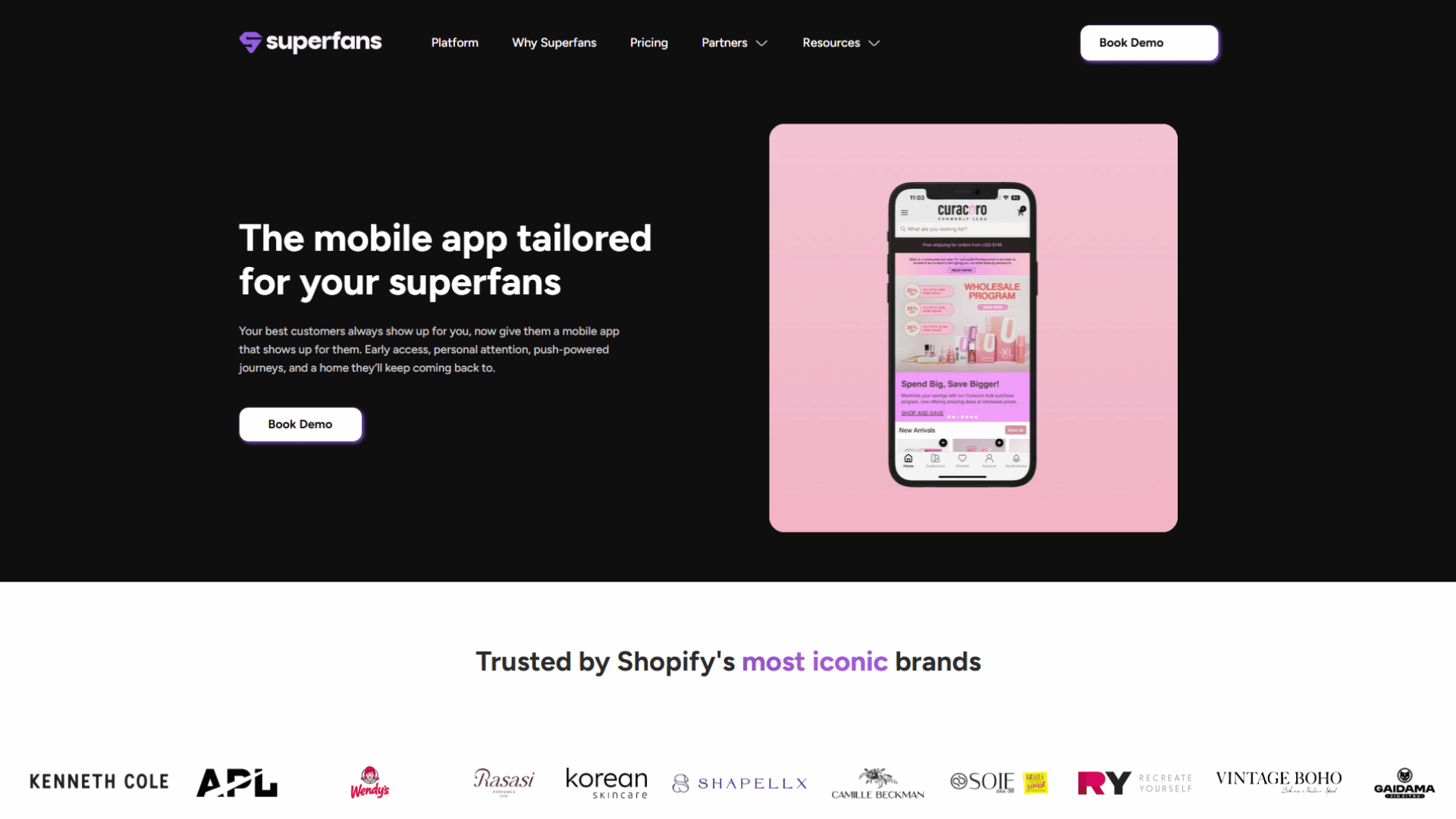
In one line: The builder for brands that sell in real time.
Why it wins: One of the longest-running platforms in the space (founded 2016), Superfans pioneered in-app live-stream shopping and has rebranded from Vajro, repositioning around retention and loyalty. It's purpose-built for fashion drops, collectables, and beauty: live selling on both app and Facebook (from the base plan), behaviour-based segmented push, 70+ one-click integrations, custom blocks via an SDK, and a support team with a strong reputation. Its Shopify listing carries a large base of five-star reviews (1,700+).
The catch: Read this before you budget. Public pricing genuinely doesn't agree. Superfans' own site now promotes a flat, "no tiers, no locked doors" model with unlimited features and no success fees, framed around sales milestones (20×/50×/100× ROI tiers) but its Shopify App Store listing still shows entry pricing from around $149/month under the legacy Vajro path, and one reviewer reports paying close to $600/month while using live selling only weekly. Get a written quote in the demo. It's also less suited to brands that want a content-rich traditional storefront app over a live-and-community angle.
Price check: Treat "flat, unlimited features, no success fees" as the headline positioning, then pin down your specific number in writing because the App Store listing tells a different story.
Leave Shopney for this if live shopping and community are the core of how you sell a use case Shopney only partially serves, and only from its Platinum tier up.
5. Plobal Apps automation and AI-driven push
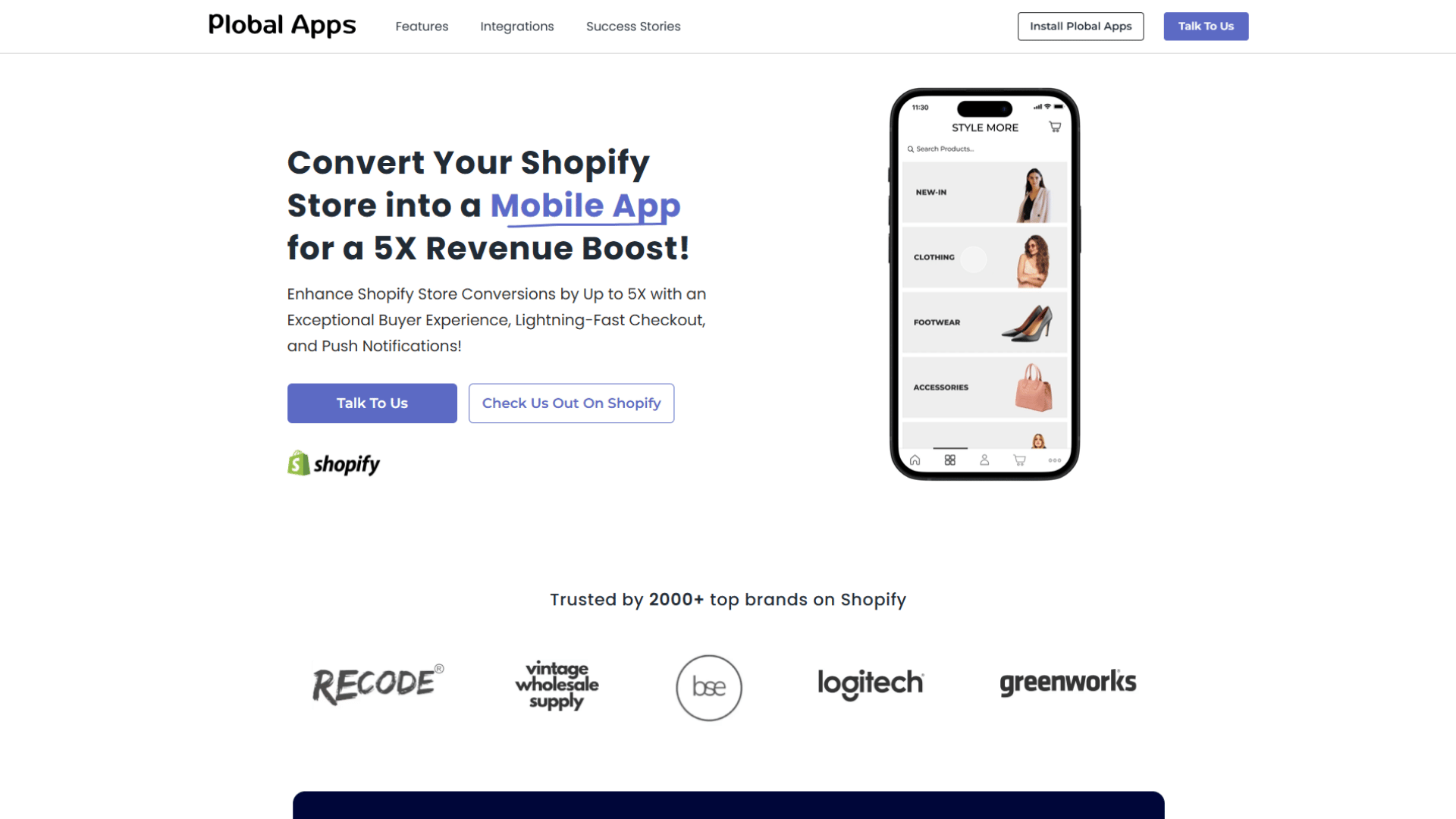
In one line: The pick when your growth lever is smart, segmented push at scale.
Why it wins:Plobal pairs a drag-and-drop builder with genuinely advanced automation: AI-driven product recommendations and user-segmented push notifications that go well beyond broadcast blasts. For brands whose retention strategy is built on behavioural triggers cart abandonment, price-drop alerts, re-engagement flows Plobal offers granular control that Shopney's standard push lacks, without you having to build it yourself.
The catch:It's Shopify-only, and the advanced integrations and segmentation depth live on higher tiers, so the entry plan's handful of standard integrations can feel tight for a mature marketing stack. Reviews are solid on core functionality but note limits on advanced personalisation versus top-tier rivals.
Price check:From $199/month (Growth, ~four standard integrations) up to roughly $1,199/month (Enterprise, unlimited advanced integrations).
Leave Shopney for this if push segmentation and marketing automation are your priority and you want AI-driven personalisation out of the box.
6. MageNative: the low-cost, multi-platform option
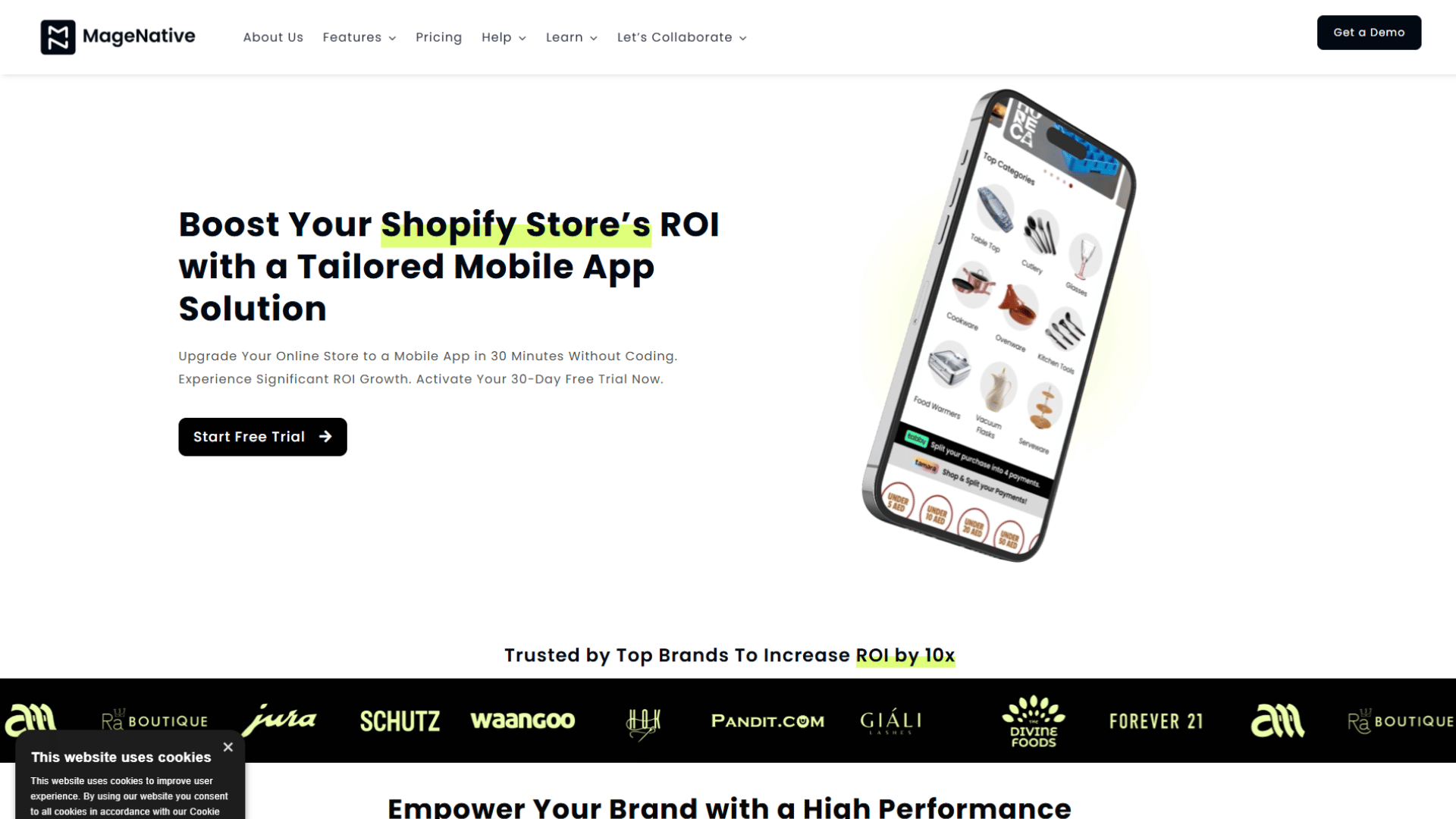
In one line: The essentials done reliably, for less and not just for Shopify.
Why it wins:MageNative turns Shopify (and other) stores into native apps without frills or success fees. It's among the cheapest credible entry points here, supports Magento, WooCommerce, and BigCommerce alongside Shopify, offers a gentle learning curve, and adds nice touches on premium tiers like augmented-reality product viewing, AI recommendations, and multi-language/multi-currency support.
The catch:It lacks the advanced personalisation and conversion tooling of higher-end platforms, its integration library is narrower (notably no native email or SMS marketing connection, so app-specific Klaviyo flows aren't a given), and some reviewers report bugs and slower resolution on complex issues. Because it spreads across several backends, no single platform gets the deepest integration.
Price check:Paid plans run roughly $49–$249/month depending on source and billing, with custom pricing above that. No success fees at any tier.
Leave Shopney for this if your needs are straightforward, budget is the main constraint, or you run more than one commerce backend.
7. MobiLoud turn your existing site into an app
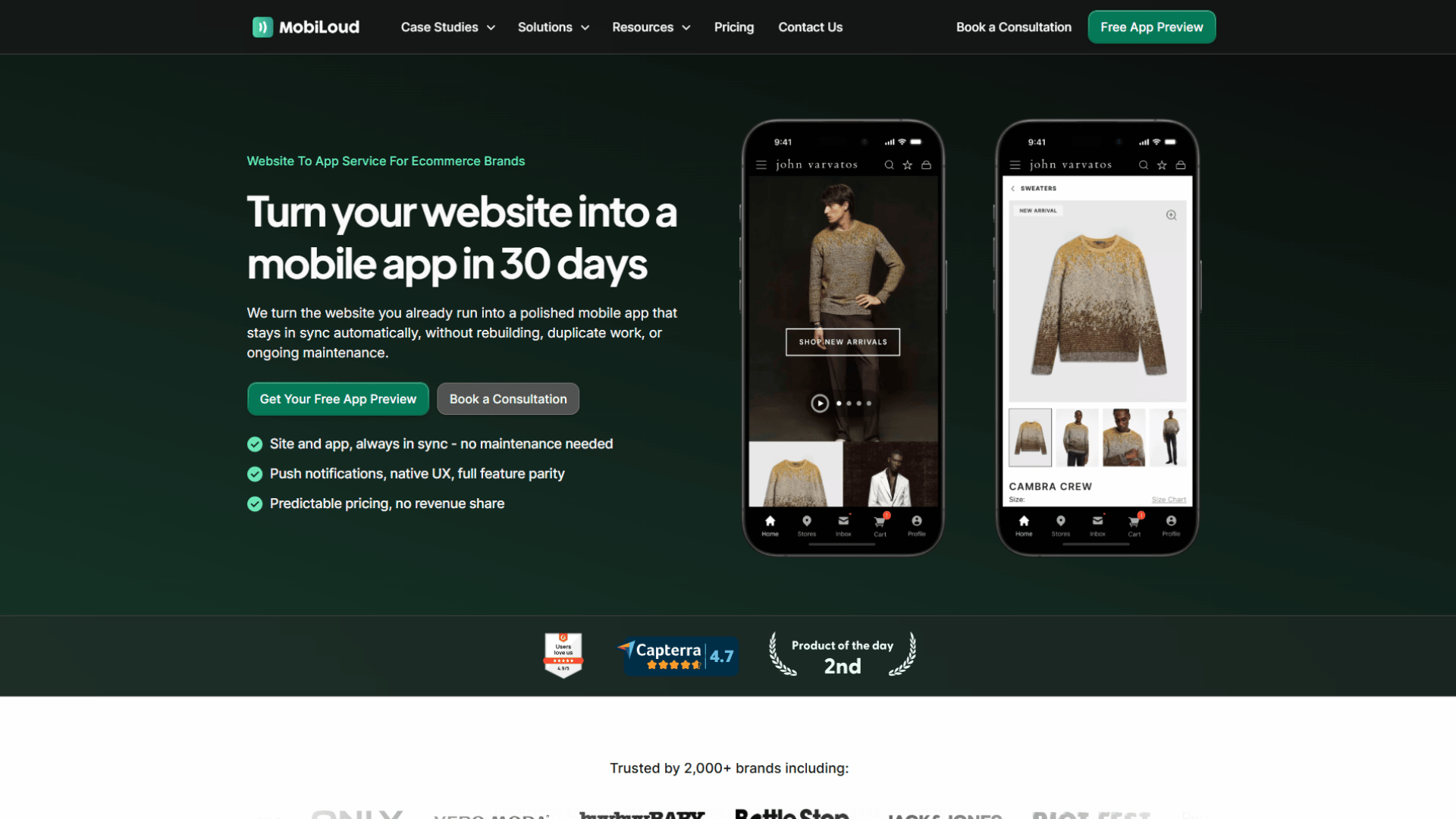
In one line: The fully managed route for anyone not rebuilding in a block editor and the only real option if you're off Shopify.
Why it wins:MobiLoud takes a different path entirely: instead of recreating your store, it wraps your existing mobile website in a native shell (native navigation, push, deep linking) and manages the whole build, submission, and maintenance for you. It works with any platform: Shopify, Shopify Plus, WooCommerce, BigCommerce, Adobe Commerce, Salesforce Commerce Cloud, WordPress, headless, and custom builds. Whatever works on your web checkout works in the app, with no second platform to maintain. It reports having helped 2,000+ businesses launch apps.
The catch:There's no drag-and-drop builder, so you can't design app-specific layouts that differ from your site the opposite of why many people leave Shopney. All-in cost is higher, the agreement runs 12 months, and launch takes longer (typically 6–8 weeks). Push runs through OneSignal or Klaviyo rather than a native dashboard.
Price check:Per MobiLoud's own pricing page, the Business plan is a flat $1,499/month + a $5,000 one-time setup fee, including 10,000 monthly active users ($50 per additional 1,000 MAU). Enterprise is custom-scoped. Around 25,000 sustained MAU, Enterprise typically becomes the better value.
Leave Shopney for this if you're off Shopify or running headless, and you'd rather a team ship and maintain the app than build it yourself.
8. OneMobile: the near-free starting line
In one line: The cheapest way to find out if an app moves the needle before you invest more.
Why it wins:OneMobile is among the most budget-friendly serious options, with a click-based no-code builder, AI-generated app setup, pre-built themes, and unlimited push notifications even on entry plans. It carries the "Built for Shopify" badge and includes promotion tools like Facebook and Google ad integrations, plus an AI Sales Assistant, wishlist, and loyalty features. Uniquely, it can publish your app under its own Apple and Google developer accounts, saving you those fees handy for pure validation. For testing the channel at minimal risk, it's hard to beat a free plan.
The catch:Advanced customisation and personalisation are limited, the ecosystem is smaller, and enterprise readiness is thin. Paid tiers layer revenue-based fees after certain thresholds (for example, no fee on the first $2,000 of app revenue, then a small percentage above it), so read the plan details. It's a validation tool, not a forever home.
Price check:A free plan plus paid tiers from $29/month (Start-Up), scaling through $99, $299, and $990/month as your needs grow.
Leave Shopney for this if budget is the whole constraint and you want to prove the channel cheaply, including below Shopney's $149 entry, before committing.
9. Shop2App subscriptions and B2B, handled natively
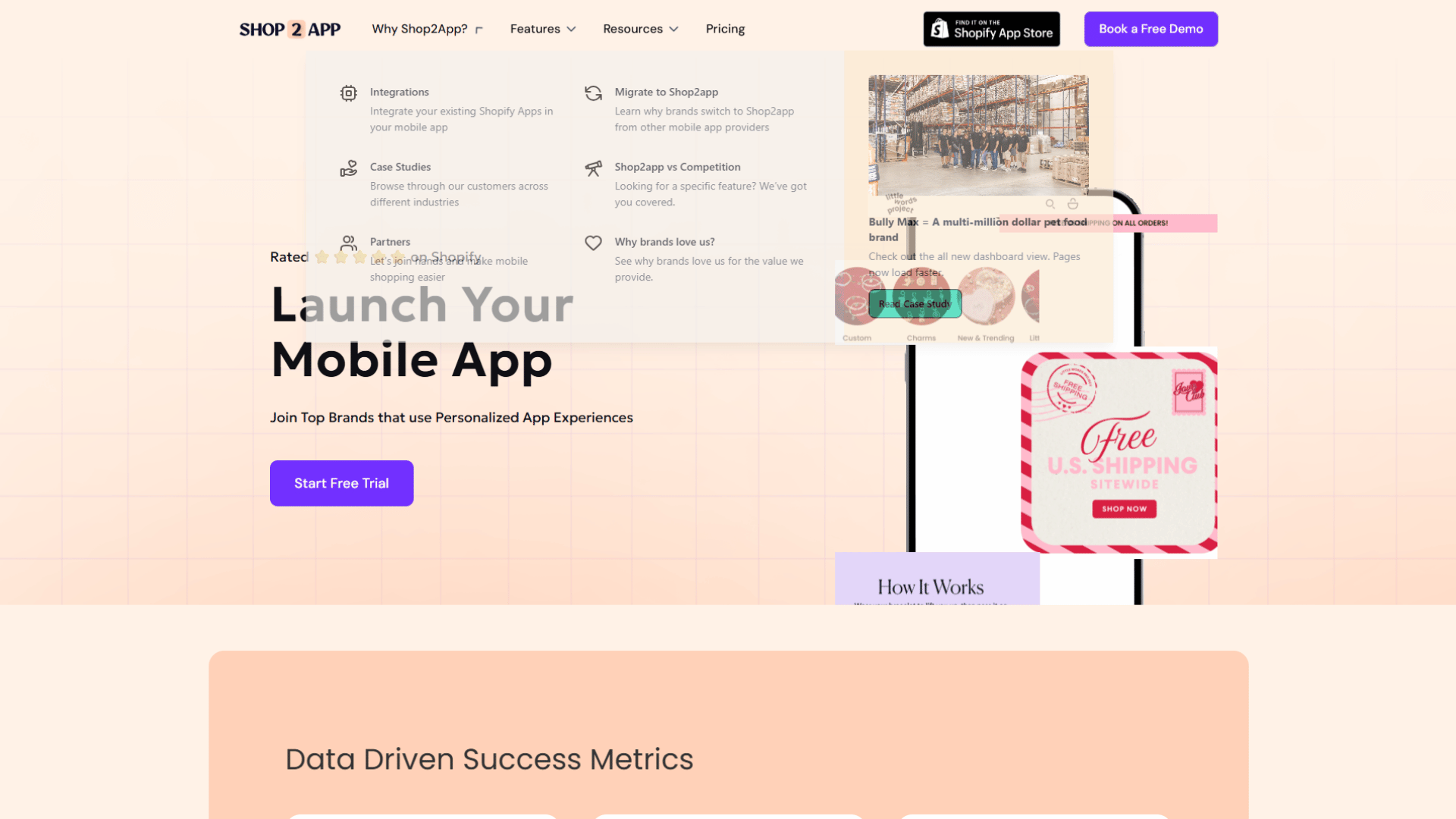
In one line: The focused pick when subscriptions or B2B are the model.
Why it wins:Shop2App leans into genuine strength in native subscription management and B2B workflows, areas most builders treat as add-ons. Its in-app subscription portal lets customers skip, pause, swap products, update addresses, and change delivery frequency without a support ticket. It emphasises fast launches, custom PDP blocks, memberships, shoppable video, wholesale features, and a dedicated app designer on higher tiers, and integrates with Recharge, Klaviyo, Yotpo, and Smile.
The catch:Its brand footprint and review base are smaller than the market leaders, and the advanced tiers climb into premium territory quickly.
Price check:Growth starts around $500/month (custom PDP blocks, dedicated designer), with Enterprise near $1,299/month (more integrations, scheduled updates, custom development). At least one 2026 roundup cites a higher top-tier figure, so confirm current tiers directly.
Leave Shopney for this if subscriptions or B2B are central to how you sell and you want those workflows native rather than bolted on.
10. Venn Apps fully managed premium apps
In one line: The done-for-you enterprise option when you want an agency-grade build, not a DIY tool.
Why it wins:Venn Apps delivers enterprise-grade functionality with strategic account management and a fully managed build. It supports the serious retention stack Klaviyo, Yotpo, LoyaltyLion, Shopify POS and pairs higher-tier plans with a dedicated account manager offering strategic guidance. For brands that want an app delivered rather than built in-house, it's a credible step up from a template tool.
The catch:The premium price point starts high, which limits accessibility for small to mid-sized stores and keeps its user base smaller than mid-tier alternatives.
Price check:From $1,999/month (Pro), with Enterprise plans at $2,999/month.
Leave Shopney for this if you're an enterprise brand that wants a fully managed premium app with strategic support and budget isn't the constraint.
Do The Math Before You Sign: The Four Fee Models.
The sticker price is the least reliable number in this category. Four fee models are in play, and the cheapest headline can be the most expensive in practice.
| Fee model | Who uses it | What to watch |
|---|---|---|
| Flat monthly, no commission | Apptile (paid plans), MageNative, OneMobile (base), Plobal, Venn Apps, and Shopney itself | Predictable as revenue climbs, the safest model at scale |
| Flat + small percentage | AppMaker (1% of in-app sales) | Transparent; run the math at your revenue |
| Flat + usage/performance fees | Tapcart, OneMobile (above thresholds) | Real cost scales with success; model it before signing |
| Managed, per-MAU | MobiLoud (flat + monthly-active-user overage) | Suits high-revenue, moderate-traffic stores |
A worked example (fashion brand). Say your app does $50,000/month in sales. A 2.5% performance fee adds $1,250/month on top of the subscription, enough to turn a "cheap" plan into the priciest one on your shortlist. On AppMaker's 1%, the same $50,000 adds $500/month, half the cost of a 2.5% model at identical revenue.
A second worked example (subscriptions). A supplements brand doing $120,000/month in-app on a 2.5% model pays $3,000/month in fees alone, more than most enterprise flat plans. At that scale, a flat platform (Venn Apps, Apptile) or a low-percentage one (AppMaker at 1% = $1,200) is dramatically cheaper. The higher and more predictable your app revenue, the more a flat or low-percentage model wins.
And don't forget the constants. Most builders Shopney included require an Apple Developer account ($99/year) and a Google Play Console account ($25 one-time), billed by Apple and Google directly. The exception is worth knowing: a few builders, such as OneMobile, publish your app under their own shared developer accounts, folding that cost in. Confirm which model applies before you budget.
Match Yourself To The Right Builder (A 3-Question Framework)
Answer three questions before you book a single demo, and most of this list eliminates itself.
1. What platform are you on?
If you're not on Shopify, or you run headless, your shortlist is only AppMaker (Shopify + BigCommerce, WooCommerce, WordPress), MageNative (Shopify, Magento, WooCommerce, BigCommerce), or MobiLoud (any platform, including headless). Everything else here and Shopney too is Shopify-only.
2. What's your realistic monthly app revenue?
- Low or unproven → validate cheaply with OneMobile (free plan) or MageNative (from ~$49/mo).
- Established and growing → a flat or flat-plus-1% platform like AppMaker, or a native one like Apptile or Venn Apps, pays off and you avoid usage fees that scale against you.
3. Will you have developer time?
- No dev time → a template-led builder (OneMobile, Plobal) gets you live fast.
- Real dev time or heavy customisation → AppMaker (Open Model, code access) or MobiLoud (managed, mirrors your site).
Then layer your model on top: live selling and drops → Superfans; subscriptions or B2B → Shop2App; push automation and AI segmentation → Plobal; one platform that scales from no-code to custom code and reaches beyond Shopify → AppMaker; fully managed enterprise build → Venn Apps or MobiLoud.
The single fastest way to shorten your shortlist is to write down your platform and your realistic monthly app revenue. Those two answers alone usually eliminate six or seven of these ten before you compare a single feature.
Migrating Off Shopney Without Losing Your Users
Most builders offer free migration and promise no loss of existing users, but "promise" isn't "confirmed in writing." Before you switch, get answers to these, on paper, during the demo:
- Do existing users, reviews, and ratings carry over, or does the app relist from zero?
- Do push-notification subscribers transfer, or do customers have to re-opt-in?
- Does customer data (accounts, order history, store credit, gift cards) migrate intact?
- What's the timeline, and are there one-time migration or setup fees?
- Will there be app-store downtime during the switch?
- If you cancel later, does your app go offline immediately, and can you export your user and notification data?
A vendor confident in its migration will put it on paper. Note that most builders take your app offline if you cancel, so data portability is a question to settle before you commit, not after.
The Bottom Line
Shopney is a strong product aimed at a specific customer: a brand that wants a good-looking, theme-based app live fast, with excellent support and flat pricing. If that's still you, you may not need to switch at all. But if you've hit its ceiling deeper customisation, real personalisation and segmentation, developer access, live selling without tier-gating, a platform beyond Shopify, or simply a cheaper way to test the right alternative is the one whose constraints match yours.
Write down three things before you book a single demo: your platform (Shopify or not), your realistic monthly app revenue, and whether you'll have developer time. If you want the broadest, most future-proof option native quality, real customisation, reach beyond Shopify, and an AI toolkit that does more than build screens AppMaker is the strongest all-round choice, which is why it leads. If your strategy hinges on live selling, subscriptions, push automation, or the lowest possible entry cost, a specialist will serve you better than a generalist.
Every serious option offers a free trial. Use them before you sign a year-long anything.
Frequently Asked Questions
What is the best alternative to Shopney?
For most scaling brands, AppMaker delivers native quality, a useful AI stack, developer-level customisation, and reach beyond Shopify so you're less likely to outgrow it. If you specifically need live selling, subscriptions, or the lowest entry price, a specialist (Superfans, Shop2App, or OneMobile) will beat a generalist for your case.
Which Shopney alternative is cheapest?
OneMobile has a free plan (paid tiers from $29/month), and MageNative starts around $49/month with no success fees. Both undercut Shopney's $149 entry. Always factor in any revenue-based fees plus the Apple ($99/year) and Google ($25 one-time) developer costs where they apply.
Which Shopney alternatives charge no commission on sales?
MageNative, Plobal Apps, and Venn Apps use flat pricing with no cut of app sales. AppMaker charges a flat fee plus 1%. Tapcart adds usage/performance fees, and OneMobile can layer revenue-based fees above thresholds, so read those two carefully.
Which is best for enterprises?
AppMaker (Enterprise tier with full developer access and multi-backend reach) and Venn Apps (fully managed premium) are the strongest, with Shop2App a fit for subscription-heavy or B2B enterprises.
Which is easiest for non-technical teams?
OneMobile and Plobal Apps get a polished app live quickly with no-code editors, much like Shopney. AppMaker also gives non-technical teams a drag-and-drop Studio, then adds developer access for later so you don't have to migrate again when you scale.
Do any of these work beyond Shopify?
Most are Shopify-only, as is Shopney. The exceptions are AppMaker (Shopify + BigCommerce, WooCommerce, WordPress), MageNative (Shopify, Magento, WooCommerce, BigCommerce), and MobiLoud (any platform, including headless and custom).
How much does a Shopify mobile app cost overall?
Using a no-code builder, realistically $50–$2,000+/month depending on the tool and tier; some add a revenue share or usage fees plus Apple and Google developer fees where they apply. A managed conversion like MobiLoud runs about $1,499/month plus a one-time setup fee. Full custom native development is a different universe, typically $50,000 to $150,000+ upfront plus ongoing maintenance, which is why most scaling brands use a builder.
Are these truly native apps or web wrappers?
Most build genuinely native iOS and Android apps (many on React Native), which load faster and convert better than wrappers. MobiLoud is the deliberate exception: it wraps your existing site in a native shell, which works well when your mobile site is already well optimised.
How long does the launch take?
Most no-code builders get you live in days to a couple of weeks, including app-store submission. A managed conversion like MobiLoud runs roughly 6–8 weeks.
Can I migrate from Shopney without losing my app users?
Most builders offer migration support and state that existing users carry over. Confirm the specifics: user data, reviews, and push subscribers in writing before switching, and ask about timeline and one-time fees.
Is Shopney still worth it in 2026?
Yes, for the brand it's built for: one that wants a well-designed, theme-based app live quickly, with strong support and flat, no-commission pricing starting at $149/month. You'd switch only if you hit a specific ceiling: customisation depth, segmentation, developer access, live selling without tier-gating, or a move off Shopify.
Do I still need to pay Apple and Google developer fees?
For most builders, yes, an Apple Developer account is $99/yea, and Google Play is a $25 one-time fee, billed directly by Apple and Google. A few builders (OneMobile, for example) publish under their own shared developer accounts and fold that cost in, so confirm the policy with your chosen platform.