

























Mobile apps have become a key part of how businesses connect with customers. For ecommerce brands, an app supports faster shopping, repeat purchases, and a better customer experience.
As more brands invest in mobile, app development demand continues to grow. The global mobile app development market is expected to reach USD 553.57 billion by 2033, showing how deeply apps are shaping digital business.
With this growth comes an important question: how much does it actually cost to build an app in 2026? The answer is rarely simple. Pricing depends on app complexity, features, platforms, and long-term maintenance.
In this blog, we will discuss realistic app development costs in 2026, what influences pricing, and how ecommerce brands can plan their budgets without relying on misleading averages.
Overview
- Ecommerce app development in 2026 typically starts around $30K-$50K for simple companion apps. However, fully transactional or enterprise-grade platforms often exceed $150K-$250K based on scale and complexity.
- Costs rise quickly when apps require secure checkout, multiple payment gateways, CRM, inventory sync, and analytics, with development alone accounting for $30K-$200K+ of the total budget.
- Platform and technology decisions materially impact spend, with native iOS or Android apps costing $50K-$150K per platform. Meanwhile, cross-platform or PWA approaches can reduce upfront costs by 20-40%.
- Ongoing expenses are unavoidable, as ecommerce apps typically require 10-20% of the initial build cost annually for maintenance, plus $1K-$10K per month for hosting and backend services.
- Teams that validate demand early, limit MVP features to core commerce flows, and plan for post-launch scaling avoid costly rebuilds.
What is the Average Cost of Building a Mobile App?
App development costs in 2026 vary widely depending on complexity and scale, and ecommerce businesses should not rely on generic averages. Basic apps today typically start around $40,000, while full-featured, scalable ecommerce platforms can easily exceed $150,000.
This variation reflects differences in team structure, platform choice, and long-term support requirements. Understanding these broad cost trends helps ecommerce brands plan budgets realistically.
Now that you have a cost range, the next step is understanding what app development pricing trends look like.
App Development Cost Trends in 2026
Post-2025, ecommerce app costs reflect shifts in tools, teams, and complexity. AI-driven design and no-code platforms reduce early-stage prototyping and UI creation costs by $5,000-$15,000, while distributed global teams enable cost-efficient development without compromising quality.
However, apps with integrated payment gateways, loyalty programs, CRM, inventory, and analytics still push budgets higher. Scaling for traffic surges, ensuring PCI and data compliance, and supporting both iOS and Android further add to costs.
Typical ecommerce app built in 2026:
- Simple apps: $30,000–$50,000
- Mid-range transactional apps: $50,000–$120,000
- Enterprise-level apps: $150,000–$250,000+
With current pricing trends in mind, it helps to see how these costs break down across different ecommerce app types, based on functionality, scale, and operational complexity.
Also Read: Appmaker integration with LoyaltyLion: Build Customer Loyalty
App Cost Ranges Based on Ecommerce App Type
When budgeting your ecommerce app, knowing how complexity affects cost ensures you invest where it drives growth, without overspending on features your store doesn’t need.
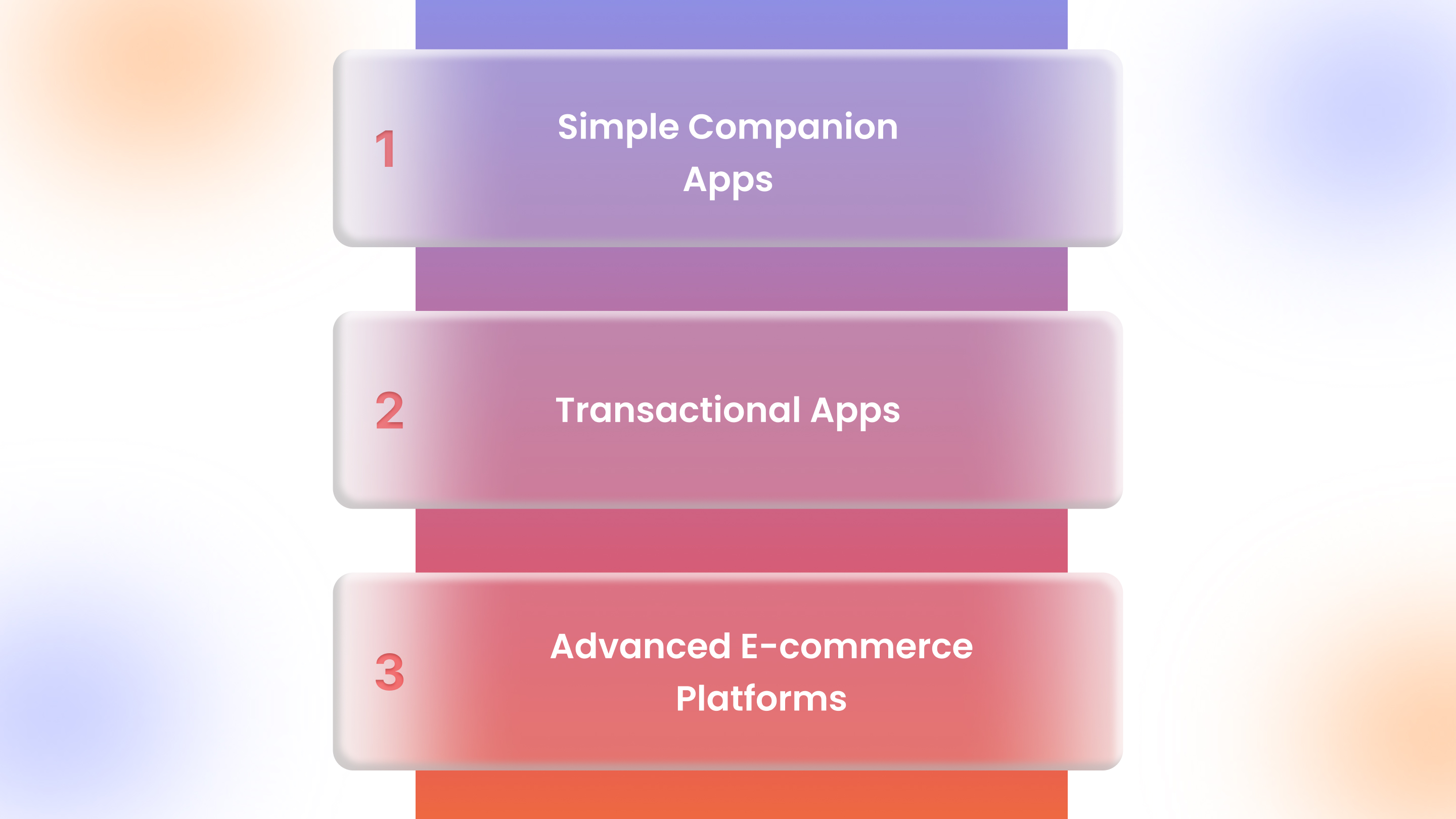
- Simple Companion Apps: support catalog browsing, loyalty programs, or content updates. It typically costs around $30K-$50K. For example, an online boutique is launching a mobile catalog with push notifications and seasonal promotions to keep customers engaged.
- Transactional Apps: handle accounts, checkout, and payment flows. They range between $50K and $120K, depending on the number of integrations. For instance, a D2C fashion brand adding cart management, multiple payment options, and inventory synchronization to simplify orders.
- Advanced E-commerce Platforms: enable subscriptions, AI recommendations, and omnichannel experiences. It costs between $120K and $250K+. For example, a beauty subscription service integrating personalized product suggestions, recurring billing, and CRM-driven loyalty features.
Once app types and ranges are clear, the logical next question is where this money actually goes during development. You must also learn which phases consume the largest share of your budget.
Where the Money Goes: App Cost Breakdown Explained
Understanding how the budget is allocated helps ecommerce teams plan effectively. Here’s a tentative breakdown of app cost:
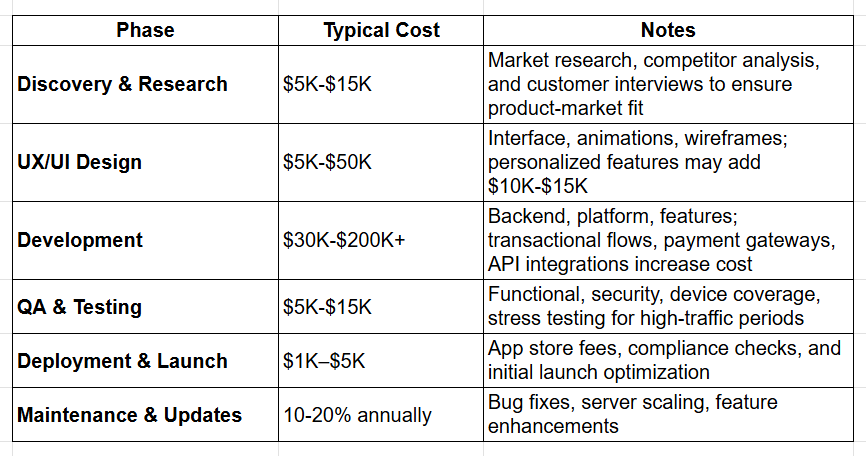
Understanding allocation is useful, but cost allocation alone doesn’t explain why ecommerce apps scale in price. Next, let’s examine the specific factors that push costs higher or lower.
The Real Cost Drivers for Ecommerce Apps
Ecommerce apps come with distinct cost considerations, as every extra feature, integration, and security requirement directly impacts development complexity and overall budget. Here's a breakdown of the key drivers and their typical cost impact:
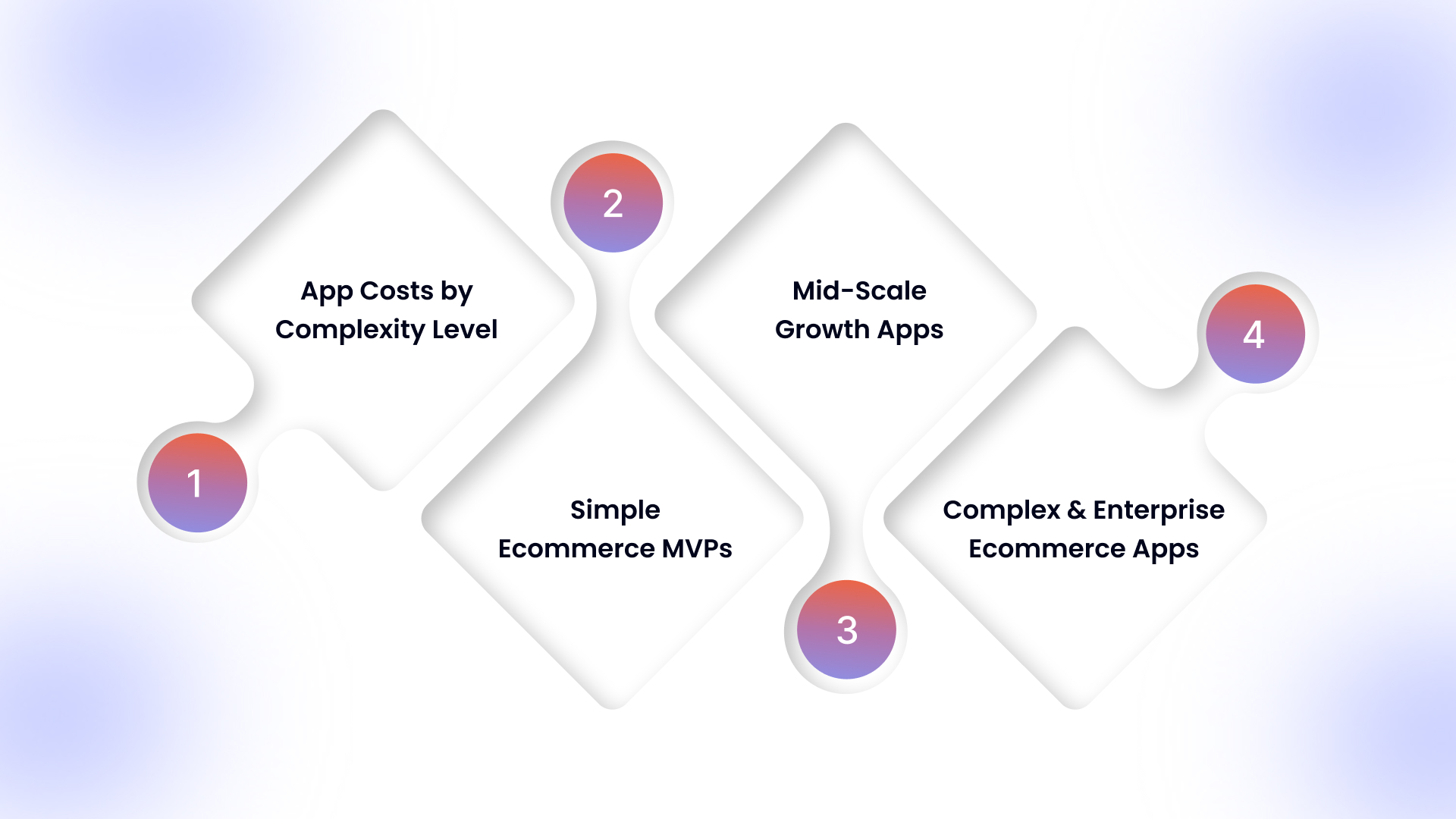
1. App Costs by Complexity Level
Ecommerce app costs rise sharply as you add features, integrations, and scalability requirements. Knowing these thresholds helps you budget accurately and prioritize features for launch.
2. Simple Ecommerce MVPs
These apps are ideal for testing your market and engaging early users without heavy backend demands. Typical features include catalog browsing, loyalty programs, and push notifications. Development costs generally range from $30K-$40K, suitable for small boutiques or niche D2C brands launching limited SKUs and seasonal promotions.
3. Mid-Scale Growth Apps
Designed for brands expanding their operations, these apps handle multi-option checkout, user accounts, inventory synchronization, and analytics dashboards. Development typically costs $50K-$100K, reflecting the need for multiple payment integrations, marketing automation tools, and moderate scalability to support growing traffic.
4. Complex & Enterprise Ecommerce Apps
Built for high-traffic, subscription-based, or omnichannel brands, these apps include AI product recommendations, real-time inventory management, and advanced personalization engines. Costs usually start at $15,000 and can exceed $300K, especially when integrating multi-warehouse logistics, dynamic pricing, or high concurrency support during sales events.
While these factors are major, it’s also essential to look into the platform and technology choices that directly affect performance, scalability, and overall development spend.
Platform and Technology Decisions That Change
Cost
The platform you choose directly affects how much you spend building and maintaining your ecommerce app. Your options include:
- Native apps: You pay the highest cost because iOS and Android are built separately, but you get smooth checkout, real-time inventory, loyalty features, and reliability during traffic spikes.
- Cross-platform (React Native, Flutter): You reduce upfront costs (around 15%-20%) by sharing code across platforms, though advanced ecommerce features still increase customization expenses.
- PWA: You launch fastest at the lowest cost (40%), but payments, subscriptions, and complex ecommerce workflows remain limited.
If you already run on Shopify, tools like AppMaker can significantly reduce costs by converting your store into a native app without rebuilding core commerce features. Your catalog, checkout, and customer data stay fully in sync while delivering a true app experience.
Once platforms are decided, feature selection becomes the next major cost variable, especially in ecommerce apps where even small additions can significantly impact development effort.
Feature-Level Cost Multipliers in Ecommerce Apps
Every feature you add directly impacts development cost and timeline, so making deliberate choices is key to controlling spend:
- Payment integrations: Adding gateways like Stripe, PayPal, or Apple Pay can add $5K-$20K per integration, depending on complexity and testing requirements.
- AI-driven product recommendations: Personalized suggestions and dynamic upsells enhance engagement but can increase development by $10K-$25K due to backend setup, data management, and ongoing updates.
- Third-party APIs: Connecting inventory, CRM, marketing, or analytics systems adds $5K-$15K per integration, depending on API availability and customization.
- Accessibility compliance: Implementing WCAG standards may cost $3K-$8K but reduces legal risk and ensures usability for all shoppers.
Beyond feature costs, many teams underestimate what happens after launch. Let’s look at the ongoing and often hidden expenses that ecommerce apps continue to incur.
Ongoing and Hidden Costs Most Ecommerce Teams Miss
Even after launch, your ecommerce app demands continuous attention to keep shoppers engaged and systems running smoothly. Maintenance and updates, covering bug fixes, feature tweaks, and server upkeep, typically account for 10-20% of your total development spend annually.
Hosting and backend services scale with traffic, ranging from $1K-$10K per month, while marketing, ASO, and retention tools cost $5K-$25K yearly. Don’t forget app store compliance and operational overhead, which can add $1K-$5K annually to your ongoing investment.
Ongoing costs vary widely based on who builds your app and where, making geography the next important piece in understanding total investment.
How Geography Affects App Cost?
Location directly influences hourly rates and the quality of your ecommerce app. Here’s what you need to know in terms of geographical areas:
- North America: $50-$200/hr, best for mission-critical apps needing full-stack expertise and compliance with US payment and data standards.
- Europe: $35-$150/hr, balances cost and skilled execution; ideal if you need experienced developers with moderate budgets and EU market knowledge.
- Asia: $15-$80/hr, cost-effective but may require extra oversight for ecommerce-specific workflows like inventory sync, payment gateways, and scalability.
With team and location considerations covered, the focus shifts to control. This means how you can actively optimize ecommerce app development costs without sacrificing performance or growth.
How to Optimize Ecommerce App Development Costs?
Avoiding overspend requires a strategic approach. By validating demand, prioritizing features, and planning for post-launch growth, you ensure your ecommerce app delivers maximum ROI without unnecessary complexity or wasted resources.
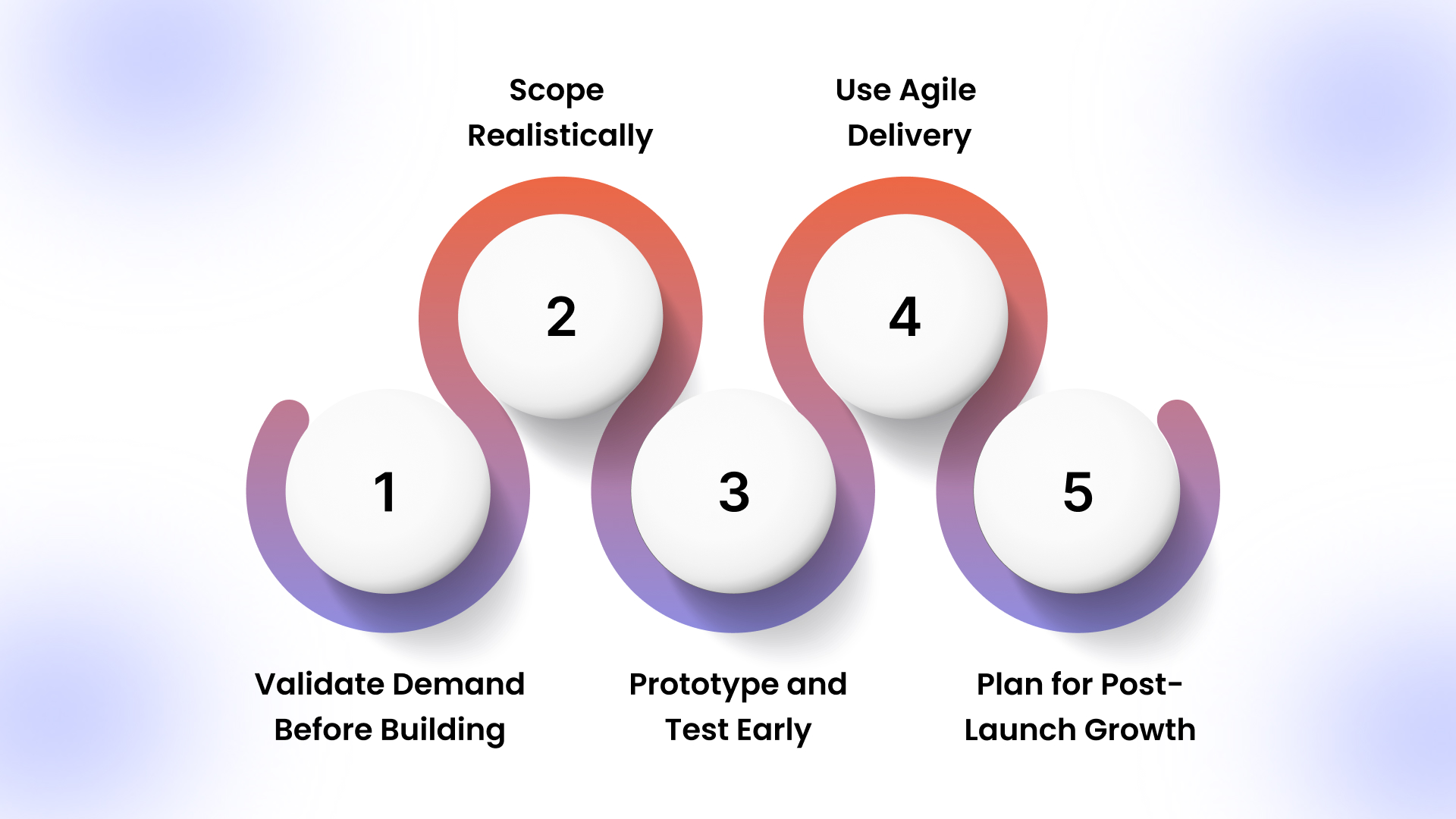
1. Validate Demand Before Building
Before writing a single line of code, test your ecommerce concept with real users. Surveys, landing pages, or lightweight prototypes reveal if shoppers value your app’s core features, saving thousands in unnecessary development.
2. Scope Realistically
Focus only on features that directly impact conversion and retention. Avoid overbuilding. Limiting your app to essential commerce flows, catalog, checkout, account, and loyalty prevents wasted effort and reduces post-launch maintenance burdens.
3. Prototype and Test Early
Develop interactive prototypes to validate UX, payment flows, and inventory integration. Early testing identifies friction points before coding begins, cutting costly redesigns and improving your app’s usability and overall ecommerce performance. You can also use tools like AppMaker to quickly convert your Shopify store into a native app, letting you test features and validate your MVP while keeping development costs low.
4. Use Agile Delivery
Implement iterative development with sprints and regular reviews. Agile ensures transparency, faster feedback, and flexibility, allowing your team to adjust priorities without inflating budget or timelines, especially for feature-heavy ecommerce apps.
5. Plan for Post-Launch Growth
Account for scaling traffic, adding new payment options, and updating loyalty or personalization features. Budgeting for future iterations ensures your ecommerce app can scale without costly emergency rebuilds or downtime.
Cost optimization only works when paired with forward planning, so let’s look at what app development costs mean for future builds.
What App Development Costs Will Look Like Next?
You’ll notice that ecommerce app development is shifting. AI and no-code tools can lower early-stage costs, but complex apps still need skilled developers for reliability and scale.
- AI and No-Code Adoption: You can cut prototyping and design time, but backend, integrations, and advanced ecommerce features still require expert hands.
- Simple App Costs: Expect lower expenses if you build basic catalog, loyalty, or content apps, thanks to simplified design and testing.
- Complex App Costs: For your enterprise ecommerce app with subscriptions, personalization, or omnichannel features, costs will stay high through 2027.
- Skilled Developer Demand: You’ll still need experienced developers for backend, API integrations, scalability, and security to ensure your ecommerce app performs reliably.
Now that you understand future cost trends, let’s see how AppMaker can help reduce development spend without compromising ecommerce performance.
Also Read: Holidays 2025: How Ecommerce Brands are using Mobile Apps to Win BFCM 2025
How AppMaker Helps Reduce Ecommerce App Costs?
When building a native ecommerce app, choosing the right platform can save time and money. AppMaker specializes in converting Shopify stores into fully functional apps, keeping your catalog, checkout, and customer data in sync without rebuilding core commerce features. This ensures you get a true app experience while cutting development overhead.
To make your app efficient and cost-effective, AppMaker offers:
- Native App Conversion: Turn your Shopify store into iOS and Android apps seamlessly.
- Eidolon AI: Transform Figma files or screenshots into ready-to-use app layouts quickly.
- John AI: Gain analytics-driven insights to optimize content and engagement.
- Push Notifications: Send targeted updates to drive repeat purchases.
- Real-Time Shopify Sync: Keep products, inventory, and orders always up to date.
- Multi-Language Support: Expand reach without extra development.
- Integration Support: Integrates easily with major e-commerce platforms and other services like CRM, inventory systems, payment gateways, and more.
With these features, AppMaker lets you launch a robust, scalable ecommerce app while managing costs and complexity.
Final Takeaway
Ecommerce app development in 2026 comes with varied costs, driven by complexity, features, integrations, and platform choices. Understanding these factors helps you plan budgets wisely, avoid overspending, and prioritize features that drive growth and engagement for your store.
Tools like AppMaker can simplify this process by converting your Shopify store into a fully functional native app, keeping inventory, checkout, and customer data in sync. With AI-assisted design, analytics insights, real-time updates, and multi-language support, AppMaker reduces development overhead while delivering a high-quality, scalable app experience.
Take control of your ecommerce growth and ensure every dollar counts. Contact our team now to start building an app that truly drives sales and loyalty.
FAQs
1. How much does it cost to create a mobile app and website combo, and how long does that take?
Building an ecommerce app with a responsive website costs $80K-$200K+, depending on features, integrations, and platforms. Development typically spans 12-28 weeks, including design, testing, and deployment for robust performance.
2. Can I launch an ecommerce MVP first to save costs, and what should it include?
An ecommerce MVP costs $30K-$70K, focusing on catalog browsing, basic checkout, account management, and essential integrations. It validates product-market fit before full-scale development, minimizing risks and unnecessary spend.
3. How do third-party integrations affect ecommerce app development cost?
Integrations like payments, CRM, analytics, or inventory management add $5K-$20K each. This depends on API complexity, customization, and testing requirements, significantly influencing total development cost and timeline.
4. What role does platform choice (iOS, Android, PWA) play in cost and timeline?
Native iOS or Android apps cost $50K-$150K per platform due to separate builds and QA. Cross-platform or PWA solutions reduce costs 20-40% but may limit certain e-commerce-specific features and performance.